Art History · Learning chapter
Atlas I — Foundations and ancient worlds · 1 of 10
Prehistoric art: image, object, place, and the limits of the archive
A five-site guide to reading prehistoric images and objects without turning a fragmentary archaeological record into a universal story of artistic progress.

.jpg)
What we’ll look at
What can five very old objects and places tell us, and what remains unknown?
This article looks at five things made by people who left no text explaining them: a marked piece of ochre, an ivory figure, a wall of hand stencils, a stone gathering place, and a decorated pot.
We will first ask what each one is, where it was found, and when it was made. Then we will separate what the evidence shows from what remains an interpretation or a guess.
The examples range from South Africa about 77,000 years ago to Japan around 2500 BCE. This is not a complete history of prehistoric art. It is a guide to understanding five very different examples without pretending that we know more than the surviving evidence can tell us.
“Prehistoric” does not mean one worldwide period
Prehistory usually refers to a past for which researchers do not have usable written records made by the people they are studying. Its dates therefore change from place to place.
Writing was used in parts of Mesopotamia while people elsewhere recorded and shared knowledge through objects, landscapes, speech, memory, and practice. Japan’s Jōmon period also overlapped with literate states in other regions. Calling both places “prehistoric” does not put them at the same stage of development.
“Art” is a modern study category too. We do not know whether the makers in this article separated art from tools, ritual objects, buildings, storage vessels, or social signs. We can still study their choices about form, colour, material, skill, and placement.
As you read, keep three things separate:
- Evidence: the material, marks, findspot, archaeological layer, and measurable age of an object.
- Interpretation: an explanation supported by that evidence.
- Guess: a possible explanation that the evidence cannot confirm.
Guessing is not automatically wrong. The problem begins when a guess is presented as a fact.
Only some parts of the past survived
Stone, fired clay, bone, and some pigments can survive for a very long time in the right conditions. Cloth, baskets, wood, feathers, food, body paint, dance, and sound usually disappear.
Even strong materials do not survive equally. A painted cave wall may last longer than one exposed outdoors. An object left untouched underground will have a different history from one that was repeatedly used, repaired, or recycled.
The archaeological record is therefore not a balanced summary of everything people made or valued. Material, climate, burial, excavation choices, conservation, and chance all shape what we can see today.
Remember this when a book says that art “began” with one object. The oldest example found so far is not necessarily the first one people ever made. It is simply the oldest example that has been found, dated, and published.
Blombos Cave: a 77,000-year-old marked ochre fragment
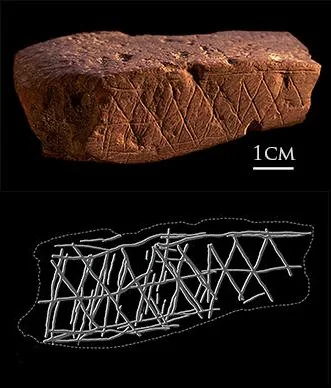

First, what is this object? It is a small piece of ochre found in Blombos Cave in South Africa. Ochre is an iron-rich mineral that can be ground into red or brown pigment. This piece fits in a hand; it is not a large rock or a cave wall.
Someone smoothed its surface and then cut crossing lines into it. Some lines end at broken edges, so the pattern was probably once larger. The black-and-white tracing below the photograph is not an ancient drawing. Researchers made it to help us see the engraved lines more clearly.
The Iziko South African Museum dates the piece to about 77,000 years ago. Researchers did not reach that date from its appearance alone. They dated the layers of sediment in which the marked pieces were found. The 2002 research report compared results from two light- and heat-based dating methods, and later microscopic studies examined other marked ochres from the cave.
The important point is not the long names of the methods but where the date comes from: the archaeological layer around the object supports the estimate of about 77,000 years. The date does not explain what the lines meant.
The piece shows that people in southern Africa selected ochre, prepared its surface, and engraved organised marks at a very early date. Blombos Cave also contained shell beads, bone and stone tools, and evidence of pigment processing. This object belonged to a wider life of making and using materials.
What did the pattern mean? We do not know. It might have marked identity, counted something, taught a pattern, tested a tool, or served another purpose. We can say that the lines were repeated and deliberately made; we cannot translate them.
The photograph is not the object itself. A scale bar shows its size, and the tracing helps us see the cuts. Neither can give us the object’s weight, mineral surface, exact position in the cave, or full relationship to nearby finds.
Why the date of “the oldest art” can change
In January 2026, researchers reported that a hand stencil on Sulawesi, Indonesia, was at least 67,800 years old. A hand stencil is made by placing a hand against a rock wall and applying pigment around it, leaving the hand’s shape unpainted.
The Nature study did not date the pigment itself. It dated a thin mineral layer that formed later on top of the image. If that layer formed 67,800 years ago, the hand stencil underneath must be older. The result therefore means at least 67,800 years old, not exactly that age.
At the time of publication, the researchers described it as the oldest known wall art attributed to our species. “Wall art” matters here: the Blombos ochre is a portable object, while the Sulawesi hand was made on rock.
The title of “oldest” is never permanent. A new object may be found, or an existing date may change. Older also does not automatically mean more beautiful, complex, or important. Dates put evidence in order; they do not rank human worth.
Lion Man: a sculpture joining human and animal
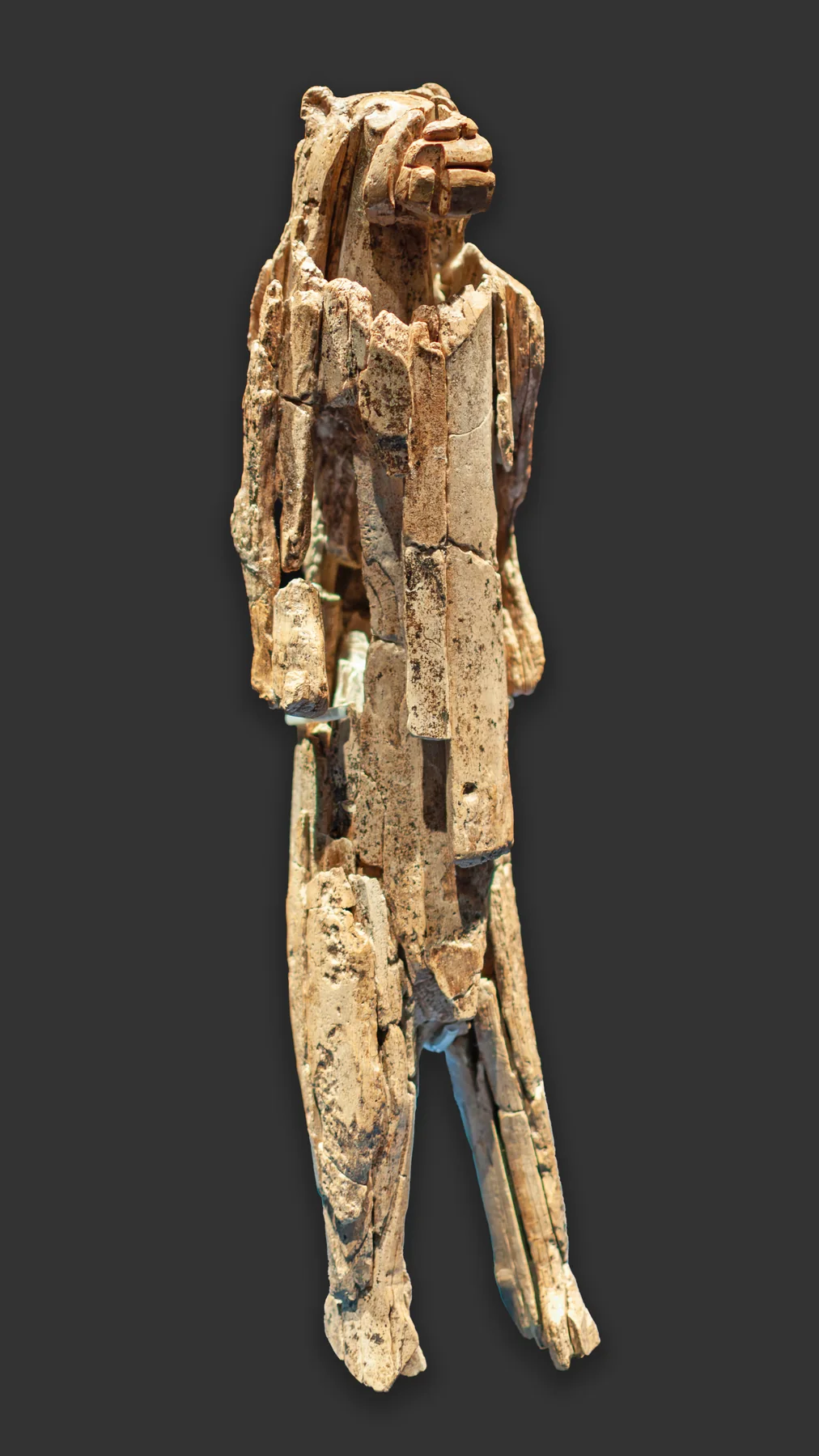

We now move from a small piece of ochre to a three-dimensional sculpture. Lion Man is a figure carved from mammoth ivory about 40,000 years ago. It was found in broken pieces in Hohlenstein-Stadel Cave in Germany.
The figure has an upright humanlike body, small rounded ears, and the long face of a large cat. Its human and animal features remain clearly visible in the same body.
Museum Ulm dates the carving to about 40,000 years ago. The wider UNESCO-listed Swabian Jura cave group also contained animal figures, human-animal hybrids, jewellery, and musical instruments. Lion Man did not appear in isolation.
Making it required skill. Someone had to choose the ivory, plan around the curve of the tusk, cut and scrape the surface, and join observations of human and animal bodies in one form.
The sculpture supports one careful but important conclusion: its maker could carve a body that does not exist as a single animal in nature. It combines observed anatomy through imagination.
We do not know who this being was. “Deity,” “spirit,” “shaman,” “ancestor,” “costume,” and “mythical creature” are modern suggestions, not translations of its original name. Its position inside the cave may point to a special use, but it does not reveal a complete ritual.
The visible joins and missing areas matter too. The figure survives through modern conservation and assembly. In the museum, we are looking at both an ancient carving and the later work that put its fragments together.
Cueva de las Manos: hand stencils added over generations
Cueva de las Manos, or “Cave of the Hands,” is a rock shelter in Argentine Patagonia. Its walls contain many hand stencils, along with animals, people, and hunting scenes.
The stencils were not made by dipping hands in paint and pressing them onto the wall. People placed their hands against the rock and applied pigment around them. When they removed their hands, an unpainted outline remained.
UNESCO’s site record dates the images to a long period between about 9,300 and 1,300 years ago. Red, purple, white, yellow, and black pigments came from natural minerals.
In a photograph, all the hands can look as if they were made together. Different colours, overlaps, states of preservation, and dated deposits show otherwise. The wall was built up over many generations.
Each stencil came from a particular body, but the whole wall is collective. We cannot safely call it a gallery of signatures or self-portraits. We do not know the names, ages, genders, family groups, or exact intentions of the people whose outlines survive.
We should not casually assign the makers a present-day identity either. UNESCO notes possible links to later Patagonian hunter-gatherer communities and ancestors of the first Tehuelche people known from historical records. “Possible” is important: archaeology, colonial labels, and living identity cannot be treated as the same thing without evidence and community knowledge.
Touching, graffiti, dust, and the removal of painted fragments have damaged the site. Preservation rules are not pointless barriers between visitors and the images. They help an irreplaceable surface survive.
Göbekli Tepe: when images become part of a building
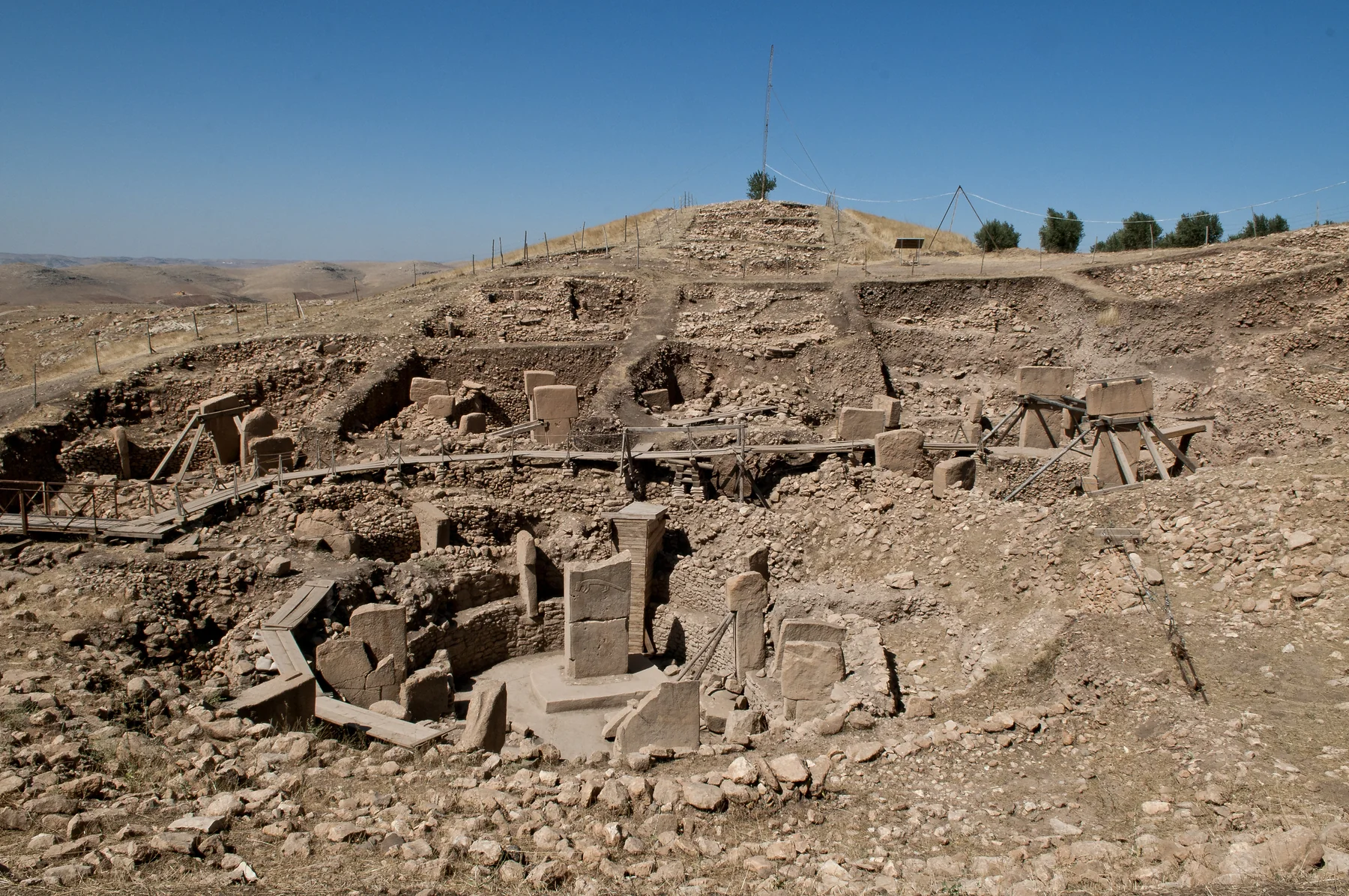

Göbekli Tepe is a settlement and gathering place near Şanlıurfa in present-day Türkiye. Its large stone structures were used between about 9600 and 8200 BCE. T-shaped limestone pillars stand inside them.
According to the UNESCO record, some pillars reach 5.5 metres. Carved arms, hands, belts, and loincloths suggest that some represent people. Other reliefs show wild animals.
This makes it difficult to separate image from architecture. The pillars do not merely hold decoration; together, their humanlike forms and animal reliefs shape the entire space.
Their size shows planning and coordinated work. It does not prove that there were kings, a state, a permanent priesthood, or one chain of command. People can organise labour in many ways. The buildings show collective ability; their exact political structure remains unknown.
Calling Göbekli Tepe the “world’s first temple” is also too certain. UNESCO uses the more careful term monumental communal buildings and says that they were probably connected to social events and rituals. Archaeologists have also found smaller structures that seem domestic. “Ritual” and “domestic” may not have been separate parts of life for the people using the hill.
Göbekli Tepe is sometimes fitted into a simple story: hunter-gatherers built monuments, then farming and civilisation followed. The site is more useful because it challenges that straight line. People already had stoneworking knowledge, social networks, shared images, and large gatherings while ways of finding food were changing.
The photograph records a later chapter too. It shows the excavated site in 2011, including supports, paths, cut sections, and exposed fills. Archaeology made the structures visible while also changing the conditions in which they survive.
A Jōmon vessel: made for use and visual impact
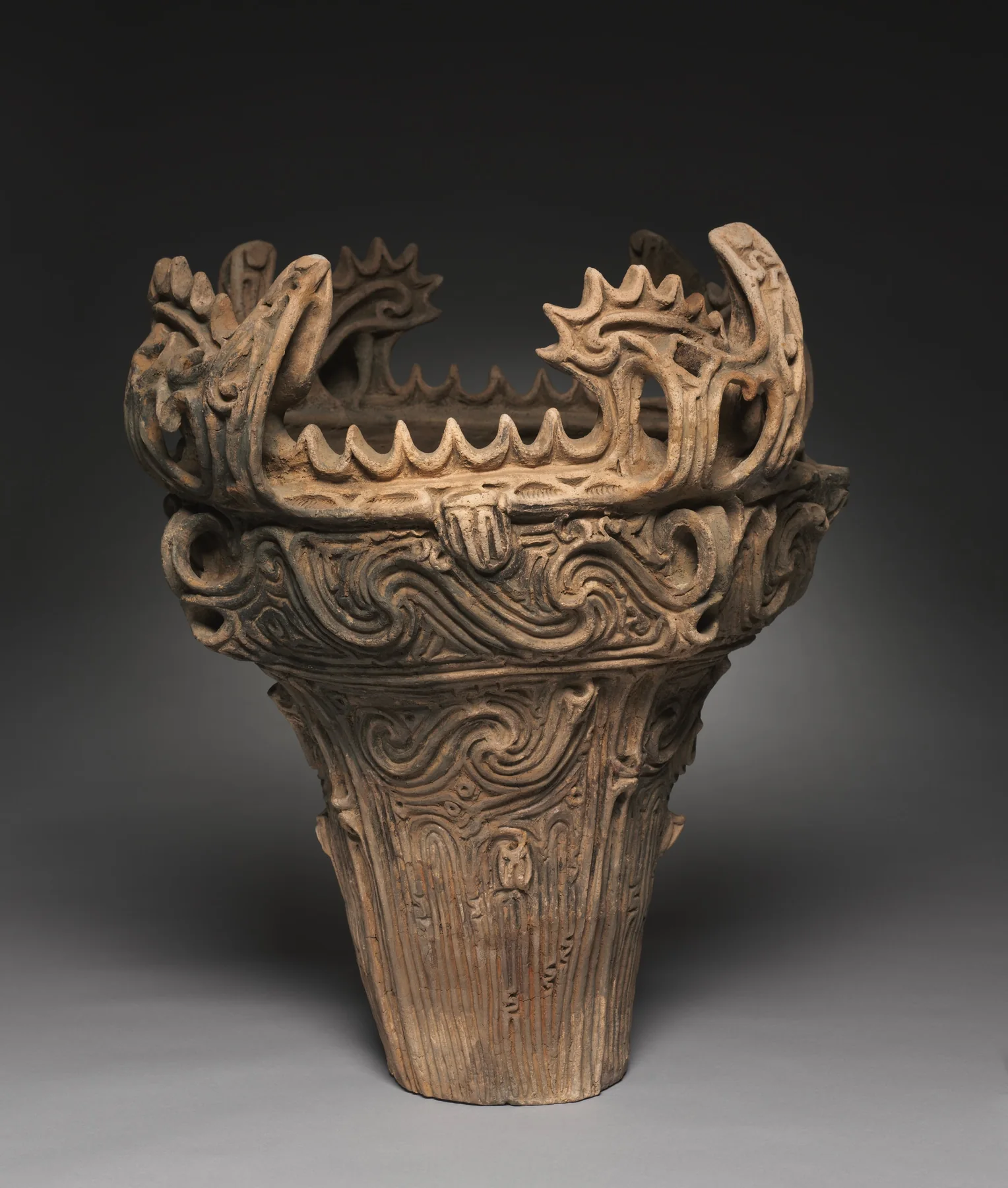
The final example is an earthenware vessel made in Japan around 2500 BCE. Jōmon names a long period in Japanese history; it does not refer to one artist or one style.
The vessel narrows toward the base. Its upper section is covered with curling lines, projections, and openings. Because its rim looks like flames, this type is now called “fire-flame” pottery.
The Cleveland Museum of Art stresses that this name is a modern comparison. We do not know what the makers called the form or what they intended it to mean. The present name describes its appearance; it does not translate an ancient message.
The pot also challenges a sharp division between useful object and artwork. The official Jōmon heritage resource explains that hand-built pottery expanded cooking and storage, while shapes and surface treatments changed across time and region. The Met’s study of a related flame-style vessel shows how makers built sculptural rims with coils, openings, small added pieces, cut lines, and cord impressions.
A pot used for cooking did not have to look plain. The same object could prepare food, take part in daily life, carry regional skills, and create a strong visual effect. “Useful” and “symbolic” are not opposite choices here.
The museum record contains an important warning. During twentieth-century restoration, a base from another ancient vessel was attached to this one. The addition made it about ten centimetres taller. Today’s measurement of 61 centimetres describes the assembled museum object, not the exact ancient vessel.
Its online provenance begins with a Tokyo gallery before the museum bought it in 1984, and it gives no excavation site. We can study the material and form, compare it with securely excavated pottery, and explain the reconstruction. We cannot recover a missing settlement context.
Five cases, five different kinds of evidence
| Case | What survives | Strongest responsible claim | What remains unresolved |
|---|---|---|---|
| Blombos engraved ochre | Incised mineral object in a dated archaeological sequence | People deliberately organised repeated marks in Middle Stone Age southern Africa | The pattern’s exact meaning, audience, and use |
| Lion Man | Fragmentary mammoth-ivory hybrid from a cave context | A maker joined humanlike and feline anatomy in a portable imagined body | The being’s name, story, social role, and manner of use |
| Cueva de las Manos | Layered hand stencils, figures, pigments, and rock-shelter context | Image-making recurred collectively at the site across a long sequence | Individual identities and a complete account of continuity between communities |
| Göbekli Tepe | Monumental enclosures, anthropomorphic pillars, reliefs, and settlement evidence | Images and built space organised collective encounters before urban states | One fixed function, political hierarchy, or complete belief system |
| Jōmon flame-style vessel | Decorated fired clay, partial ancient body, modern reconstruction | Useful ceramic technology and sculptural surface could occupy one object | Original findspot, exact motif meaning, and the vessel’s complete ancient form |
The comparison has no winner. It exposes how the word “art” changes its work.
At Blombos, it asks whether organised mark-making is enough. With the Lion Man, it follows imagination through a portable body. At Cueva de las Manos, it becomes cumulative action on a landscape. At Göbekli Tepe, it expands into architecture and gathering. In the Jōmon vessel, it refuses to separate visual invention from material use.
A compact, provisional timeline
| Date | Evidence | Why the date needs a boundary |
|---|---|---|
| about 77,000 years ago | Engraved ochres in dated Blombos Cave layers | The layer dates the archaeological context; it does not translate the incisions |
| at least 67,800 years ago | Hand stencil at Liang Metanduno, Sulawesi | Calcite above the pigment supplies a minimum age, not an exact date for painting |
| about 40,000 years ago | Lion Man from Hohlenstein-Stadel | The figure belongs to a broader Aurignacian cave ensemble dated about 43,000–33,000 years ago |
| 9600–8200 BCE | Monumental buildings at Göbekli Tepe | Construction, rebuilding, and use occurred across a long site sequence |
| about 9,300–1,300 years ago | Rock-art sequence at Cueva de las Manos | The visible wall combines phases rather than one moment |
| about 2500 BCE | Cleveland Jōmon flame-style vessel | The type is ancient, but the displayed base belongs to another vessel and the findspot is unrecorded online |
These dates should be revised when methods, excavations, or publications change. A timeline is a research tool, not a permanent podium.
Key terms
Prehistory: a modern label for pasts studied without usable written records from the people and period in question. Its chronological boundary varies by region.
Material archive: surviving objects, sites, residues, bodies, landscapes, and their documented contexts. It is partial and shaped by preservation and research.
Context: an object’s physical and relational setting—layer, feature, nearby finds, site, and later history. Context is evidence, not decorative background.
Stratigraphy: the study of deposited layers and their relationships. A secure layer can provide a date range and association for an object found within it.
Minimum age: a lower time boundary. If mineral growth formed over a painting 67,800 years ago, the painting is at least that old.
Ochre: an iron-rich earth or mineral material that can produce red, yellow, or brown pigment and may also be cut, ground, or engraved.
Parietal art: imagery made on an immovable rock surface, such as a cave or shelter wall. It differs materially from portable objects.
Negative hand stencil: an image produced when pigment is applied around a hand against a surface, preserving the unpainted outline after the hand is removed.
Megalith: a large stone used as an architectural or monumental element. Size alone does not reveal the political system that organised its movement.
Reconstruction: a modern attempt to assemble fragments or restore a legible form. It can support study while also introducing new material and interpretation.
Questions for close looking
Choose one prehistoric object or site and delay the search for a story. Begin with the archive:
- What material survives, and which once-present materials probably do not?
- Is the image cut, applied, sprayed, modelled, built, worn, carried, or fixed to a place?
- Was the object dated directly, dated through its layer, or given a minimum age through material above it?
- Which claim comes from visible form, laboratory analysis, excavation context, comparison, or later interpretation?
- Does a photograph isolate one object from a group, flatten a curved surface, combine a tracing with a find, or hide reconstruction?
- What can repetition establish: a single action, a learned convention, a long sequence, or none of these without more evidence?
- Does the label “art” clarify the decisions being studied, or make function and context disappear?
- Who cares for the object or site now, and what responsibilities accompany viewing and reproduction?
The Observation → Effect → Context → Argument method helps keep those evidence levels separate. To compare two cases, hold one question steady—body, repetition, placement, labour, or reconstruction—and use How to compare two artworks to build a relational thesis.
Six myths to retire
- “Art began in European painted caves.” Much earlier mark-making and pigment practices are documented in Africa, while early rock art in Southeast Asia continues to reshape the chronology.
- “Prehistory is one universal stage before civilisation.” The label has different regional boundaries and does not rank societies by achievement.
- “The oldest object is the most advanced or important.” Age answers a chronological question, not a question of human value or aesthetic quality.
- “Without writing, meaning is whatever we imagine.” Material, context, dating, use-wear, association, and comparison constrain interpretation even when they do not produce a translation.
- “An object must be either useful or artistic.” The Jōmon vessel shows why material function and visual intensity must be studied together.
- “A museum photograph shows the ancient object as it originally existed.” Scale bars, tracings, lighting, assembly, restoration, missing context, and modern support structures all shape what becomes visible.
Where to continue
Start with the institutions responsible for the objects and sites. Iziko’s archaeology collection places the Blombos ochre within southern African research and museum care. Then read the 2002 dating report and the later study of engraved ochres to see how claims grow from layer, microscopy, experiment, and comparison.
For Ice Age Europe, use Museum Ulm’s Lion Man record alongside UNESCO’s Swabian Jura cave ensemble. The first centres one sculpture; the second restores caves, other objects, and landscape.
For rock art and place, continue with UNESCO’s full records for Cueva de las Manos and Göbekli Tepe. Both pages separate evidence, interpretation, conservation, and continuing research more carefully than headline versions of the sites.
For dating as a method rather than a ranking, read the 2026 Liang Metanduno study, especially its explanation of minimum ages and its stated limit on identifying the makers. For pottery, pair Cleveland’s unusually transparent Fire-flame Cooking Vessel record with the official overview of regional and chronological change in Jōmon culture.
Then return to the wall of hands. Each outline seems immediate because a human body once occupied its centre. Yet the body is gone, the makers are unnamed, and the wall combines centuries.
That is not a failure of the archive. It is the condition of reading it well: presence held inside an absence, and interpretation made accountable to what remains.
Editorial record
About this article
- Author
- Publisher
- GeMarkt
- Published
- Updated
- Reviewed
- Internal source & rights check. Conducted by GeMarkt Research Review. This is an internal editorial check—not independent peer review.
- Source standard
- Art history source standardPrioritises object records and research sources, distinguishes evidence from interpretation, and states material uncertainty.
Found a claim that needs checking? Report a factual error.