Collections · The Swiss Alps
The Swiss Alps, restored for the way you live
Between 1900 and 1930, Swiss resorts and mountain lines commissioned some of the finest travel lithographs ever printed. Each listed sheet is dated and attributed; any rights conclusion is limited to the named poster, intended sales territory and documented provider file. Sixteen are below; the catalogue holds 70+.
Explore the edit on GeMarkt, then compare the sizes and print formats currently offered by our frofyprint Etsy shop.
A considered place to start
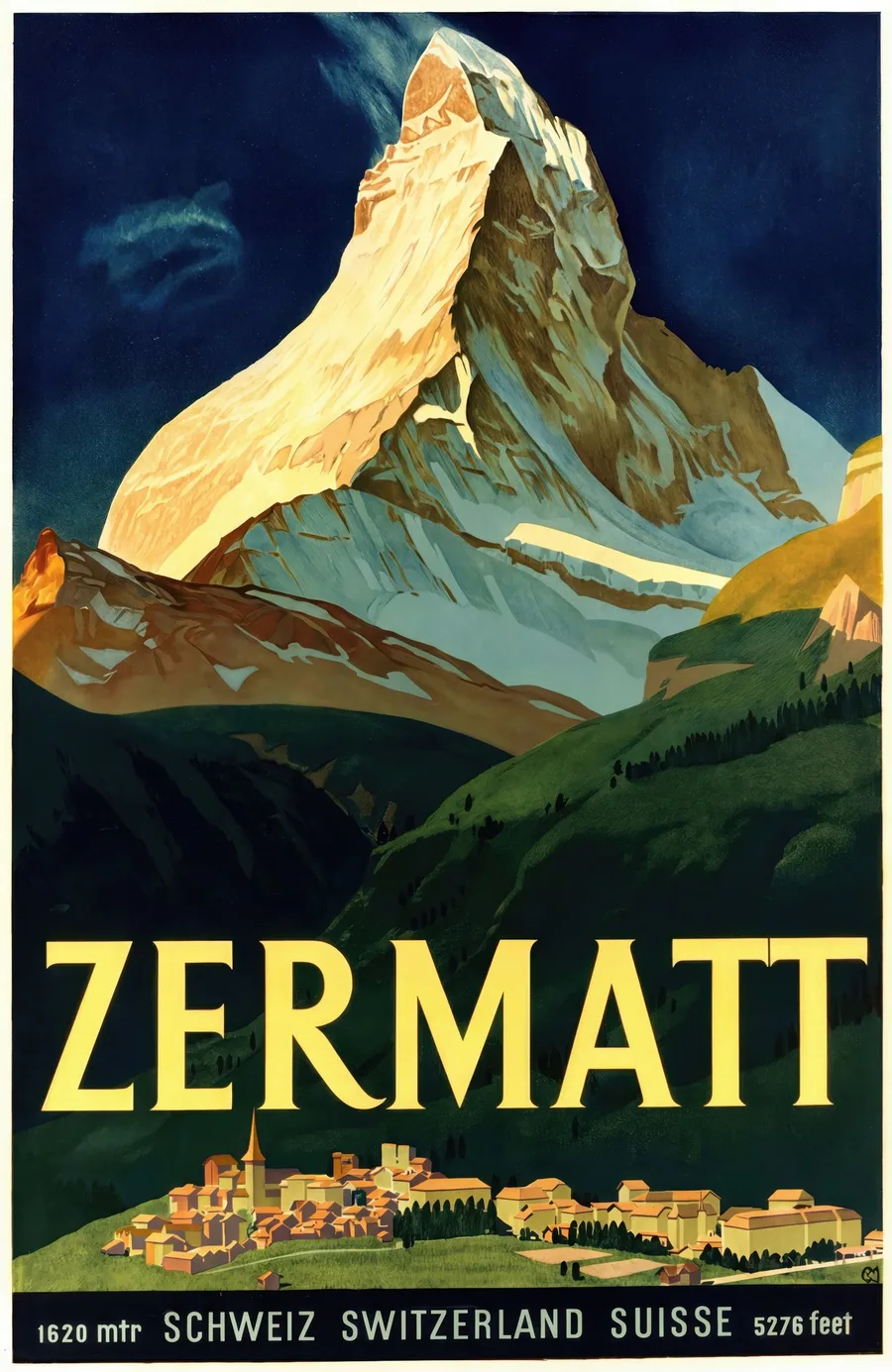
Zermatt – Matterhorn, 1908
Emil Cardinaux's 1908 Matterhorn is widely called the first modern Swiss poster — MoMA keeps a copy. The peak catches the last sun against a night-blue sky; if that blue drifts toward black, the lamplit village at the bottom stops glowing.
First modern poster · current options on Etsy
See sizes and prices on Etsy ↗
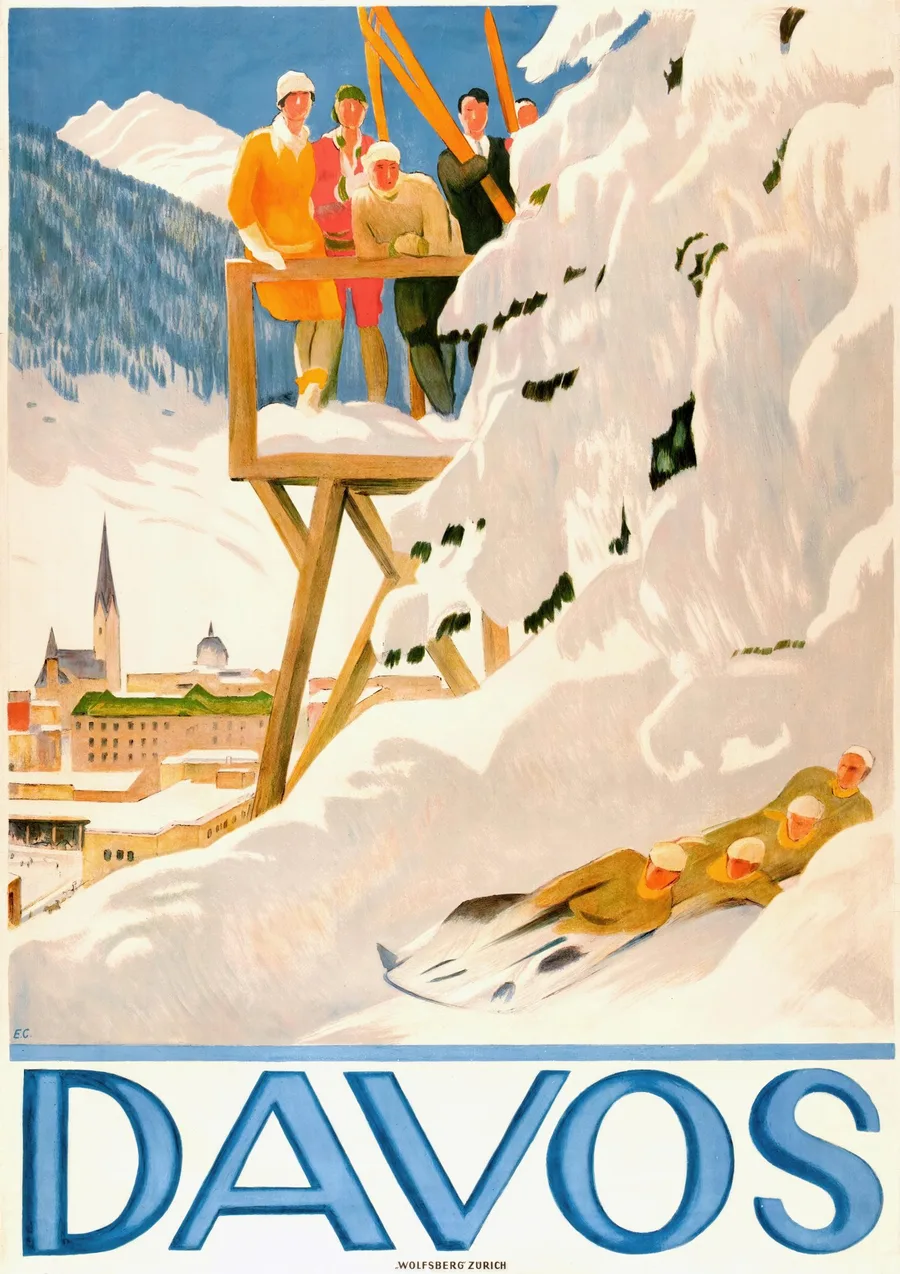
Davos, 1918
A five-man bob streaks past the spectators' stand while the town sits quiet below — Emil Cardinaux, 1918, printed by Wolfsberg in Zürich. The snow is mostly bare paper; the pale blue shadows are all that model it, and they have to stay pale.
Bobsleigh winters · current options on Etsy
See sizes and prices on Etsy ↗
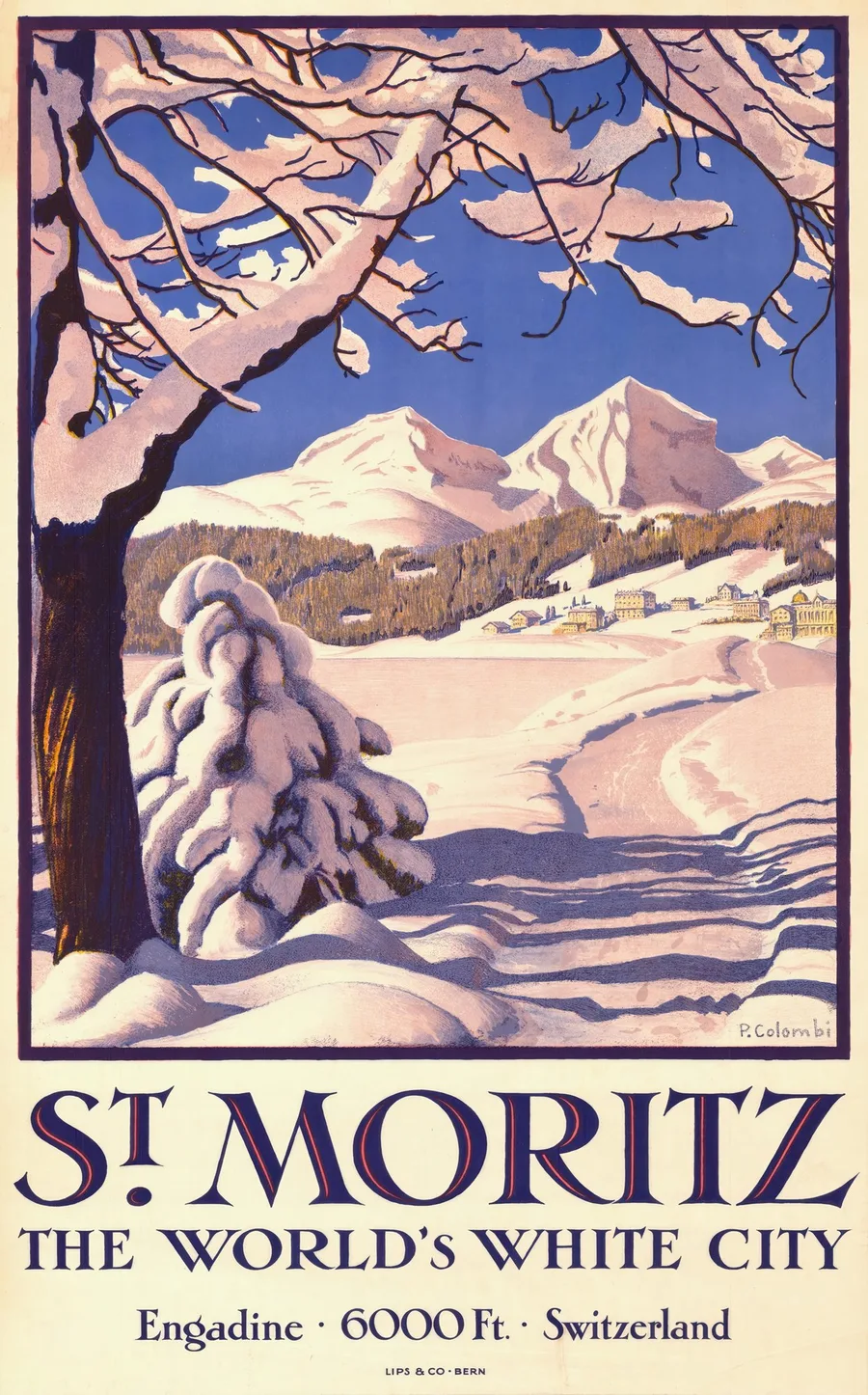
St. Moritz – The World's White City, 1929
Plinio Colombi's 1929 view across the frozen lake, made when St. Moritz was styling itself 'The World's White City'. It is white on white nearly everywhere — the violet shadows striping the foreground snow are what keep the picture standing.
Engadin winters · current options on Etsy
See sizes and prices on Etsy ↗
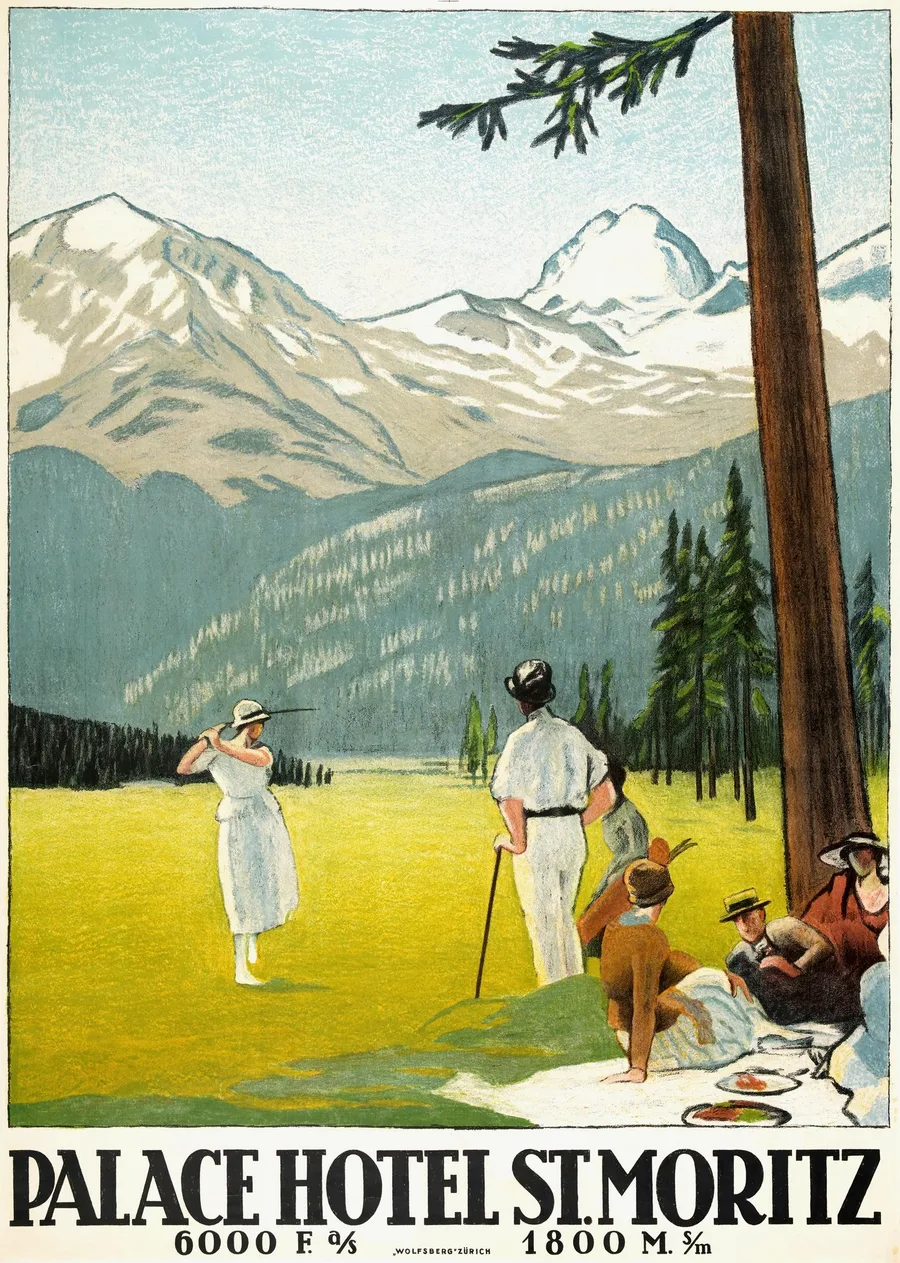
Palace Hotel St. Moritz, 1920
Emil Cardinaux sold the palace in 1920 by never showing it: a golf swing, a picnic under the pine, and the Engadin peaks do the advertising. The meadow's acid yellow-green is the fragile note — let it dull and the whole afternoon goes overcast.
Hotel palaces · current options on Etsy
See sizes and prices on Etsy ↗
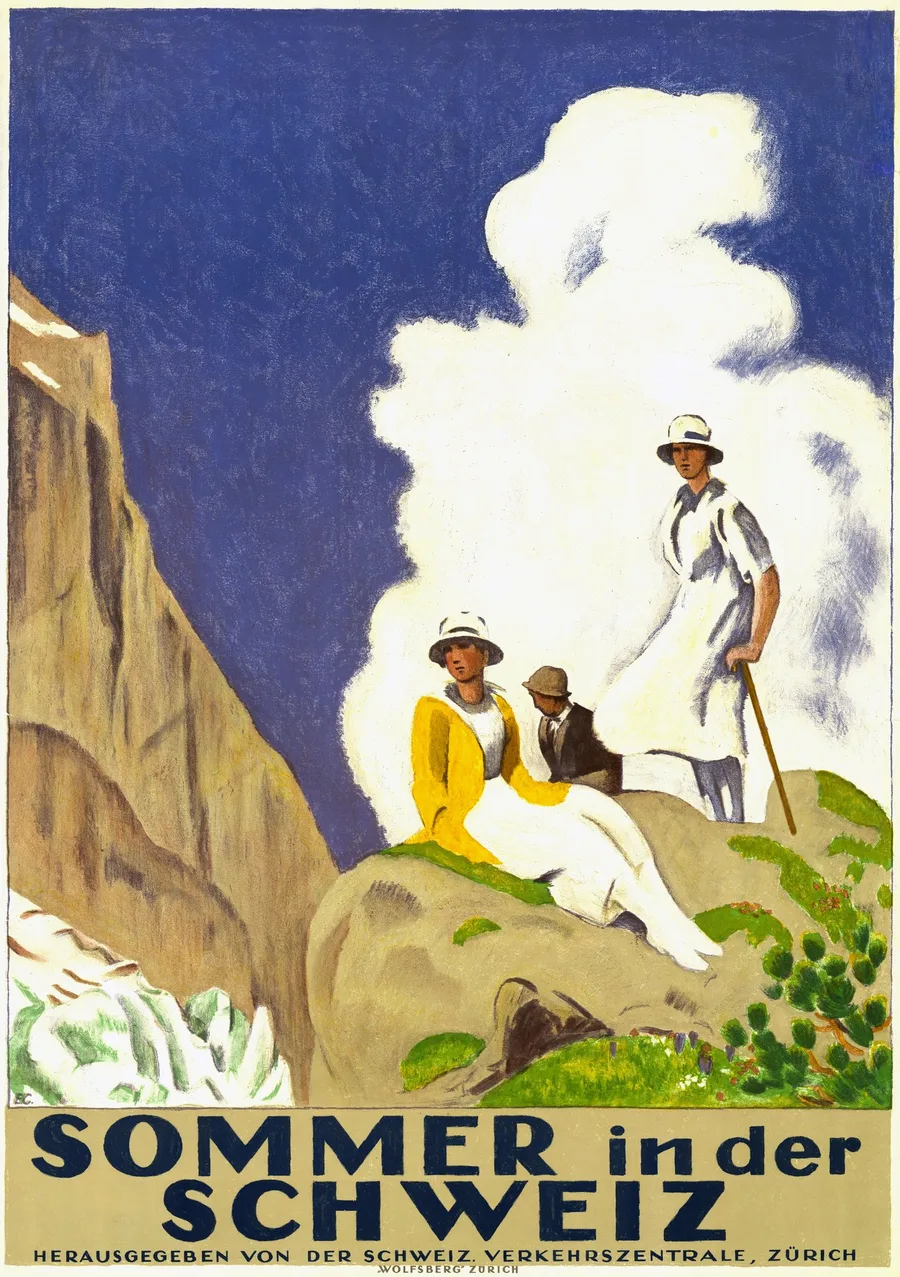
Sommer in der Schweiz, 1921
Painted for the national tourist office in 1921, with a French twin titled L'été en Suisse. Emil Cardinaux gives half the sheet to a single towering cloud; the one yellow jacket is the only hot color and must stay clean against all that white.
National campaigns · current options on Etsy
See sizes and prices on Etsy ↗
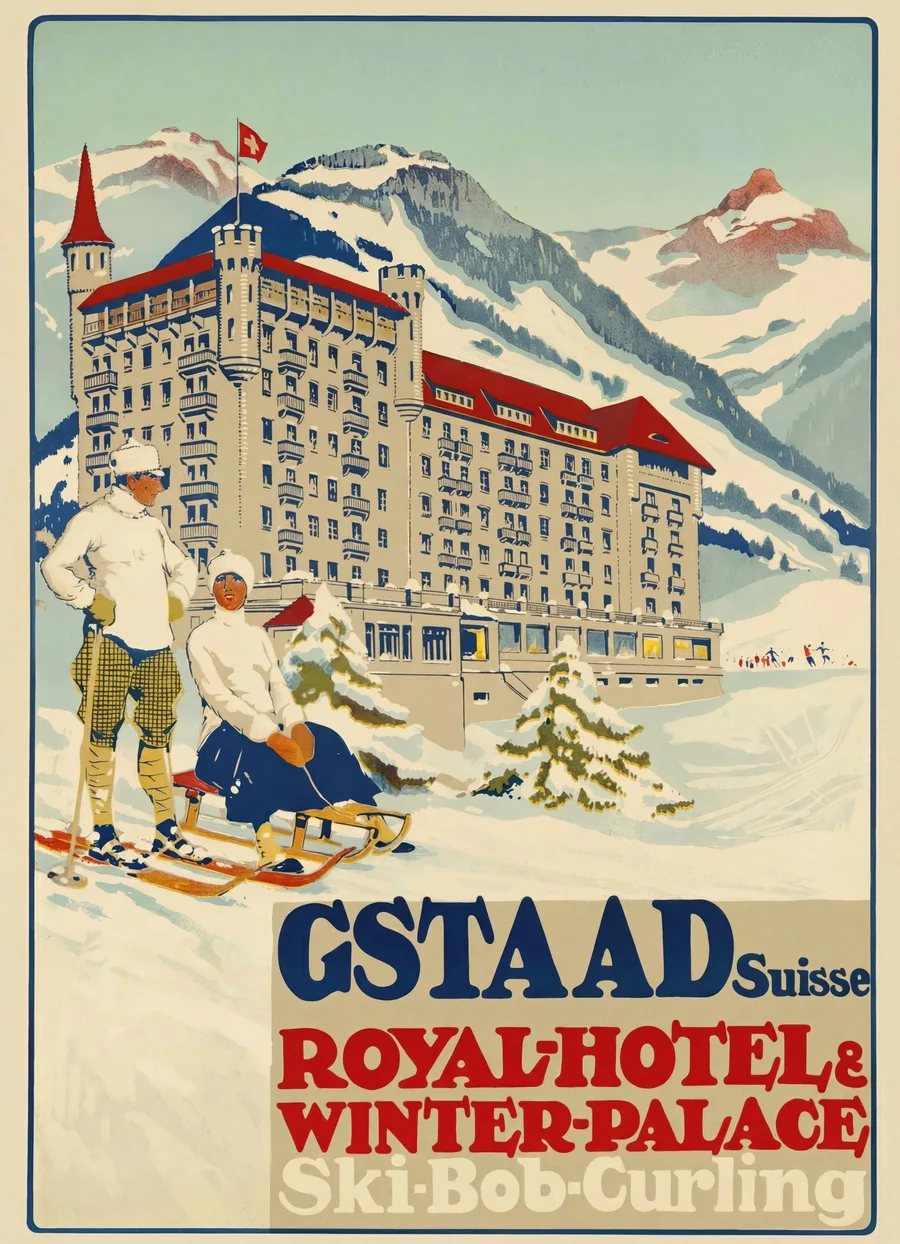
Gstaad – Royal Hôtel & Winter Palace, 1913
Printed for the Winter Palace's grand opening in December 1913 and attributed to Carlo Pellegrini. The turreted hotel reads as a fairy-tale castle above the promise of 'Ski-Bob-Curling'; its red roofs are what keep it from sinking into the mountain behind.
Belle Époque hotels · current options on Etsy
See sizes and prices on Etsy ↗
Keep exploring
Beyond the Matterhorn — valley towns, lake light and hotel winters.
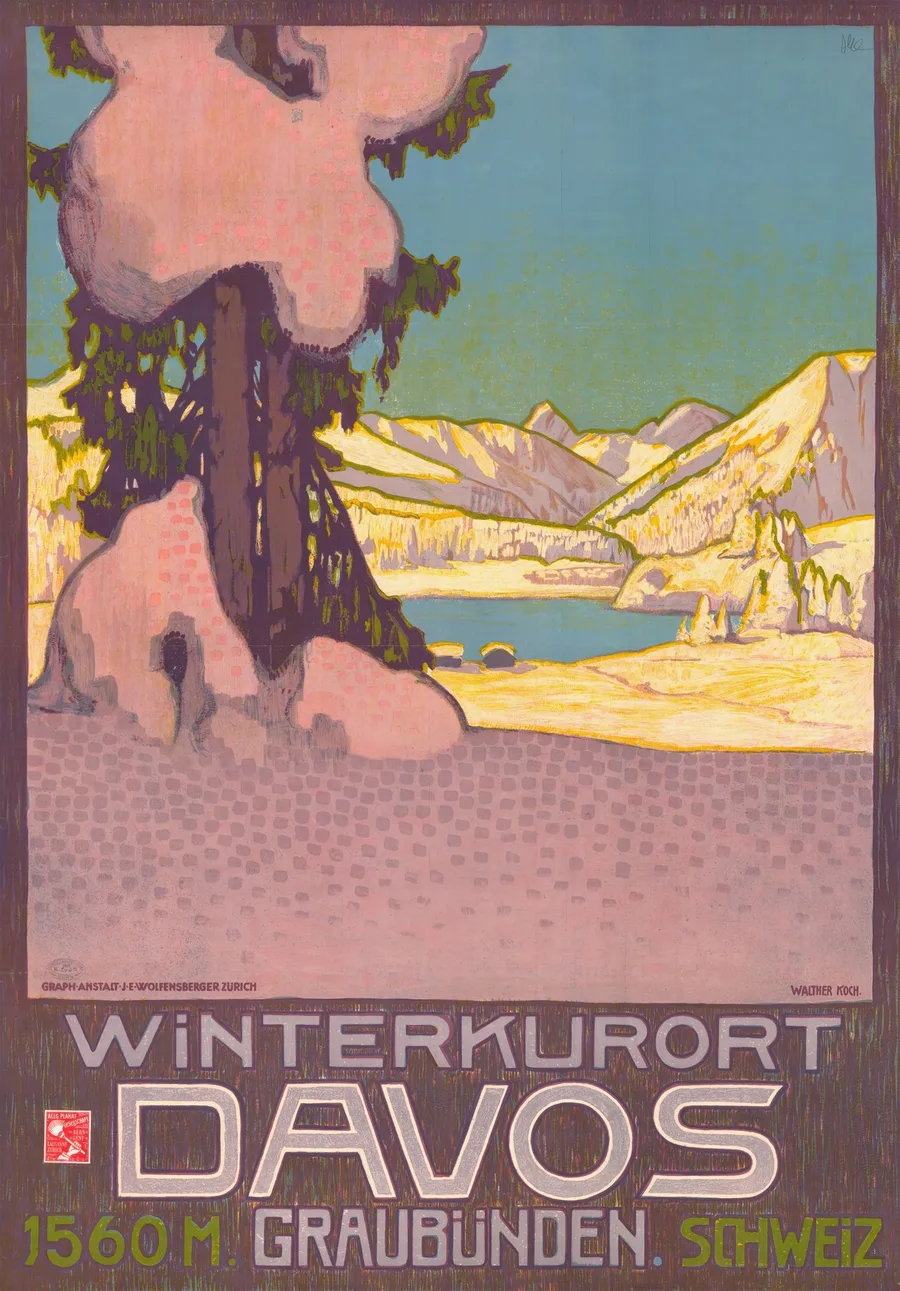
Winterkurort Davos, c. 1905–1910
Walther Koch's Davos of around 1905 is still a Winterkurort — a health resort — not yet a ski circus; he died in 1915 and left only a handful of posters. The snow is stippled with little squares of pink and mauve; flatten them and the shimmer is gone.
Health resort era · current options on Etsy
See sizes and prices on Etsy ↗
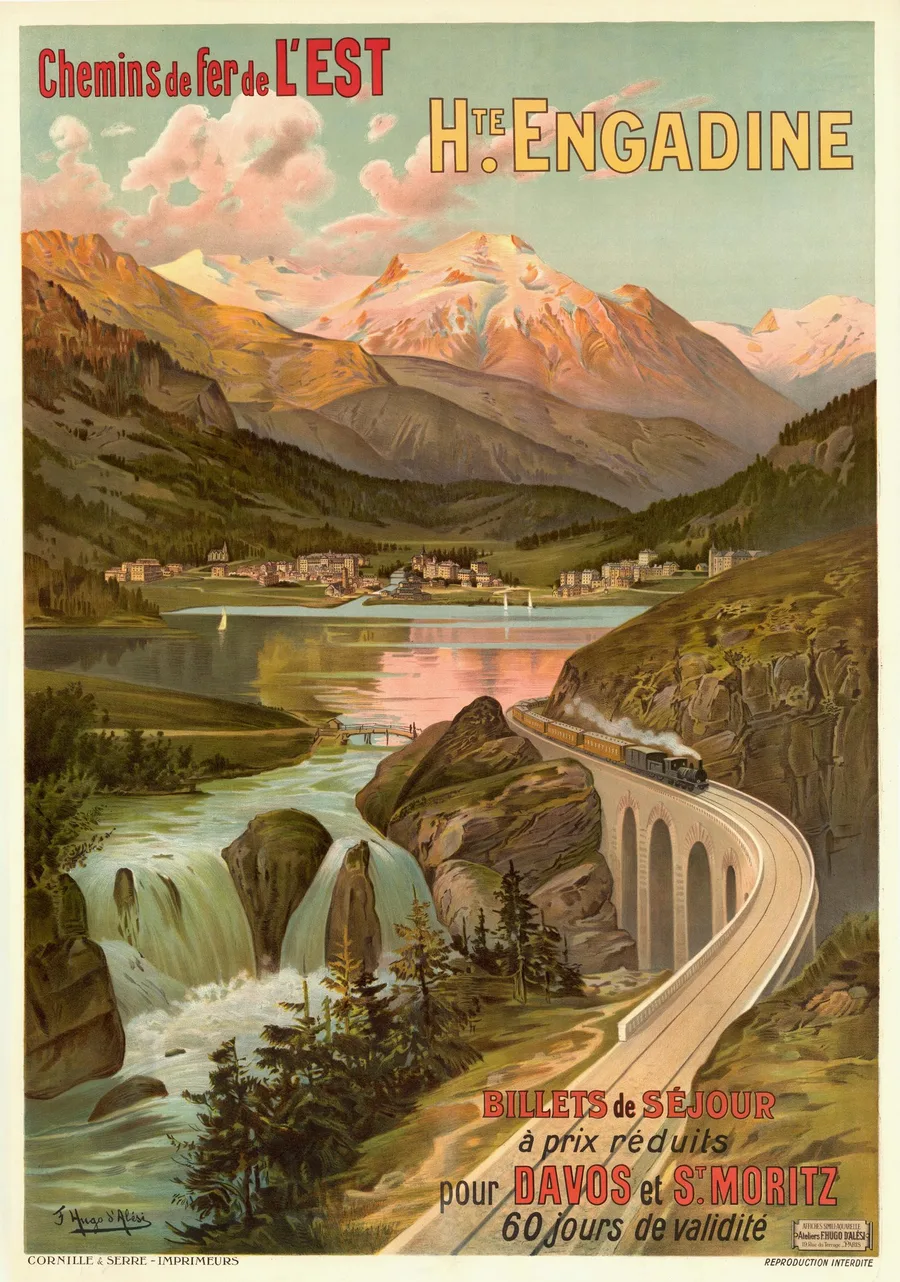
Haute Engadine – St. Moritz, c. 1898
F. Hugo d'Alési painted this around 1898 for a French railway selling sixty-day tickets to Davos and St. Moritz. Alpenglow does the persuading — the pink on the far peaks has to stop short of orange, or the lake below loses its evening stillness.
Engadin lakes · current options on Etsy
See sizes and prices on Etsy ↗
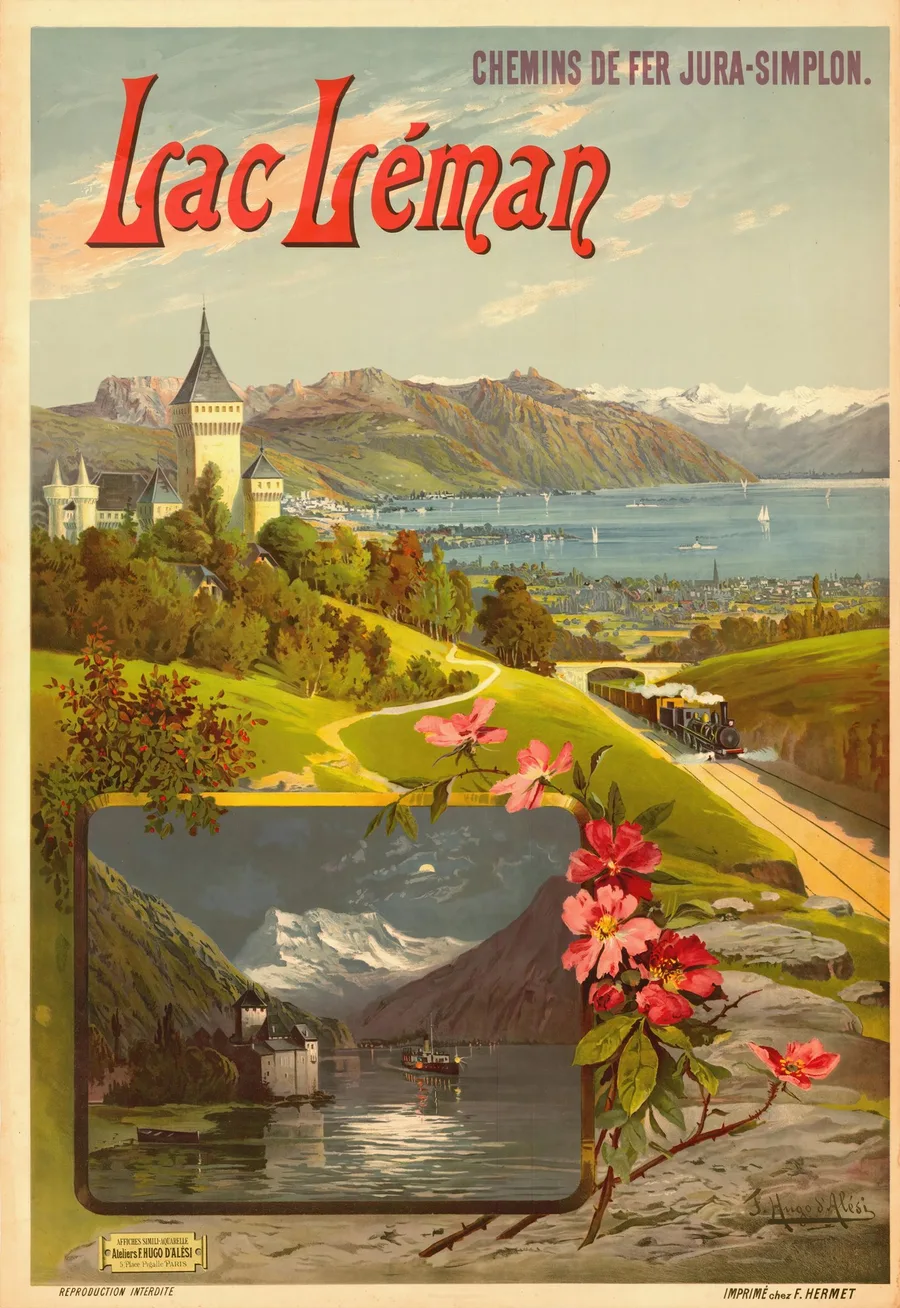
Lac Léman, c. 1898
One poster, two views: F. Hugo d'Alési sets a moonlit Château de Chillon inside the sunlit sweep of Lake Geneva, c. 1898, for the Jura-Simplon railway. The wild roses sprawling across the corner are the painter showing off — their pink must stay separate from the sunset haze.
Belle Époque lakes · current options on Etsy
See sizes and prices on Etsy ↗
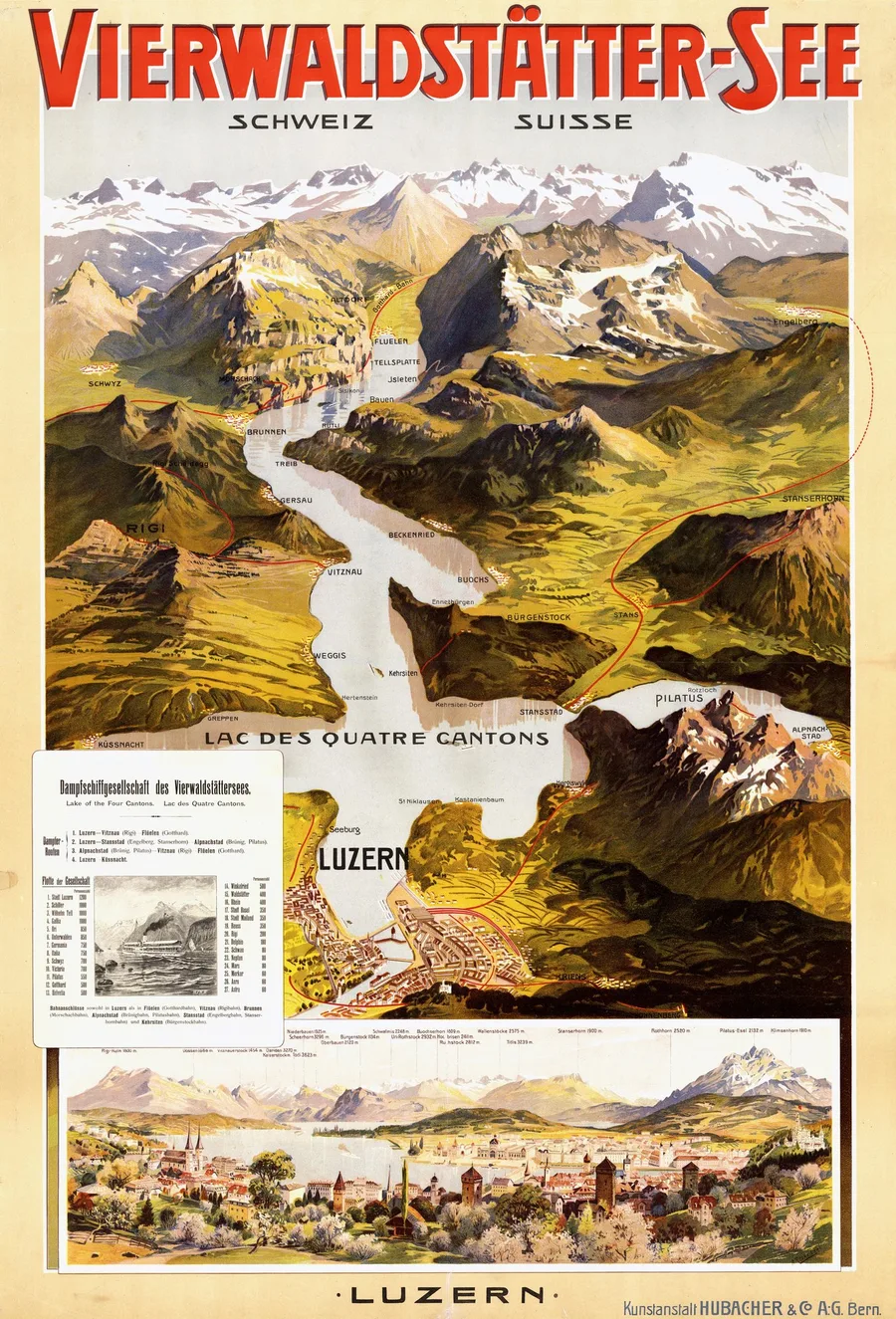
Vierwaldstättersee – Luzern, c. 1904
Anton Reckziegel drew Lake Lucerne from the air around 1904, before anyone had actually seen it that way — every landing stage named, the whole steamer fleet tabled in a corner. It is a poster made for reading; the thin red route lines have to stay legible at arm's length.
Steamer age · current options on Etsy
See sizes and prices on Etsy ↗
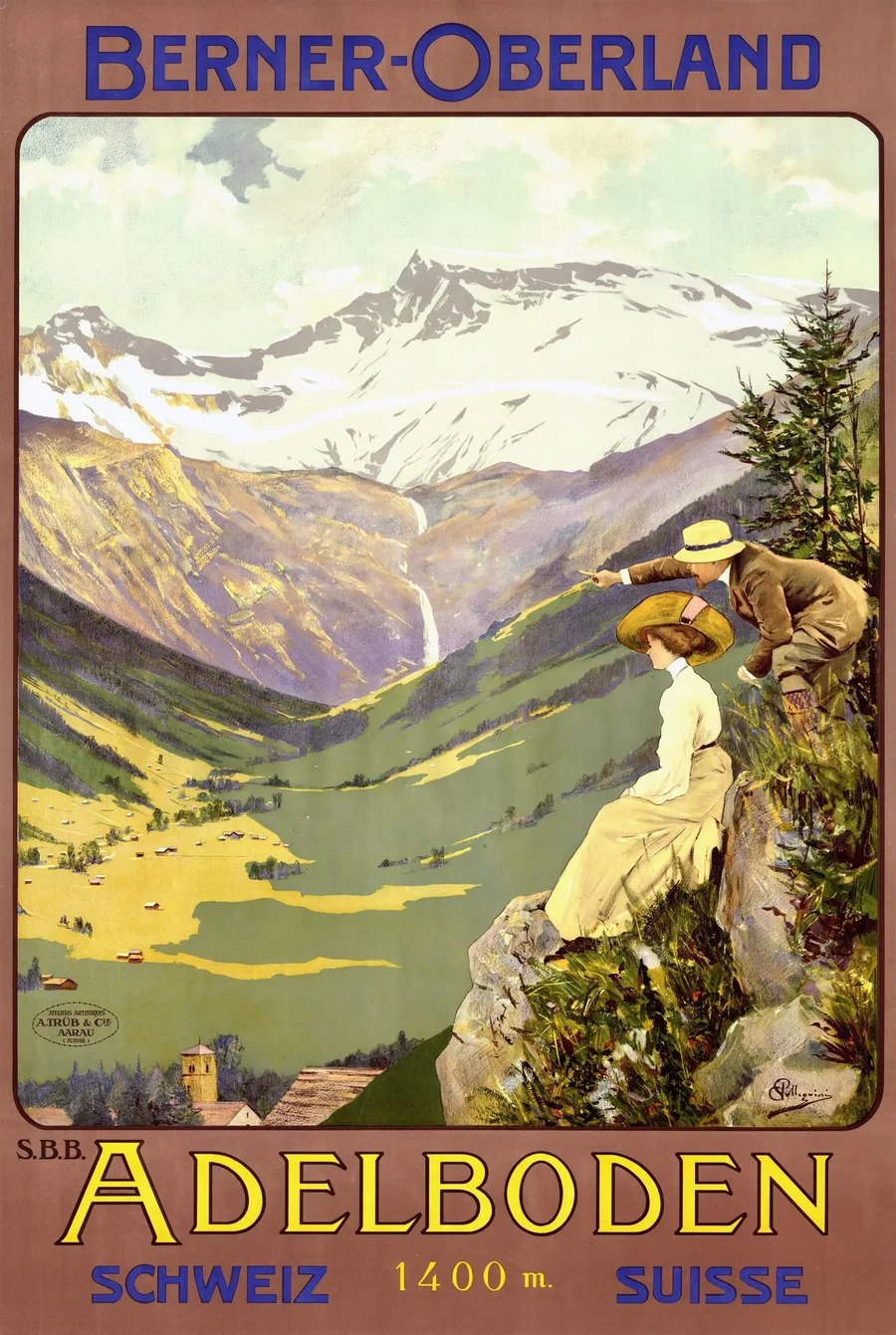
Adelboden – Berner Oberland, c. 1905–1910
Carlo Pellegrini poses two Edwardian hikers on a ledge above the Engstligen valley, around 1905, for the federal railways. Her white dress against the green valley floor carries the whole composition — the waterfall behind is barely a whisper of white.
Berner Oberland · current options on Etsy
See sizes and prices on Etsy ↗
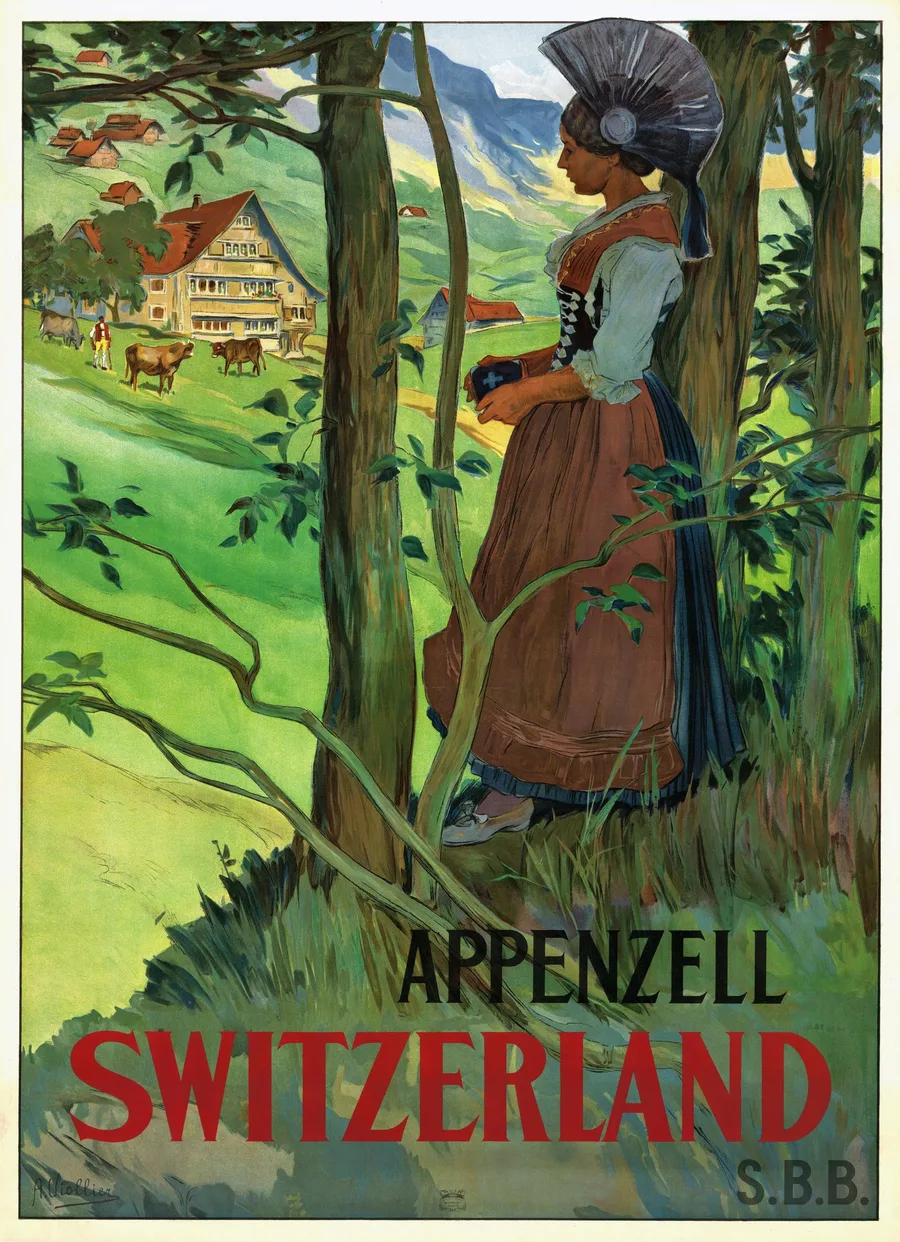
Appenzell – Switzerland, 1904
Auguste Viollier, 1904, from the federal railways' first destination series. Everything hangs on the great fan of the Appenzell headdress — its pleats need to stay crisp against the beech trunks — while cows and a gabled farmhouse keep the valley busy behind her.
Eastern Switzerland · current options on Etsy
See sizes and prices on Etsy ↗
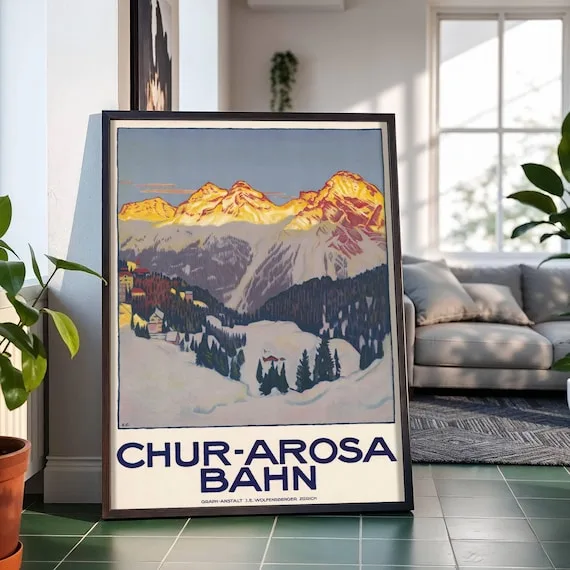
Chur–Arosa Bahn, c. 1915
The electric line from Chur reached Arosa in December 1914, and Emil Cardinaux painted its poster within the year, printed at Wolfensberger in Zürich. Everything depends on the band of alpenglow — the yellow may burn on the summits and nowhere else, or the blue snowfields below lose their evening cold.
Electric mountain lines · current options on Etsy
See sizes and prices on Etsy ↗
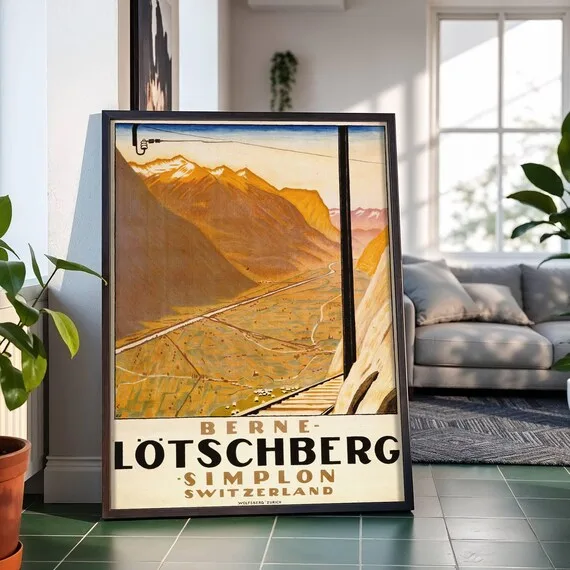
Berne–Lötschberg–Simplon, c. 1921
The Lötschberg tunnel had joined Bern to the Simplon route since 1913; around 1921 Emil Cardinaux looked down the whole Rhône valley from the ledge the railway rides. The sheet is ochre haze from edge to edge — the track curving out of the foreground is its one hard line, and it has to stay razor-clean.
Lötschberg line · current options on Etsy
See sizes and prices on Etsy ↗
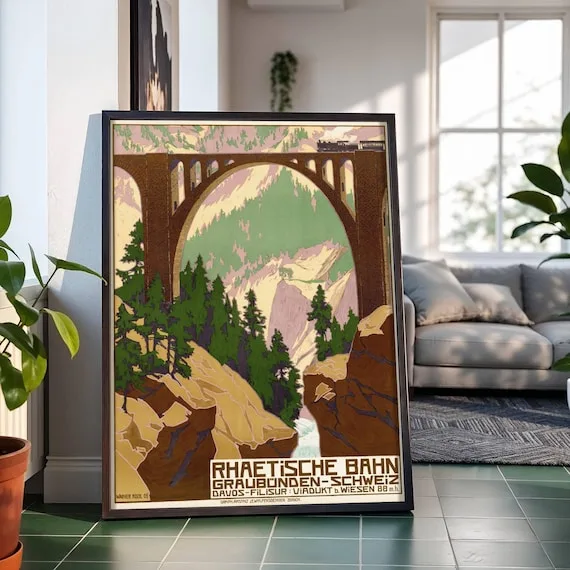
Rhätische Bahn — Wiesen Viaduct, 1909
Walther Koch signed and dated the stone 1909, the summer the Davos–Filisur line opened across the Wiesen viaduct — the poster prints the bridge's 88 metres like a boast. He draws the arch from the gorge floor in flat woodcut planes of pink rock and fir green; the train on top must stay tiny to keep the bridge enormous.
Davos–Filisur line · current options on Etsy
See sizes and prices on Etsy ↗
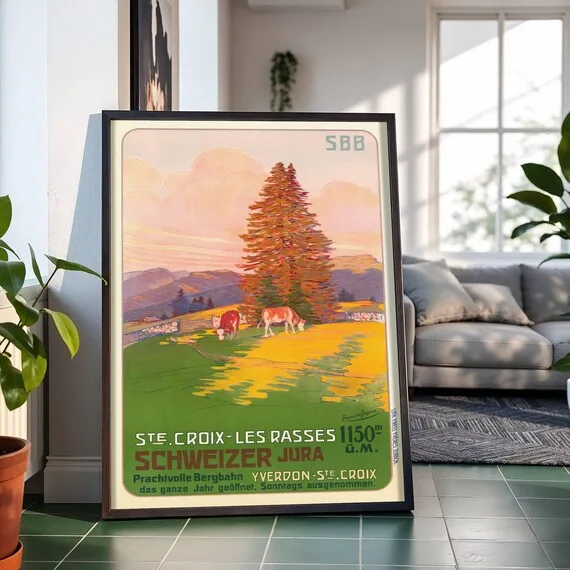
Ste-Croix — Les Rasses, c. 1920
François Jaques painted his own corner of the Jura for the federal railways, down to the small print promising the Yverdon–Ste-Croix line runs all year, Sundays excepted. A single giant fir holds the sheet against the pink evening sky — the chrome yellow along the pastures must stay sunlit, never sour.
Jura heights · current options on Etsy
See sizes and prices on Etsy ↗
Follow what catches your eye
These works are only the beginning. The GeMarkt archive contains 70+ The Swiss Alps records; current Etsy availability may change. Continue by subject:
Choosing a format
Rolled poster
The cheapest way in — pick it if you already own a frame or want one chosen for the room, not the shipment.
Framed paper
Arrives ready to hang, glass over paper — the classic museum-print look, and the safest default for most rooms.
Stretched canvas
No glass, no glare — texture close to a painting's, and a natural fit for painterly surfaces.
Framed canvas
The canvas texture with a finished edge — the most furniture-like of the four, and the largest sizes live here.
Prices and available formats vary by listing; Etsy shows the current options and currency for that work. Undecided? Our print format guide compares the four honestly.
From the journal
Why is this work free to print in the first place? The Swiss Alps and the public domain — the full guide →