GeMarkt Blog · Essay
Night in Art: Moonlit and Starry Paintings
Look closely at eight night scenes, from Friedrich and Whistler to Van Gogh and Hiroshige, and discover what darkness lets an artist show.

A night picture does not have to contain much black. Van Gogh fills his sky with yellow; Whistler lets a harbour hover inside grey-green paint; Hammershøi finds the moon in a bright rectangle on a floor. Darkness changes what can be seen, but it also changes what an artist can leave unresolved.
These eight works offer different ways into the subject. Six are oil paintings; two are woodblock prints, included because their cut lines and printed darkness make a revealing comparison with painted light. They are not a complete history of night across cultures, or eight illustrations of the same mood.
As you move between them, keep three questions in mind. Where does the light come from? What becomes difficult to recognise? And who, if anyone, shares the darkness with us? The answers lead from contemplation and working harbours to domestic space, local belief and invented encounters.
Friedrich makes us watch with someone
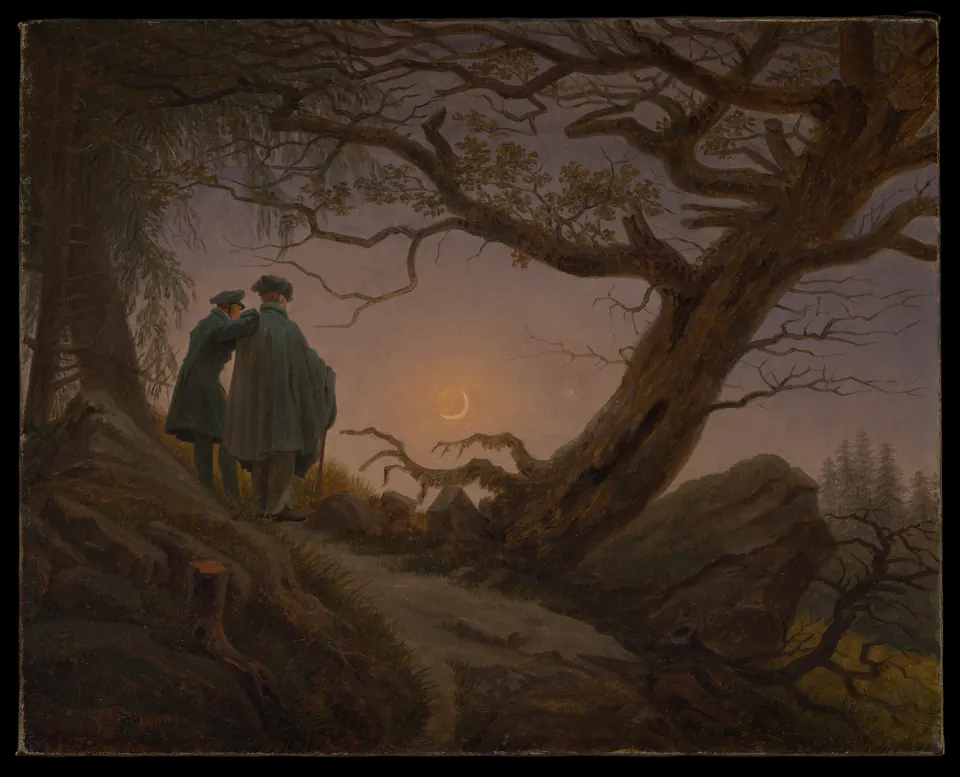
The men do not look at us. Their turned backs make the crescent moon the destination of their attention and ours. A leaning trunk and tangled branches build a rough opening around the delicate light. The moon is small, but the composition gives it room to matter.
The Met identifies this canvas as the third version of Friedrich’s composition, rather than the 1819 Dresden painting. It also connects the subject with Romantic contemplation of nature. The proposed identities of the two men remain identifications, not a reason to treat the scene as a literal record of one walk.
Notice how companionship affects the picture. This is not simply a solitary person overwhelmed by the universe. Two figures pause together, and one inclines towards the other. Their shared looking makes the distant light intimate without making it ordinary.
Whistler makes the harbour almost disappear
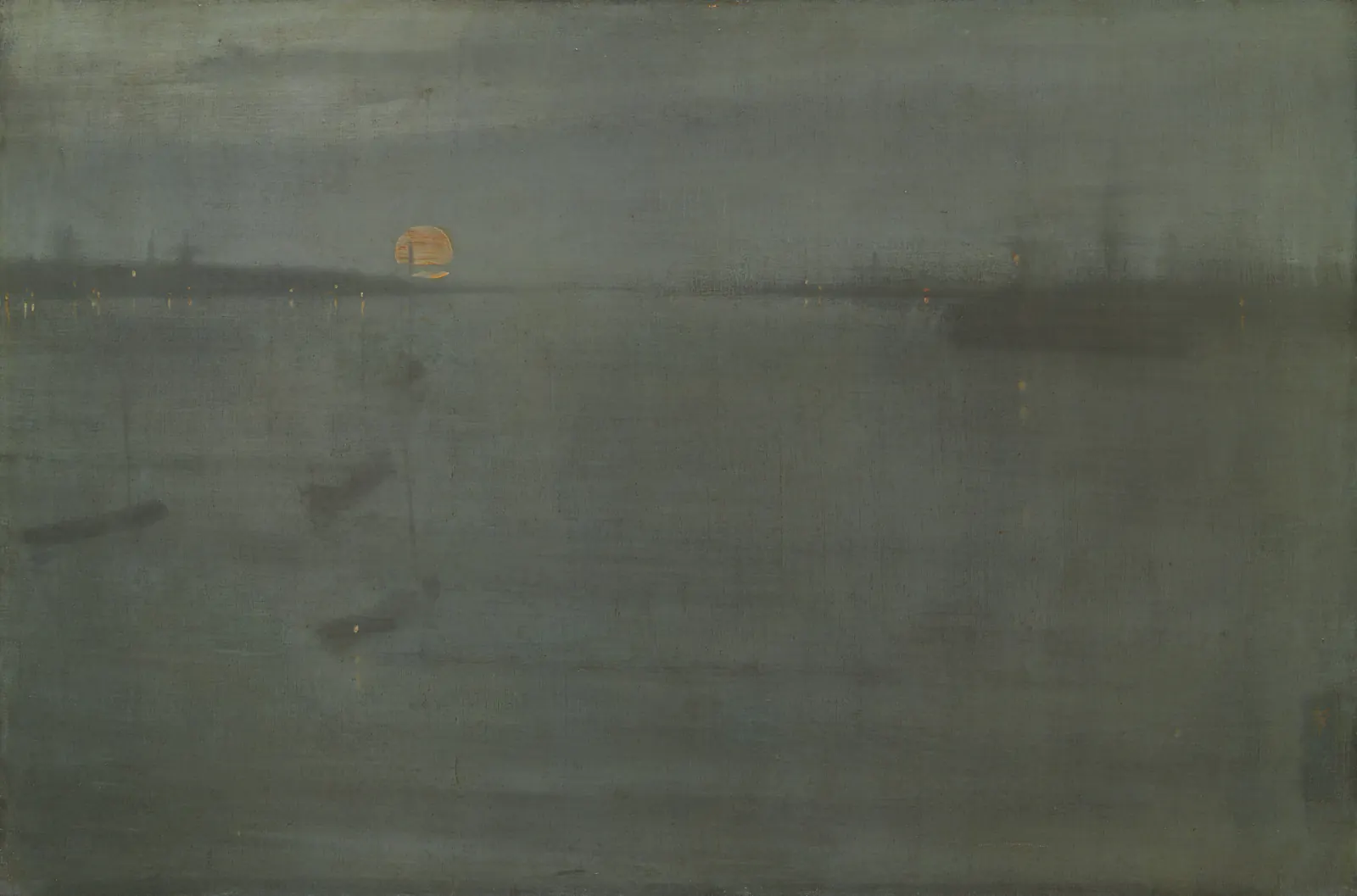
Here it takes a moment to separate water from sky. The vessels are not crisply outlined, and the moon is an imperfect disc rather than a polished astronomical symbol. The tiny lights along the harbour compete with it on a much smaller scale.
The Art Institute’s account relates Whistler’s nocturnes to music and to harmonies of subdued colour. That helps explain the title: it directs attention towards relationships of tone, not only the named place.
Try looking before identifying. A low dark band, a few vertical interruptions and pale touches make a harbour without describing every mast. Compared with Friedrich, Whistler offers fewer narrative footholds. Darkness is not chiefly a setting for contemplation; it is a practical way to loosen the connection between an object and a sharply defined painted shape.
Van Gogh gives the sky a moving surface
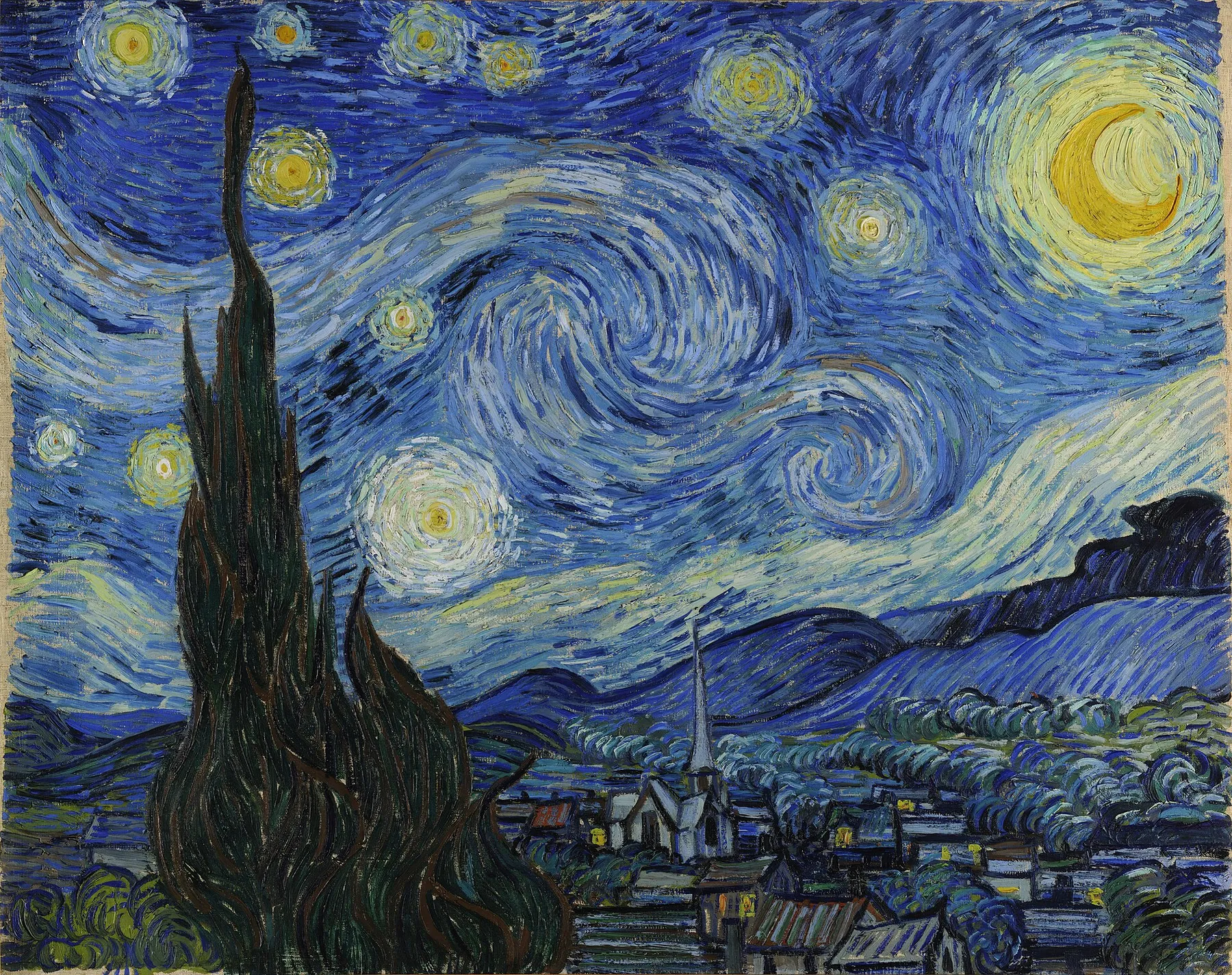

Whistler’s surface asks us to slow down; Van Gogh’s brushstrokes send the eye circling. The stars have broad haloes, the blue sky bends around them, and the dark cypress cuts through several horizontal layers of land and atmosphere.
MoMA distinguishes observation from construction: Van Gogh drew on the view at Saint-Rémy but painted during daylight sessions and assembled the village from other views. This is not a photograph of one instant outside his window.
The useful contrast is between the compact, angular houses and the curving marks overhead. Both belong to the same canvas, but they seem to move at different speeds. We do not need to turn each mark into a symptom or decode every star to notice that tension. Van Gogh makes night vivid through the physical direction of paint, not simply through a subject called darkness.
Hammershøi brings the moon indoors
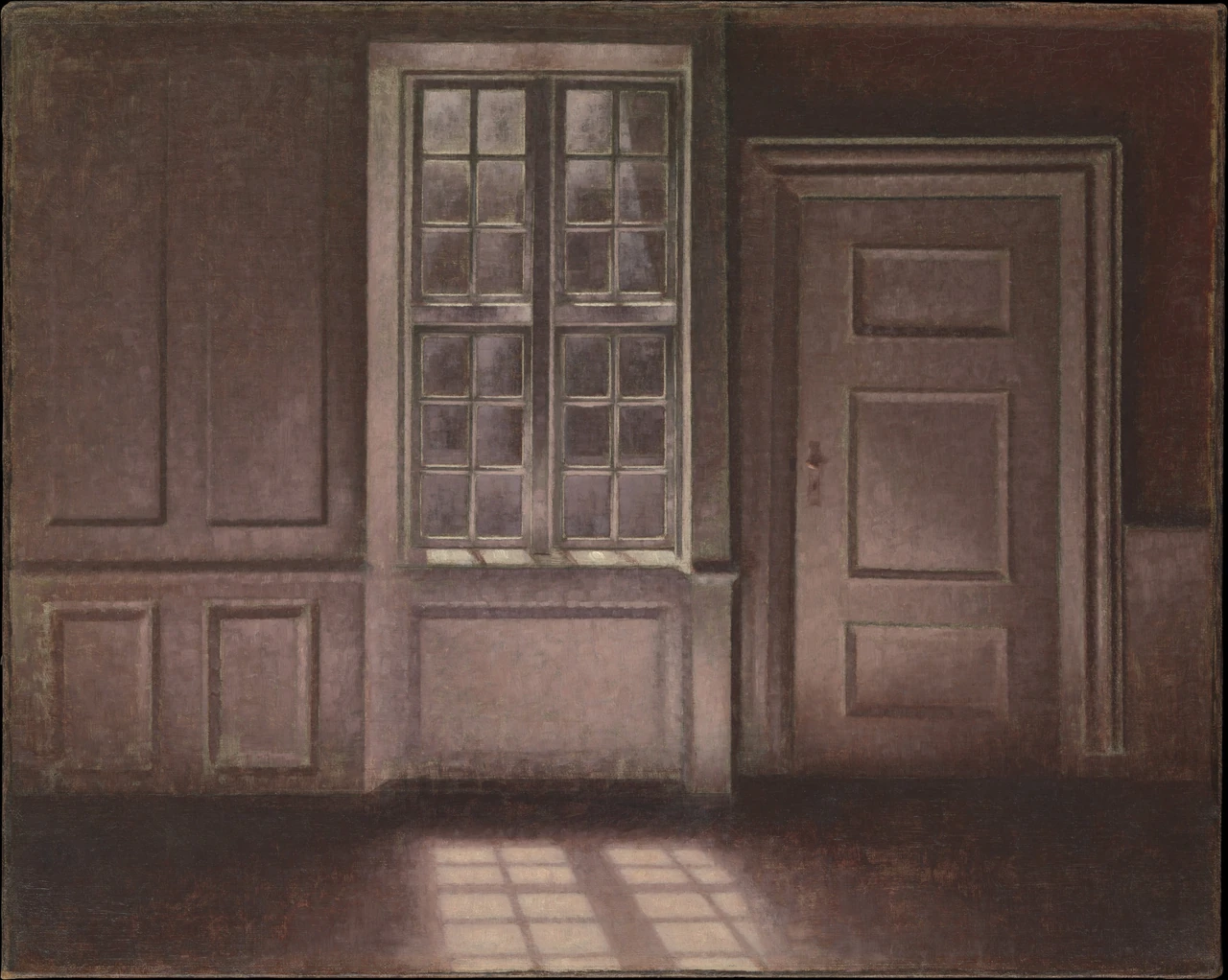
There is no visible moon here. Its presence is carried by the window pattern on the floor, which turns an absent light source into a set of tangible shapes.
The Met identifies the room as part of Hammershøi’s Copenhagen apartment, a space he painted at different times of day. Across the courtyard, the window gives a glimpse of another part of the home. The geometry is therefore anchored in a particular place, not an unspecified haunted house.
Look at how many rectangles the painting contains: window panes, door panels, wall mouldings and the patch of light. Their slight differences prevent the room from becoming a perfect diagram. Without a figure to explain the scene, we register the act of looking itself. Emptiness need not mean loneliness; the image leaves that emotional conclusion open.
Aivazovsky sets moonlight against a steamship
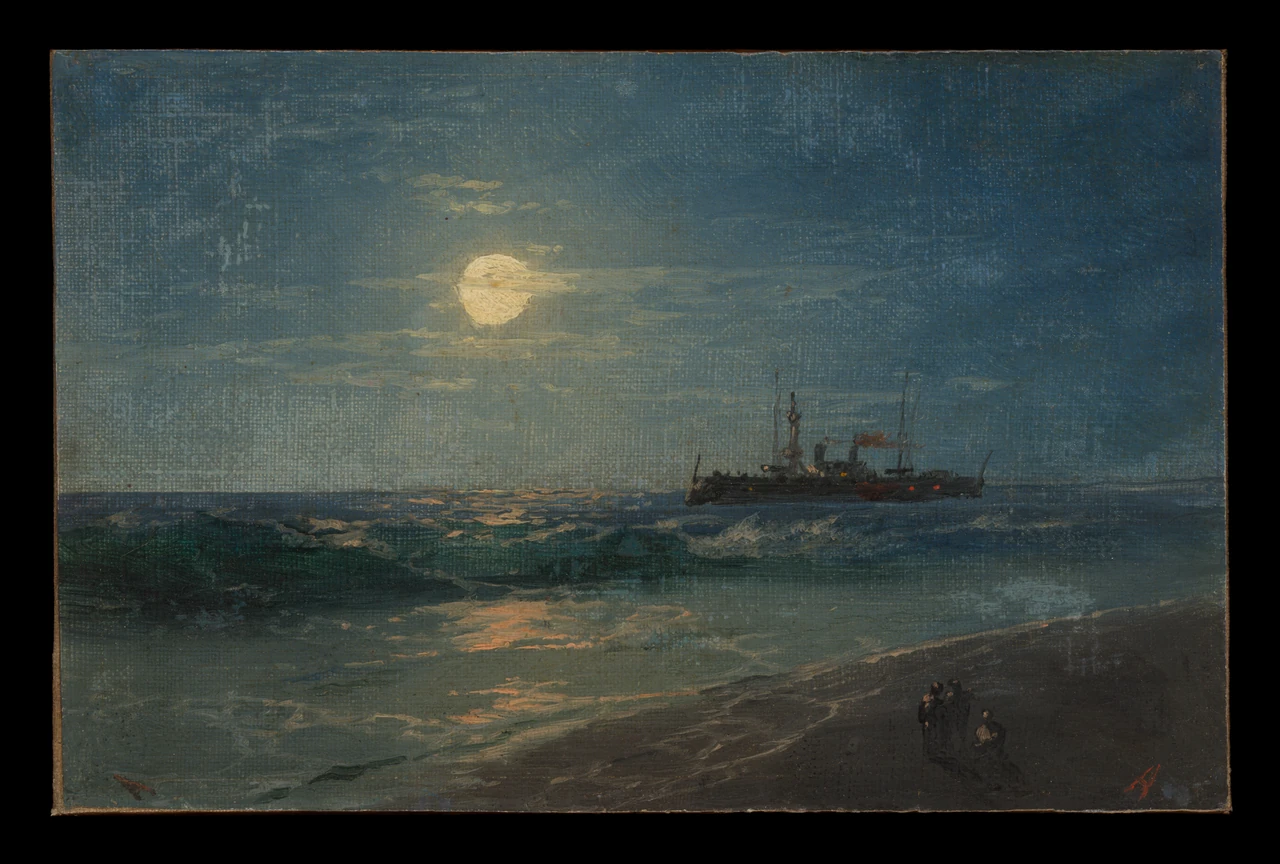
The moon’s reflection does not form a smooth ladder. It breaks into fragments as the water changes angle. Against this moving brightness, the vessel is a dark, compact shape with a funnel and small lights.
The Met explicitly identifies a steamship. That matters: moonlight has not transported us into a world outside technological change. Modern shipping occupies the same water that supplies the painting’s atmospheric drama. The current museum record gives no creation date, so none is invented here.
Compare this with Whistler. Both pictures contain vessels and points of light, yet Aivazovsky keeps the waves, shore and ship more readily legible. The tiny people at the lower right also give us a possible place to stand. Night can obscure the world or organise it around a stronger contrast.
Hiroshige makes small lights tell a story
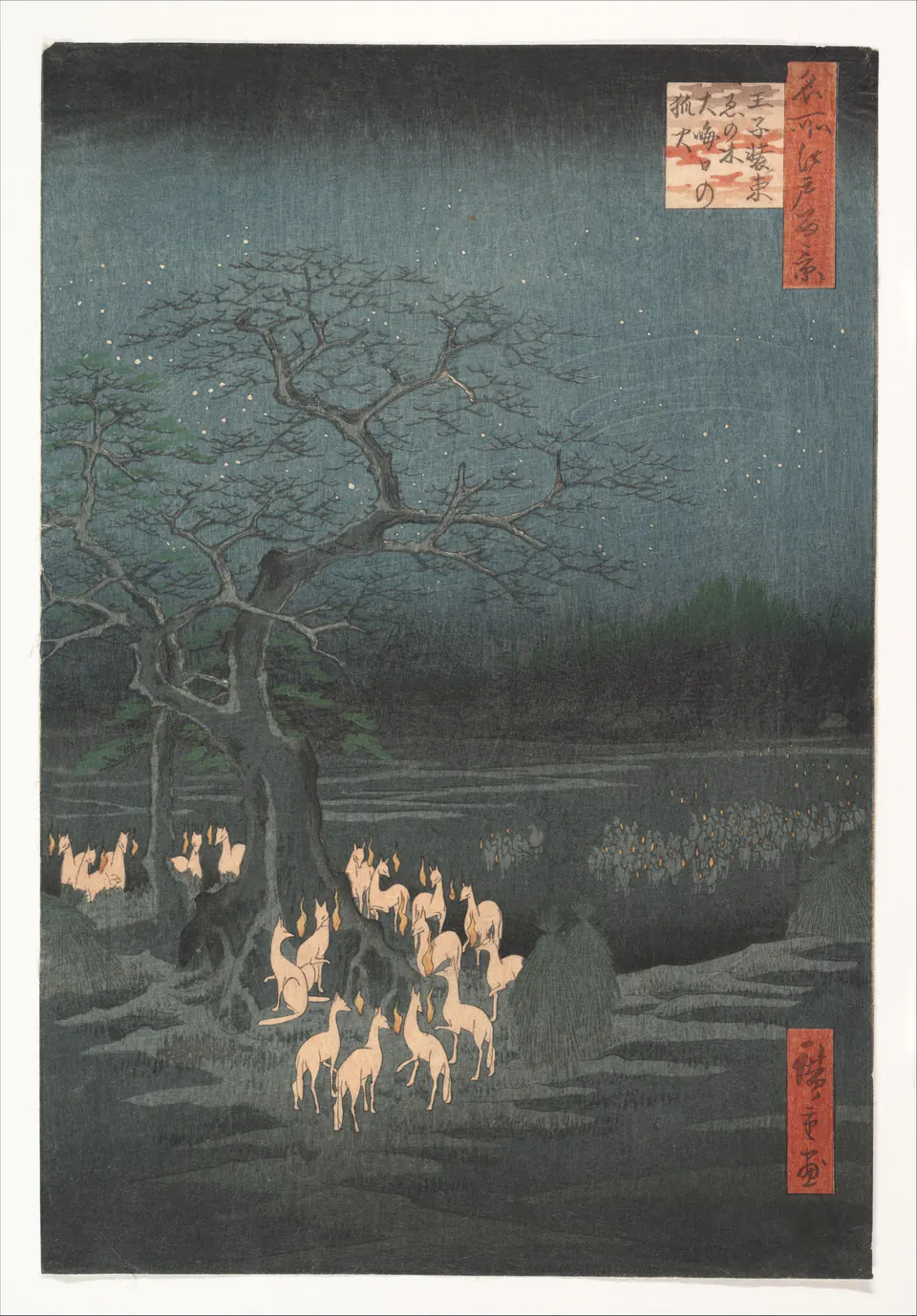
The lights in Hiroshige’s sky are joined by another procession of lights close to the ground. The foreground foxes are clear and pale; the distant group becomes an accumulation of tiny marks. Depth emerges from the shrinking bodies and flames.
This is not just a picturesque animal gathering. The Met explains its connection to Ōji Inari shrine, where foxes serve as messengers, and to a belief that farmers could read the coming harvest through the foxfires.
The print makes two kinds of space coexist: a named Edo location and a scene shaped by local belief. Unlike the broad glowing moon in the European seascapes, its many little lights organise a collective event. Calling all night scenes dreamy would flatten precisely the cultural difference that makes this one worth reading closely.
Gauguin’s night is cut into wood
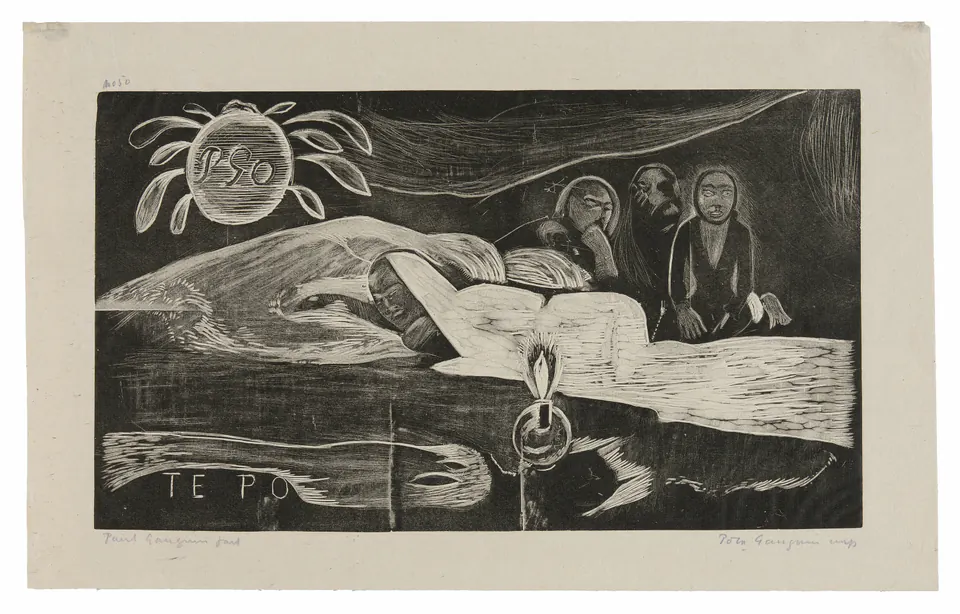
In Te po, or The Night, darkness is also a material fact: a dense field of printed black ink. Pale cuts expose faces, fingers and the long reclining body. You can follow the tool’s interruptions rather than imagine a brush mixing blue with yellow.
The Art Institute identifies this particular impression as a 1921 issue of the earlier Noa Noa design, printed by Gauguin’s son Pola. Design date and the date of the sheet are different pieces of information.
The shapes resist a tidy description of ordinary space. Heads seem to gather beside or above the reclining figure; lines sweep across the upper area without supplying a conventional horizon. That is a visual observation, not proof that the scene documents a specific ritual. The print is useful here because it turns night from coloured atmosphere into an arrangement of revealed and withheld forms.
Rousseau keeps the ending out of sight
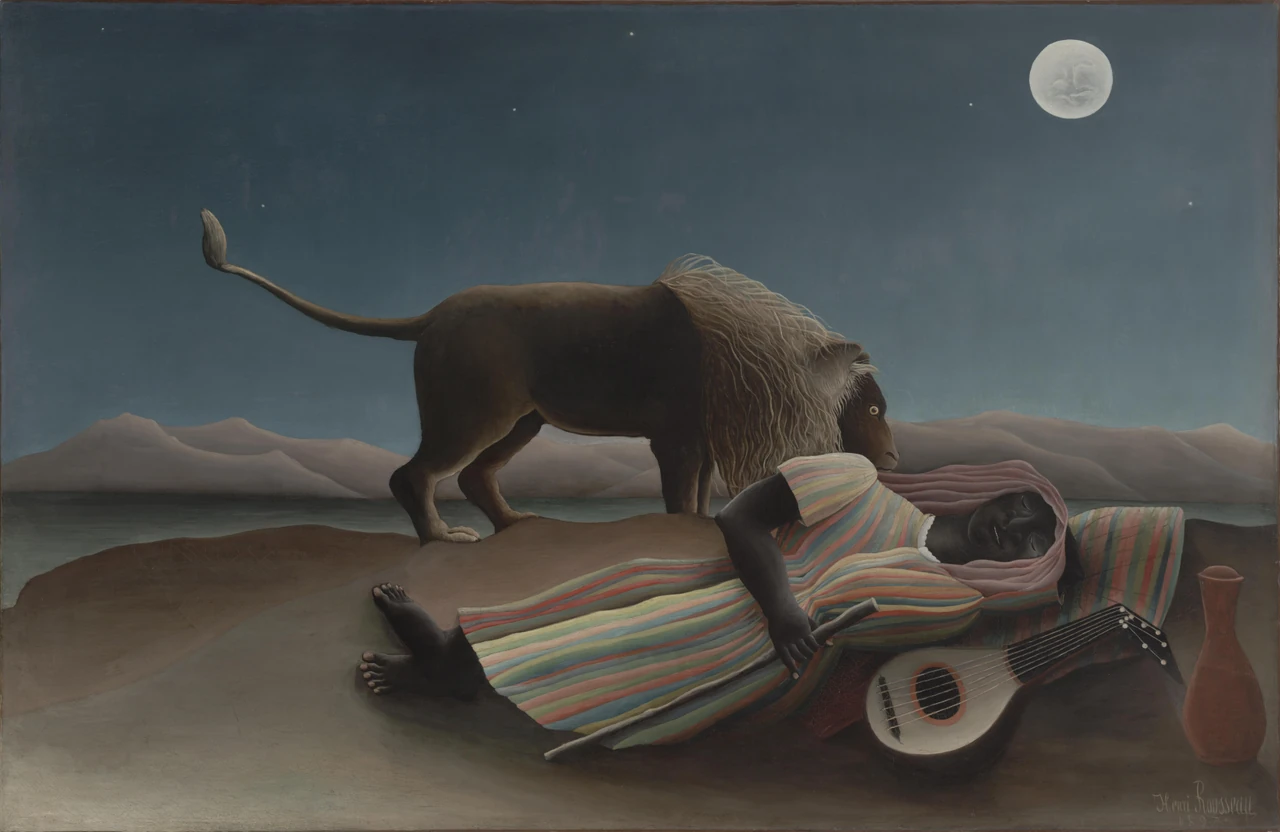

The lion has come close, but nothing in the still image tells us what will happen next. The sleeper’s closed eyes, the carefully striped garment and the instrument occupy the foreground with an almost display-like clarity. Behind them, a small moon hangs over a simplified landscape.
MoMA dates the canvas to 1897. The historical title is retained to identify the work, not used here as a description of a real person’s ethnicity. Nor does the scene give us grounds to claim that Rousseau witnessed such an encounter.
Compare its quiet contours with Van Gogh’s restless sky. Both pictures are intensely constructed, but Rousseau holds each shape apart. Night supplies suspense without visible action. The painting keeps us between two possible readings—danger and unexpected coexistence—rather than resolving either into a moral.
What to look for in another night scene
First locate the light, then follow what it does. It may reveal a shared view, dissolve a harbour, turn a room into geometry or gather a procession. Next look at the edges: sharp outlines and barely visible shapes make very different kinds of darkness.
Continue with the artist guides to Friedrich, Whistler, Van Gogh, Hiroshige and Rousseau. The Van Gogh collection offers a separate route into available designs; it is not a claim that every work discussed here is sold.
For choosing a reproduction for a room, use our separate night-scenes guide. Here, the reward is learning to see how much an artist can do when visibility becomes uncertain.
Editorial record
About this article
- Author
- Publisher
- GeMarkt
- Published
- Reviewed
- Internal source & rights check. Conducted by GeMarkt Research Review. This is an internal editorial check—not independent peer review.
- Source standard
- Art history source standardPrioritises object records and research sources, distinguishes evidence from interpretation, and states material uncertainty.
Found a claim that needs checking? Report a factual error.