Is Vincent van Gogh's art public domain? A collector's guide
Van Gogh died in 1890, making his work the clearest public-domain case in classic art. The ten-year career, the two copyright rules, and what that means for a print on your wall.
From the guide to the collection
Explore the Van Gogh collection → · Shop all art → · Free Van Gogh wallpapers — the complete paintings at 4K ↓
From the studioVan Gogh prints — 450+ restored works, curated and annotated →
A ten-year career that changed painting
Vincent van Gogh painted for barely a decade. He came to art late, after failed attempts at careers as an art dealer, a teacher, and a lay preacher, and only committed himself fully to painting around 1880. Between then and his death in July 1890, at the age of thirty-seven, he produced roughly nine hundred paintings and over a thousand drawings — an output so concentrated that entire museum wings are devoted to individual years of his life.
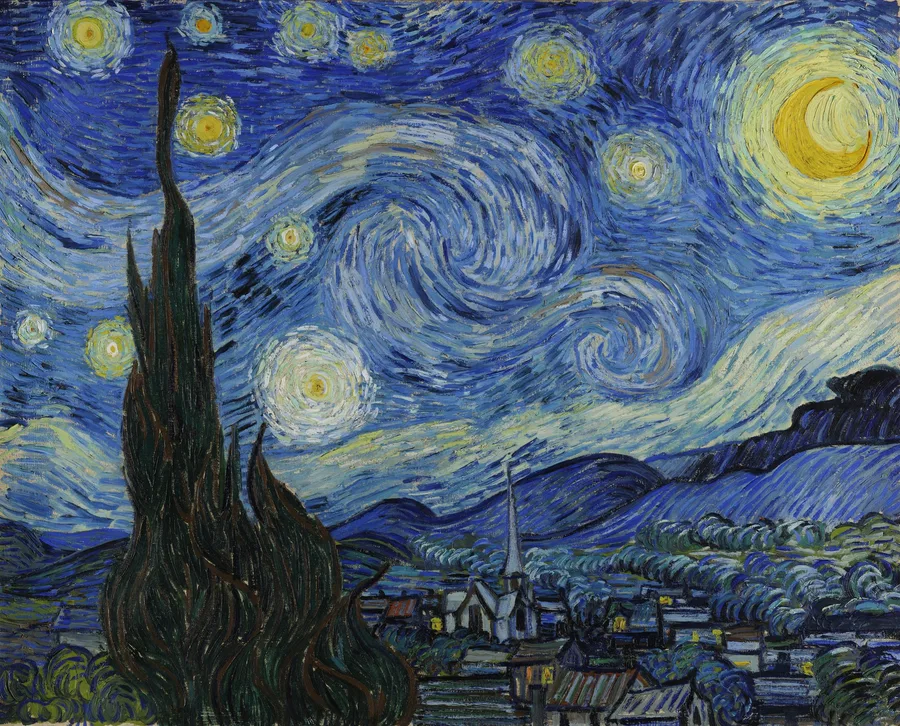
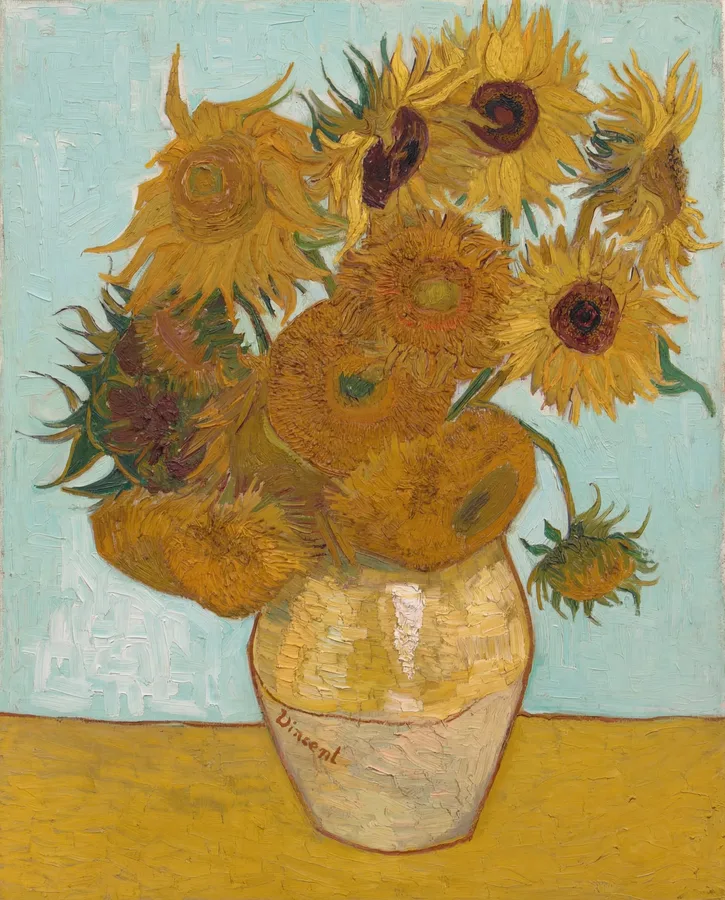
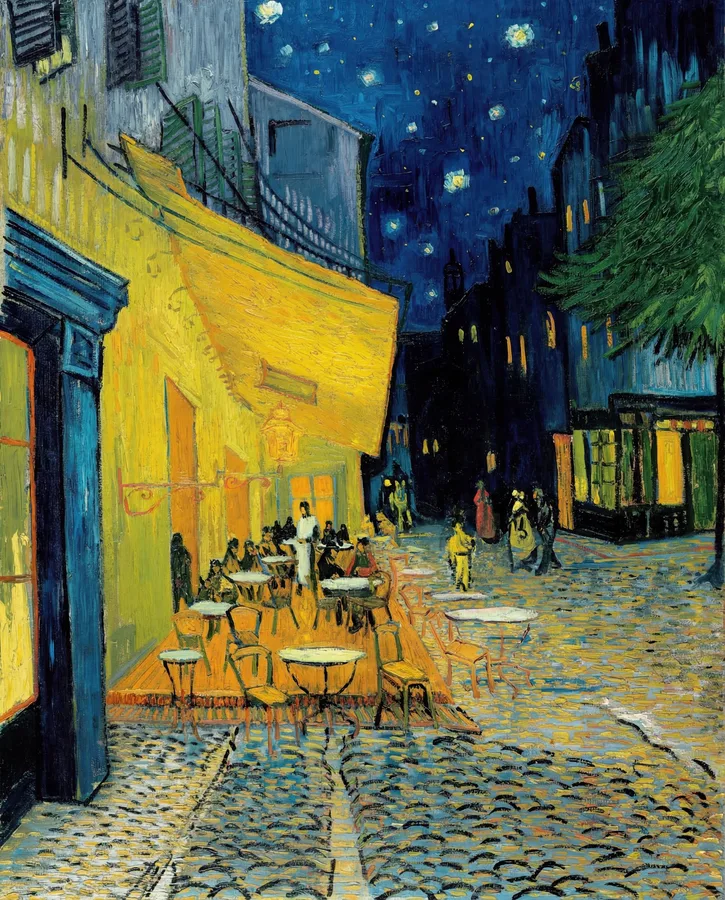
The work divides naturally into chapters. The early Dutch period is dark and earthbound, culminating in The Potato Eaters of 1885. Paris (1886–1888) brightened his palette through contact with the Impressionists and Japanese prints. Then came Arles, where in 1888 he painted the Sunflowers series and Café Terrace at Night (Place du Forum); the asylum at Saint-Rémy, where Irises and The Starry Night were painted in 1889; and finally Auvers-sur-Oise. One of his last serene works, Almond Blossom, was painted in February 1890 as a gift for his newborn nephew.
He sold almost nothing during his life. The fame arrived afterward, driven largely by his sister-in-law Johanna van Gogh-Bonger, who preserved the paintings and published his letters. Today he is arguably the most reproduced painter in history — which makes the question of who owns his images a practical one for anyone who wants his work on their wall.
Is Van Gogh’s art public domain?
Yes — and among the great painters, his is the clearest case there is.
Copyright in most of the world lasts for the life of the author plus seventy years. Van Gogh died in 1890, so under the life-plus-seventy rule his copyrights expired generations ago — by 1960 at the latest, and in many countries earlier under shorter historical terms. The United States uses a different system for older works, based on publication date rather than the artist’s death: works published more than ninety-five years ago have entered the public domain. Every painting in our Van Gogh collection dates from before 1890, which clears that bar by an enormous margin.
The result: Van Gogh’s paintings are in the public domain worldwide, under both major systems, with no edge cases to argue about. There is no estate holding rights, no country where the term is still running. Anyone may reproduce, adapt, print, and sell his work.
Two honest caveats. Copyright terms do vary by country, and a handful of jurisdictions apply unusual rules to specific situations — for an artist who died in 1890, none of them change the answer, but the principle is worth knowing when you look at more recent artists. And this page is general information about copyright terms, not legal advice; if you have a commercial question that depends on it, consult a lawyer in your jurisdiction.
“Public domain” is not the same as “every file is free”
This distinction trips up a lot of collectors. The painting — the artwork Van Gogh created — is public domain. A particular digital file of that painting is a separate question. Some museums and image libraries assert rights or contractual terms over their photographs of public-domain paintings, and while the legal strength of those claims varies from country to country, the practical point stands: the freedom attached to the artwork does not automatically attach to every reproduction of it floating around online.
That is why provenance of the file matters as much as the status of the painting. The restorations we sell are our own work, and we verify the rights status of every individual piece before it is listed — artwork and source both.
Van Gogh in our collection
Our Van Gogh collection is the largest in the shop: over 450 works, spanning the full arc from the Dutch years to Auvers. The icons are all here — The Starry Night, Café Terrace at Night, Almond Blossom, the Sunflowers, Irises — alongside the orchards, wheat fields, portraits, and drawings that rarely make it onto posters but reward a slower look.
Every piece is available in the same four formats: rolled poster, stretched canvas, framed canvas, and framed paper print. The rolled poster suits collectors who already have a framer they trust; the framed options arrive ready to hang.
If any painter belongs on the wall of someone who cares about where their images come from, it is the one whose entire body of work is unambiguously, globally free — restored with care and documented honestly. Browse the Van Gogh collection — twelve works chosen and annotated by the studio, and a door to the rest; with 450+ to choose from, the hard part is stopping at one.
Editorial record
About this article
- Publisher
- GeMarkt
- Published
Found a claim that needs checking? Report a factual error.