GeMarkt Blog · Essay
Expressionism and Der Blaue Reiter: Marc and Kandinsky
Eight works by Marc, Kandinsky, Jawlensky, Macke and Klee show how the Blue Rider circle changed colour, shape and the relationship between painting and reality.

A tiger becomes a knot of black curves. A dancer’s face seems almost white against a red costume. A boat survives as a few slanting strokes inside a painting that is mostly colour. These works do not share one subject or one technique, but they ask a related question: how much can an artist change appearances before a picture loses its connection with experience?
Expressionism offers several answers. It describes approaches that intensify or reshape what we see rather than treating accurate imitation as the final goal. A face can remain recognisable while its colour becomes startling. An animal can be simplified without turning into a symbol with one fixed meaning. Abstraction is one possibility, not a requirement.
Der Blaue Reiter—the Blue Rider—was a particular network within this much larger story. Its differences are as revealing as its similarities.
A circle, not one look
The Blue Rider took shape around Wassily Kandinsky and Franz Marc in Munich through exhibitions in 1911 and 1912 and an almanac published in 1912. It was not a school in which everyone learned to paint the same way. The Lenbachhaus’s account of the network stresses artistic exchange across national and disciplinary boundaries.
Gabriele Münter and Marianne von Werefkin belong in that account, not outside it as background figures. Jawlensky, Macke and Klee also had distinct practices and different relationships with its activities. “Blue Rider” is therefore a useful connection, but not a membership stamp we can apply to every Expressionist painting.
The eight works below follow five artists from recognisable animals and people towards less settled pictorial worlds. Two later Klee works extend the comparison beyond the original exhibitions; they are not presented as objects shown in those early events. For each image, begin with something visible—an edge, a face, a repeated mark—before attaching a theory to it.
Marc: an animal and its surroundings
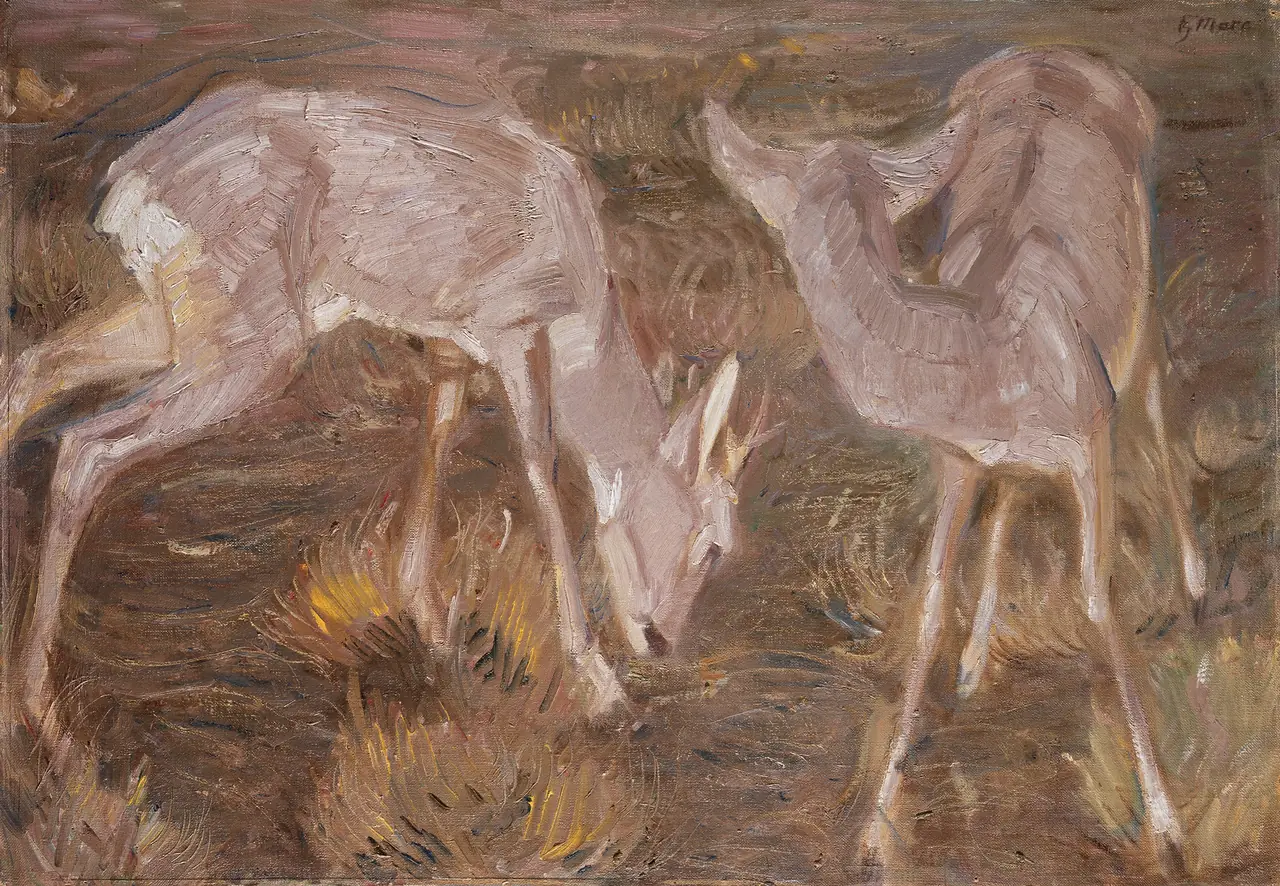
In Deer at Dusk, two pale bodies curve down into a loosely painted landscape. Their outlines remain easy to follow, but the ground is not a neutral stage. Mauve strokes and yellow tufts give it an activity of its own. The animals’ lowered heads make the scene feel absorbed rather than confrontational; that is a reading of the posture, not evidence of what either animal thinks.
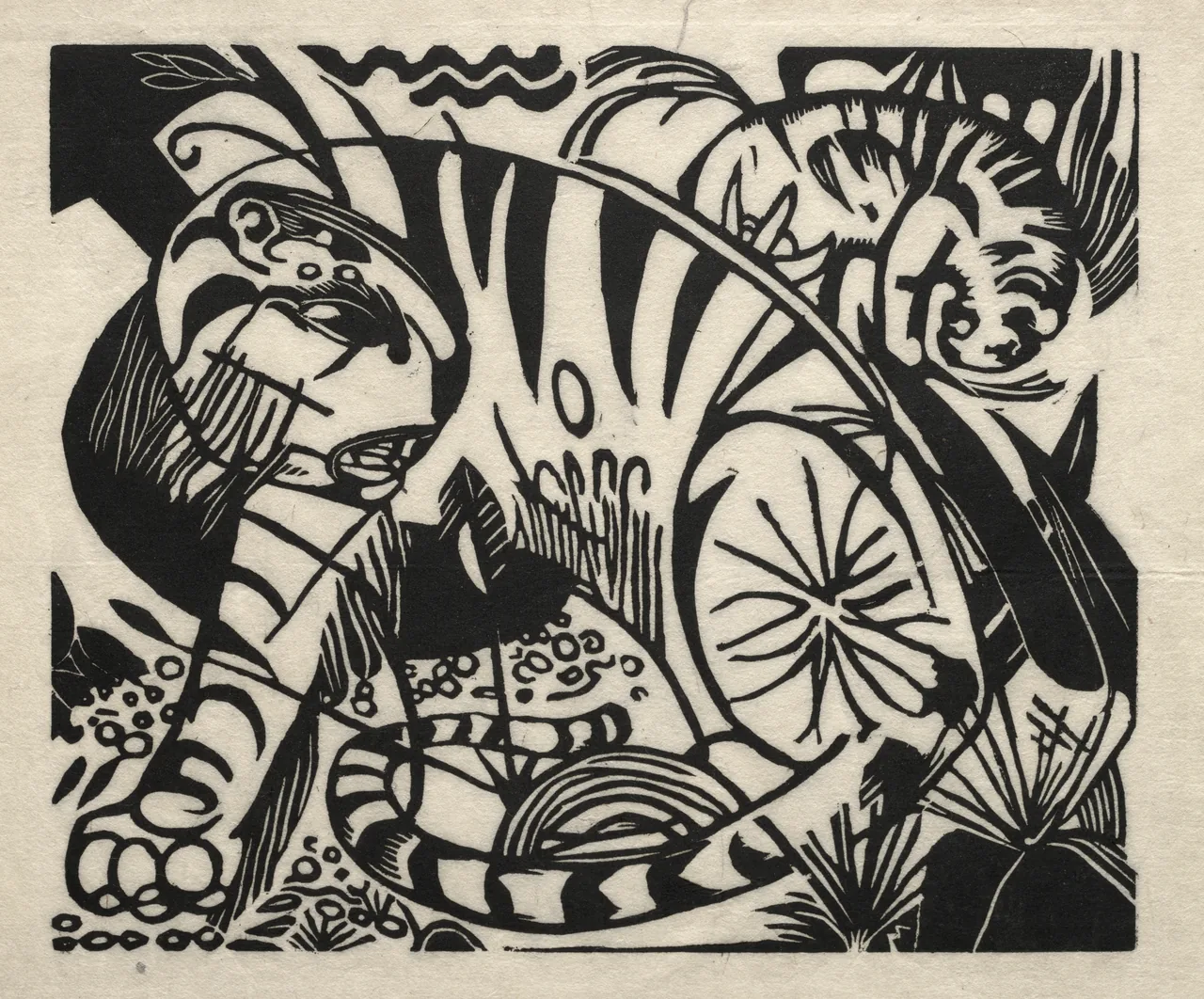
The 1912 woodcut Tiger makes a different kind of connection. Black stripes, leaves and bodily curves repeatedly interrupt one another. Follow a thick line and it can become difficult to decide whether you are tracing fur or vegetation. The print’s energy comes partly from these near-collisions.
This is the woodcut, not Marc’s similarly dated painting of a tiger. Comparing the two images here shows why medium matters: patches of paint make the deer’s environment permeable, while cut black-and-white shapes make the tiger’s surroundings lock together. Neither effect requires a realistic colour chart. The Marc guide provides a broader work-specific introduction.
Jawlensky: a face made for performance
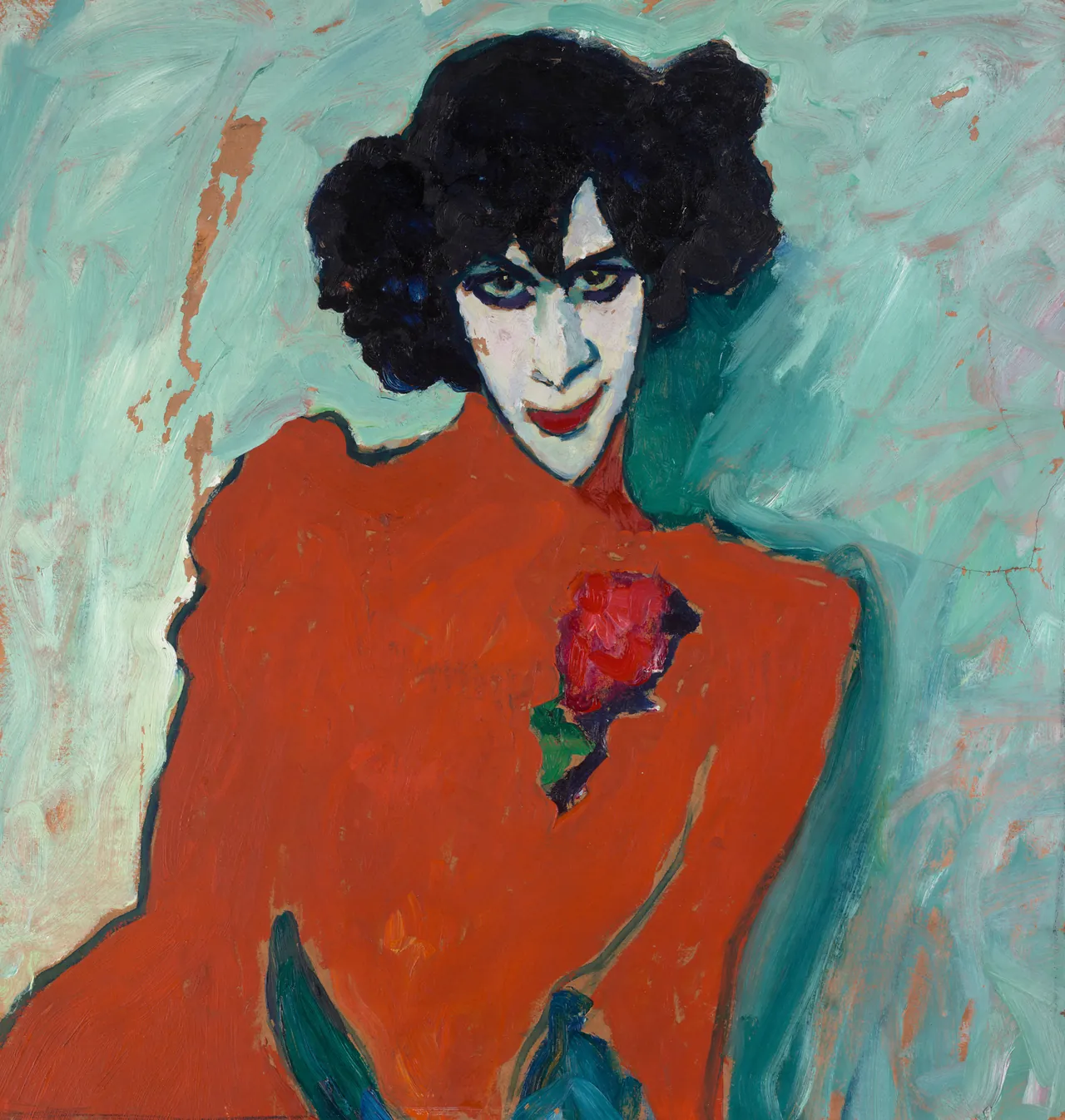
The Lenbachhaus identifies the sitter as the dancer Alexander Sacharoff, shown in costume and make-up. That context matters: the strongly marked eyes and red mouth are not simply evidence that Jawlensky abandoned observation. Performance had already transformed the face he was painting.
Look at how little the portrait needs to suggest volume. The red garment spreads as a broad shape, while the pale face catches the eye between black hair and a greenish background. A hand and flower supply concentrated details without turning the whole painting into a description of fabric and anatomy.
The result sits between the person, the performed appearance and the painter’s arrangement. Calling it “emotional” is not enough. The useful question is how the small, sharply marked face holds attention against those much larger colour areas.
Macke: colour organises an ordinary place
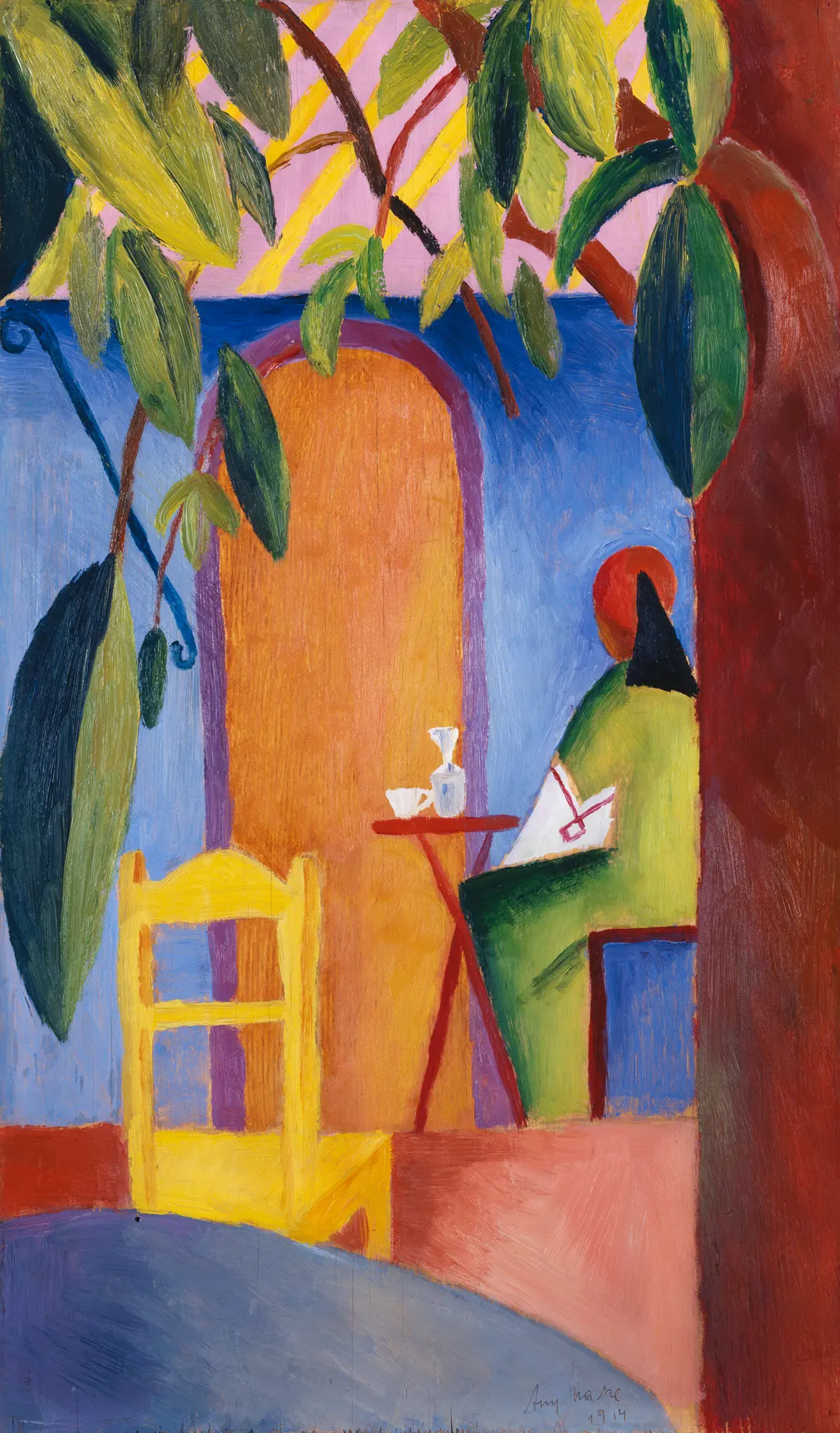
Macke’s title should not send us to the wrong country. The museum connects this café with his 1914 journey to Tunisia with Klee and Louis Moilliet. This is the Lenbachhaus version, completed after the trip, not a generic illustration of a “Turkish” interior.
The composition is unusually upright. A yellow chair holds the lower left, the seated figure occupies the right, and a blue wall and warm arch rise above them. Rather than softening these divisions, Macke makes them legible. The colours are vivid, yet the figure is quiet.
That contrast is a useful correction to the idea that Expressionist pictures must show anguish or agitation. Here, strong colour provides structure. The little table and its vessels keep the scene particular, while the larger shapes make an everyday pause feel almost architectural. The empty chair gives your eye somewhere to enter without needing to imagine an invented conversation.
Kandinsky: between an event and a colour experiment
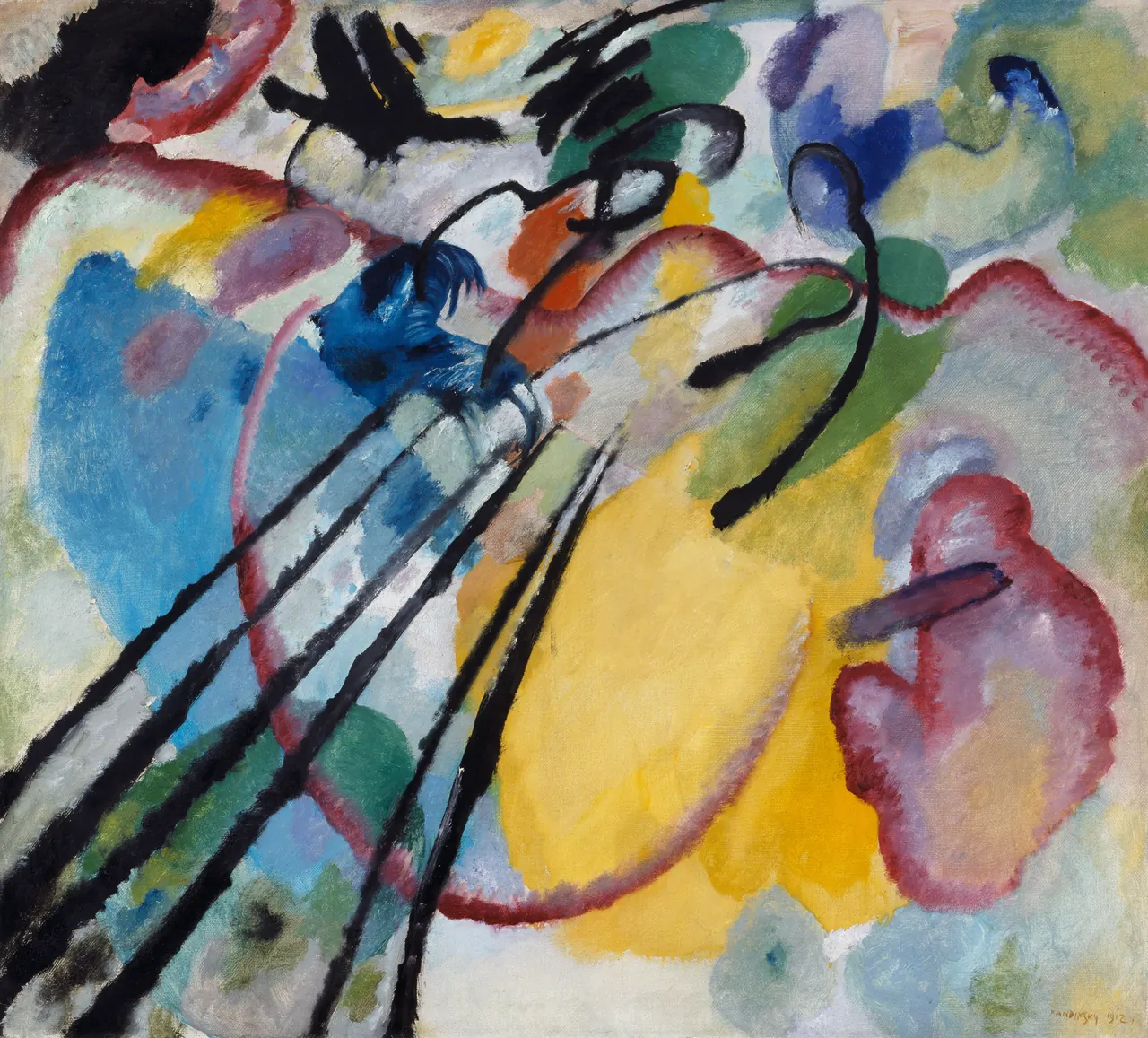
The parenthetical title of Improvisation 26 (Rowing) offers a foothold. Long diagonal strokes can begin to read as oars; clustered marks can suggest people. Yet identification does not exhaust the painting. Those diagonals also cut through coloured areas that refuse to settle into ordinary water, shore and sky.
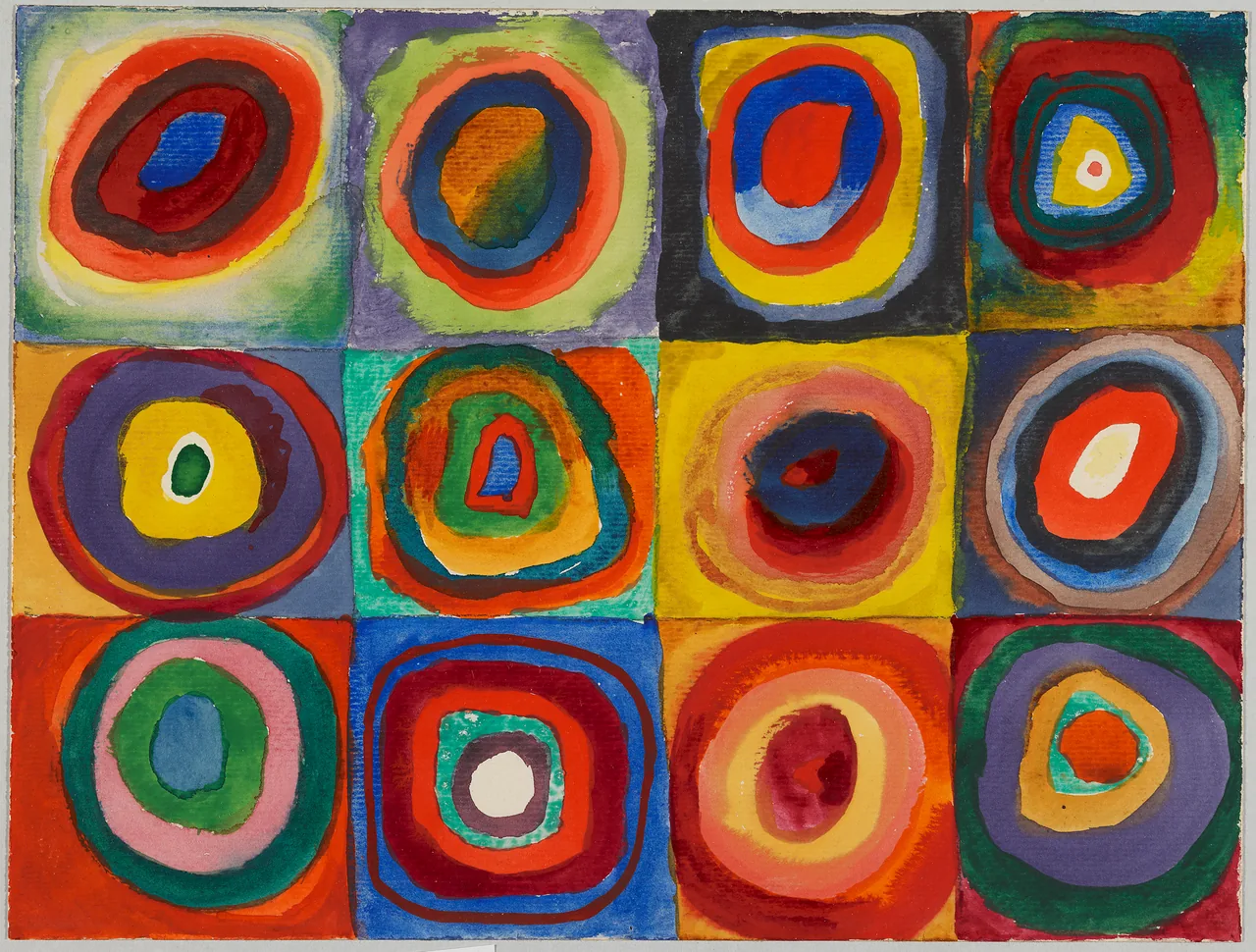
In the Colour Study, repetition makes a different kind of looking possible. Compare a pale ring against dark blue with a similar pale ring against red. Their neighbours change how forcefully they register. Uneven edges preserve the sense of an experiment made by hand, not a finished chart of universal emotional meanings.
One image leaves traces of an event; the other sets up repeated conditions for comparing colour. They show two routes away from straightforward depiction, rather than one abrupt moment when Kandinsky stopped seeing the world. Our Kandinsky guide distinguishes individual works and their sources.
Klee: after the first exhibitions
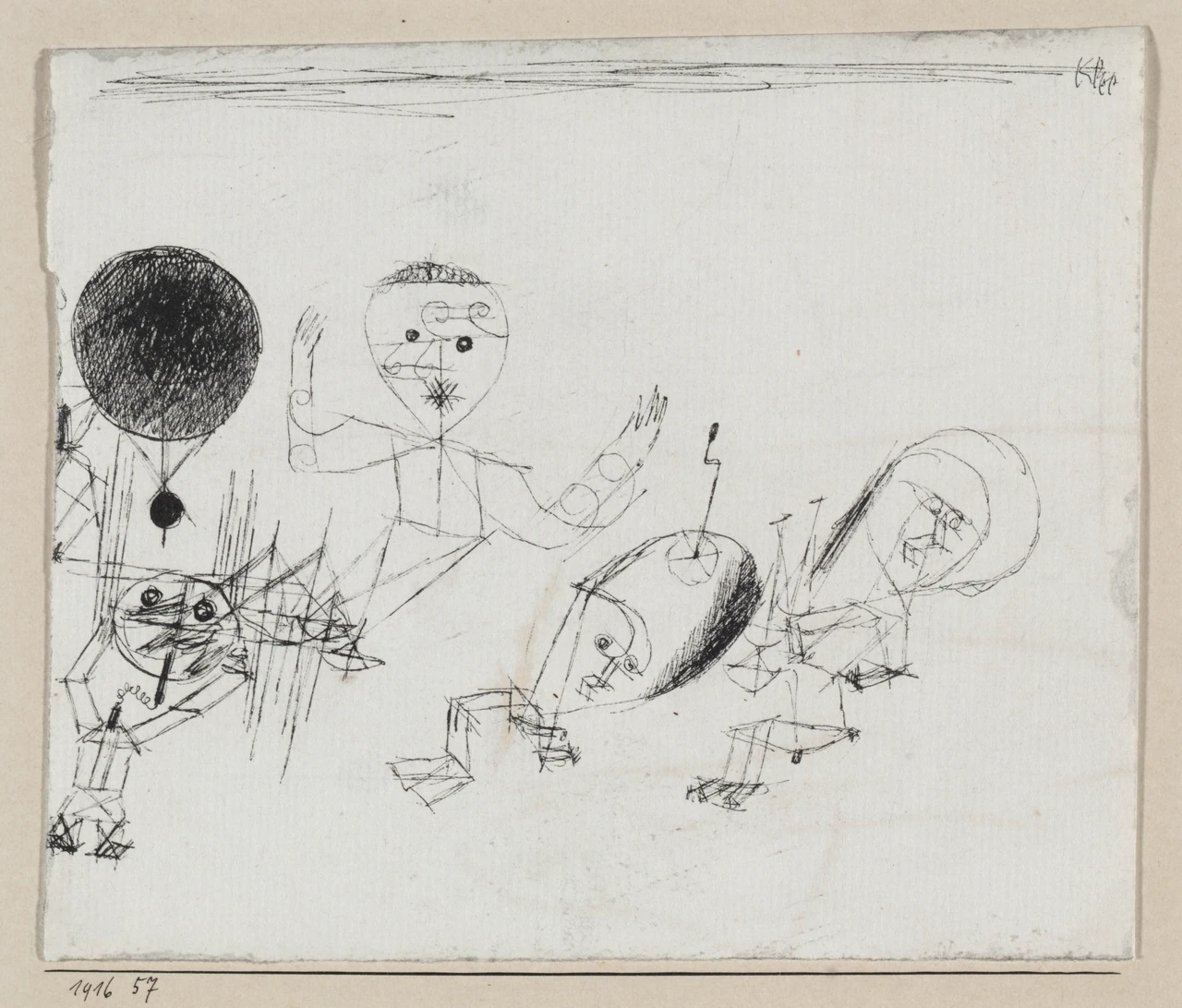
Klee complicates a story told only through brilliant paint. With the Dot uses economical black lines to build an unstable world. The museum reads its hovering creature and fallen figure in relation to the First World War. Even before that context, the imbalance between the heavy circle and fragile bodies creates tension.
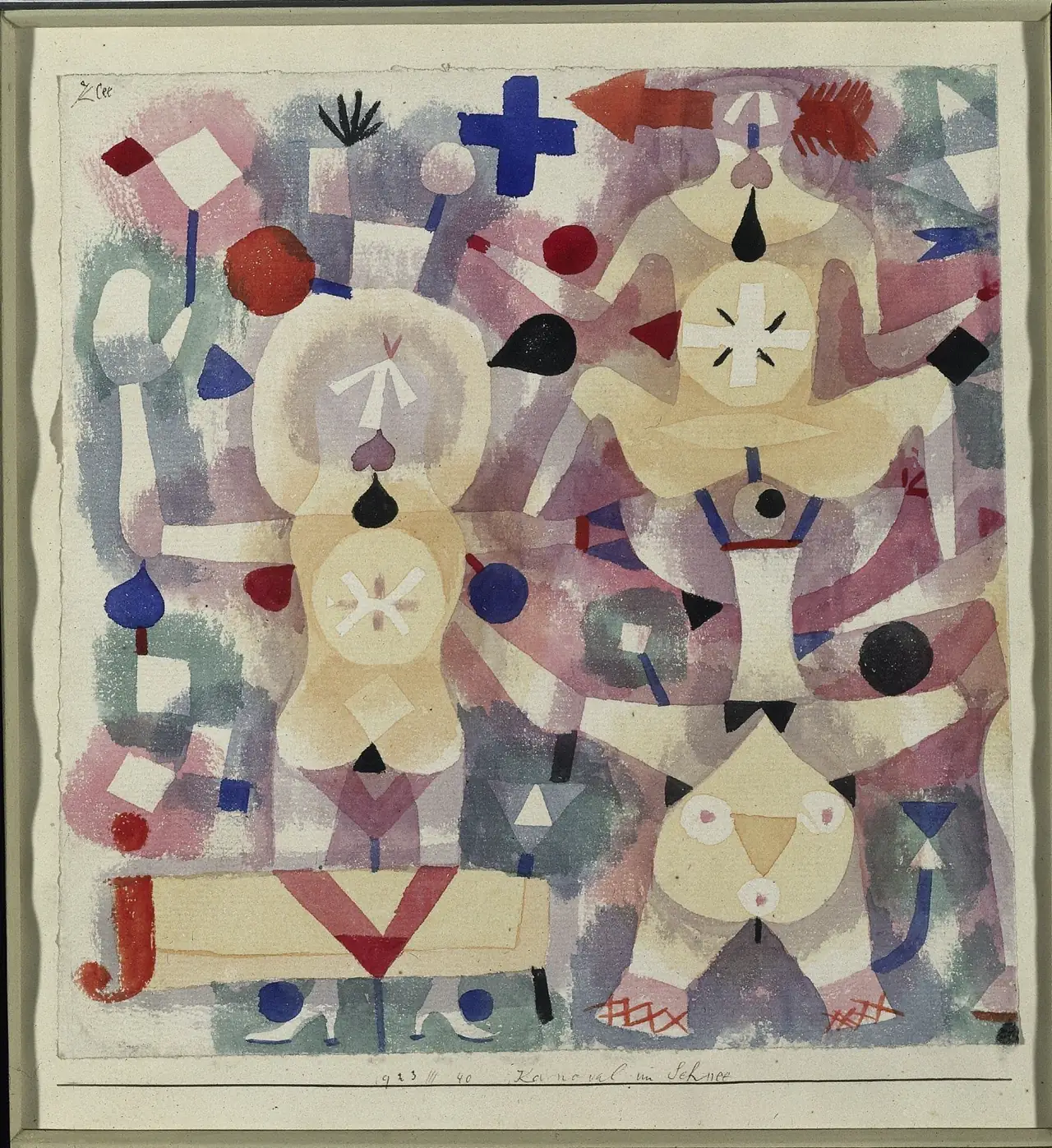
Seven years later, Carnival in the Snow lets figures emerge from intersecting colour and geometry. Heads, limbs and patches do not all stay separate. A viewer can switch between seeing performers and seeing the shapes that assemble them.
These are later developments, not evidence that every Blue Rider participant shared the same wartime experience or theory. They demonstrate how long the problem of transforming appearances remained productive. The Klee guide and Kandinsky–Klee comparison offer further ways into that difference.
What to look for next
Start with the connection between shape and subject. Does colour describe local appearance, organise the surface, or do both? Do outlines hold objects apart or make them merge? Is an identifiable person performing a role, or is a figure only just becoming visible?
Those questions are more useful than treating bright colour as an automatic Expressionist label. They also leave room for quietness, humour and close observation. These artists did not all replace the outside world with the same “inner” one. They found different ways to make a picture carry more than a literal description.
For art to live with, the collections directory is a separate browsing route, not a claim that every work above is offered as a print. A movement label also says nothing by itself about permission to reproduce an individual artwork or photograph.
Editorial record
About this article
- Author
- Publisher
- GeMarkt
- Published
- Reviewed
- Internal source & rights check. Conducted by GeMarkt Research Review. This is an internal editorial check—not independent peer review.
- Source standard
- Art history source standardPrioritises object records and research sources, distinguishes evidence from interpretation, and states material uncertainty.
Found a claim that needs checking? Report a factual error.