GeMarkt Blog · Essay
Art Nouveau vs Art Deco: Look Beyond Curves and Angles
Compare Tiffany with Lalique and Vienna’s Secession building with the Chrysler tower to understand Art Nouveau and Art Deco beyond a simple shape test.

Art Nouveau and Art Deco are different, but “curves versus angles” is only a rough starting point. Art Nouveau is associated with turn-of-the-century design that often makes natural forms and flowing lines part of an object’s structure. Art Deco belongs mainly to the following decades, with a wide range of stylised, geometric and streamlined forms. Neither description fits every object equally well.
Two comparisons make the overlap easier to see: Tiffany and Lalique glass, then an exhibition building in Vienna and an office tower in New York. All four use curves. All four organise ornament carefully. The revealing difference is what those shapes do—not simply whether they are present.
A useful timeline, not a changeover date
The Met places Art Nouveau’s development between the 1880s and the First World War. The V&A gives Art Deco a broad span of roughly 1910–1940. These are useful historical frames, not expiry dates for individual designers. They overlap because people did not stop making one kind of object when a new label became convenient.
The famous Paris exhibition of 1925 is a landmark in Art Deco’s story, not proof that the style began that year. In its account of furniture designer Ruhlmann, the Met identifies work in his distinctive luxury idiom by 1913 and explains the later exhibition’s connection with the name. A pre-1925 object can therefore belong in the discussion.
Dates also distinguish an original from a revival. A newly made lamp borrowing a 1900 vocabulary is not an antique simply because its stem bends like a plant. The visual resemblance is real; the historical claim still needs evidence.
Tiffany and Lalique: nature did not disappear
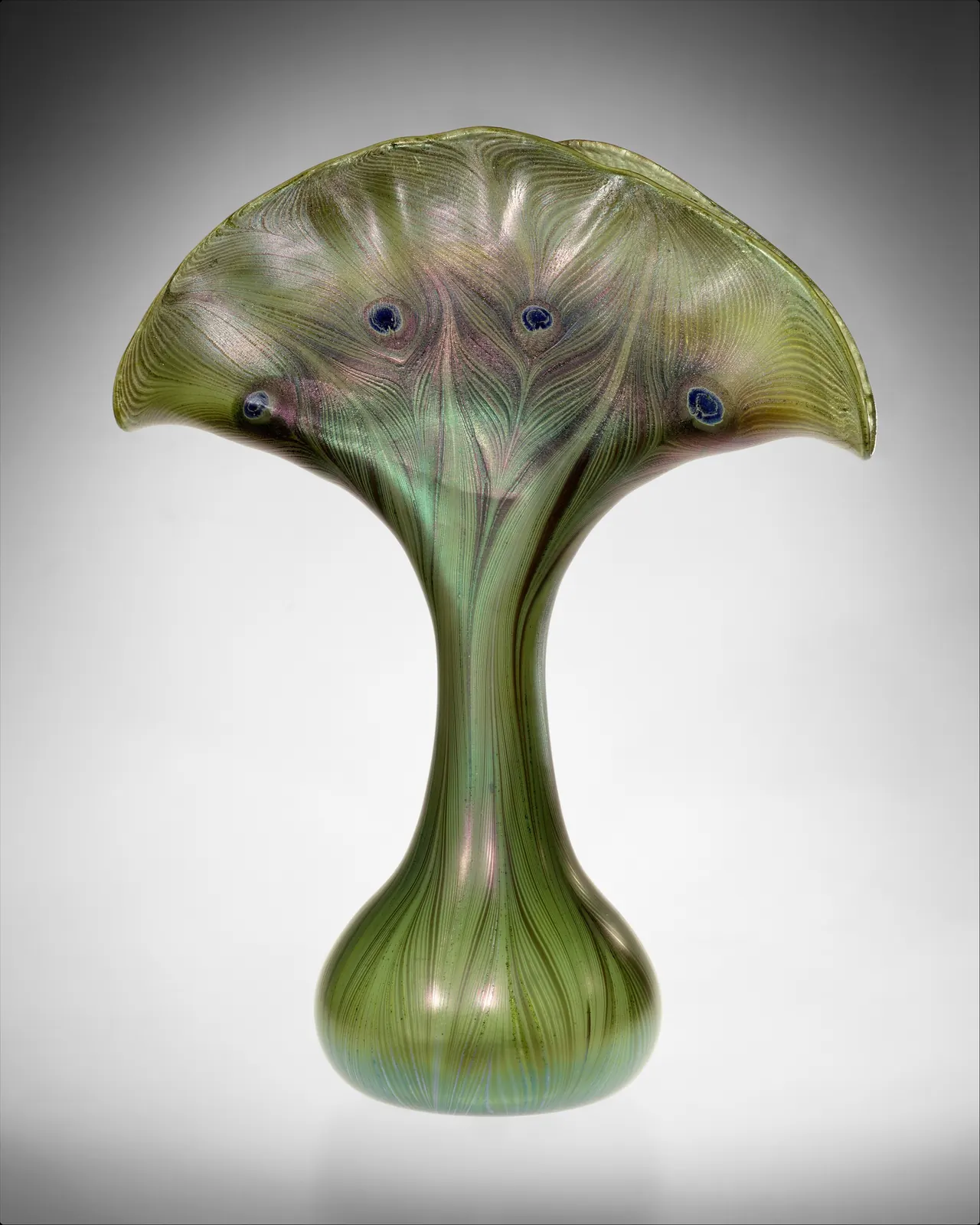
The feather-like markings on Tiffany’s vase spread outward with its fan-shaped top. Colour and outline reinforce each other: narrow streaks rise through the stem, then open across the broad upper surface. The blue eye-like spots punctuate that expansion. Nature is not merely a picture placed on a conventional cylinder; it helps us read the entire shape.
The Met dates this particular Favrile vase to 1893–96. Its record also connects Tiffany’s glass forms and finishes with both nature and ancient glass. The photograph shows one museum object, not a claim that every vessel attributed to Tiffany has the same appearance or provenance.
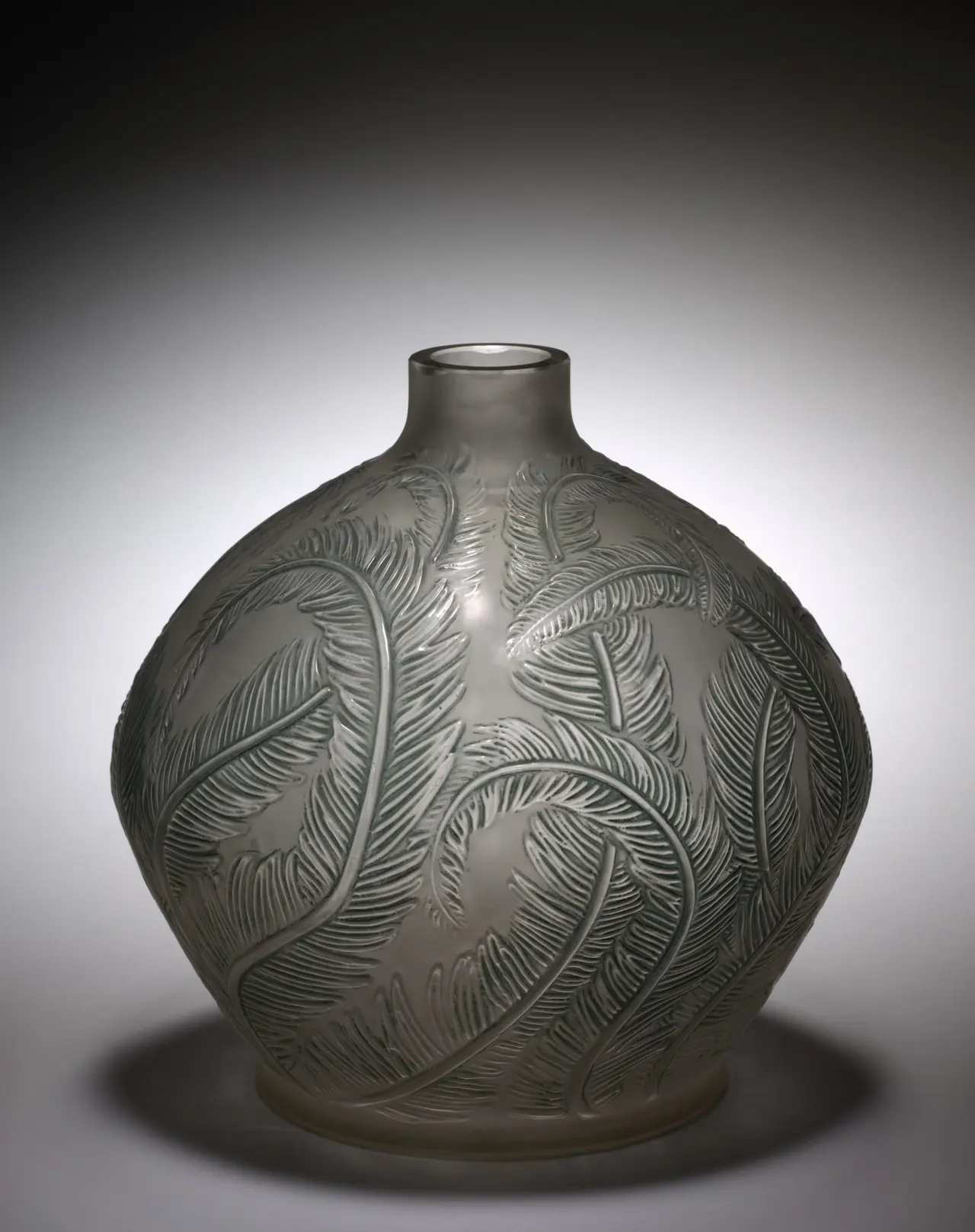
Lalique’s Plumes still uses feathers. Here, however, they curve across a broadly rounded body whose short neck and base remain clearly defined. Light picks out the relief; the motif does not open the silhouette into a fan. Look at the difference between a pattern guiding the outer edge and a pattern moving over a stable volume.
The Cleveland museum dates this vase to 1920. Lalique himself crosses the supposedly hard boundary: the V&A describes his move from Art Nouveau jewellery into Art Deco glass production. That career makes a stronger comparison than an invented rule that Deco abandoned plants and animals. These two photographs are not to scale, and their different lighting should not be mistaken for a controlled comparison of glass finishes.
Vienna and New York: two kinds of architectural emphasis



Olbrich’s building belongs to the Viennese context of Art Nouveau, but rectangles and repeated squares are already prominent. The plants run up flat sections of wall rather than concealing the windows. Across the top, horizontal bands restrain the decoration. This view is a useful corrective to the idea that all design before Deco was an uninterrupted tangle.
The NGV identifies the 1898 exhibition building with the Secession’s interest in new art and designed environments. It is not an early skyscraper, so the comparison does not imply that it solved the same architectural problem as the Chrysler Building.
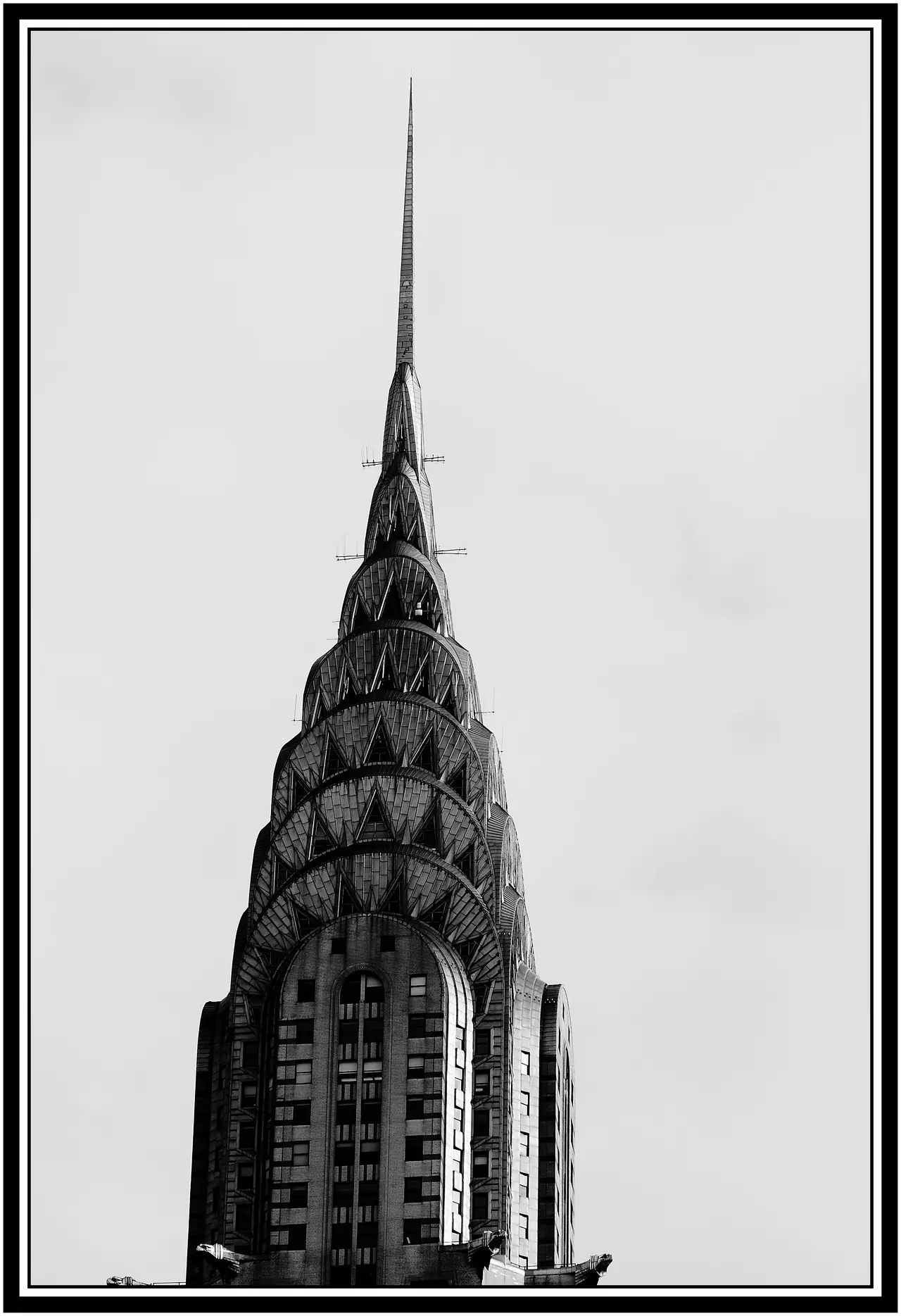
On the New York tower, arches rise in diminishing stages towards the spire. Triangular windows sit within those curves; repeated lines direct attention upward. The city’s landmark designation identifies William Van Alen’s 1928–1930 building as Art Deco and describes the steel arches and triangular openings. Geometry here produces a highly recognisable crown rather than eliminating ornament.
Both photographs show selected exterior views taken long after construction. One is in colour and the other monochrome; neither supplies an original colour chart. Compare the arrangement of openings and repeated forms, not the impression that one historical period was pale and the other black-and-white. The photographer’s border around the Chrysler image is also not part of the architecture.
Handmade and machine-made is another false shortcut
It is tempting to place Art Nouveau on the side of craft and Deco on the side of machines. That distinction is too neat. The Met’s Ruhlmann exhibition emphasises costly materials and skilled furniture production within French Art Deco. A geometric outline did not necessarily make something cheap or quick to produce.
At the same time, the V&A describes American streamlining through rounded shells, manufacturing and consumer goods. Those aerodynamic curves belong inside the wider Deco story. They also show why the sharp-edged skyscraper cannot stand for every object of the period.
Ask what the object is made from and how it was produced before making a social claim about it. A photograph may reveal joints, relief or repeated components, but it does not establish manufacturing cost, edition size or the amount of hand finishing. Those need a record, not a stylistic guess.
How to read an unfamiliar object
First look at the overall silhouette without trying to name the style. Does the outline seem to unfold, swell, taper, step or repeat? Then move inward: does ornament continue that movement or sit within a separate panel? Tiffany’s fan and Lalique’s rounded body give different answers while sharing a natural motif.
Next find a reliable maker, place and date. “Vintage” alone tells you very little. Distinguish the date of a design from the date of an individual object, later edition or photograph. A museum’s accession number helps keep those details tied to the example you are actually seeing.
Finally, test your first impression against another work. If your definition of Deco excludes Lalique because it has feathers, the definition is too narrow. If your definition of Nouveau excludes the straight windows in Vienna, it needs adjusting too. Exceptions are not nuisances here; they make the comparison more accurate.
Choosing images without inventing a period room
For a wall, you do not need to reconstruct a complete historical interior. You might prefer the strong enclosed shape of the Lalique photograph or the expanding silhouette of the Tiffany vase. Those are useful visual preferences even when both objects contain organic ornament.
When combining images, compare their density and direction rather than relying only on a style label. A busy outline may work beside a quieter surface; two images full of competing small details may need more space. These are suggestions to test with your own room, not historical rules. The Art Nouveau guide offers further examples across different media.
Art Deco is not a copyright status
Neither “all Art Deco is copyrighted” nor “it is old, so it is free” is a dependable answer. The U.S. Copyright Office explains that duration depends on several factors; for older works, publication history can matter. A making date alone does not settle that history, and another country can apply different rules.
The exact digital file matters too. Cleveland releases the selected Plumes image through its CC0 open-access programme; the two modern building photographs carry the photographers’ specified licences. Those permissions do not establish a movement-wide right to reuse any picture found online. Keep the work, the file and the intended use separate—and use the comparison to sharpen your looking, not to shortcut that check.
Editorial record
About this article
- Author
- Publisher
- GeMarkt
- Published
- Reviewed
- Internal source & rights check. Conducted by GeMarkt Research Review. This is an internal editorial check—not independent peer review.
- Source standard
- Art history source standardPrioritises object records and research sources, distinguishes evidence from interpretation, and states material uncertainty.
Found a claim that needs checking? Report a factual error.