GeMarkt Blog · Essay
Impressionism: The Painters Who Chased Light
Recognise Impressionism through eight paintings: broken colour, modern streets, everyday work and the very different styles of seven artists.

Impressionism is a way of painting modern life in which light, colour and visible brushstrokes often matter more than a polished outline. But it is also the story of artists who exhibited independently in nineteenth-century Paris. A sunny landscape is only one part of that story. A ballet lesson, a rainy street and a child having a bath belong here too.
Start with the eight paintings below. Beside each image is one thing to look for, explained in ordinary language. The observations are our readings of the pictures; the linked museum records identify the actual objects, dates and sources. You do not need to memorise a list of movements before you can enjoy them.
What Impressionism means
In 1874, artists organised their own exhibition in Paris outside the official Salon system. The group held eight exhibitions through 1886, with changing participants rather than a fixed membership. Monet’s Impression, Sunrise supplied the name that a critic initially used disparagingly. The Metropolitan Museum’s introduction explains this history and the group’s different approaches.
That difference matters. The artists were not following one instruction to make everything look blurry. Some used loose colour; others kept firm drawing. Subjects could be private or public, rural or urban. The paintings chosen here include work made before the first exhibition and after the last: the exhibition dates are not a fence around everything these artists painted.
How to recognise it without a checklist trap
Look at a small area first. Can you see separate touches of paint instead of a smooth blend? Then step back: do those touches become rippling water, fabric or leaves? This is what people mean by broken colour—neighbouring marks remain visible while helping describe a larger form.
Next, look at the whole scene. Is ordinary contemporary life treated as worth a large painting? Does an edge cut off a person or object, making the view feel like a moment within a wider world? These are useful clues, not tests that every work must pass. Caillebotte’s crisp street below is the clearest warning against identifying Impressionism by brushwork alone. Nor does a spontaneous-looking picture prove that it was painted quickly or entirely outdoors.
Monet: a white dress full of colour
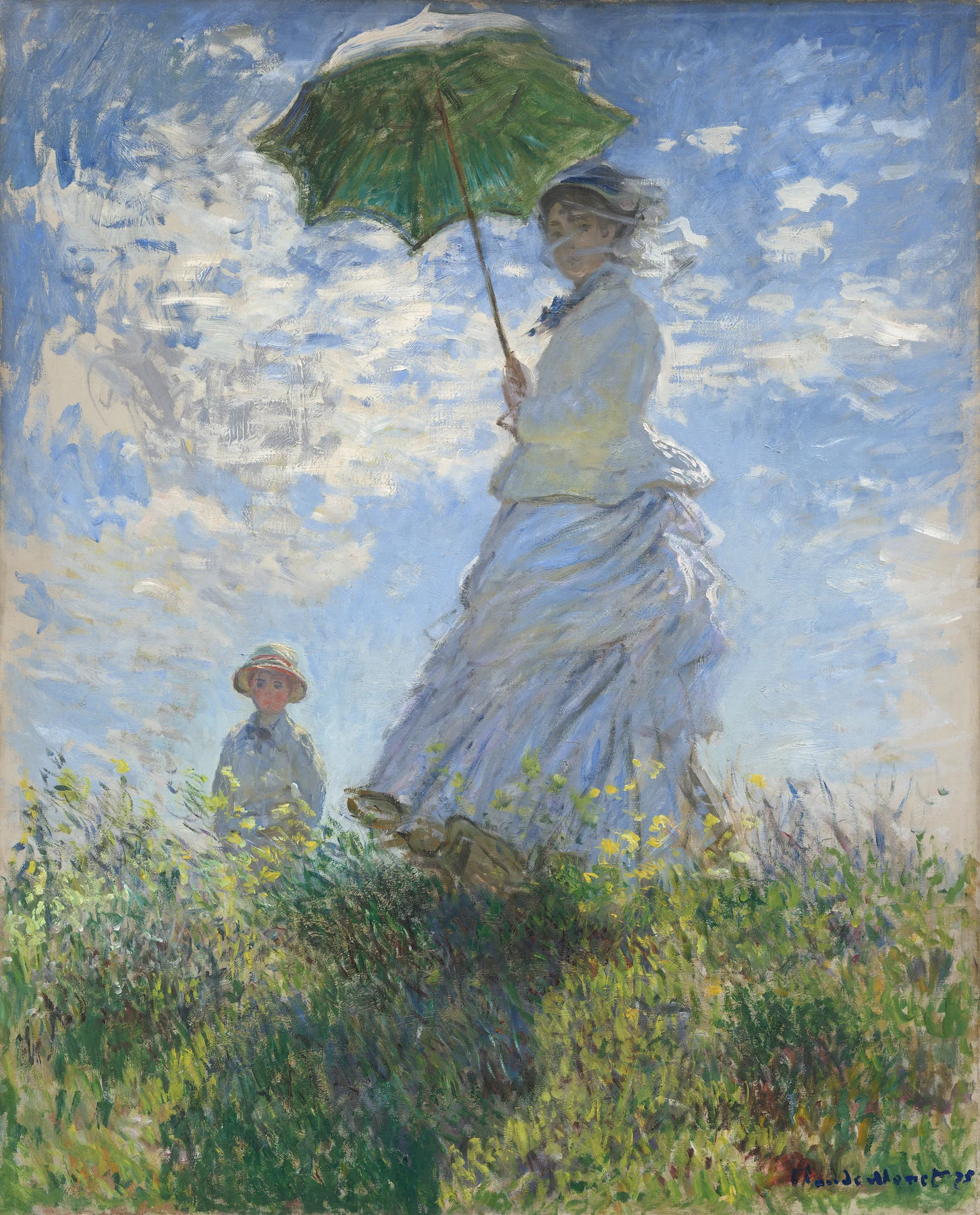
Camille’s dress reads as white, but its folds contain blue-grey shadows and warm reflected colour. The grass, clouds and veil move in different directions; together they give the day its windy character. The NGA records that Monet made this painting in a single outdoor session. Here, quick working has specific documentary support—it should not become a claim about every Impressionist canvas.
Look for: how the sky and dress share colours even though one is air and the other fabric. Light connects the figure to her surroundings.
Renoir: water that will not stay still
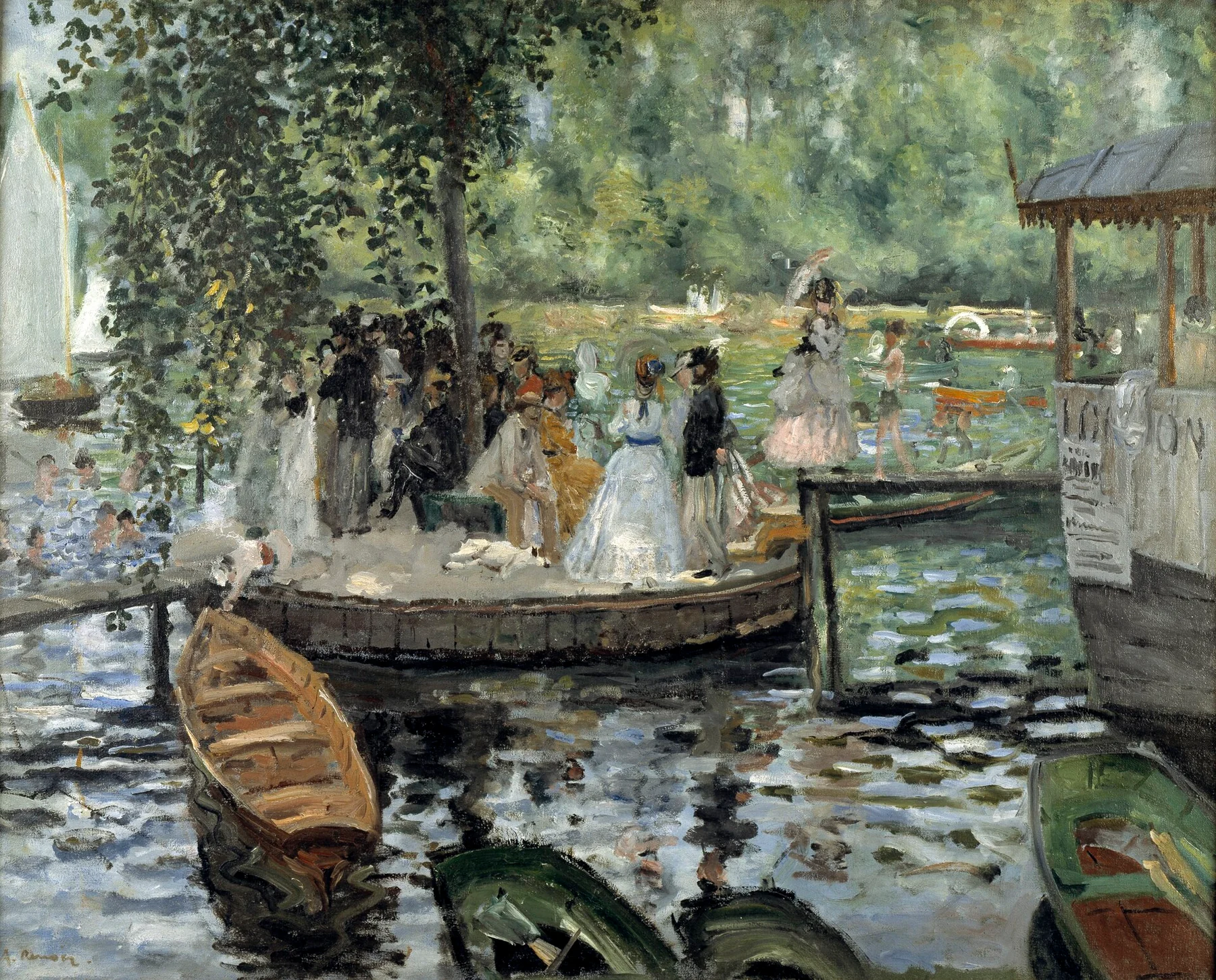
The island of people is quite compact; the water beneath it is busy with scattered dark and light marks. Try following one reflection. Instead of becoming an unbroken vertical stripe, it breaks apart across the surface. Renoir makes the river feel restless without outlining every ripple. The scene also joins leisure to landscape: boats, fashionable clothes and a gathering place are part of the view, not distractions from nature.
Look for: the contrast between the little social stage in the middle and the fluid surface surrounding it.
Degas: the work behind the performance
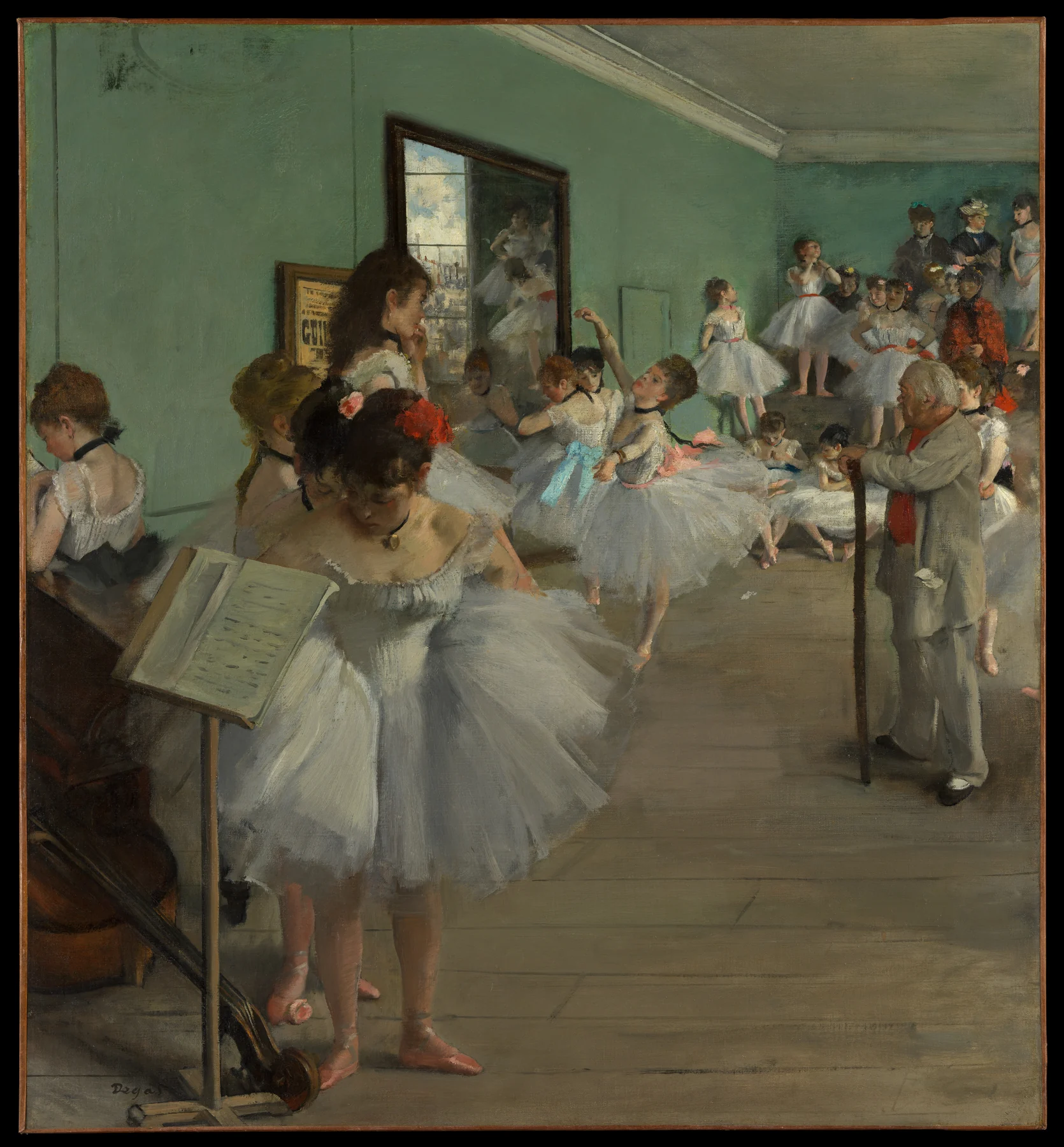
Not everyone is dancing. Some figures wait, lean or adjust themselves. The open floor leads our eye towards the back of the room, while nearby bodies feel abruptly close. This is a useful correction to the idea that Impressionism means gardens painted in sunlight: Degas makes indoor training and waiting into a subject. What looks like an informal glimpse is also a carefully organised arrangement of space.
Look for: the large empty floor. It helps the crowded room breathe and gives individual gestures more force.
Morisot: a room built from light touches
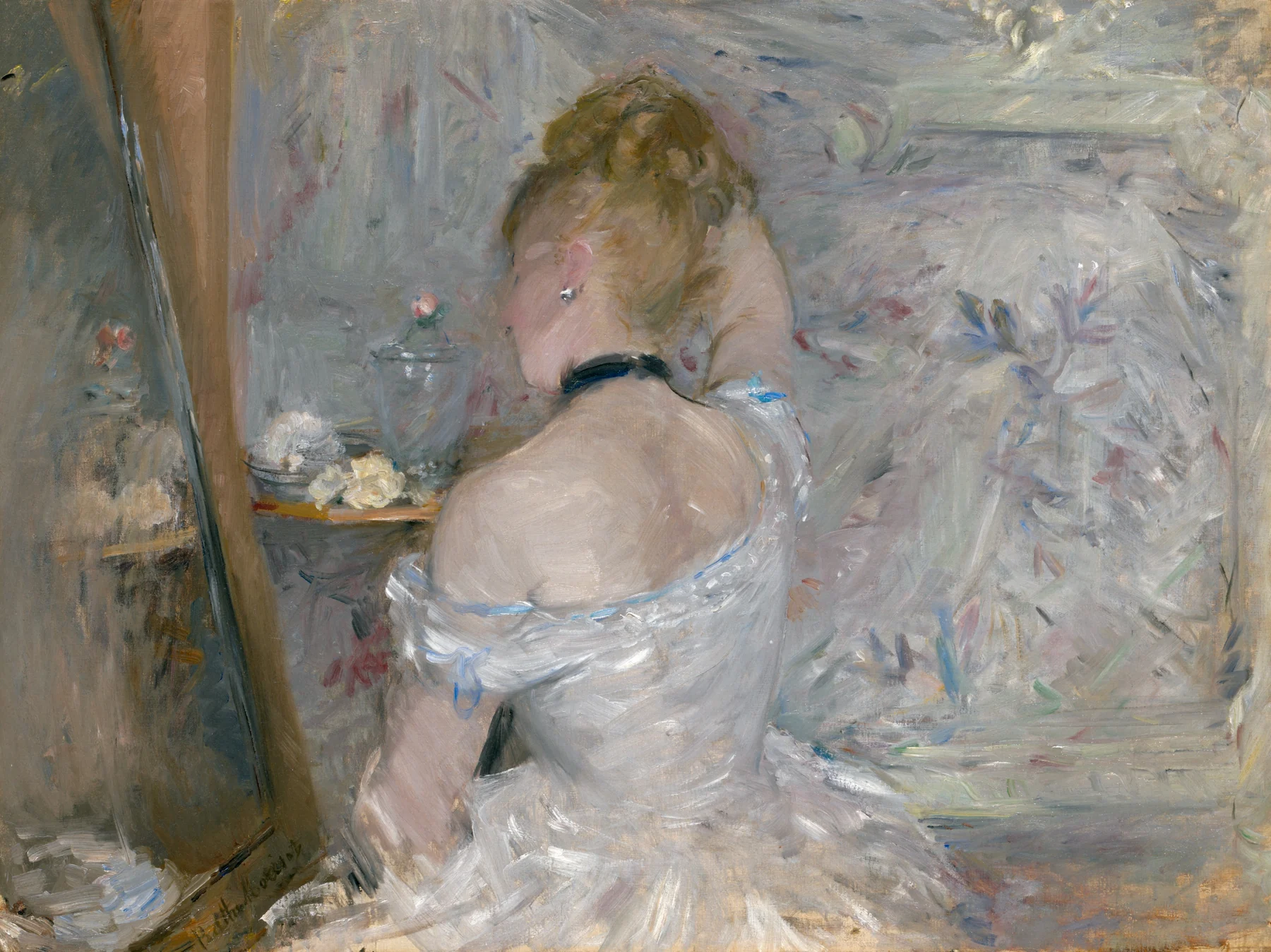
Here toilette means dressing or grooming. The woman’s shoulder is more firmly described than much of the surrounding room. You can identify fabric, reflection and furnishings without every edge closing neatly. Pale colours pass between the body and its setting, so the room seems to gather around the gesture of a raised hand. This is selective description, not a picture waiting to be finished.
Look for: which details stay clear and which dissolve. The painter decides where your attention will settle.
Caillebotte: clear lines and an uncertain meeting
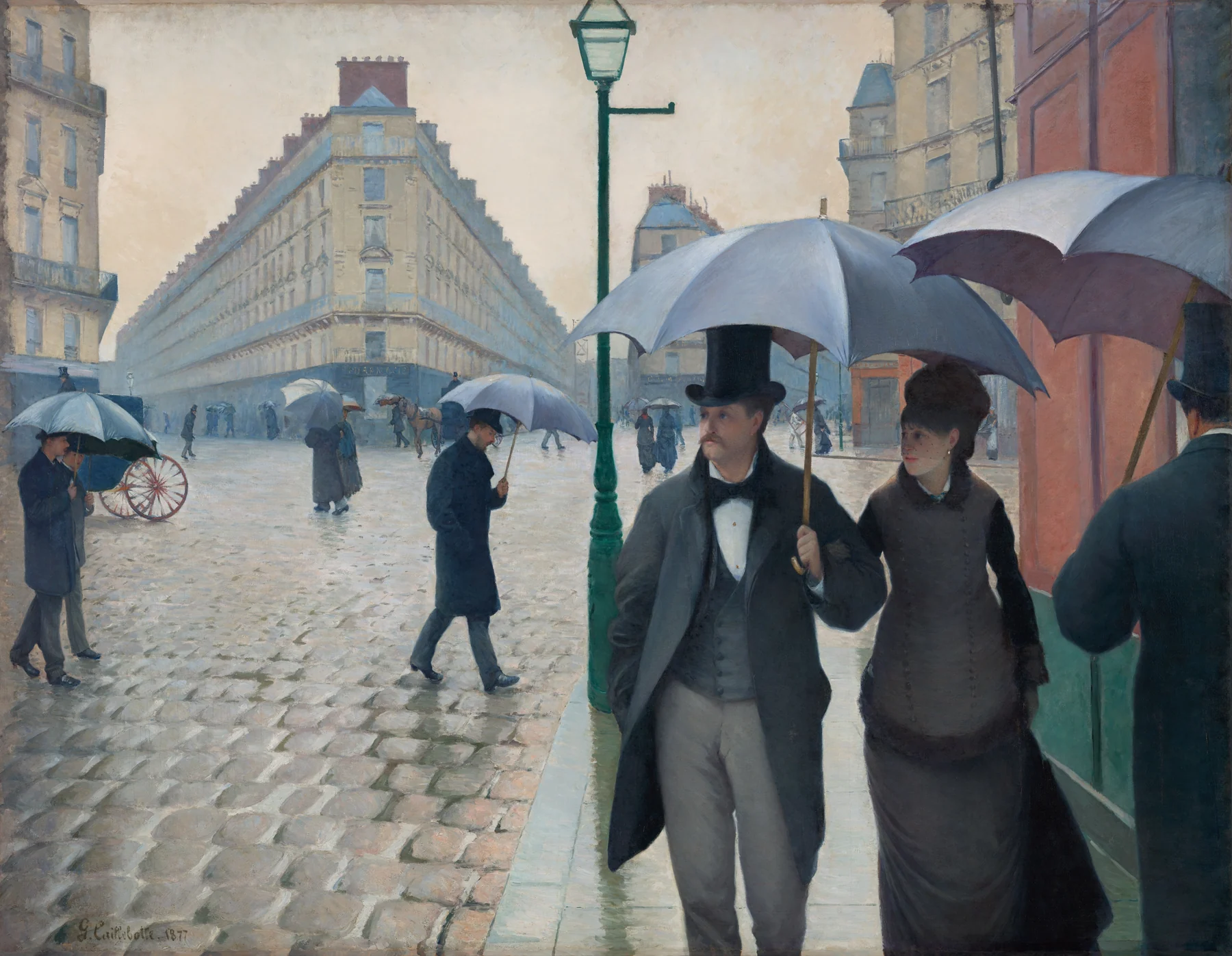
The paving and buildings have much firmer outlines than Renoir’s river. Yet the subject is a passing encounter on a modern street, with a figure cut by the right edge. The museum’s exhibition history places it in the third Impressionist exhibition in 1877. Loose paint is therefore not a membership requirement. Caillebotte uses precise perspective to make an ordinary walk feel monumental and slightly uneasy.
Look for: the lamppost dividing the picture, and the uncertain space through which the approaching pedestrians must pass.
Monet: a bridge in a changing river
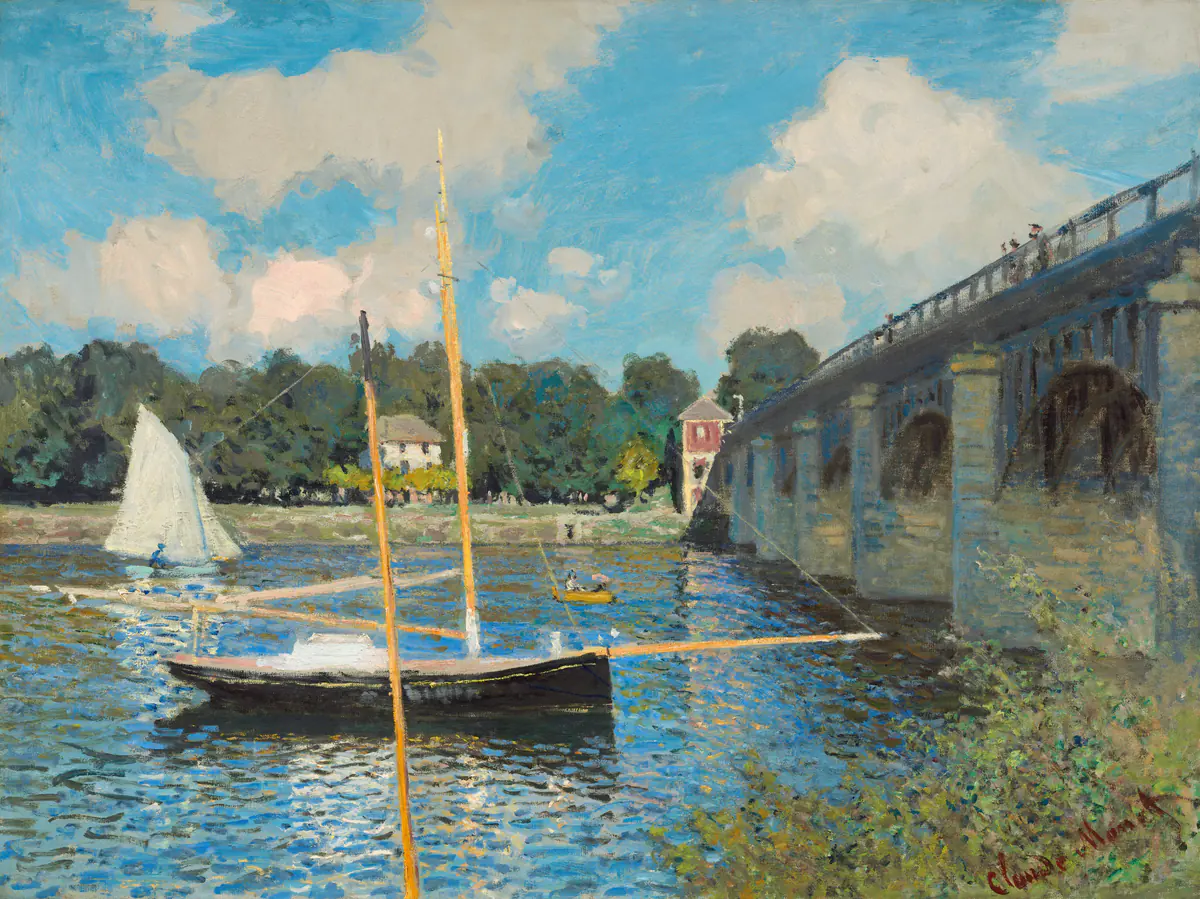
Compare the bridge with its reflection. Above the water, repeated supports establish a structure. Below, coloured strokes interrupt the same shapes. The picture does not simply dissolve everything into atmosphere: solid and unstable forms depend on one another. The bridge also prevents us from imagining that these landscapes always describe untouched countryside. Built structures and leisure boats occupy the same environment.
Look for: how far a reflection can break apart before you stop recognising what it reflects.
Cassatt: pattern around a careful action
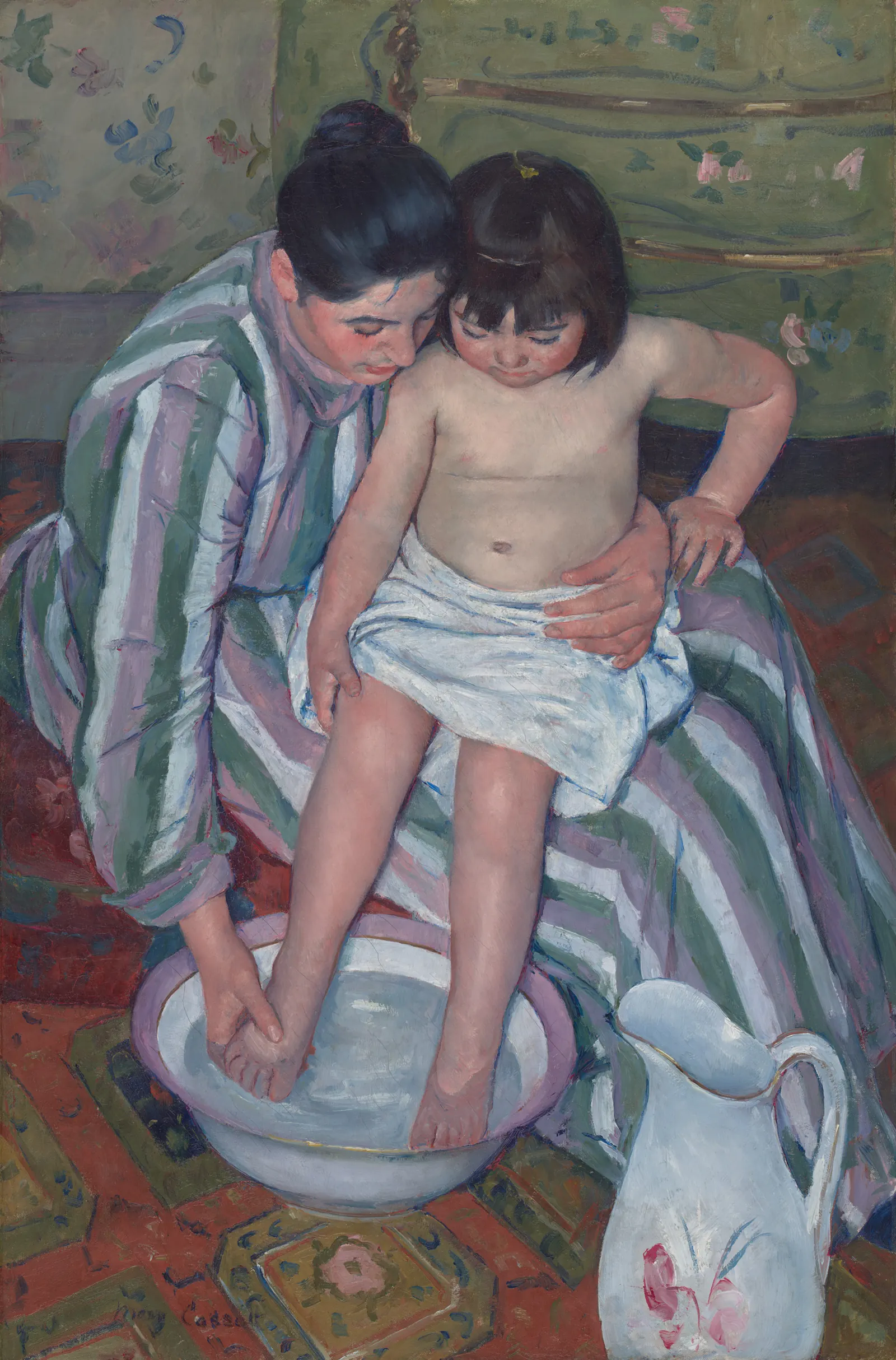
Our viewpoint is high: we look down towards the basin. Stripes and patterns fill much of the surface, but the hands and the child’s foot hold the action together. Cassatt’s scene is intimate without needing a grand event. It was painted after the independent exhibitions ended, showing why an artist’s later work still belongs in a discussion of their practice without being assigned to an exhibition it never entered.
Look for: the route from the adult’s supporting hand to the foot and water.
Pissarro: a city seen from above
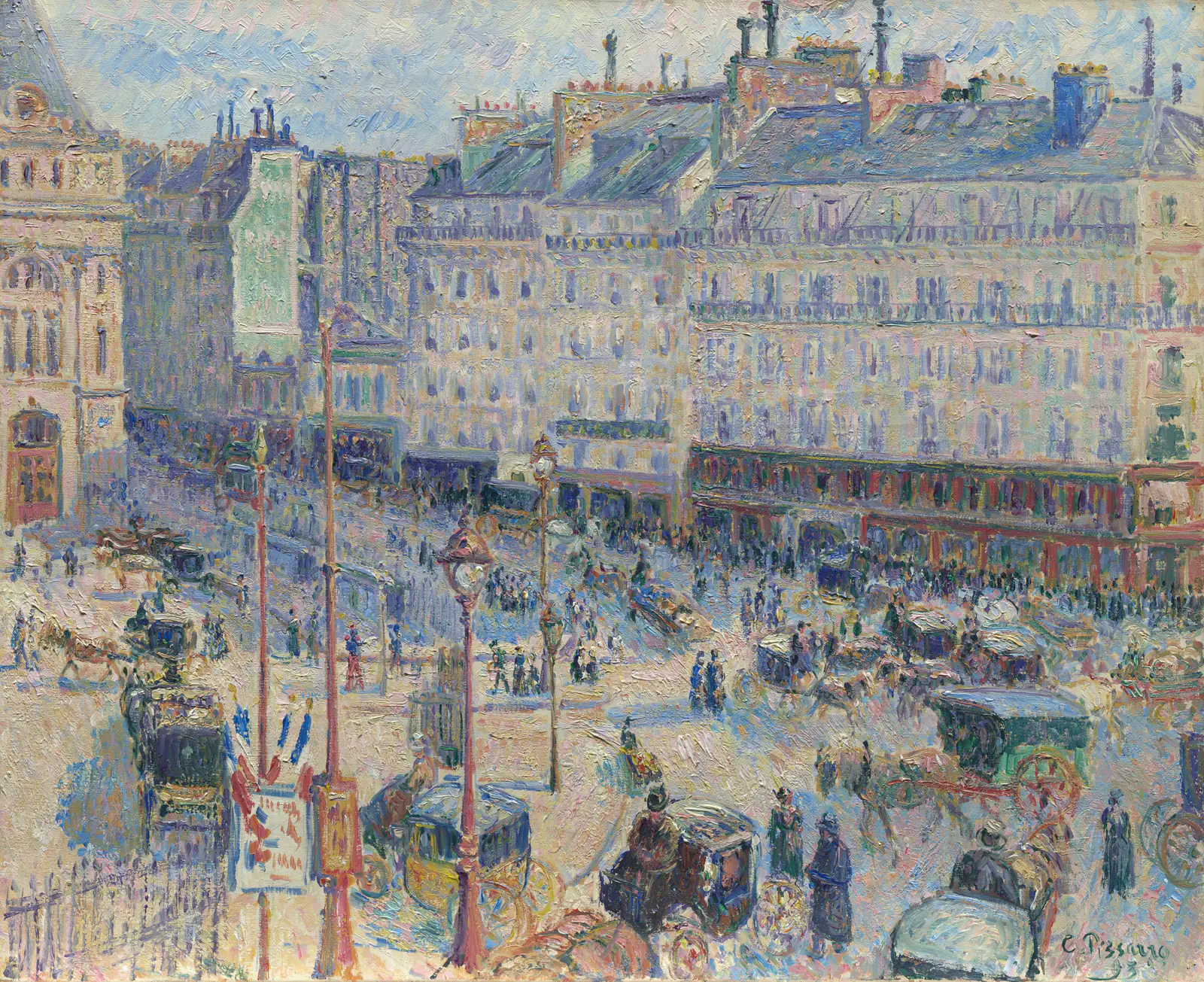
From this distance, the crowd becomes a web of small marks. The buildings remain large and legible, while people and vehicles produce a restless lower half. Compare it with Caillebotte’s street: there we share pavement space with approaching strangers; here we watch circulation across an entire junction. The change in viewpoint changes what urban life feels like.
Look for: where individual people become a pattern, and where that pattern becomes a sense of movement.
Seven artists and where to go next
Follow the individual guides for Monet, Renoir, Degas, Morisot, Caillebotte, Cassatt and Pissarro. Their careers are not interchangeable, and a movement label does not decide a digital image’s reuse rights.
For a useful next comparison, read Monet vs Manet. They were different painters; proximity to the same circle did not mean the same exhibition choices. If you want to live with one of these approaches to light, explore the Monet collection, then compare the actual composition and proportions—not just an Impressionist label.
Editorial record
About this article
- Author
- Publisher
- GeMarkt
- Published
- Reviewed
- Internal source & rights check. Conducted by GeMarkt Research Review. This is an internal editorial check—not independent peer review.
- Source standard
- Art history source standardPrioritises object records and research sources, distinguishes evidence from interpretation, and states material uncertainty.
Found a claim that needs checking? Report a factual error.