GeMarkt Blog · Essay
Monet vs Manet: What's the Difference?
Claude Monet and Édouard Manet were different French painters. Compare their names, careers, relationship and paintings to learn what to look for.

Claude Monet and Édouard Manet were two different French painters whose careers overlapped in nineteenth-century Paris: Monet has an o; Manet has an a. Monet is often easiest to recognise by the way light, weather and separate touches of colour shape a scene, while Manet often builds modern subjects from strong figures, abrupt contrasts and flatter areas of paint. Those are tendencies, not rules—Monet painted people, Manet painted landscapes, and they influenced one another.
The portraits above show the two men, not paintings they made of themselves: Renoir painted Monet, while Fantin-Latour painted Manet.
Monet and Manet at a glance
Claude Monet (1840–1926)
- Exhibited in most of the independent Impressionist exhibitions from 1874.
- Look for light, atmosphere and changing colour across the scene.
- Not just landscapes: he also painted portraits and figures.
- Famous works: Impression, Sunrise (1872), Woman with a Parasol (1875), and the Water Lilies series—many paintings, not a single canvas.
Édouard Manet (1832–1883)
- Pursued the official Paris Salon; never joined the independent Impressionist exhibitions.
- Look for strong figures, silhouettes and dark–light contrasts.
- Not just people or dark colours: he also painted bright outdoor scenes.
- Famous works: Olympia (1863), The Railway (1873), and A Bar at the Folies-Bergère (1882).
The dates and exhibition distinction are documented in the National Gallery’s artist records for Monet and Manet.
Why are their names so easy to confuse?
Only one vowel separates the surnames, and the confusion began during their lifetimes. At the 1865 Salon—Paris’s official annual art exhibition—Monet’s landscapes were hung alphabetically near Manet’s Olympia. According to the Getty’s account of the episode, visitors congratulated Manet for paintings that were actually by the younger Monet. The episode tied their names together in public; they later developed an important professional relationship.
Their similar names did not mean similar careers. Manet was eight years older and sought recognition at the Salon, even while his paintings challenged its conventions. Monet became a central participant in the independent exhibitions later known as the Impressionist exhibitions. It is more accurate to say that Manet was closely associated with and influential on the Impressionists than to force him into, or entirely outside, a single label.
Compare how they painted people
The following comparisons are our readings of the paintings. They offer useful clues, not rules for identifying every work.
Monet’s Woman with a Parasol—Madame Monet and Her Son (1875) is a figure painting, but weather is almost a second subject. We look up from a low viewpoint as Camille Monet’s dress, veil and parasol react to the wind. Broken cloud shapes and touches of colour across the grass and fabric make the moment feel changeable. The National Gallery of Art records that Monet painted it outdoors, in a single session.
In Manet’s The Railway (1873), a woman faces us while a child turns towards steam rising beyond an iron fence. The black bars cut the view into firm vertical sections. The train itself is hidden, so the picture’s tension comes from the figures’ opposing directions, the fence, the close viewpoint and the unexplained instant. This is a useful example of cropping: the picture edge cuts through forms and withholds part of the surrounding scene.
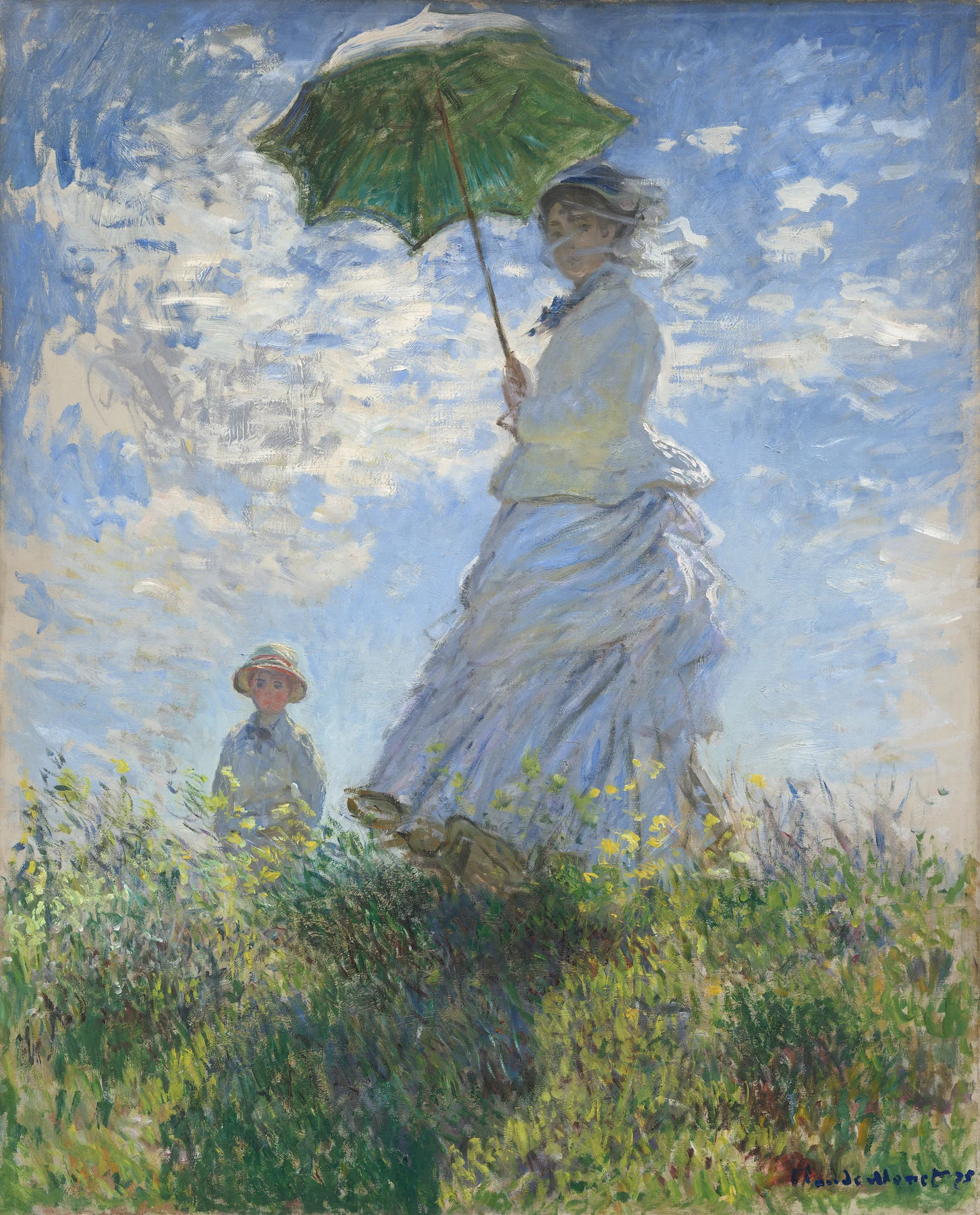
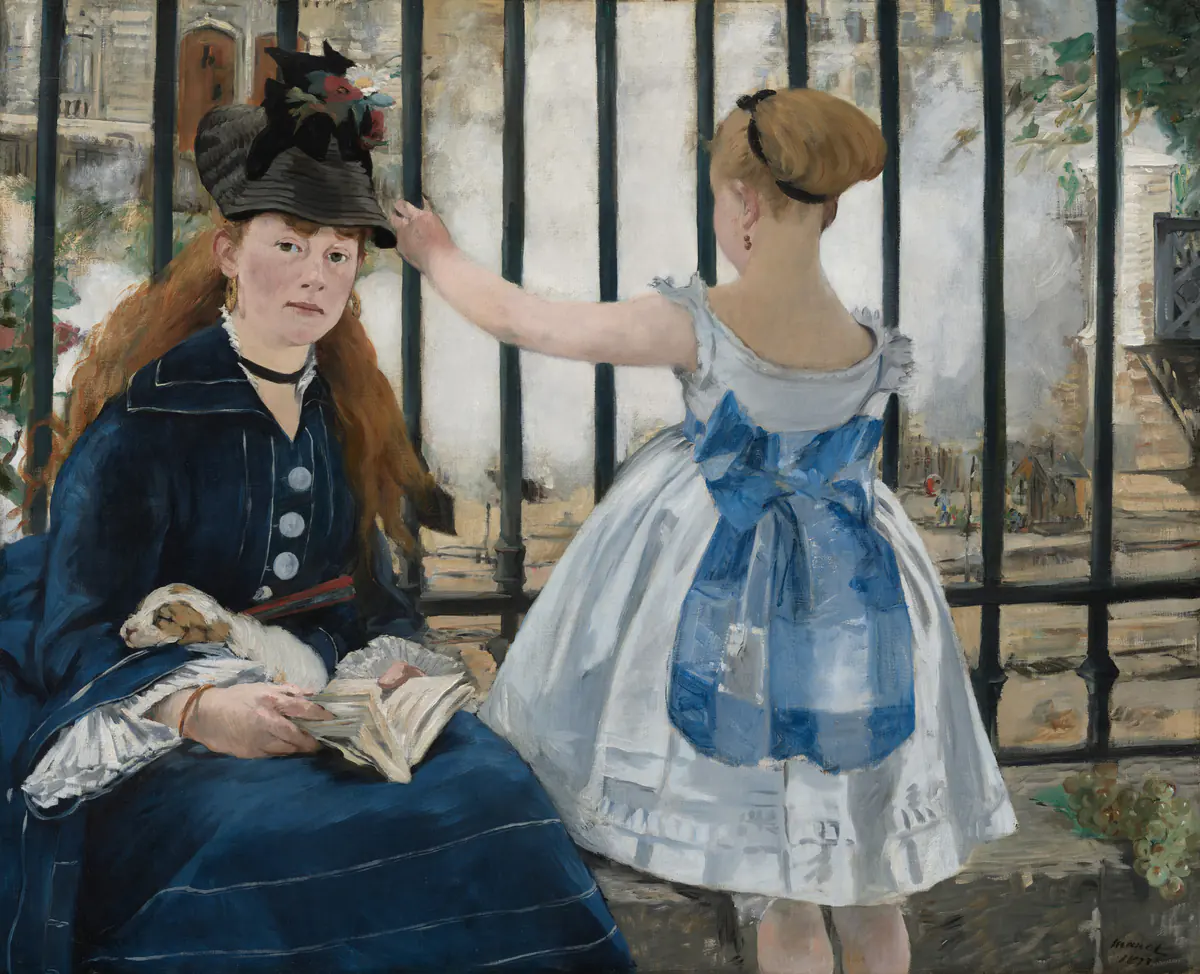
Both paintings include women and children in modern life. The practical difference is not “Monet painted landscapes; Manet painted people.” It is what each painter asks the surroundings to do. In Monet, figure, wind, grass and sky participate in one changing effect of light. In Manet, the figures and the strong structure around them create a more deliberate visual confrontation.
Compare the same place in the same year
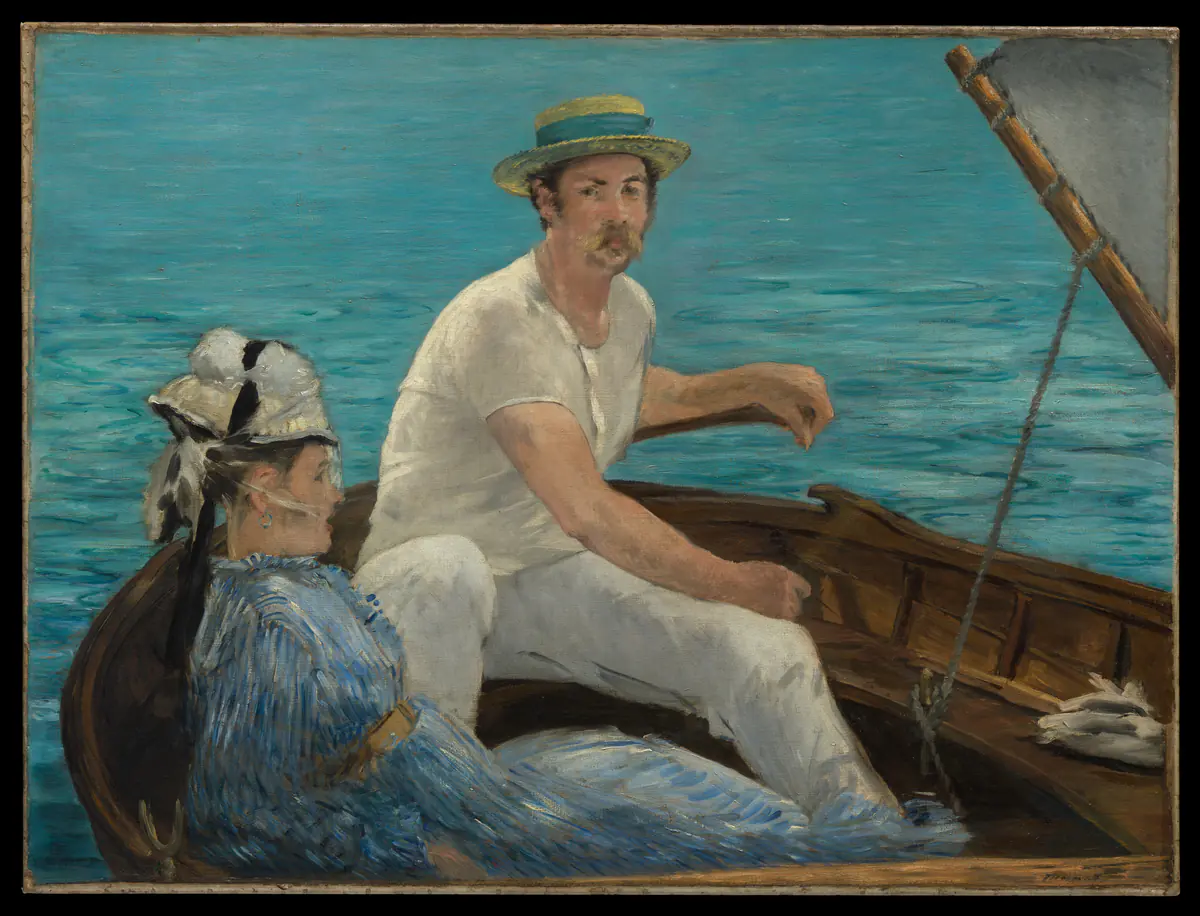
The clearest test is to compare works made around Argenteuil in 1874. Manet’s Boating places a man and woman in a sharply cropped boat against a broad field of blue water. The Metropolitan Museum of Art notes that Manet adopted a lighter palette—the range of colours used in a painting—and lighter touch while spending time with Monet and Renoir that summer. Yet the large colour areas, strong diagonal sail and abrupt crop remain distinctly his.
Monet’s The Bridge at Argenteuil, painted in the same year, gives more of the canvas to water, sky and their reflections. Short strokes of blue, green, pink, white and brown make the river flicker. Boats, bridge and people remain readable, but the figures can be described with only a few quick marks. Brushwork means these visible traces of the artist’s brush; here, their direction and colour help create the sensation of moving water.
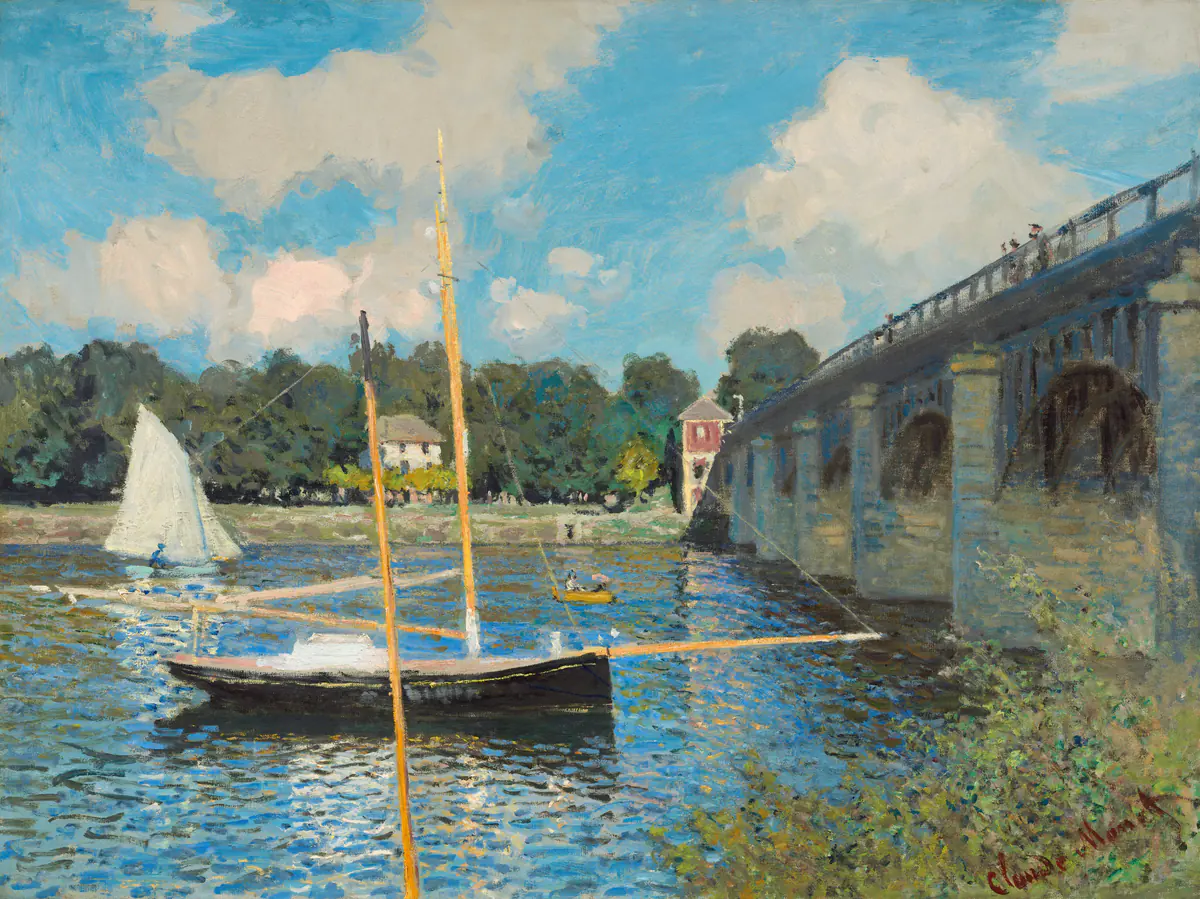
The pair matters because the subject alone cannot identify the artist. Both men painted boats, water, leisure and the modern Paris suburbs. Manet concentrates the scene into a forceful arrangement of people and shapes. Monet distributes attention across the atmosphere, so that no single figure dominates what the eye experiences.
Their influence ran both ways
Monet and Manet were not simply rival names in an art-history quiz. The National Gallery’s biographies of Monet and Manet explain that Manet influenced Monet’s figure paintings in the 1860s, while Manet later worked under the influence of Monet and Renoir in his own landscapes and street scenes. In 1874, the artists saw one another frequently at Argenteuil.
Manet’s The Monet Family in Their Garden at Argenteuil makes that contact visible: Claude Monet gardens at the left while Camille and their son Jean sit nearby. Manet also painted Monet working in his studio boat, as recorded by the Bayerische Staatsgemäldesammlungen. Their approaches remained different, but those differences developed through contact, not isolation.
The relationship continued after Manet’s death. The Musée d’Orsay records that Monet organised a public subscription in 1890 to secure Manet’s Olympia for the French state. That act is better evidence of lasting respect than a simple story of two men with confusing names.
A quick way to tell Monet from Manet
When you meet an unfamiliar work, try three questions:
- How are the forms arranged? A firm figure, a sharp edge or a large dark shape may point towards Manet. Repeated touches of colour moving across water, sky, foliage and clothing may point towards Monet.
- What changes as your eye moves around? Monet often makes shifting light or weather the organising problem. Manet often makes the relationship between figures, setting and viewer feel more immediate or unresolved.
- Does another verified work support the guess? Compare museum records, dates and signatures rather than trusting one visual shortcut.
There are exceptions. Monet did not always complete every canvas entirely plein air—a French term for painting outdoors in front of the subject. The National Gallery describes La Pointe de la Hève, Sainte-Adresse as probably painted on the spot as a study for a larger Salon painting made in the studio.
Manet did not always use heavy blacks or indoor settings; Boating is the obvious counterexample. Start with the vowel, then notice where your eye goes first and what keeps it moving. That will take you further than treating either artist as a fixed formula.
For another practical comparison, see how to compare two artworks. Questions about reproduction rights are covered separately in our Monet and Manet guides.
Editorial record
About this article
- Author
- Publisher
- GeMarkt
- Published
- Reviewed
- Internal source & rights check. Conducted by GeMarkt Research Review. This is an internal editorial check—not independent peer review.
- Source standard
- Art history source standardPrioritises object records and research sources, distinguishes evidence from interpretation, and states material uncertainty.
Found a claim that needs checking? Report a factual error.