Is Edgar Degas's art public domain? A collector's guide
Degas died in 1917, placing his art in the public domain. Explore the 1918–19 atelier sales, his posthumous bronzes, and why a digital file's provenance still matters.
From the guide to the collection
Explore the Degas collection → · Shop all art → · Free Degas wallpapers — the complete paintings at 4K ↓
From the studioDegas prints — 300+ restored works, curated and annotated →
The painter who did not need to sell
Edgar Degas was born in Paris in 1834, into a banking family, and the money shaped his career as surely as his eye did. Unlike most of the painters he exhibited alongside, he was never forced to produce for the market. He could sell when it suited him, refuse when it did not, and hold back anything he was not finished thinking about. Over a working life of more than five decades, he held back a very great deal — a habit that produced one of the strangest afterlives in the history of art.
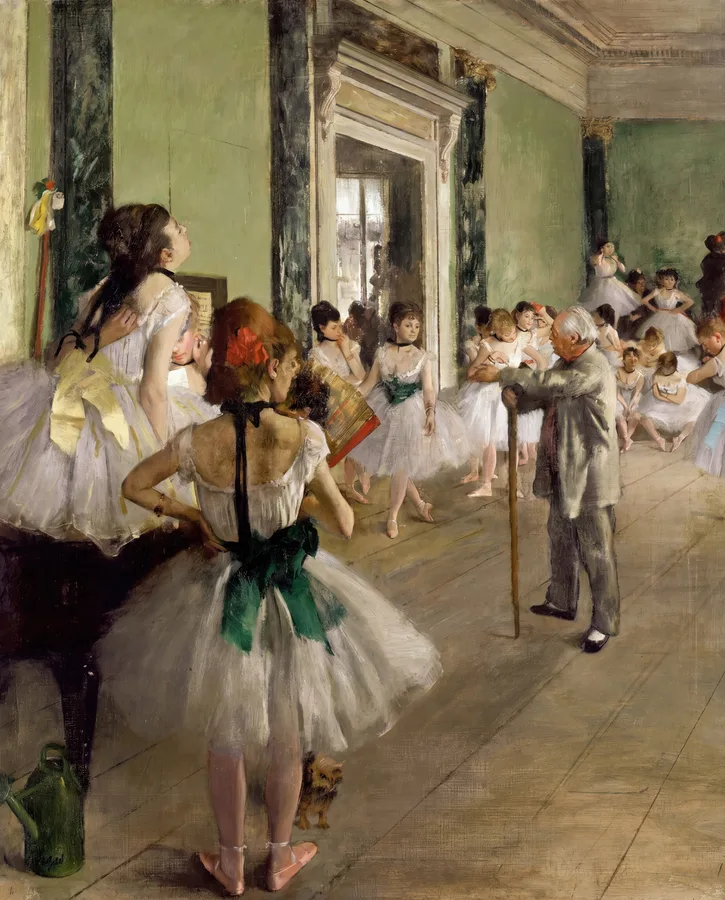
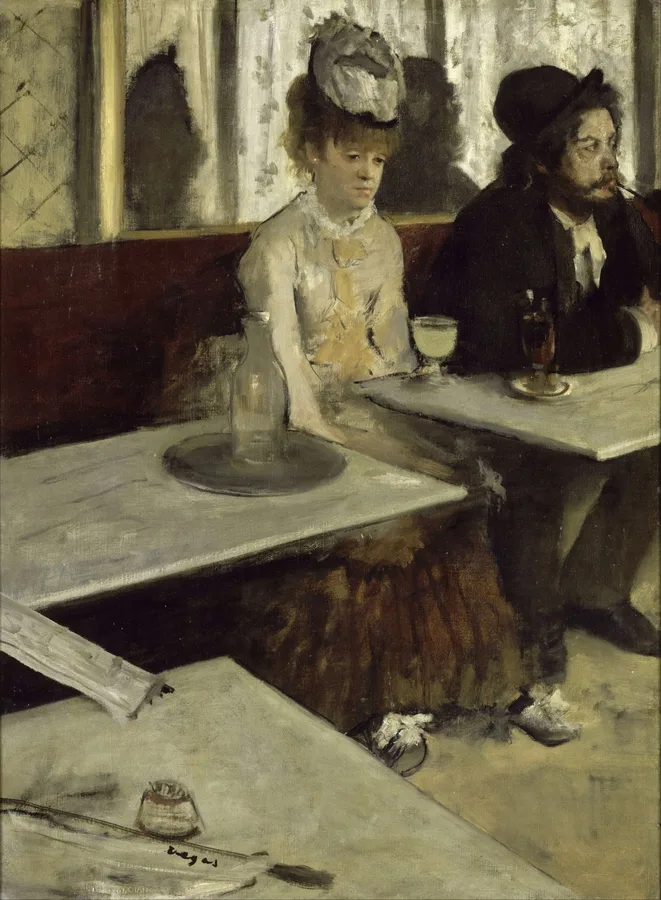
The career the public did see was formidable. The Bellelli Family, a nearly life-size portrait of his aunt’s household begun in Florence when he was twenty-four, announced a portraitist of unusual gravity. By the 1870s he had claimed the territory he never really left: the rehearsal rooms of the Paris Opéra in The Dance Class (1873–76), where the old ballet master Jules Perrot leans on his stick, painted from life; the flat morning light of In a Café (L’Absinthe, 1875–76), which scandalised London; laundresses, milliners, jockeys. At the final Impressionist exhibition in 1886 he hung a suite of bathers, The Tub among them, seen straight down as if through a keyhole. And in 1881 he showed the only sculpture he would ever exhibit — Little Dancer Aged Fourteen, modelled in wax and dressed in a real bodice, tutu and wig.
In his last years his eyesight failed, and he spent them nearly blind, wandering the streets of wartime Paris. He died in September 1917, at eighty-three.
The auctions that stunned the art world
Then the studio was opened. Degas had kept early pictures he never let go of and late work almost nobody had seen, and the sheer quantity astonished the dealers who inventoried it. His own paintings, pastels and drawings were dispersed in four auctions at the Galerie Georges Petit between May 1918 and July 1919 — the first held while German shells were falling on Paris — with further sales of his prints and of the superb private collection of other artists he had assembled: eight auctions in all. Curators and collectors suddenly confronted decades of work they had not known existed. Much of what now hangs in museums, and much of what we restore, first reached the world through those sales.
Is Degas’s art public domain?
Yes. His paintings, pastels and drawings are public domain worldwide, and the arithmetic is not close.
Most of the world runs copyright on the life-plus-seventy rule: protection lasts for seventy years after the artist’s death. Degas died in 1917, so his term expired by 1988 at the latest, and in many countries earlier under the shorter terms that applied historically. The United States uses a different system for older works, keyed to publication rather than to the artist’s death: works published more than ninety-five years ago are public domain there. Everything two-dimensional Degas made predates 1918, which clears that bar by a very wide margin. Two different systems, one answer.
One nuance is worth a paragraph: the sculpture. The familiar bronze dancers and horses were cast after his death — his heirs contracted the Hébrard foundry, which cast them between 1920 and 1936 from roughly 150 wax and clay figures found in the studio; Degas himself never authorised a bronze in his lifetime. One posthumous cast of the Little Dancer sold at Christie’s in 2022 for $41.6 million. For a collector the practical point is simple: posthumous casts are newer objects, and photographs of sculpture carry their makers’ own choices and sometimes their own claims. The clear public-domain core of Degas is the flat work — the paintings, the pastels, the drawings.
The honest caveat: copyright terms vary by country and are occasionally revised, and this page is general information about how the two major systems work, not legal advice. For an artist dead more than a century, none of the variations change the answer — but if you have a commercial question that depends on it, ask a lawyer in your own jurisdiction.
The painting is free; a file of it may not be
Here is the distinction that catches people out. The artwork Degas made is public domain. A particular digital file showing that artwork is a separate object with a separate history. Museums and image libraries sometimes assert rights, or attach contractual terms, to their photographs of public-domain paintings; how far those claims hold up differs from one country to the next. The freedom that belongs to the painting does not automatically travel with every file of it circulating online.
That is why the provenance of the file matters as much as the status of the artwork. The restorations we sell are our own work, and we verify the rights status of every individual piece before it is listed — the artwork and the source both.
Degas in our collection
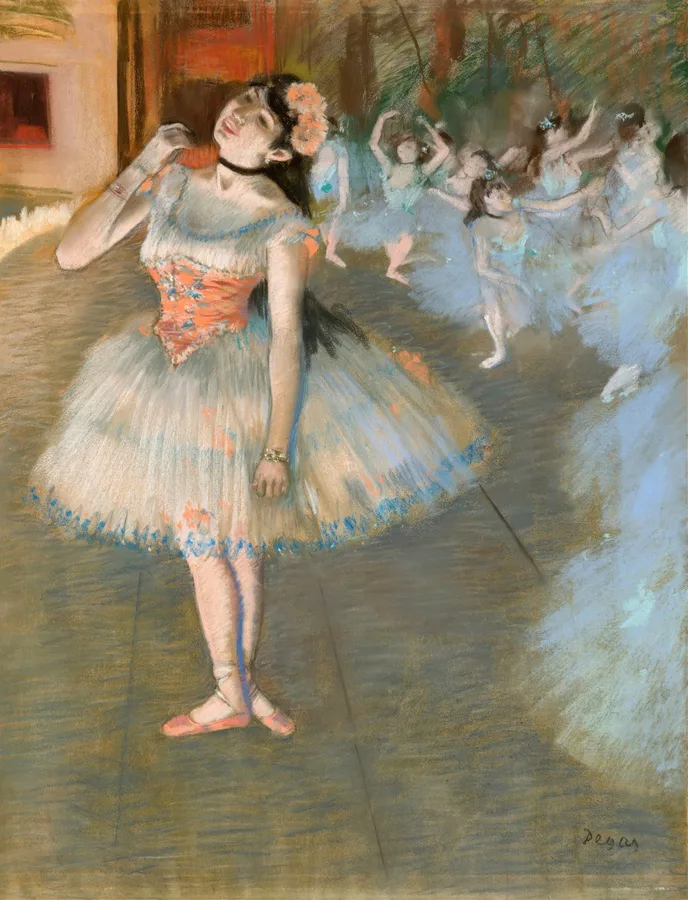
We keep over 300 restored Degas works in the shop, and the range mirrors the man: the stage and the wings, the racecourse, the laundry, the milliner’s counter, the bath. The Star is here, its single dancer caught in the stage light, her coral bodice burning against the green flats — the first thing tired copies dull, and the thing we worked hardest to keep. So are the grey harmonies of In a Café, the warm-to-cool greens of The Dance Class, and the late Dancers in Blue, where blue is laid against blue and the whole job is keeping them apart.
Every piece comes in the same four formats: rolled poster, stretched canvas, framed canvas, and framed paper print. The rolled poster suits collectors with a framer they trust; the framed options arrive ready to hang.
Degas kept his best work to himself for fifty years, and the world only met it at auction after he was gone. It belongs to everyone now. Start with the Degas collection — twelve works chosen and annotated by the studio, and a door to the other three hundred and more.
Editorial record
About this article
- Publisher
- GeMarkt
- Published
Found a claim that needs checking? Report a factual error.