Is Pierre-Auguste Renoir's art public domain? A collector's guide
Renoir died in 1919, and his copyrights expired decades ago worldwide. From the porcelain factory to the Moulin de la Galette, learn what this means for prints.
From the guide to the collection
Explore the Renoir collection → · Shop all art → · Free Renoir wallpapers — the complete paintings at 4K ↓
From the studioRenoir prints — 750+ restored works, curated and annotated →
Pierre-Auguste Renoir was born in Limoges in 1841, the son of a tailor, and began his working life not at an easel but in a porcelain factory, painting flowers and rococo figures onto plates and cups. That apprenticeship left a permanent mark: even at his most radical, Renoir remained a craftsman in love with the pleasures of the surface — the feathered stroke, the pearly skin tone, the shimmer of fabric. When he moved on to formal training in Paris, he fell in with Claude Monet, Alfred Sisley, and Frédéric Bazille, and together they began working outdoors, chasing natural light in a way the official Salon found baffling. Out of that circle came Impressionism, and Renoir stood at its very center.
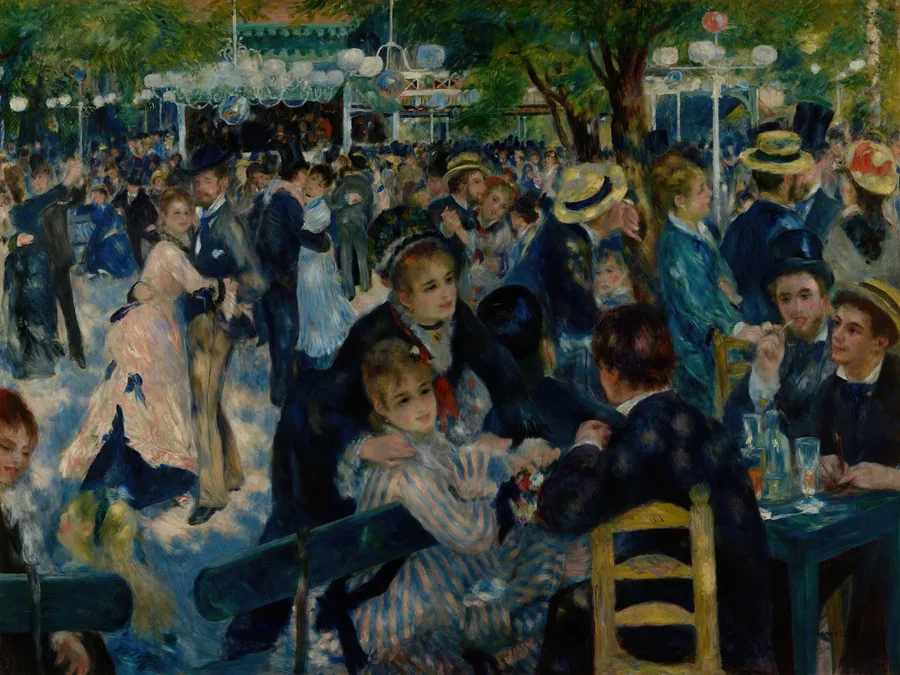
What sets Renoir apart from his fellow Impressionists is his subject matter. Where Monet turned increasingly to pure landscape, Renoir never lost interest in people — dancers, readers, boating parties, children, friends around a table. Bal du moulin de la Galette (1876), his great canvas of a Sunday dance in Montmartre, is dappled sunlight made social: light falling through leaves onto straw hats, glasses, and conversation. In the decades that followed he restlessly reinvented himself, passing through a tighter, more classical “dry” manner in the 1880s and arriving at the warm, monumental late style of his final years. He kept painting through severe rheumatoid arthritis until his death in 1919, brush bound to a hand that could no longer fully grip it.
The short answer: yes, Renoir is public domain
Renoir died in 1919. In the many countries that protect an artist’s work for the duration of their life plus 70 years, his copyright expired at the end of 1989 — meaning his paintings have been in the public domain since 1990, more than three and a half decades now.
The United States uses a different clock for older works, based on publication rather than the artist’s death: roughly speaking, works of this era are protected for 95 years from first publication. In practice, anything first published in 1930 or earlier is public domain in the US as of 2026, and Renoir’s paintings — all created well before his death in 1919 — clear that bar comfortably.
Two honest caveats. Copyright terms genuinely vary by country, and a handful of jurisdictions use longer terms than life plus 70, so if you are working internationally it is worth checking the rules where you are. And this page is general information from a print studio, not legal advice.
“Public domain” is not the same as “every file is free”
Here is the distinction that trips people up. When Renoir’s copyright expired, it was the paintings that entered the public domain — the images he created. A specific digital file is another matter. A museum photograph or scan of a Renoir is a reproduction of a public domain work, and whether that reproduction carries any rights of its own is answered differently in different countries. Some institutions openly release their images for any use; others assert claims or attach license terms to files downloaded from their sites. The painting being free does not automatically settle the status of every file of it floating around the internet.
This is exactly why we treat rights as a per-artwork question rather than a blanket assumption: we verify the rights status of every work individually before it is listed, and the restorations we sell are our own.
Renoir in our collection
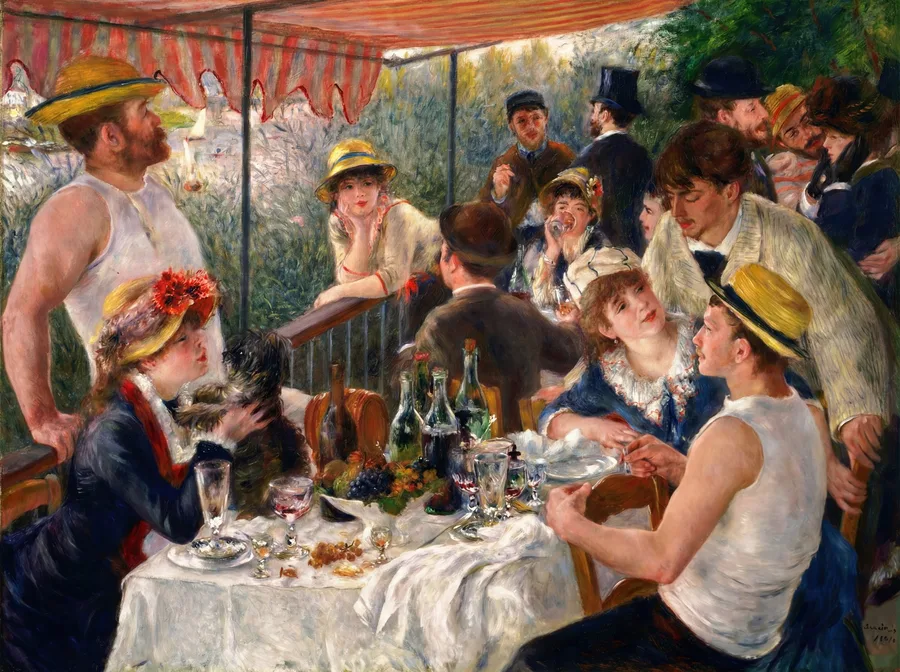
Renoir was extraordinarily prolific, and our catalog reflects that: with more than 770 works, he is the single largest artist collection we carry. That breadth is part of the pleasure of collecting him. Beyond the icons — Bal du moulin de la Galette, Luncheon of the Boating Party (1880–1881), Girl with a Watering Can — there are decades of portraits, riverside scenes, gardens, still lifes, and quiet domestic moments that rarely make it onto museum postcards but hang beautifully in a home.
Every piece in the collection is available in the format that suits your space: as a rolled poster if you prefer to frame it yourself, as a stretched canvas or framed canvas for a ready-to-hang gallery feel, or as a framed paper print for a classic look under glass.
If Renoir’s world of light and company appeals to you, take your time in the Renoir collection — with over 750 works to choose from, there is almost certainly a Renoir you have never met before.
Editorial record
About this article
- Publisher
- GeMarkt
- Published
Found a claim that needs checking? Report a factual error.