Is Claude Monet's art public domain? A collector's guide
Monet died in 1926, and his paintings are public domain worldwide. How the rules work, why the water lilies are free to print, and what to check about the file itself.
From the guide to the collection
Explore the Monet collection → · Shop all art → · Free Monet wallpapers — the complete paintings at 4K ↓
From the studioMonet prints — 350+ restored works, curated and annotated →
The painter who taught the world to see light
Claude Monet was born in Paris in 1840 and raised in Le Havre, where the shifting estuary light of the Normandy coast shaped everything that followed. As a teenager he earned pocket money drawing caricatures until the landscape painter Eugène Boudin persuaded him to try working outdoors — a suggestion Monet later credited with deciding the course of his life. In Paris he fell in with Renoir, Sisley and Bazille, endured years of Salon rejections and real poverty, and during the Franco-Prussian War took refuge in London, where the fog-veiled Thames and the canvases of Turner left a permanent mark on his eye.
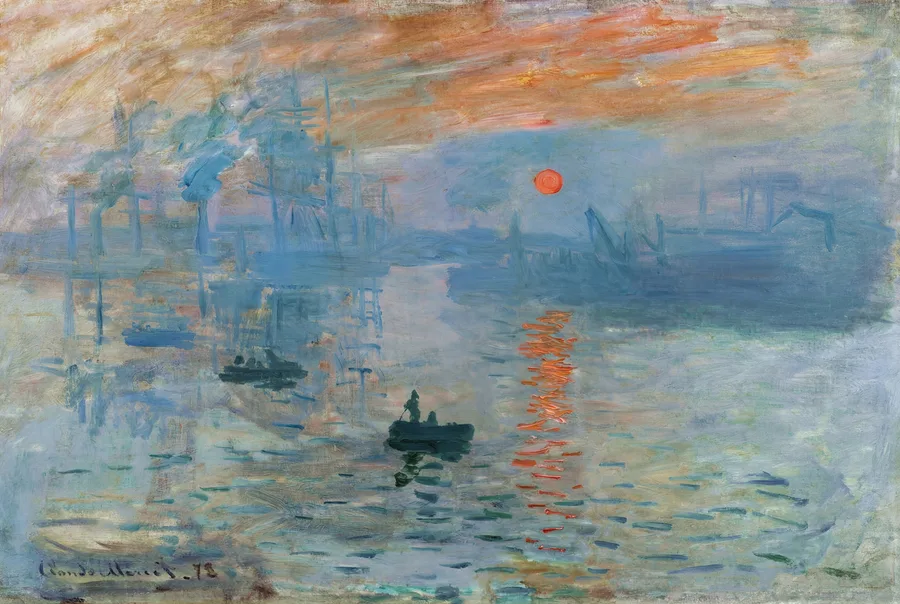
In 1874 Monet and his circle staged an independent exhibition rather than wait on the official Salon. Among his entries was Impression, Sunrise (1872), a hazy view of the harbor at Le Havre. The critic Louis Leroy seized on the title to ridicule the whole group as “impressionists” — and the insult stuck as the name of the most influential movement in modern painting. Monet’s mature career was built on the series: the same motif painted again and again under changing light and weather. The Rouen Cathedral canvases (1892–1894) pushed this idea to its limit, dissolving a Gothic façade into pure atmosphere at dawn, noon and dusk.
In 1883 he settled at Giverny, where he spent decades building the garden that became his final great subject. The Japanese footbridge over his lily pond appears in The Water Lily Pond series beginning in 1899, and in his last years — despite cataracts that nearly cost him his sight — he worked at ever larger scale on the water lilies that occupied him until his death at Giverny on 5 December 1926.
The short answer: yes — with one geographic footnote
In most of the world, copyright lasts for the life of the author plus 70 years. Monet died in 1926, so that term ran out at the end of 1996, and since 1 January 1997 his work has been in the public domain across the European Union, the United Kingdom, and the many other countries that apply the life-plus-70 rule.
The United States counts differently for works of this era: protection runs 95 years from first publication. Works first published in 1930 or earlier have now passed out of copyright there, which covers essentially everything Monet exhibited and published in his lifetime. Only for a handful of very late canvases from the 1920s does the question of when a work was first published, rather than when it was painted, become relevant under US law. Copyright terms do vary from country to country — a few jurisdictions use longer periods — so treat this page as general information, not legal advice.
“Public domain” does not mean “every file is free”
A distinction collectors should understand: the painting and a particular photograph of the painting are two different things. Museums and image libraries sometimes assert rights, or impose contractual terms, over their own photography of public-domain works. In the United States, faithful photographic copies of two-dimensional public-domain paintings are generally not considered to gain a fresh copyright of their own, but the position is less uniform elsewhere, and a website’s terms of use can still bind whoever downloads from it. So the practical question is never just “is the painting free?” — it is also “where did this particular file come from, and on what terms?”
Our own approach comes down to a single sentence: every work in our catalogue has its rights status verified individually before it is listed, and the restorations we sell are our own.
Monet in our collection
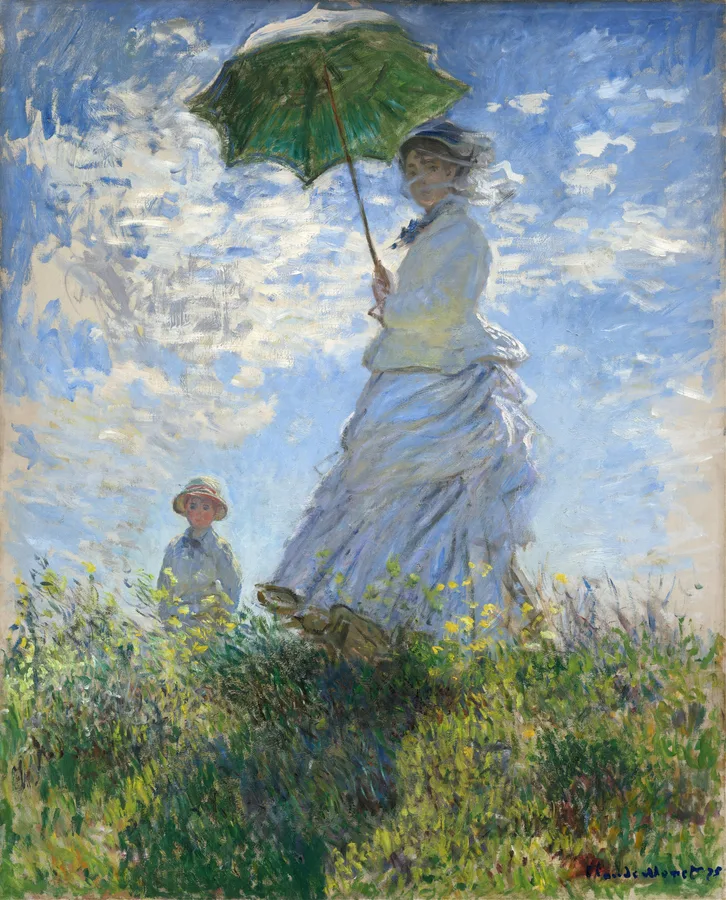
Our Monet collection currently numbers 350 works, spanning his whole career — from the harbor haze of Impression Sunrise to the wind-caught figure of Woman with a Parasol, the luminous Water Lily Pond canvases with their arched Japanese bridge, and the Rouen Cathedral series in its shifting moods of light. The late Giverny paintings, where form nearly dissolves into color, sit alongside the crisp coastal scenes of his early years.
Each piece is available in four formats: as a rolled poster if you prefer to frame it yourself, as a stretched canvas ready to hang, as a framed canvas, or as a framed paper print. The same restored image is offered across all four, so the choice is simply about how you want to live with it.
If Monet has a place on your walls, browse the Monet collection — twelve works chosen and annotated by the studio, and a door to the rest — and compare the format options on any listing to find the one that suits your space.
Editorial record
About this article
- Publisher
- GeMarkt
- Published
Found a claim that needs checking? Report a factual error.