GeMarkt Blog · Essay
Gardens in Art: Monet’s Giverny and Beyond
Explore eight garden works by Monet, Hiroshige, Fragonard, Pissarro, Van Gogh, Caillebotte and Cross, from shaded walks to painted water.

An arching bridge, floating lilies and green reflections can make Giverny seem like the inevitable subject for Monet. Yet the garden did not simply appear in front of his easel. He helped shape the place that he would return to in paint. The planting and the picture were both acts of selection.
Gardens in art sit between growing things and human decisions. A path directs visitors; a flower bed concentrates colour; a pond reflects a sky that may never appear directly. Eight works by seven artists reveal different uses of cultivated space, from Fragonard’s shaded avenue to Hiroshige’s flowering Edo garden and Monet’s late expanses of water.
A garden is already an arrangement
A garden picture is not necessarily a record of a complete garden. It may show one bed, an invented avenue, a pause in work or the reflection of plants outside the frame. Asking what has been excluded is as useful as identifying what grows there.
These examples are not a universal history of gardens. They are a route through particular paintings and prints, each with a different relationship to an actual place. Some artists cultivated their subjects; others selected or transformed what they encountered. Nor are all the people in garden pictures simply enjoying leisure. Paths, buckets, buildings and barriers help us notice the practical world around the flowers.
Monet: building the view at Giverny
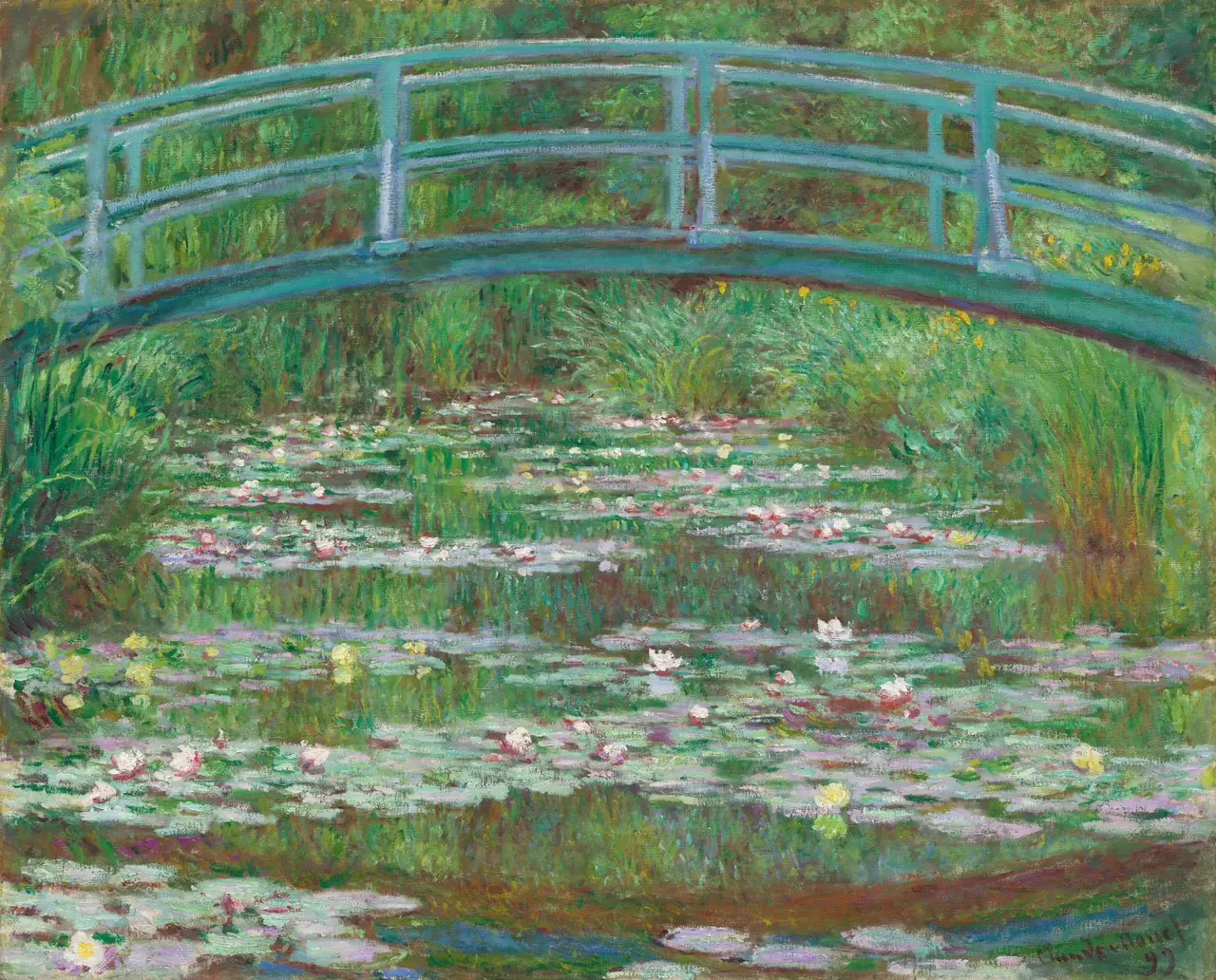
The bridge is the clearest constructed object, but the pond and planting belong to the same designed setting. The National Gallery of Art describes Monet’s acquisition of the additional land in 1893 and his shaping of the water garden. This canvas belongs to twelve bridge views painted from one vantage point in 1899.
Look beneath the arch. The bridge’s reflection repeats its curve while horizontal groups of lily pads cross the water. Above, foliage presses against the upper edge. We see no broad sky or view over the surrounding countryside: the picture concentrates on its enclosed world.
That enclosure is not proof that Monet forgot everything outside it. It is a choice in the image. His garden paintings allow an ordinary act of looking to become a sustained problem: how do bridge, leaves, water and reflection remain distinct while sharing so many greens?
Fragonard: the garden as a stage
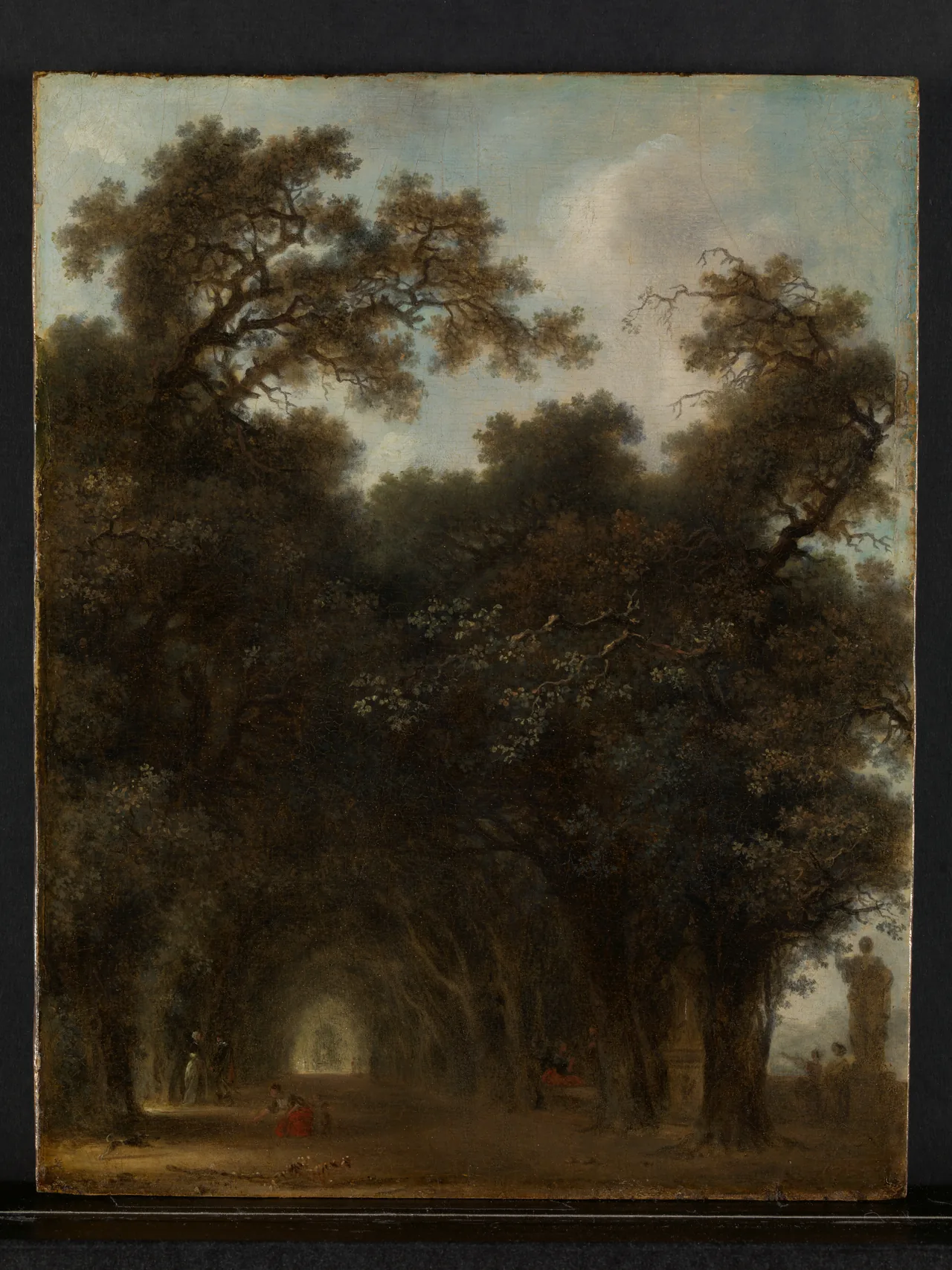
Fragonard gives us a route instead of a pond. Dark trees rise above tiny figures and form a passage towards the fountain’s light. Their scale makes the garden feel grander than its human occupants.
The Met relates these avenues to Fragonard’s experience of Italian gardens and earlier Dutch landscape painting. It does not identify this panel as an exact view of a particular surviving avenue. Naming a famous villa would add a certainty the record does not provide.
Follow the difference between the foreground shade and the small bright opening. The path works like a stage entrance, promising another space beyond the trees. Fragonard makes cultivated landscape feel theatrical without needing a clearly narrated event. The visitors supply scale and hints of activity, while the foliage and light organise the drama.
Hiroshige: a place for seasonal visitors
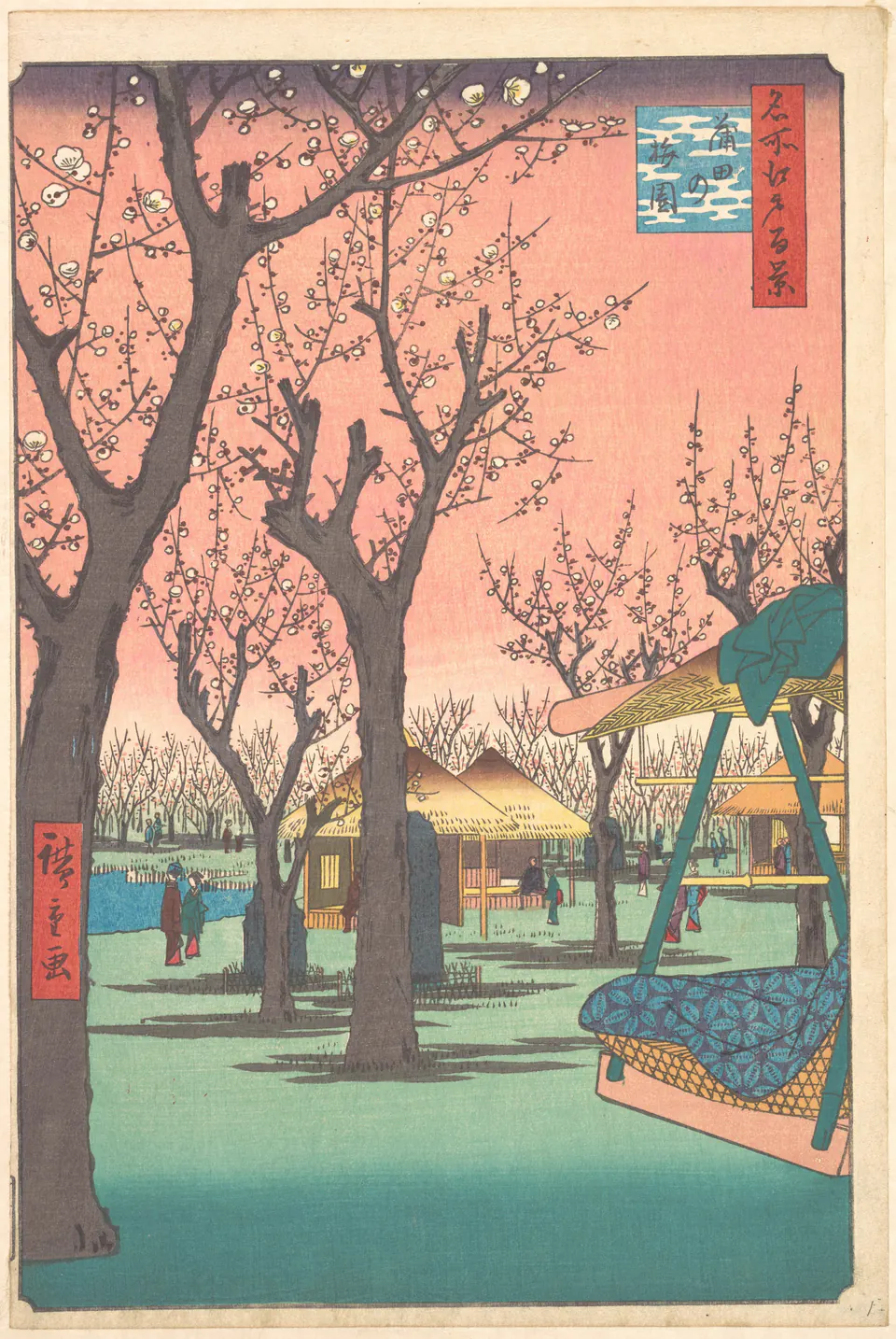
This is Kamata, not the similarly named plum garden at Kameido. The Met identifies the print within Hiroshige’s One Hundred Famous Views of Edo. Its upright format lets flowering trunks rise well above the small visitors and buildings.
The garden is neither empty nor sealed away from travel. Figures pass between the trees; the conveyance entering at the right makes arrival part of the composition. Near trunks are much larger than distant visitors, so our view feels taken from within the grounds rather than from an elevated garden plan.
Hiroshige’s printmaking also changes how a season can circulate. This is one impression of a woodblock design, not a unique oil canvas. Its blossoms and named location could be encountered on a sheet as well as through a visit. The garden becomes both a place and a carefully composed view of that place.
Pissarro: the people who use the path
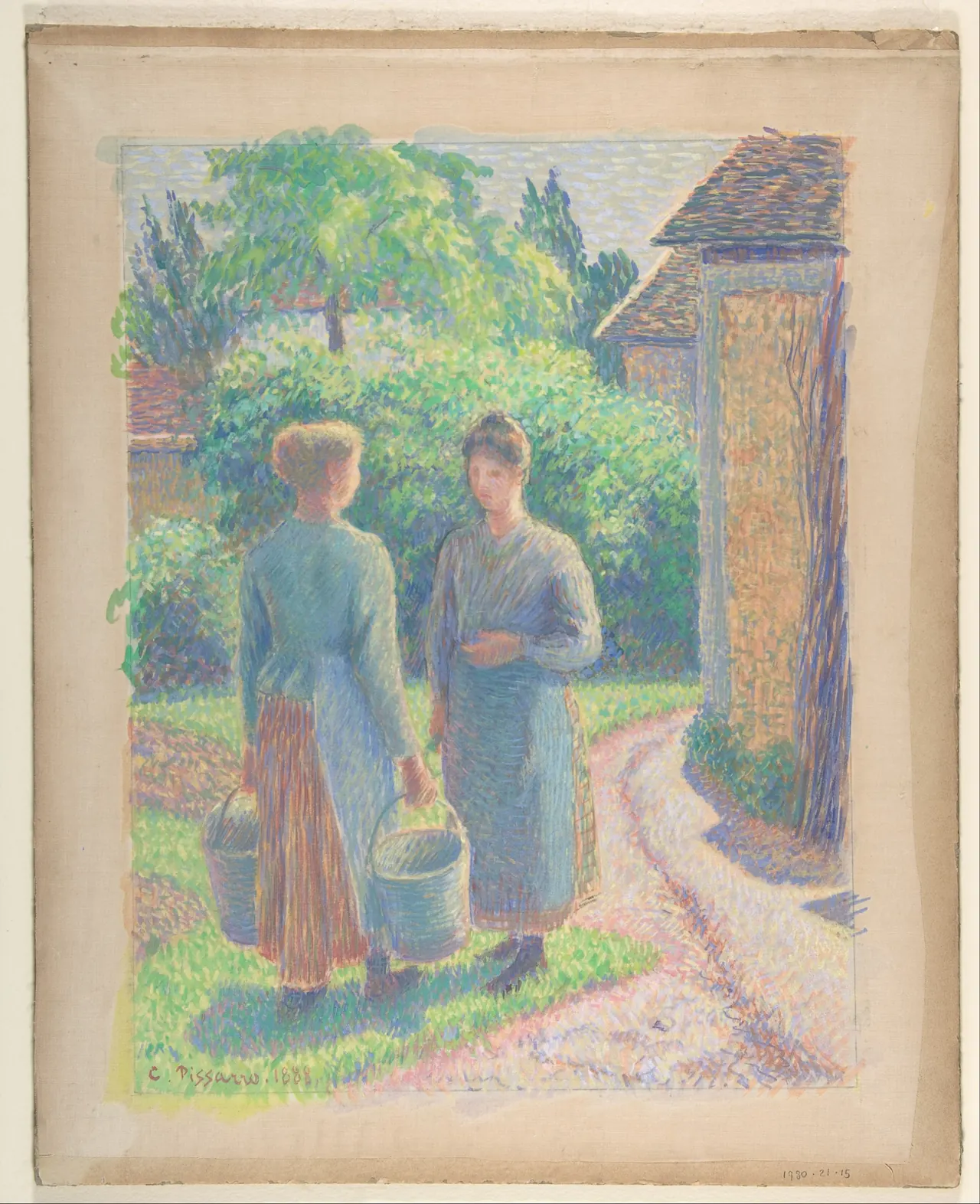
The two women occupy the foreground, not a distant corner. One carries buckets; the other faces her beside the path. We cannot hear their conversation or know whether the encounter was brief, but the objects make everyday activity visible.
The Met records this as gouache on silk, with graphite framing lines. It is not an oil painting on canvas. The preserved mount helps distinguish the physical object from a borderless digital picture.
Short coloured strokes run through clothing, foliage and path. Rather than isolating the women against a neutral backdrop, Pissarro lets the same busy surface connect them to their surroundings. Beside Fragonard’s tiny walkers, these larger figures change the garden’s emphasis. The space is somewhere people use, carry things through and meet in, not simply scenery waiting to be admired.
Van Gogh: looking into the flower bed
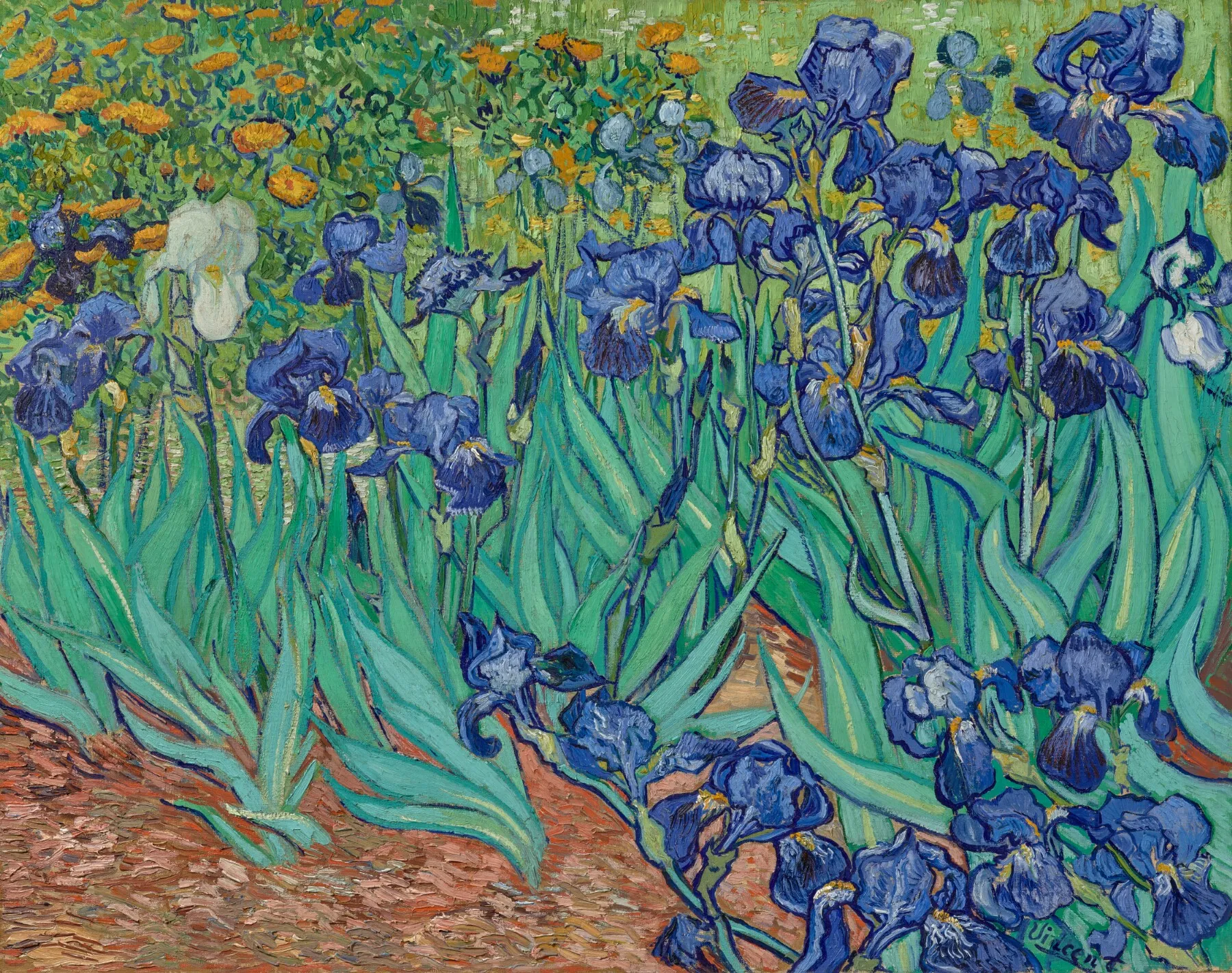
There is almost no garden to walk through here. Flowers, leaves and earth fill the canvas. The low viewpoint brings us close enough to distinguish individual bends and silhouettes rather than read a flower bed as one decorative patch.
The Getty identifies the hospital garden at Saint-Rémy as the setting. Van Gogh began the work soon after arriving in May 1889. That documented circumstance matters, but the picture should not become a diagnosis or a promise that painting cured him.
Look instead at the visible differences among the flowers: some open towards us, others turn aside; narrow leaves weave between them. The pale bloom at the left interrupts the stronger blues without requiring an invented symbolic meaning. Van Gogh turns a limited patch of cultivated ground into a varied group of forms, keeping earth and irregular growth in view.
Caillebotte: a garden without a horizon
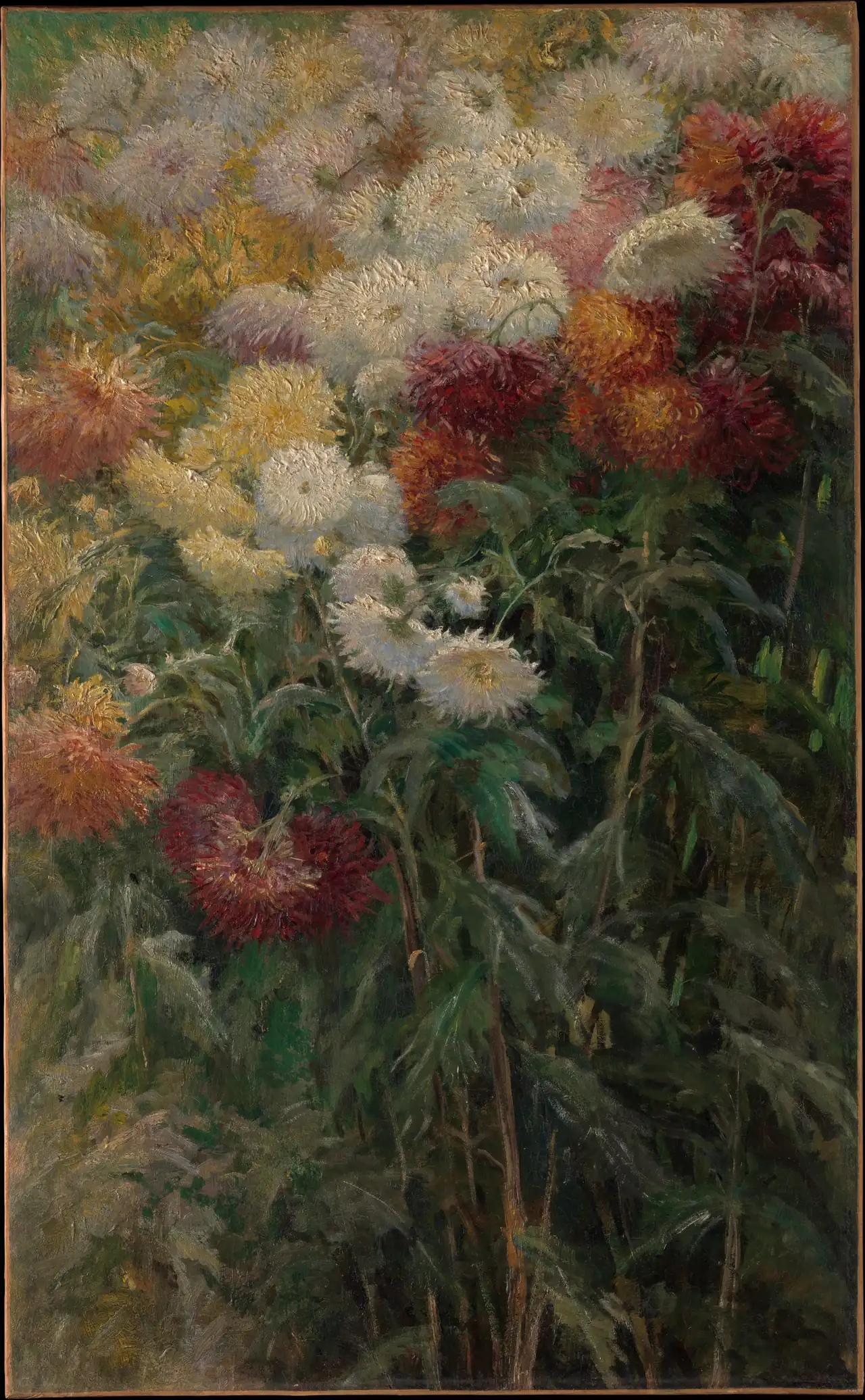
These flowers were not arranged in a vase. The Met identifies plants Caillebotte cultivated at his property in Petit-Gennevilliers. The tall canvas brings blossoms forward while stems and dark leaves occupy much of its lower half.
Compare the absence of a horizon with Van Gogh’s close view. Caillebotte gives us neither garden layout nor a distant building that would quickly establish scale. The flower heads become unusually imposing because they occupy the place where a landscape might offer sky.
The museum also relates this approach to his project for plant-decorated dining-room doors. That connection makes the narrow format worth noticing without declaring this canvas itself a door. For Caillebotte, a garden could offer more than outdoor scenery: it could become a close, sustained arrangement of colour designed to meet a vertical surface.
Cross: the garden as colour and light
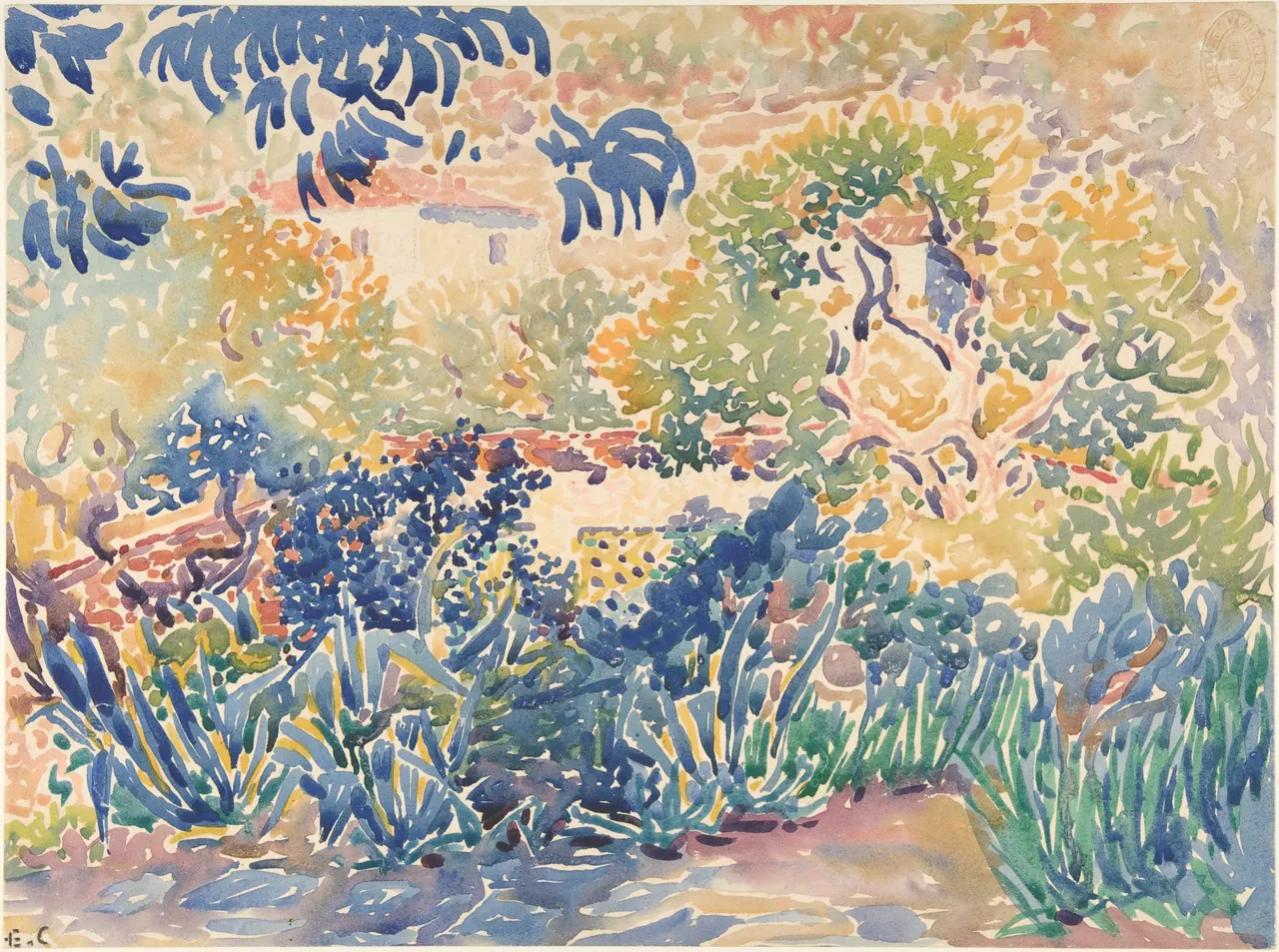
Cross lets pale gaps remain between patches of colour. A blue area may read as shadow, then as an independent brushmark; green and warm tones move between recognisable plants and a pattern spread across the paper.
The Met places this watercolour in his Saint-Clair garden on the Mediterranean coast. It describes his move away from stricter Divisionist arrangements towards broader, mosaic-like marks. Divisionism separates colours in the painted surface; it does not require every mark to be a tiny circular dot.
Here the garden’s light depends partly on what is not covered. Compared with Caillebotte’s dense flowers, the spaces between Cross’s marks make the sheet feel airy. The plants are still the subject, but the process of recognising them remains visible. You can move between reading a garden and examining how watercolour sits on paper.
Monet: when the banks disappear
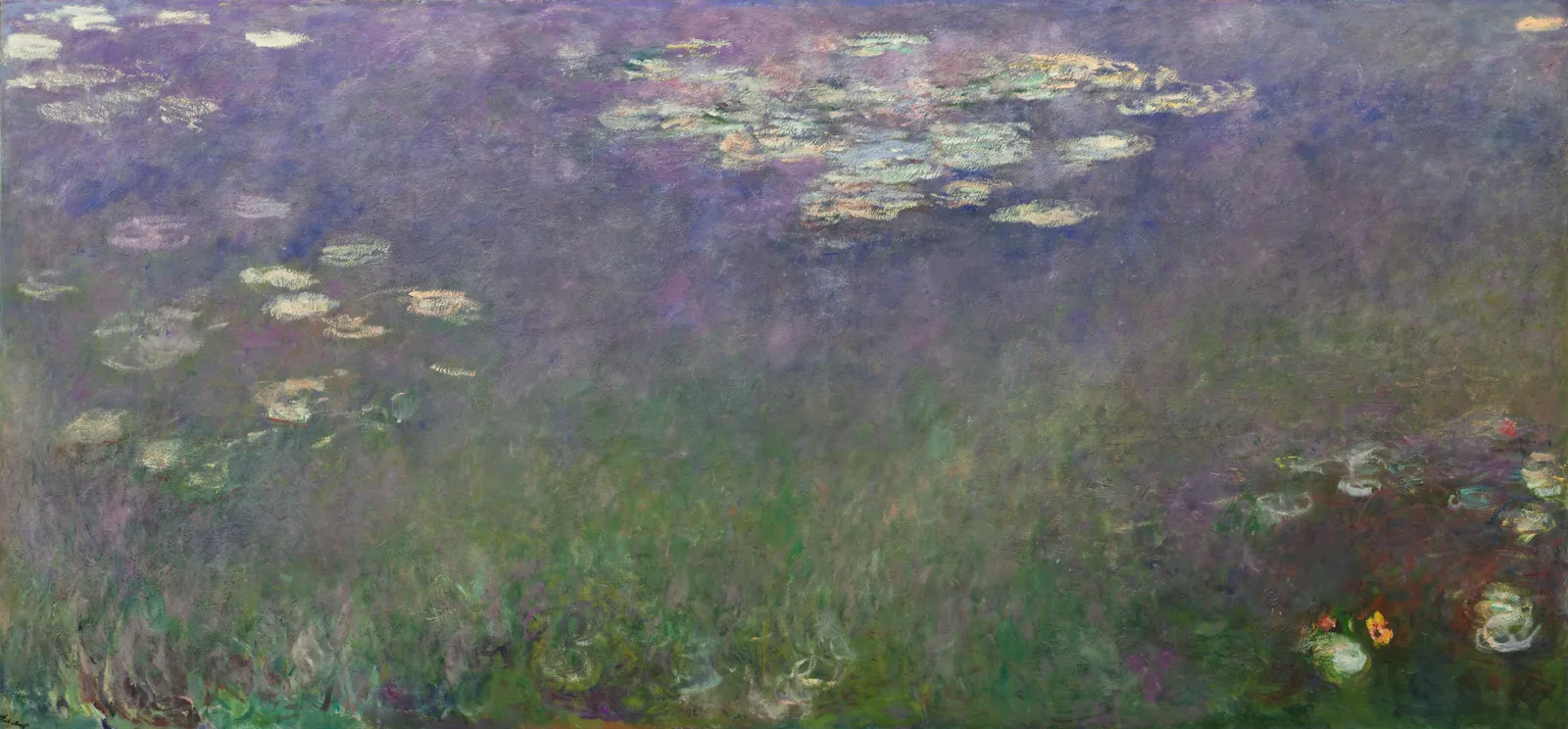
Return to Giverny without the bridge. This late canvas presents water, floating plants and reflections across a width of 4.256 metres. The Cleveland museum explains how the absent banks and horizon extend the apparent space.
The painting has not left the garden behind. Instead, the garden reaches us indirectly: through reflected greenery, lilies and changes in the water’s colour. Familiar orientation points disappear while the subject remains a particular cultivated pond.
This is the left panel of the divided Agapanthus triptych, not the whole ensemble or a view from the Orangerie. Our early and late Water Lilies comparison follows those distinctions. Here it completes another journey: from a garden organised for walking to a garden organised around looking, where a small patch of water can sustain an enormous painted surface.
Look for the garden the painter leaves out
Ask three questions when you meet another garden picture: Where could a person stand? What evidence of cultivation remains? What has the artist left beyond the frame? The answers separate Hiroshige’s visitors, Pissarro’s working objects and Caillebotte’s close flowers more usefully than calling every garden peaceful.
For a further visual route, explore the Monet collection or the Van Gogh collection. They do not contain every work illustrated here. The larger lesson belongs to the pictures themselves: a painted garden is never only a list of plants. It is also a choice about how much of a world to show.
Editorial record
About this article
- Author
- Publisher
- GeMarkt
- Published
- Reviewed
- Internal source & rights check. Conducted by GeMarkt Research Review. This is an internal editorial check—not independent peer review.
- Source standard
- Art history source standardPrioritises object records and research sources, distinguishes evidence from interpretation, and states material uncertainty.
Found a claim that needs checking? Report a factual error.