GeMarkt Blog · Practical guide
Is Jean-Honoré Fragonard’s Art Public Domain? Works and Files
Explore Fragonard’s paintings and drawings with two exact Met Open Access images, twelve research records and clear artwork, country and file distinctions.
Rights check · reviewed
The short answer
Fragonard’s ordinary EU author term has expired. Two exact Met files are designated Public Domain / CC0. That does not independently resolve the paintings’ U.S. publication histories or grant permission for every modern photograph and reproduction.
| What is being checked | Result | Why |
|---|---|---|
| European Union — ordinary author term | Named artist’s own term expired | Fragonard died in 1806; the ordinary life-plus-70 economic term has elapsed. Later contributions, first-publication rights and national moral-rights rules are not cleared by this calculation. |
| United States — work-specific publication history | Independent publication chain not established | This guide does not independently establish U.S. publication history for the twelve research objects, including every illustrated work. Museum public-domain designations are attributed, not presented as our own publication findings. Creation or exhibition dates alone are insufficient. |
| Selected digital files | Exact Met Open Access files | Met objects 436322 and 436324 supply the selected Public Domain / CC0 files. Exact source names, dimensions, accession numbers and hashes are preserved. No other modern photographer’s or publisher’s file is covered by that designation. |
| Other works, providers and countries | Separate evidence needed | No worldwide or whole-catalogue clearance. Research links do not create an approved download set. Modern photographs, adaptations, writing and other contributors’ work require separate evidence. |
Twelve exact Met research records; two illustrated paintings and ten additional research links. No generic clearance for works attributed to, after or made in the workshop of Fragonard, or for a different photograph of a similarly titled painting.
This is a documented research summary, not legal advice. Copyright and moral-rights rules can vary by country and by the history of a particular work.

What we’ll look at
Which Fragonard painting or drawing is behind the image you want to use?
Short answer: Fragonard’s own ordinary EU copyright term has expired. For the two images shown here, The Metropolitan Museum of Art also supplies exact Public Domain files through its CC0 programme. That is a useful, bounded answer—not permission for every modern photograph or an independent U.S. publication finding for his entire output.
Jean-Honoré Fragonard lived from 1732 to 1806. His paintings can feel immediately familiar: a letter, a glance, a silk dress, a garden where small figures disappear beneath trees. The apparent ease is part of their appeal. It can also tempt a caption writer to supply a detailed romantic plot that the picture does not actually establish.
This guide begins with two real objects, then separates the artwork’s identity from the file used to reproduce it. Both illustrated paintings are in the Met. The other ten links are research references, not ten more cleared illustrations.
First identify the work
A title such as The Love Letter is not a unique identifier across art history. Nor does “Fragonard kiss painting” reliably identify one composition. The Met’s The Stolen Kiss is a specific canvas dated about 1760, accession 56.100.1. Keep those details together before comparing it with another image carrying a similar title.
The medium is equally useful. The Draftsman is black chalk on paper, while Roman Interior is oil on canvas. A monochrome online image might be a drawing, an old photograph of a painting or a print made after one. The caption should say which, rather than assuming that anything under Fragonard’s name is a painted original.
When a record says “attributed to,” “after” or “workshop of,” carry that wording forward. It describes a different level of authorship or a different maker. These twelve selected Met records name Fragonard directly; that does not establish the attribution of an unrelated image on another website.
The letter does not tell us everything
The opening image, The Love Letter, dates to the early 1770s. A woman turns toward us from a writing desk. She holds a small bouquet with a piece of paper among the flowers. A dog sits beside her, while the light picks out her face, cap and pale blue dress.
The Met describes this as a genre scene rather than a portrait of a known sitter. A genre scene presents a situation from life, whether observed or imagined; it does not necessarily identify the people involved. We can see the letter and flowers, but they do not independently tell us who sent them or what happened next.
Look at the dress before trying to solve the story. Near the shoulder, paint follows the turn of the body. Across the lower skirt, long folds lead downward and outward. On the dog, small bright marks suggest a different, shaggy texture. The variety keeps the scene lively without making every surface equally smooth.
It is also a finished painting with a deliberately lively handling of paint. Loose marks do not by themselves prove that an image is an abandoned sketch. Calling the work “unfinished” simply because the brushwork is visible would confuse appearance with documented status.
A garden larger than its figures
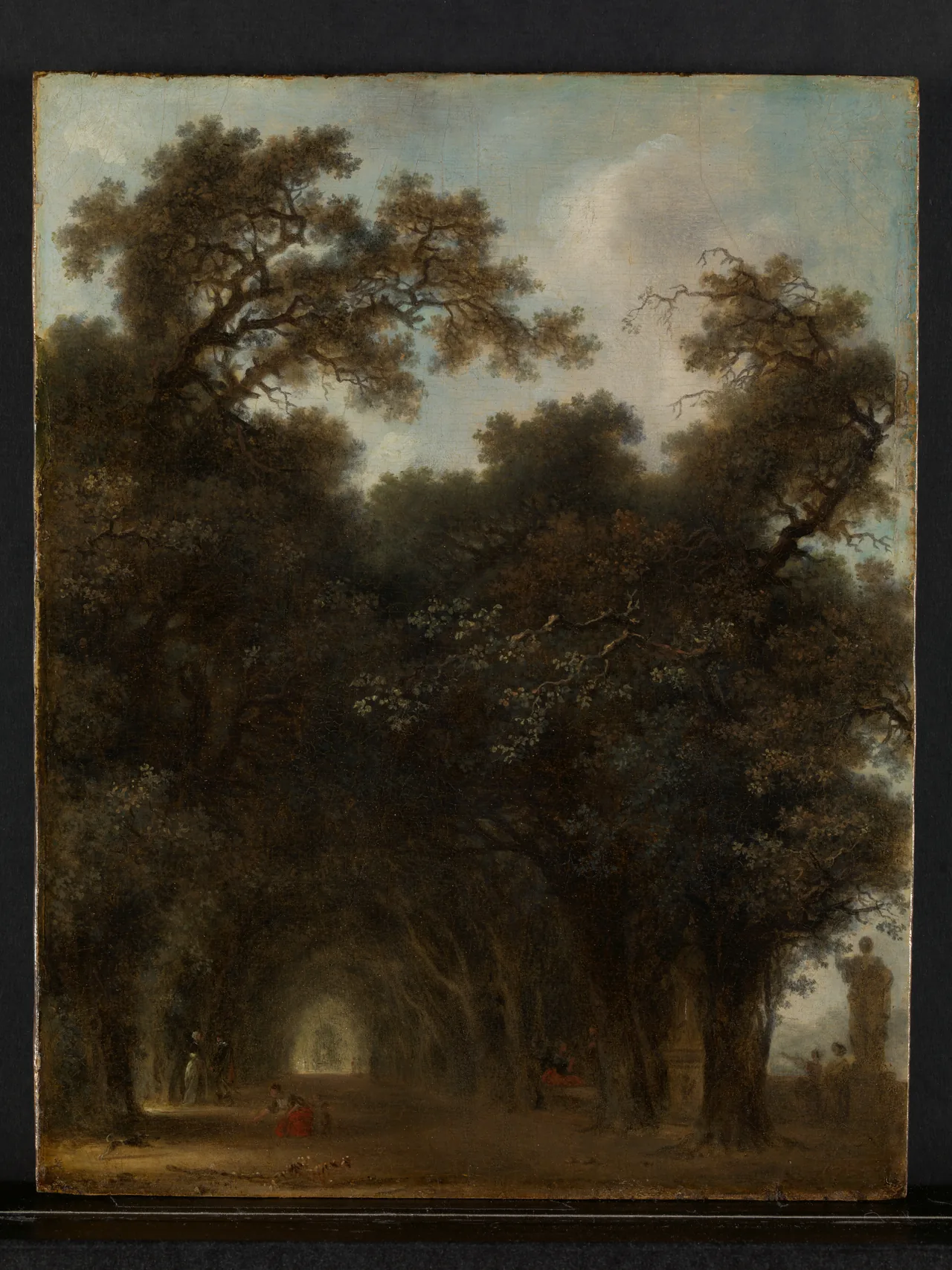
Jean-Honoré Fragonard, A Shaded Avenue, about 1775. The Metropolitan Museum of Art, The Jules Bache Collection, 1949, 49.7.51. Object record. Public Domain / Open Access (CC0).
In A Shaded Avenue, the people are much smaller than the trees. Branches and foliage build a dark passage around a distant opening. A pale statue stands at the right; small touches of red make the seated figures easier to locate near the bottom.
Try following the path from the foreground to the light. It gives the picture depth without requiring a detailed map of the garden. The people animate that space, but the towering trees do most of the work. This is a different rhythm from the close, crowded interior of The Love Letter.
The work is oil on wood, only about 29 by 24 centimetres. Its apparently immense garden occupies a small painted panel. The supplied photograph includes a dark surround and the panel’s edges; those are not more foliage. Keeping the complete file avoids confusing the painted area with its photographic surroundings.
Twelve exact records, with two illustrated files
These are separate objects, not a ranking of Fragonard’s most famous works. The selection includes landscape, domestic scenes, portraiture and drawings, which helps prevent “Fragonard” from becoming shorthand for one kind of romantic subject.
| Met work | Date / medium | Status here |
|---|---|---|
| The Love Letter | Early 1770s; oil on canvas | Exact Met CC0 file illustrated. |
| A Shaded Avenue | About 1775; oil on wood | Exact Met CC0 file illustrated. |
| The Cascade | About 1775; oil on wood | Research link. |
| Portrait of a Young Woman | 1770s; oil on canvas | Research link. |
| Roman Interior | About 1760; oil on canvas | Research link. |
| Marie Emilie Coignet de Courson with a Dog | About 1769; oil on canvas | Identified sitter, unlike the opening genre scene. |
| The Stolen Kiss | About 1760; oil on canvas | Accession 56.100.1 identifies this version. |
| The Two Sisters | About 1769–70; oil on canvas | Research link. |
| Allegory of Vigilance | About 1772; oil on canvas | Research link. |
| Landscape with Road and Monument | Mid-18th–early 19th century; pencil and wash | Broad catalogue range retained. |
| The Draftsman | 1770s; black chalk | Drawing, not a photograph of a painting. |
| The Dreamer | Late 1770s; pencil and sepia wash | Research link. |
Rights, with the limits kept visible
Fragonard’s death in 1806 means that his own ordinary EU economic term is long past the life-plus-seventy-year period. The EU directive does not turn that into a decision on every country, later publication right or national moral-rights rule.
This guide does not independently establish U.S. publication history for the twelve works, including the two illustrated paintings. It attributes the Met’s public-domain designation rather than claiming to have reconstructed a complete publication chain. Under U.S. section 303, qualifying older, formerly unpublished works need a separate analysis. A painting’s eighteenth-century date alone is not that analysis.
For the two selected files, the museum evidence is direct: each object is marked Public Domain, and the Met Open Access programme offers the designated images under CC0. This does not license another photographer’s image, modern commentary or a redesigned commercial download.
Keep a useful source note
For each file, save the museum URL, accession, exact title, qualified date, credit and rights designation. A filename such as “Fragonard vintage art final” is not a source record. The accession connects your file to a particular object even when titles are translated differently.
Describe changes honestly. A close-up can help someone see the letter or the dog, but label it as a detail rather than presenting it as the entire work. A recoloured background is an adaptation, not evidence of the painting’s original colour.
Above all, let the visible work and the institutional record set the limits of the story. You can enjoy the possibility of a romance without inventing the sender’s identity—and use an identified open file without promising that every Fragonard image on the internet is unrestricted.
Sources and review method
We checked the artist chronology against museum records, treated each named jurisdiction separately, and recorded the provider policy for the image set. These sources support the legal framework and artist dates used above; the source file for any individual image still needs its own record.
- The Love Letter, 49.7.49 — The Metropolitan Museum of Art. Exact feature image, qualified date, genre-not-portrait distinction and deliberate sketch-like handling.
- A Shaded Avenue, 49.7.51 — The Metropolitan Museum of Art. Second illustrated painting, oil-on-wood support, dimensions, date and exact open file.
- The Stolen Kiss, 56.100.1 — The Metropolitan Museum of Art. Identifies the particular Met painting, avoiding confusion among similarly titled compositions.
- Open Access at The Met — The Metropolitan Museum of Art. CC0 designation for the exact museum-supplied images marked Public Domain; not a release of unrelated third-party files.
- Directive 2006/116/EC, Articles 1, 4, 8 and 9 — EUR-Lex. Ordinary author-life-plus-70 term, later first-publication rights and national moral-rights distinctions.
- 17 U.S.C. Chapter 3, including section 303 — U.S. Copyright Office. Publication and formerly unpublished-work analysis; painting and exhibition dates do not establish publication.
Editorial record
About this article
- Author
- Publisher
- GeMarkt
- Published
- Reviewed
- Internal source & rights check. Conducted by GeMarkt Research Review. This is an internal editorial check—not independent peer review.
- Source standard
- Rights guide source standardSeparates the underlying work from the source file, records the review date, and links the evidence used for the conclusion.
Found a claim that needs checking? Report a factual error.