GeMarkt Blog · Essay
Water Lilies: Early vs Late Series
Compare Monet’s 1899 footbridge, a 1906 pond painting and a late Agapanthus panel to see how viewpoint, scale and reflected space change.

A bridge gives you somewhere to look. Its arch crosses the pond, plants crowd the banks, and lily pads float beneath it. In a later painting, that familiar garden seems to have lost its edges. Water, sky and trees meet on one surface, and the canvas can be wider than your field of vision.
Monet’s late Water Lilies often change your position from looking into a garden to looking across an enveloping expanse of painted water. But the shift was neither instant nor absolute. An 1899 bridge painting, a 1906 surface study and a late panel show the development more clearly than a simple progression from “realistic” to “abstract”.
A project not a numbered set
Water Lilies names a long project, not one painting with a fixed number of copies. Museums use the title for separate canvases, individual panels and multi-panel compositions. Nymphéas is the French name for water lilies, not a unique catalogue number.
Even overall counts depend on what is included. The National Gallery describes about 250 paintings of the water garden, distinguishing the lilies from related bridge and planting subjects. The Orangerie’s broader account speaks of almost 300 paintings. Neither number should become a claim that there are precisely that many versions of the same image.
For this comparison, “early” means the bridge-focused work around 1899, and “late” means the monumental project of Monet’s final years. The 1903–08 water-surface paintings form an important middle stage, not an inconvenient exception.
An early bridge and a late panel side by side
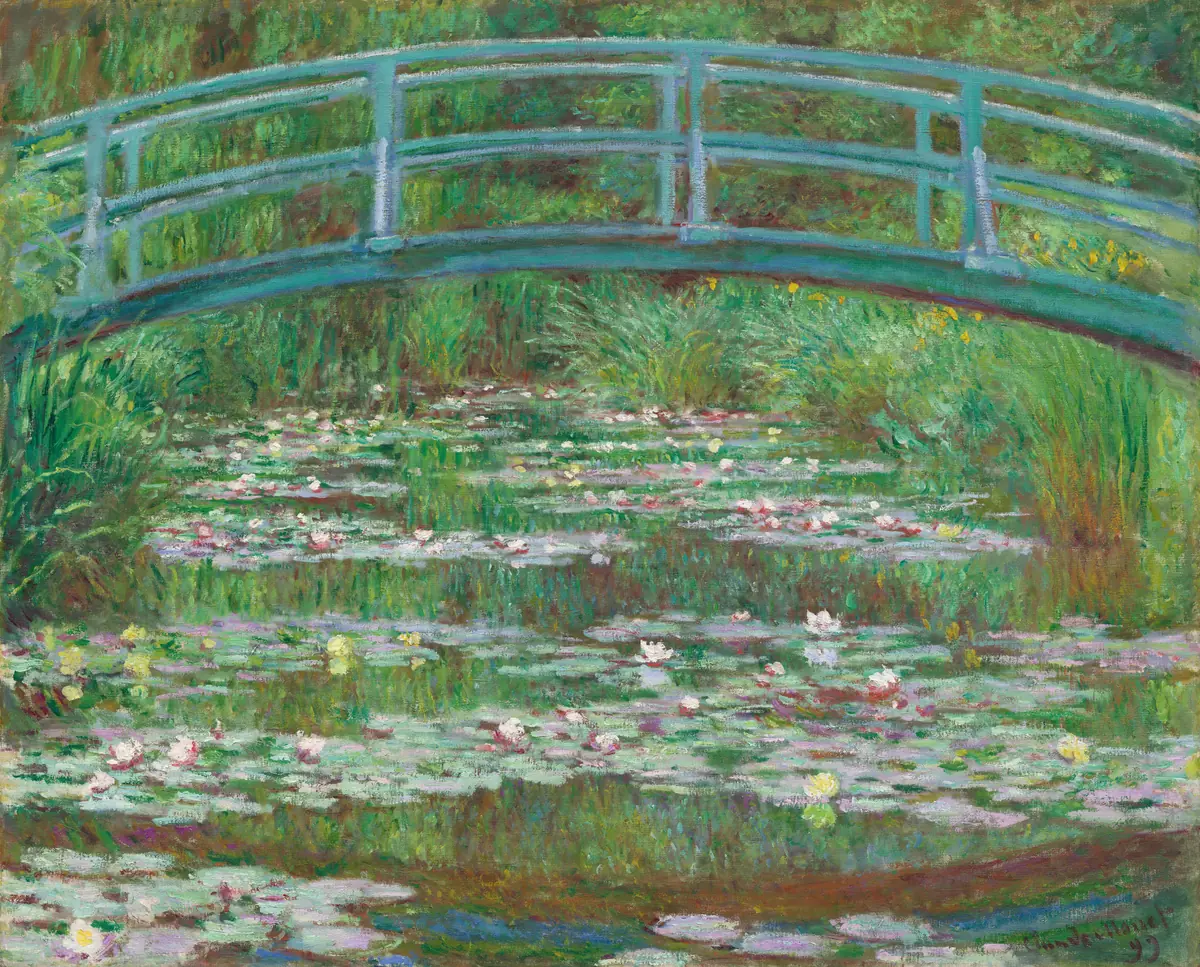
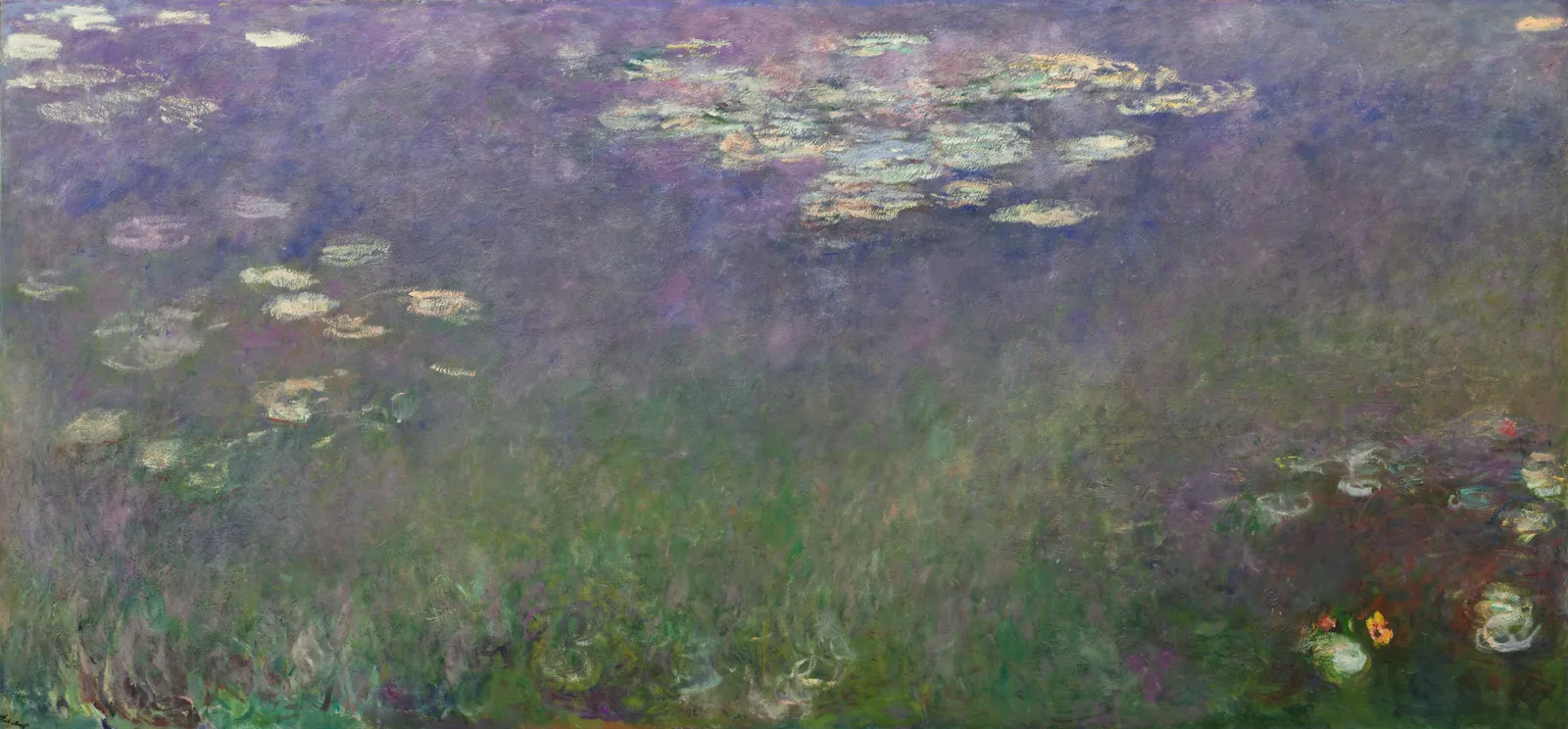
The images preserve their own proportions but are not shown at the paintings’ relative physical sizes. Notice what disappears before deciding what becomes looser. The late panel has no bridge, no firm bank and no clear division between a distant landscape and its reflection. Yet the floating plants still give your eye something concrete to find.
The bridge gives you a place to stand
In Washington’s Japanese Footbridge, follow the pale curve from left to right. Beneath it, a darker curve is reflected in the pond. The two arcs help hold the space together. Small light patches of lilies move between them and towards the foreground.
The National Gallery of Art identifies this as one of twelve 1899 views from a single vantage point. Monet had designed the garden he was painting, including the pond, plantings and bridge. Observation here concerns a cultivated place, not an untouched wilderness.
Still, the scene is less stable than a straightforward garden plan. The bridge occupies the upper portion while the lilies invite a downward look. Reflected greenery fills spaces that might otherwise let you measure the pond’s depth. You can identify the setting without being able to stand comfortably in every part of its painted perspective.
The National Gallery’s discussion of its own 1899 bridge canvas describes this shifting relation between looking up and looking down. London and Washington hold different paintings; the shared problem is not evidence that their images are interchangeable.
The 1906 painting removes the bank
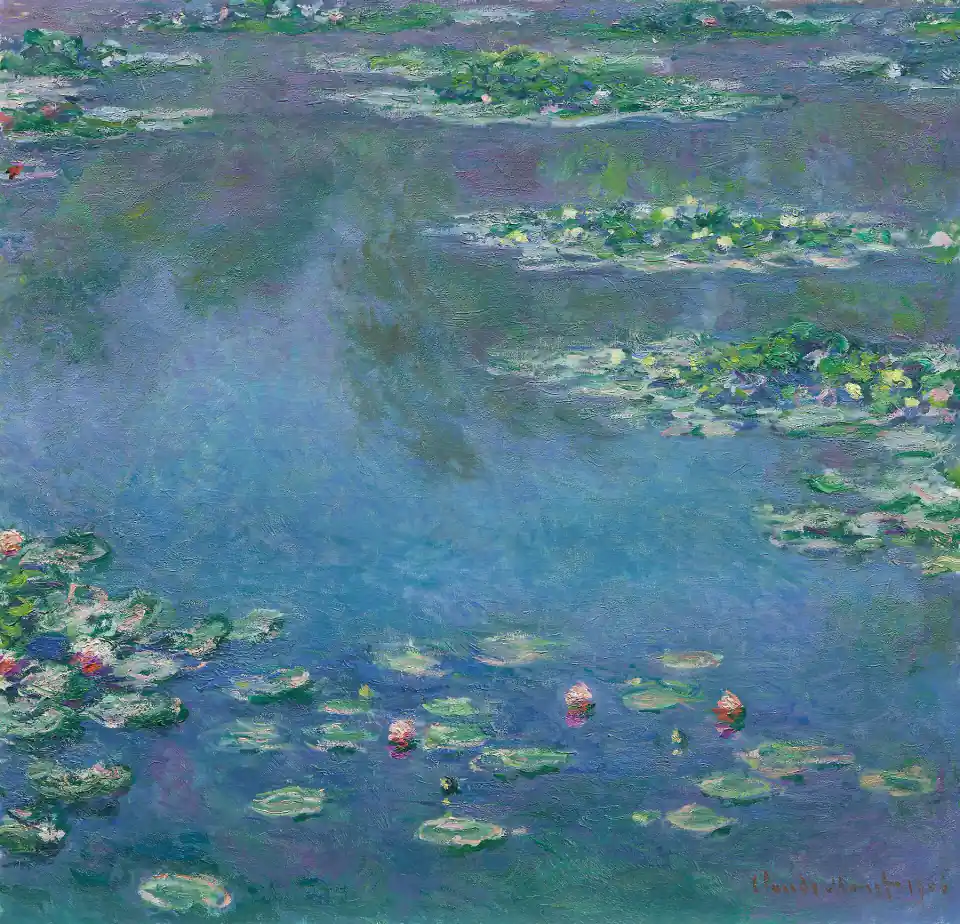

This nearly square painting is the useful interruption to a tidy early-versus-late story. It dates to 1906, well before the great late decorations, but bridge and bank are already absent.
Look into the open central blue. The plants along the edges locate the surface, while darker vertical forms seem to lead into reflected trees. The same area can appear shallow when you follow a lily pad and deep when you follow a reflection. No horizon resolves the two readings.
The Art Institute’s collection data places the work within the 1903–08 group and records significant revisions discovered through technical examination. An image that feels fleeting could therefore be built through sustained adjustment. “Impression” does not mean that every mark survived untouched from one quick outdoor sitting.
Late scale changes the encounter
Return to Cleveland’s panel. Its measured width is 4.256 metres, compared with 1.016 metres for Washington’s bridge painting. That is roughly four times the width, not merely the same experience enlarged on a screen.
Across the late canvas, pale pads gather and break apart. Longer green passages descend through violet water; darker marks collect below. There is no single object as commanding as the bridge. You can begin at several points and follow different paths without exhausting the picture’s organisation.
The Cleveland record emphasises the horizonless composition and broad format. Together they make the scene extend beyond a single framed view. This is still painting of a particular garden, but its scale encourages a bodily encounter: moving your gaze, and sometimes your position, rather than taking everything in at once.
A panel is not the whole triptych
Cleveland’s canvas belongs to the divided Agapanthus triptych. A triptych is a three-part work. Its other panels belong to the Saint Louis Art Museum and the Nelson-Atkins Museum of Art. The Saint Louis museum’s close-look guide identifies its own canvas as the central panel.
This matters when judging the composition. Cleveland’s panel is a complete physical canvas but only one component of that larger arrangement. Do not mistake its right edge for the intended end of the entire ensemble.
Nor is it MoMA’s three-panel Water Lilies. MoMA records a separate work dated 1914–26, with a combined width of 12.76 metres. Matching a broad shape and familiar title is not enough to identify either triptych.
The Orangerie is a different ensemble
The Orangerie’s famous rooms are another specific arrangement, not the destination of every late lily panel. Its history of the cycle explains how Monet’s decorative project became a panoramic encounter in two oval rooms, installed in 1927 after his death.
MoMA describes twenty-two panels installed there. Those physical panels form the Orangerie compositions; they are not twenty-two additional titles that can be counted as if each were a separate easel painting. A panel, a composition and a series are different units.
None of the three images reproduced in this article is an Orangerie view. They let us compare developments within the larger project without borrowing the identity of that installation.
Early and late are not opposites
The early bridge paintings already make reflection and shifting viewpoint difficult to separate. The middle works remove the bank without monumental scale. The late paintings enlarge and repeatedly rework those possibilities rather than suddenly abandon observation.
MoMA’s account of the late project stresses continued revision between 1914 and 1926. A broad date range can therefore be informative: it need not mean the museum has failed to find a single afternoon of painting.
The Orangerie also notes that bridge subjects returned in the later years. “Early has a bridge; late never does” would be an attractive sorting rule and a misleading one. These examples describe tendencies, not a test every Monet must pass.
How to look at a Water Lilies reproduction
Start with four things: the museum and object, the date, the original dimensions, and whether you are seeing a whole painting or one panel. Then ask where the bank has gone, what establishes the water’s surface, and how your eye moves between plants and reflections.
Our guide to where Monet’s Water Lilies are held follows the collection locations. The separate Water Lilies rights guide addresses selected works and files. Here the reward is visual: a familiar pond becomes more interesting when we stop expecting all its paintings to be the same.
Editorial record
About this article
- Author
- Publisher
- GeMarkt
- Published
- Reviewed
- Internal source & rights check. Conducted by GeMarkt Research Review. This is an internal editorial check—not independent peer review.
- Source standard
- Art history source standardPrioritises object records and research sources, distinguishes evidence from interpretation, and states material uncertainty.
Found a claim that needs checking? Report a factual error.