GeMarkt Blog · Essay
Women Reading and Writing in Art
Follow eight works by Vermeer, Fragonard, Morisot, Whistler and Cassatt to see how letters, books and newspapers change a picture’s story.

The woman is looking down, but we keep looking at her. A book or letter gives a painted figure something to do beyond posing for our attention. Sometimes the words remain private. Sometimes a lifted face acknowledges us. Sometimes another person has just brought the message into the room.
Pictures of women reading and writing are not one timeless symbol of quiet femininity. They can stage privacy, correspondence, leisure, work or an encounter with current affairs. Eight works by five artists show how much changes when we follow the hands, the page and the direction of the gaze.
The page we cannot read
These pictures place us in an awkward position: we can inspect a room more closely than we can understand its occupant’s thoughts. That gap is often their strongest narrative device. A letter implies a sender elsewhere; a book suggests an extended activity; a newspaper connects a seated reader with events outside the frame.
Yet an unreadable page is not evidence of a particular romance, political opinion or state of mind. The object record may identify the sitter or explain a historical convention. Where it does not, the painting’s arrangement remains available to us without a made-up biography. Notice, too, who makes the image: Morisot and Cassatt are artists shaping these encounters, not merely women appearing in them.
Vermeer: a letter kept private
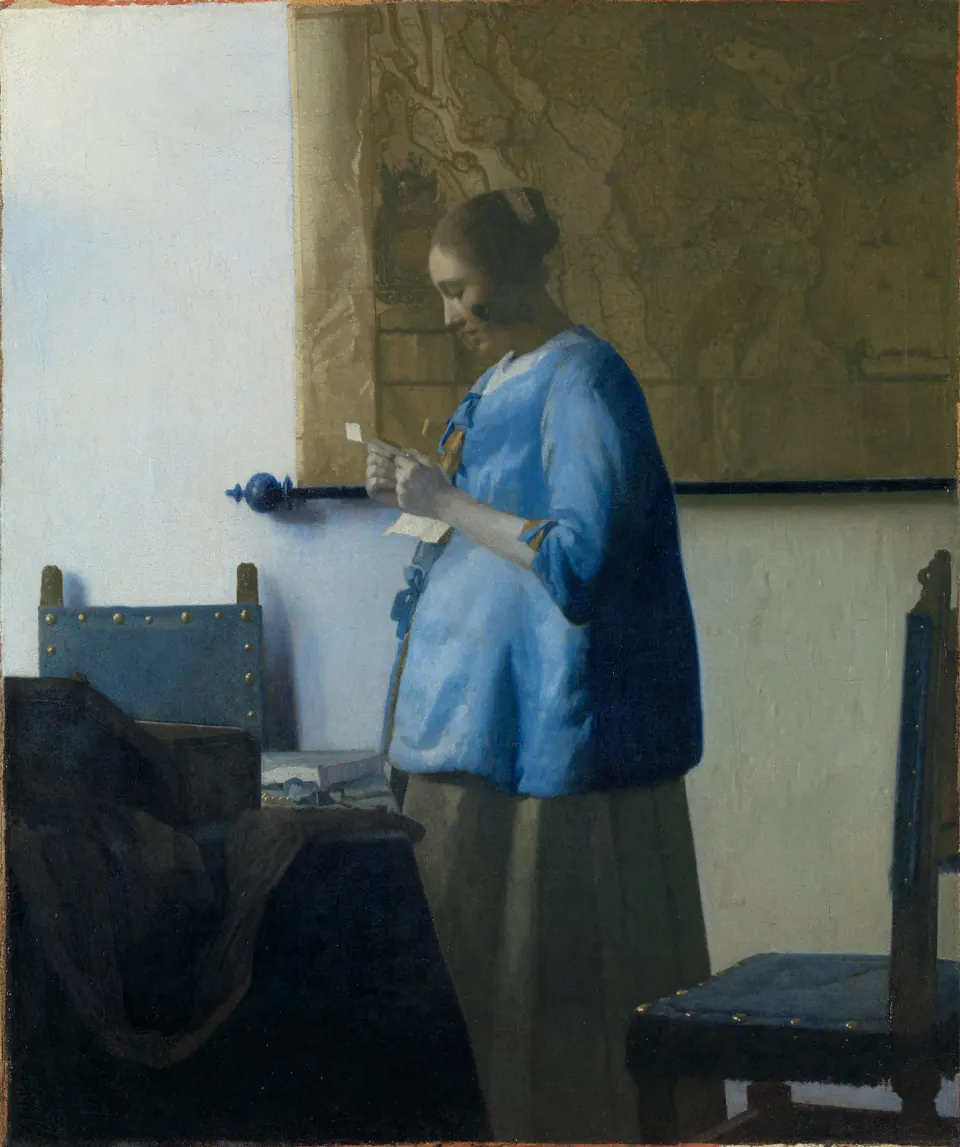
The sheet is small; the concentration around it is not. A woman stands between furniture and a wall map, her blue jacket occupying the centre. Her bent elbows form a compact space around the letter. The chairs give us no obvious route into that space.
The Rijksmuseum identifies a private morning scene. Look at the difference between the large map and the tiny paper: both might carry information, but neither yields its contents easily in this view. The map enlarges the room’s imagined reach while the reader’s attention contracts towards her hands.
It is tempting to decide that she has received news from a traveller. The visible arrangement allows that thought without proving it. What the picture securely gives us is a person absorbed in something we cannot share. Even the absence of another figure becomes active: she has an audience in us, but she does not respond to it.
Vermeer: a writer who meets your eye
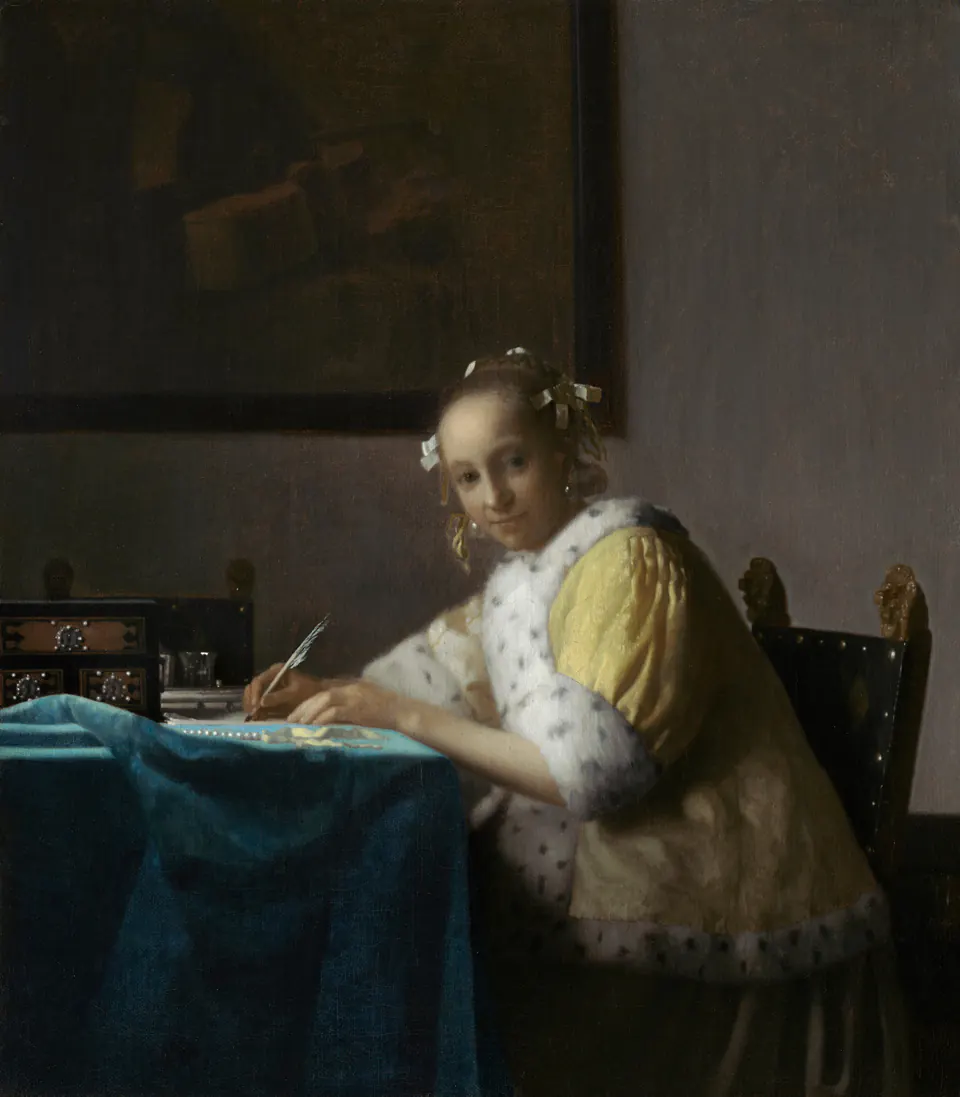
Here the hand continues to hold the quill while the face turns outward. We seem to have arrived during an action rather than after it. The bright jacket and face bring the writer forward against the dark picture on the wall.
The National Gallery of Art notes that the direct gaze has prompted a possible portrait reading, rather than treating the woman only as an anonymous figure in an everyday scene. That remains a possibility, not a securely named sitter.
Compare this with the previous painting. There, the profile kept our attention at a distance. Here, the eyes invite a relationship even though the words remain hidden. Vermeer’s interiors can make writing both an inward activity and a social encounter; a familiar yellow jacket does not make these women interchangeable characters.
Vermeer: a message between two women
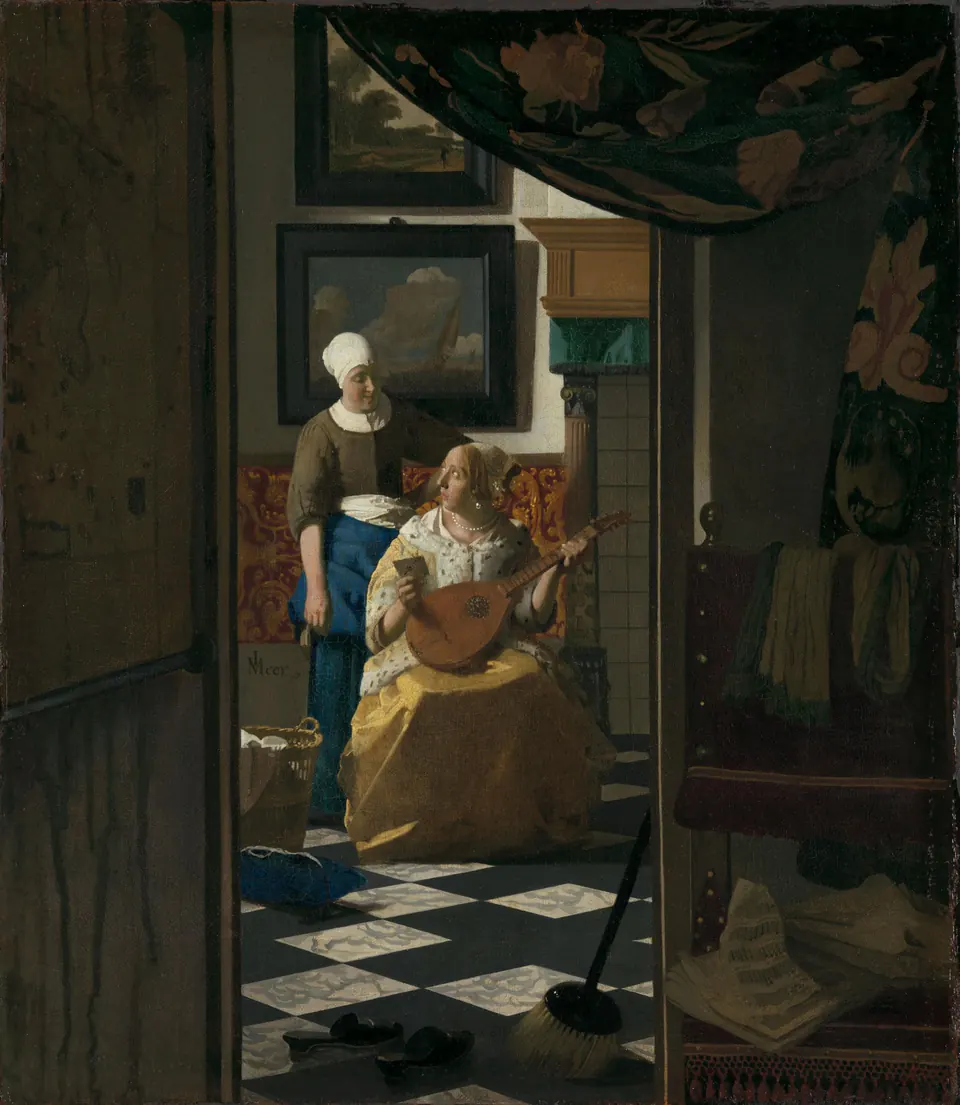
The letter now belongs to an exchange. The seated musician and standing maid look at one another, while we look through a darker adjoining space. The curtain, doorway and foreground objects make the illuminated room feel discovered rather than offered openly.
The Rijksmuseum connects the seascape behind them with a seventeenth-century comparison between love and a sea voyage. That is a historically grounded interpretation, not a rule that every painted ship means romance.
More immediately, compare the women’s positions. One has delivered a message; the other holds it while keeping an instrument on her lap. The maid is essential to the action, not incidental decoration. Before anything is read aloud, the painting turns communication into a relationship between people in different household roles. It also makes us aware that a seemingly private letter depends on someone carrying it.
Fragonard: the letter as an unfinished story
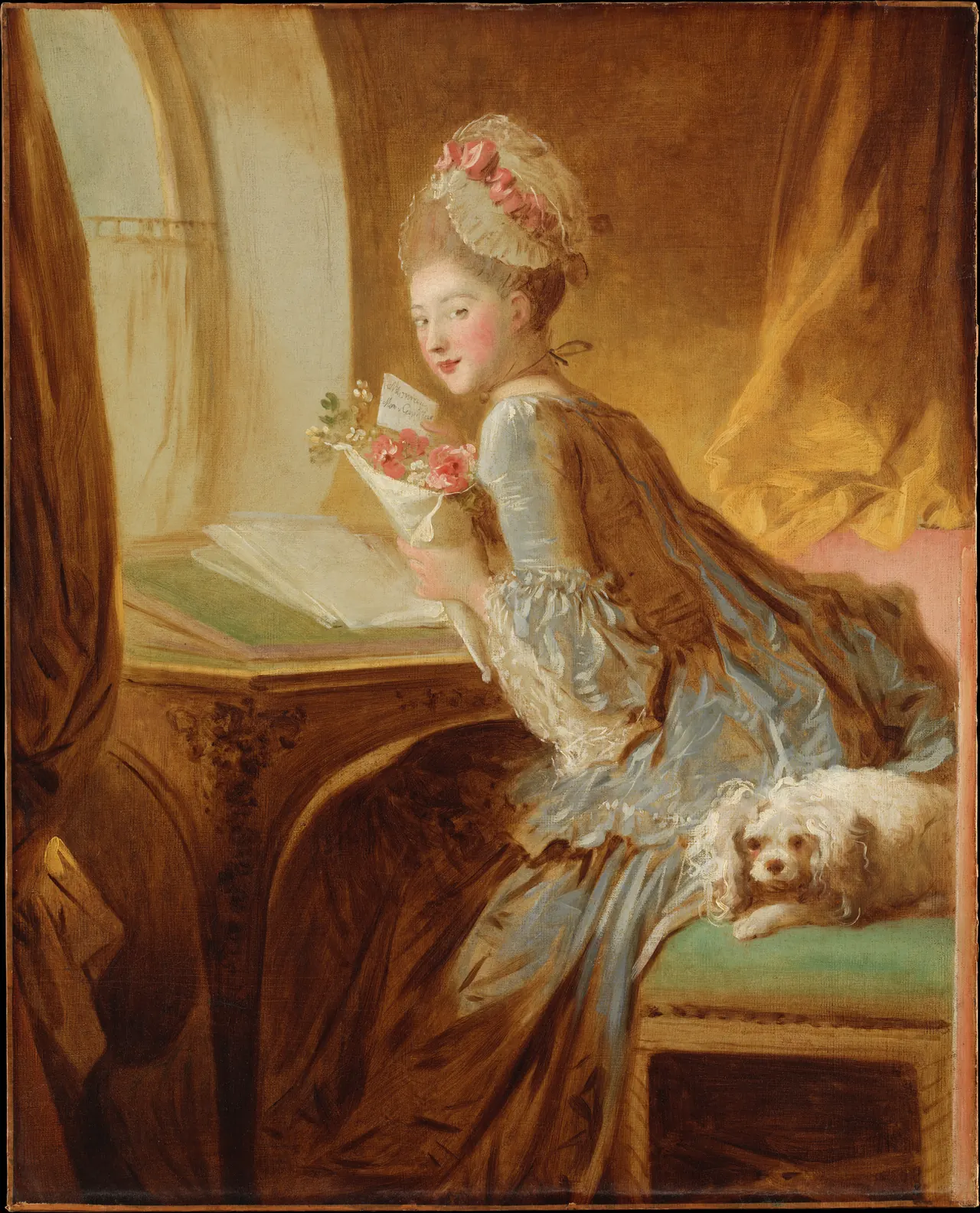
More than a century later, Fragonard makes the turn towards us almost theatrical. Letter, bouquet and face gather in the light. Swift-looking strokes animate the dress and the small dog, while the surrounding brown tones keep the bright cluster prominent.
The Met identifies this as a genre scene, not a portrait, and relates its implied story to the earlier popularity of love-letter subjects. It also explains that the painting’s sketch-like handling was a valued aesthetic, not simply a sign that the work was abandoned.
The props invite us to imagine someone outside the frame, but they do not supply a complete plot. Her turn can look welcoming, conspiratorial or interrupted depending on where we begin. The pleasure lies partly in that suspended moment: correspondence has produced an image whose next sentence is missing.
Morisot: attention beyond the viewer
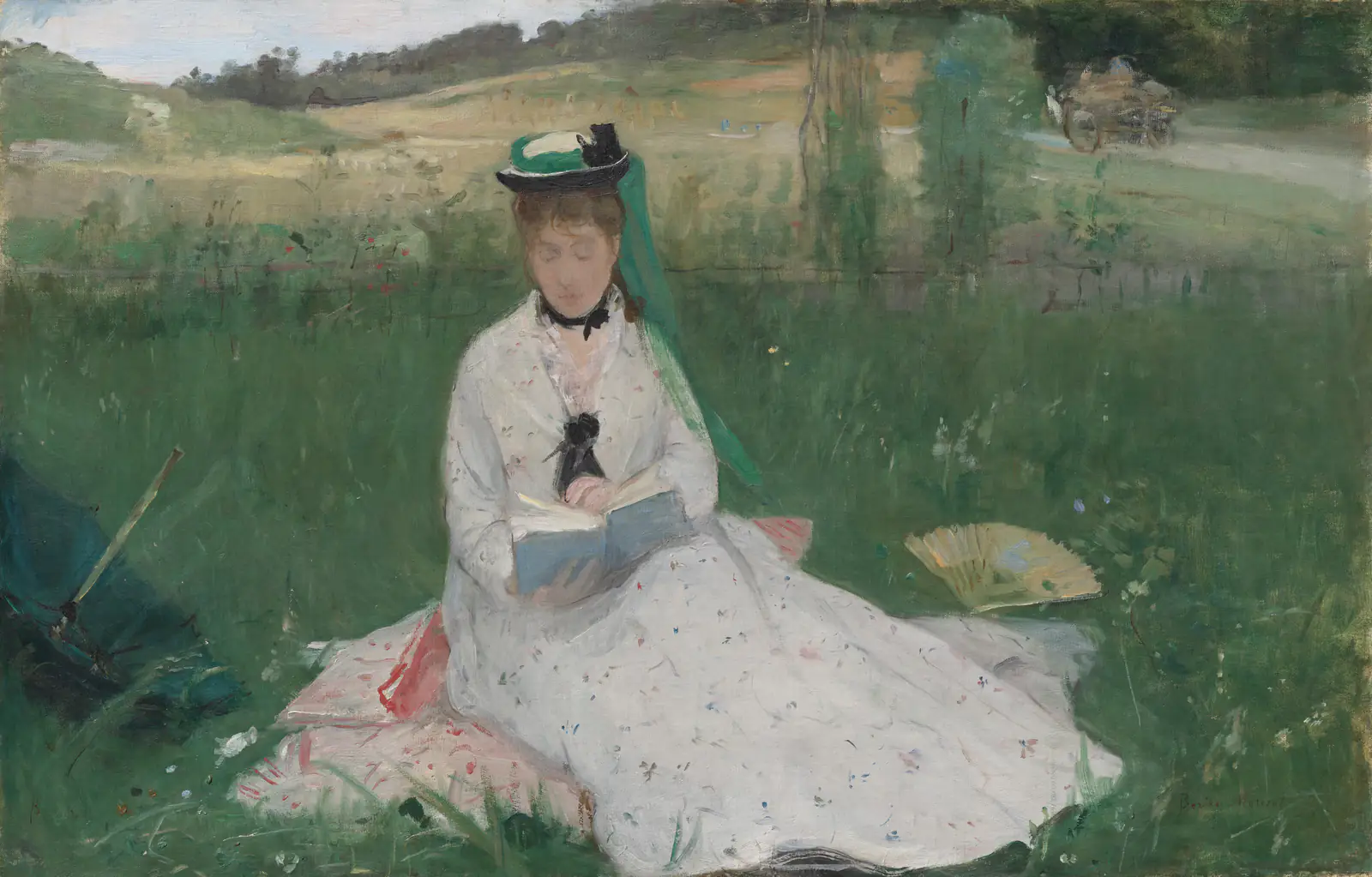
There is a named sitter here: Cleveland identifies Morisot’s sister Edma. She sits outdoors, with a fan and parasol set aside. The pale dress spreads across the foreground while the open blue book forms a smaller, firmer shape around her hands.
The museum’s technical account makes her lowered eyes especially interesting. X-rays show that Morisot first painted them directed towards the viewer, then changed their orientation. Absorption was therefore a compositional decision, not something we should assume the painter passively recorded.
We can compare this deliberate withdrawal with Vermeer’s outward-looking writer. Neither gaze reveals the sitter’s whole personality. Each changes our position as spectators. In Morisot’s painting, grass and dress remain lively with marks, but the reader need not perform that liveliness for us. The book gives her attention a destination of its own.
Whistler: a reader made of lines
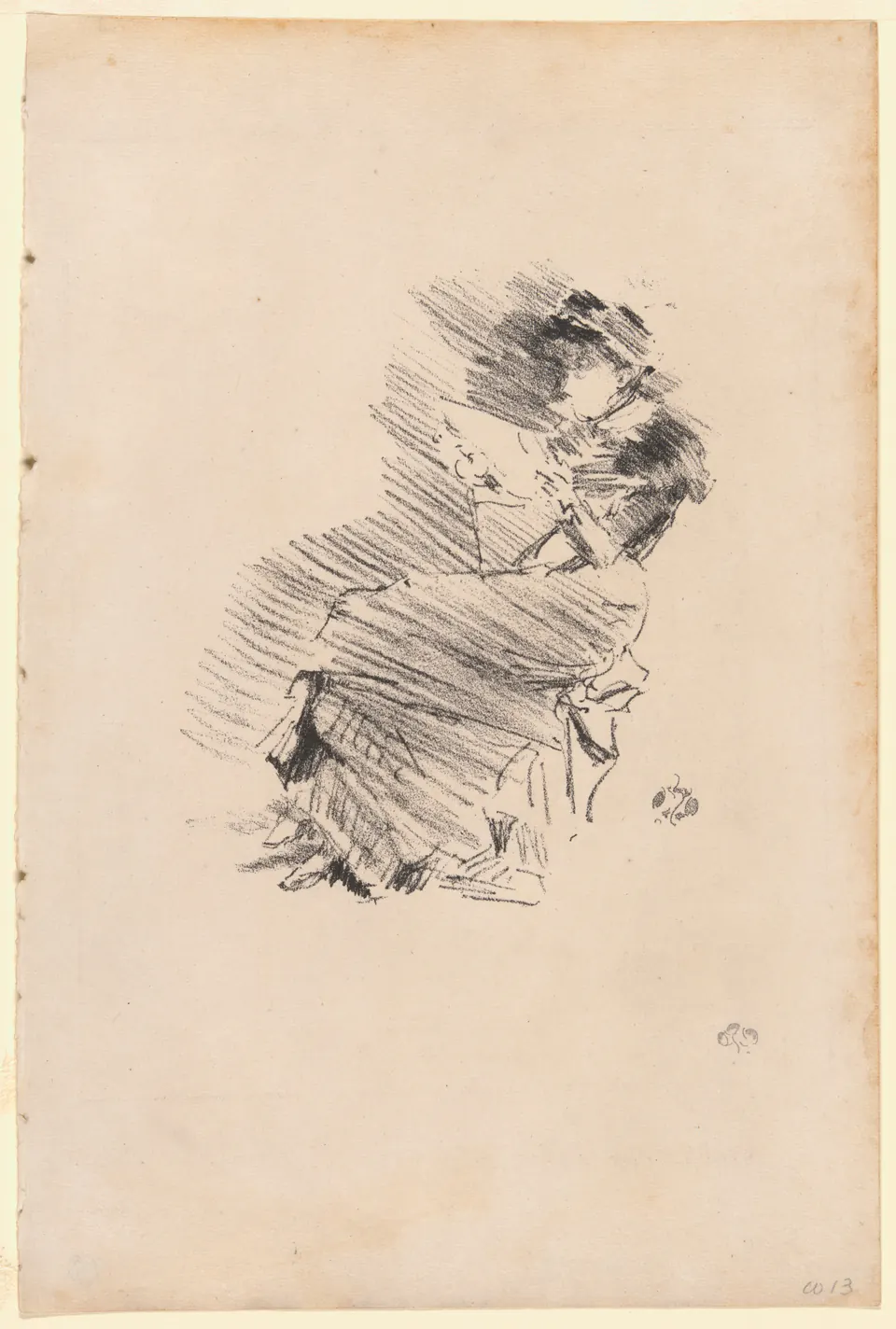
Whistler removes most of the furniture and room. The curved back, lowered head and open book remain, held together by dark strokes against the paper. A large blank surround makes this a concentrated encounter rather than a spacious interior.
The Chicago record distinguishes the 1879 image from its 1887 publication. It is a lithograph, not a pen drawing or a photograph of a painting. A Met impression of the same composition identifies the subject as Maud Franklin; the sheet shown here belongs to Chicago.
Look at how little is required to suggest sustained reading. We cannot identify the book, but the figure’s angle makes its importance clear. Whistler’s printed line carries the action without a readable sentence, elaborate furnishings or an invented explanation of what the reader feels.
Cassatt: the newspaper brings in the world
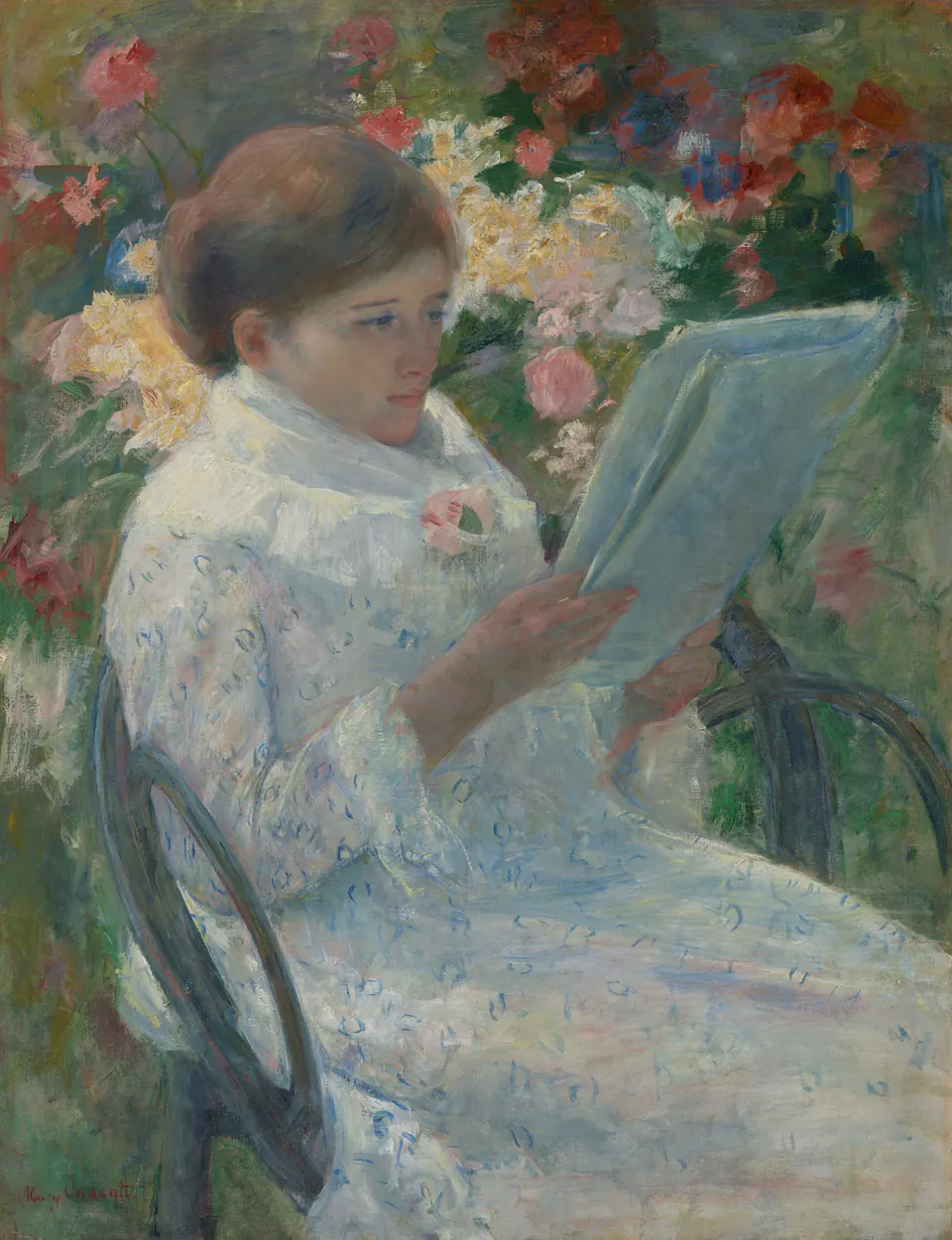
Cassatt’s reader holds the broad sheet upright in front of her. Its sloping edges interrupt the soft curves of the chair and the flowers behind her. We meet an activity with a recognisable physical shape: supporting, opening and scanning a newspaper.
The Art Institute explicitly distinguishes the newspaper from a novel, interpreting it as a connection with contemporary affairs within an intimate setting. The painting appeared in the 1880 Impressionist exhibition.
We need not invent the headline or the reader’s opinion to appreciate the difference. Unlike a private letter, a newspaper belongs to a wider circulation of information. Domestic surroundings do not make that information insignificant. Cassatt’s scene brings public and private life into the same frame without requiring the woman to leave her chair or look up for our benefit.
Cassatt: the practical work of a letter
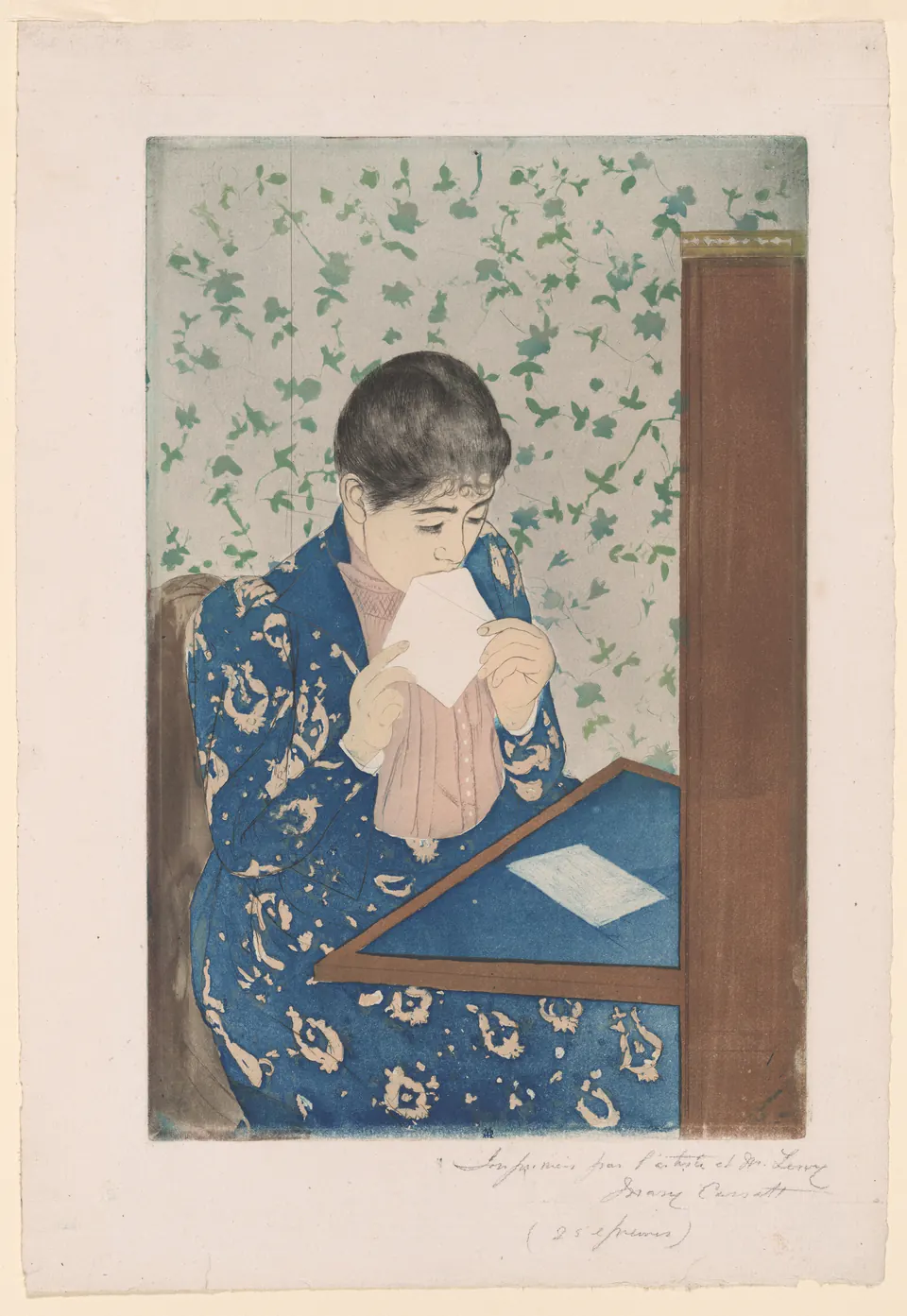
The envelope is at the woman’s mouth: this is the practical business of preparing correspondence, rather than simply gazing at its contents. The angular desk and patterned dress occupy broad areas. The face is comparatively small, yet the hands and envelope keep the action unmistakable.
The Art Institute places this print within Cassatt’s engagement with Japanese colour woodcuts. Her own sheet uses aquatint and drypoint, however, not woodblock printing. Influence does not make the techniques identical.
Compared with Fragonard’s bouquet and outward glance, the emphasis feels less like an invitation to invent a romance than attention to a task. That is a reading of the composition, not proof of the letter’s subject. Cassatt allows pattern, a small bodily gesture and ordinary correspondence to carry the picture together.
Follow the hands before inventing the story
Across these eight works, the page can create privacy, a social exchange or a connection to public events. Following the hands helps distinguish writing, receiving, reading and sealing: actions that a broad label such as “woman with a letter” can conceal.
Return to the gaze afterwards. Does the figure acknowledge you, another person or only the page? That question opens the story while respecting what remains unknown. For choosing a reproduction, our separate women reading and writing guide considers display and scale. You can also explore the collection directory; it is not a catalogue of every work illustrated here.
Editorial record
About this article
- Author
- Publisher
- GeMarkt
- Published
- Reviewed
- Internal source & rights check. Conducted by GeMarkt Research Review. This is an internal editorial check—not independent peer review.
- Source standard
- Art history source standardPrioritises object records and research sources, distinguishes evidence from interpretation, and states material uncertainty.
Found a claim that needs checking? Report a factual error.