GeMarkt Blog · Essay
The Sea in Art: Waves from Hokusai to Aivazovsky
Explore eight sea pictures by seven artists: waves, steamships, working boats and beaches that reveal different relationships between people and water.


Before deciding that a sea picture is peaceful or dramatic, find the people. Hokusai folds boat crews into the troughs between waves. Homer puts one man almost within reach, but beyond help. Sorolla lets children fill the water until the distant horizon disappears altogether.
The sea is never only a background in these eight works. It determines what people can do, how far they can see and whether they appear powerful or vulnerable. It is also a difficult subject to make visible: a moving surface that reflects light while revealing very little of what lies beneath.
This selection brings together seven artists, six oil paintings and two Japanese colour woodblock prints. It is a set of comparisons rather than a complete history. Look especially at your implied position. Are you above the water, standing safely on land, or almost inside a boat? That choice can transform the meaning of the same blue pigment or white crest.
Hokusai places us below the wave
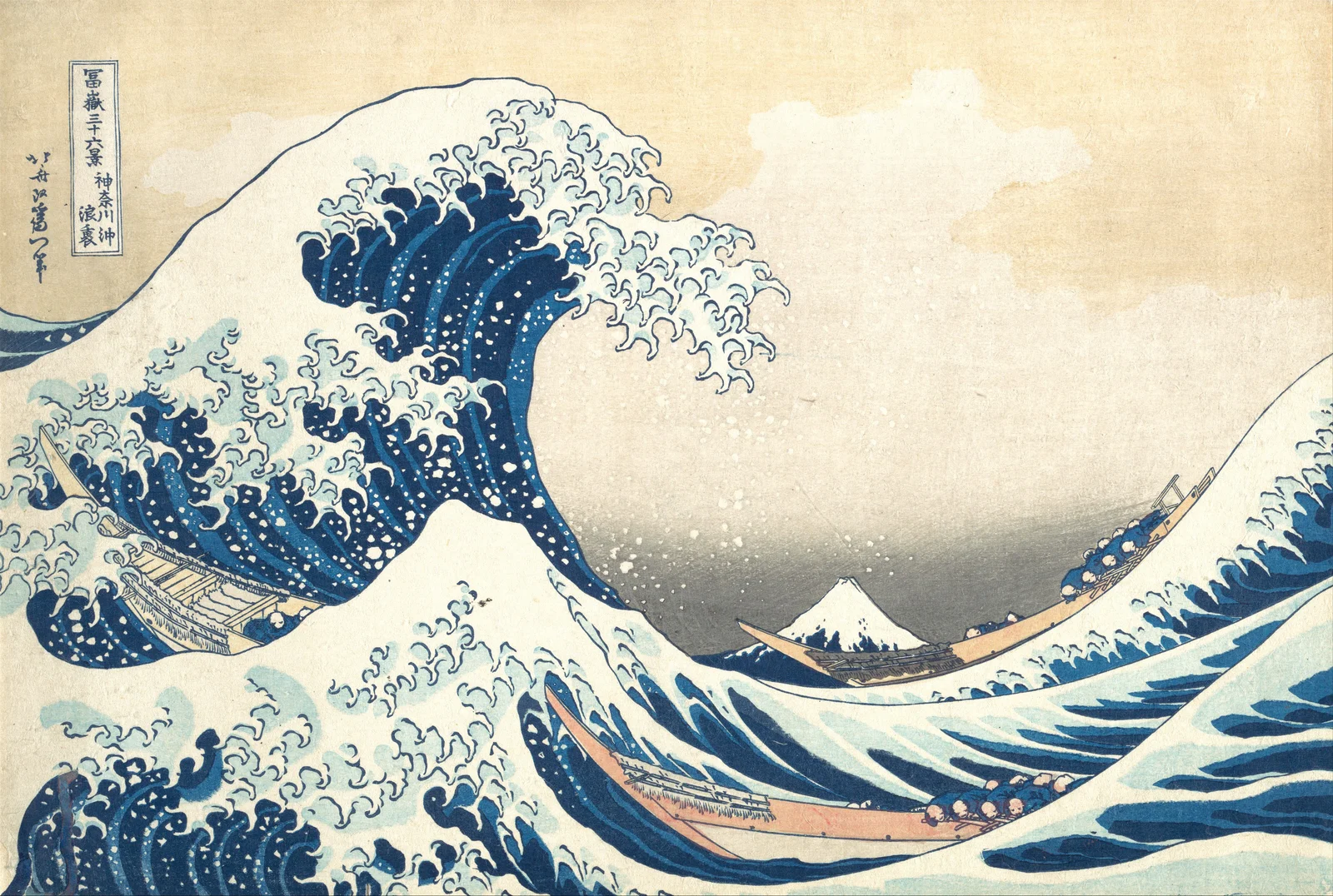
The curling crest is the first thing most viewers see. Stay longer and the boats become just as important. Their narrow hulls follow the water’s curves, while the repeated bent bodies give the scene a human rhythm beneath the foam.
In the distance, Mount Fuji is startlingly small. The Met explains Hokusai’s manipulation of perspective: the enormous mountain fits inside the opening beneath the near wave. Nearness, not real-world size, controls what dominates the picture.
This is a printed design, not an oil painting, and the image shown is one particular museum impression. Clear contours give the water a powerful structure, but they do not make it still. Follow the smaller wave at the left, the larger crest above and the long trough below: the eye travels through a sequence rather than stopping at one isolated emblem.
Hiroshige turns water into a spiral
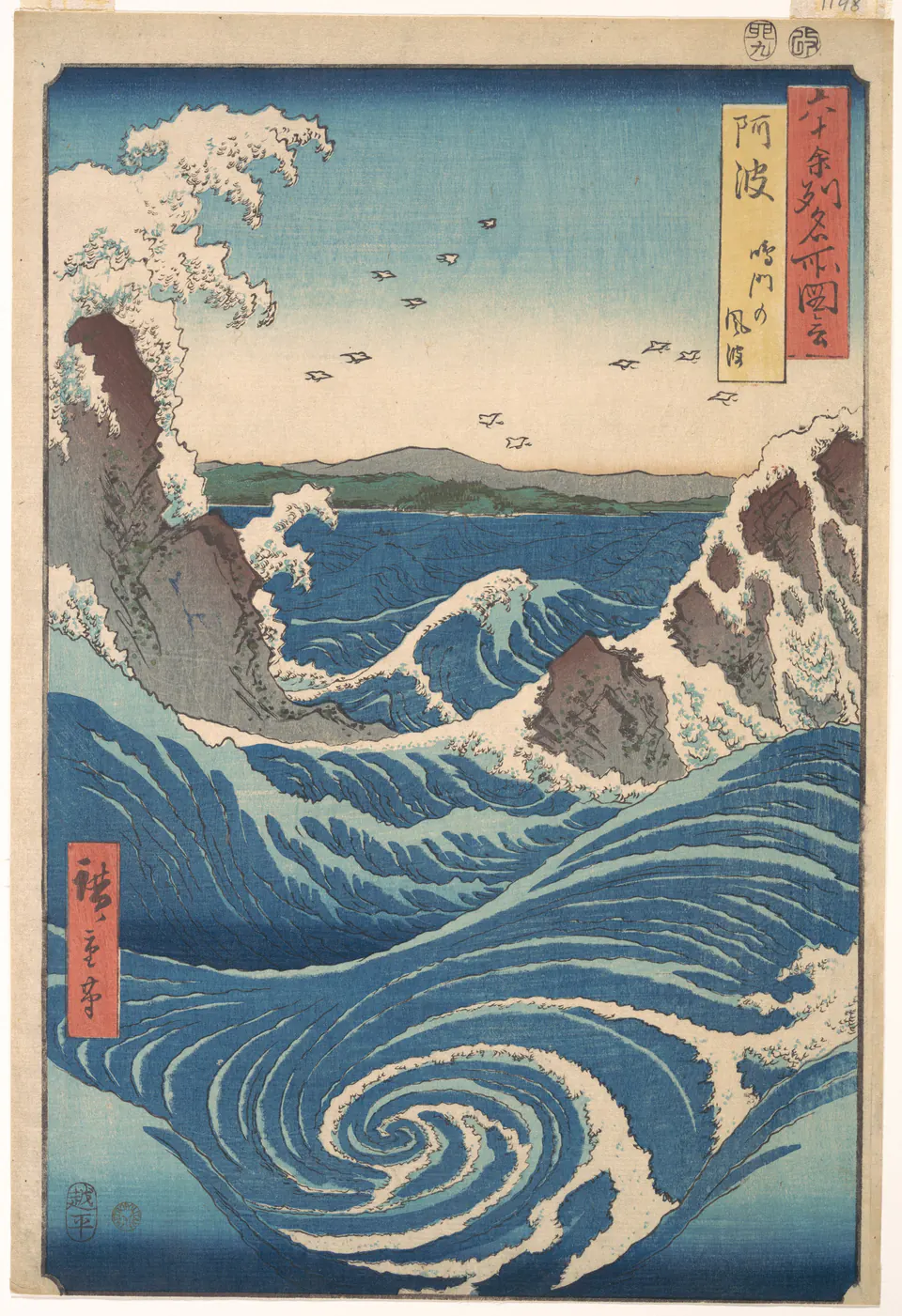
Hiroshige changes the shape of the encounter. His vertical sheet lets the whirlpool occupy a deep foreground while rocks and a distant coast rise above it. We are not aligned with a crew; we look down into a turning surface.
The Met places this print in the series about famous places in Japan’s sixty-odd provinces. Naruto is therefore both a particular named place and a problem of picture-making: how can a flat sheet describe water rotating, breaking and receding?
The answer is partly in the foam. Thin pale bands tighten around the spiral and broaden into waves as they move away. The dark rocks interrupt those patterns, making the water seem to encounter resistance. Compared with Hokusai’s suspended crest, this sea feels continuous: it would still be turning before and after the moment shown.
Turner makes the hunt hard to see
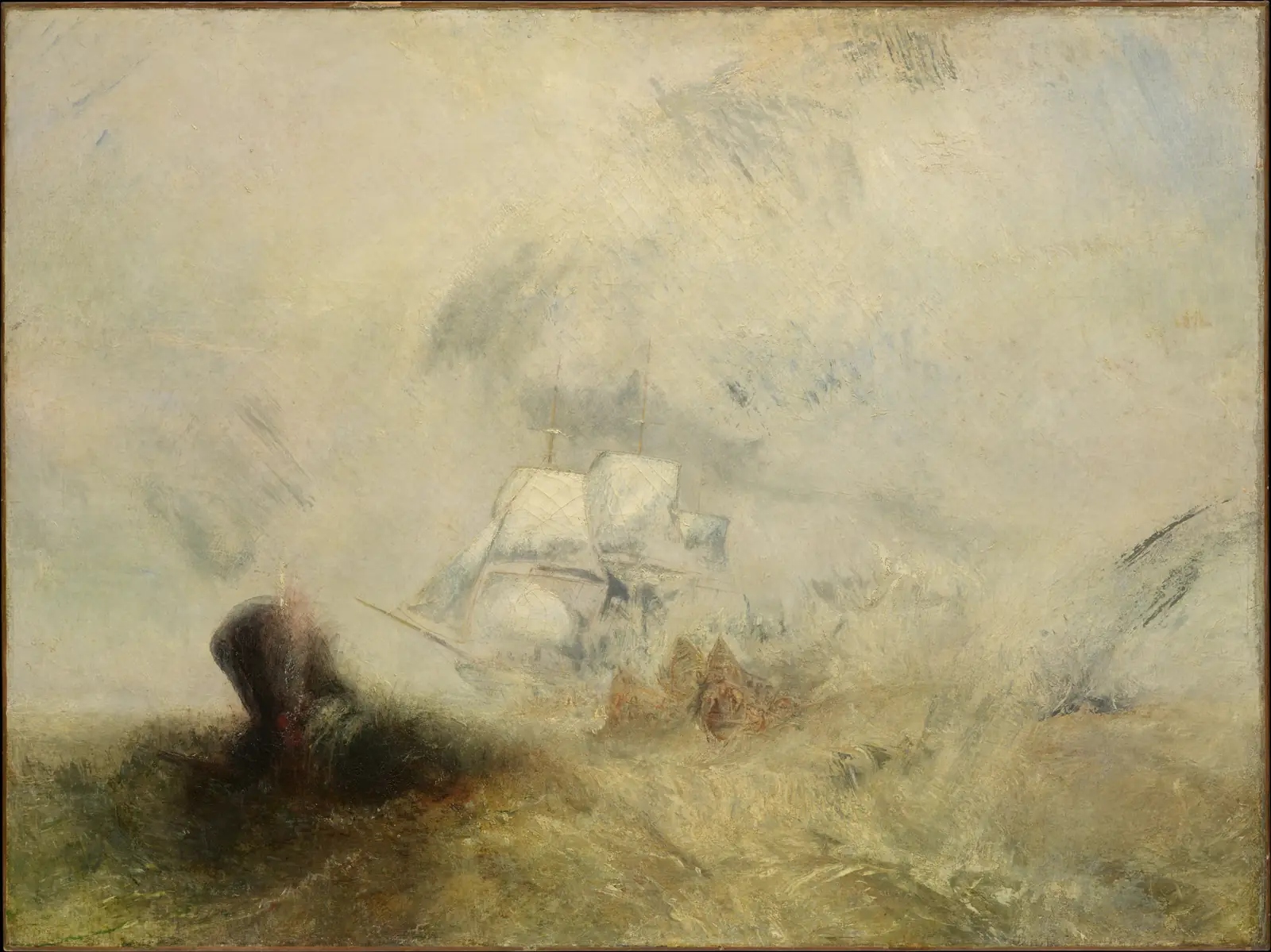
In Turner’s Whalers, recognition takes work. Begin with the dark whale in the lower left, then find the small boat towards the centre and the larger ship behind it. Spray, paint and sunlight repeatedly interrupt their outlines.
The Met records the painting’s 1845 Royal Academy appearance and the difficulty contemporary viewers had in reading its subject. It also notes the apparent connection with a collector whose wealth came from whale oil. The scene concerns an extractive industry as well as the power of weather.
It is tempting to describe late Turner only as an artist approaching abstraction. Here that can make us overlook the hunt. The difficult visibility is part of the encounter: boats and bodies are hard to distinguish inside the very activity they undertake. Compare Hiroshige’s firm wave boundaries with Turner’s unstable ones; both communicate force through very different marks.
Aivazovsky’s Ninth Wave holds danger and hope together
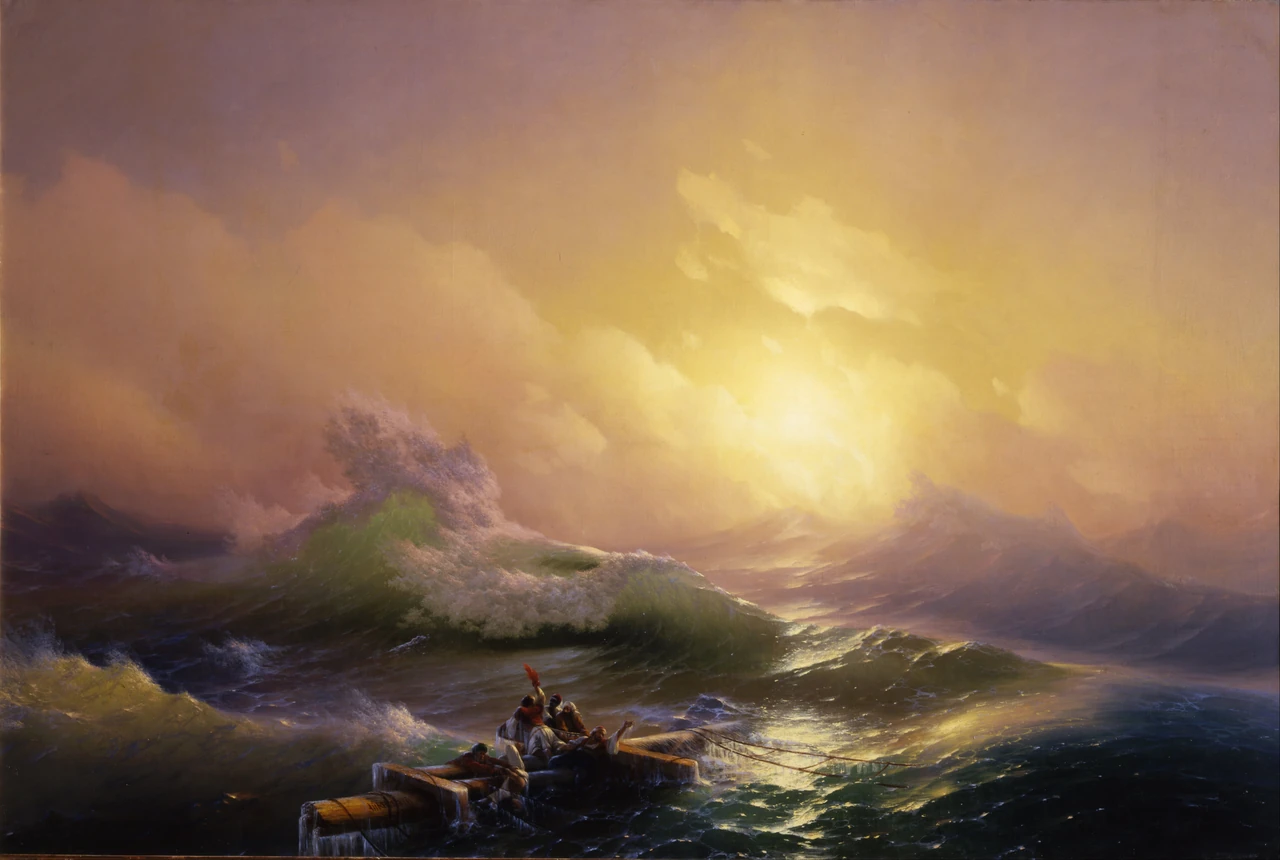
The sky offers a warmth that the survivors cannot yet enjoy. Below it, the green face of the wave rises over a group clinging to wreckage. Its translucent colour makes the water beautiful without making their situation safe.
The Russian Museum connects the title with a popular legend about an especially destructive ninth wave. It is not a scientific rule that every ninth wave at sea is the largest. The museum also reads the arriving light as a sign of hope.
That interpretation is persuasive without turning the picture into a guaranteed rescue. A raised arm and a fragment of mast give the people just enough visual presence to confront the immense water. On the full canvas, measuring 221 by 332 centimetres, their physical smallness belongs to an enormous painted spectacle. On a screen, keep that original scale in mind.
Manet’s calm water is a working route
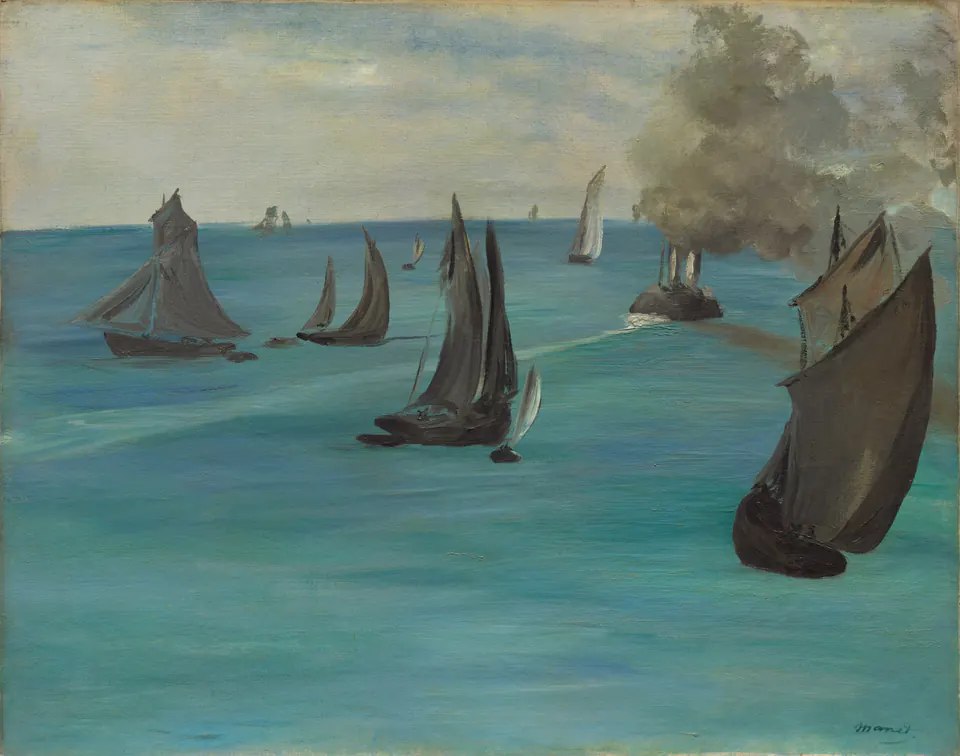
Manet’s sea is calm, but not empty. Sails lean in different directions, the nearest hull cuts into the lower right, and smoke expands above a steamer. The horizon is high enough to give the water most of the picture.
The Art Institute identifies the powered vessel as a side-wheel packet steamer, passing slower sailing boats in the English Channel. Manet developed the painting in Paris from sketches associated with a family visit to Boulogne-sur-Mer. Its immediacy is not evidence that he completed this canvas while bobbing among the boats.
Notice how little modelling some vessels need. A few broad strokes can make a dark sail stand apart from the bright water. Rather than a contest between humanity and a threatening ocean, this is a sea organised by different kinds of movement. Calm weather reveals traffic, distances and changing technology.
A moonlit steamship changes the story
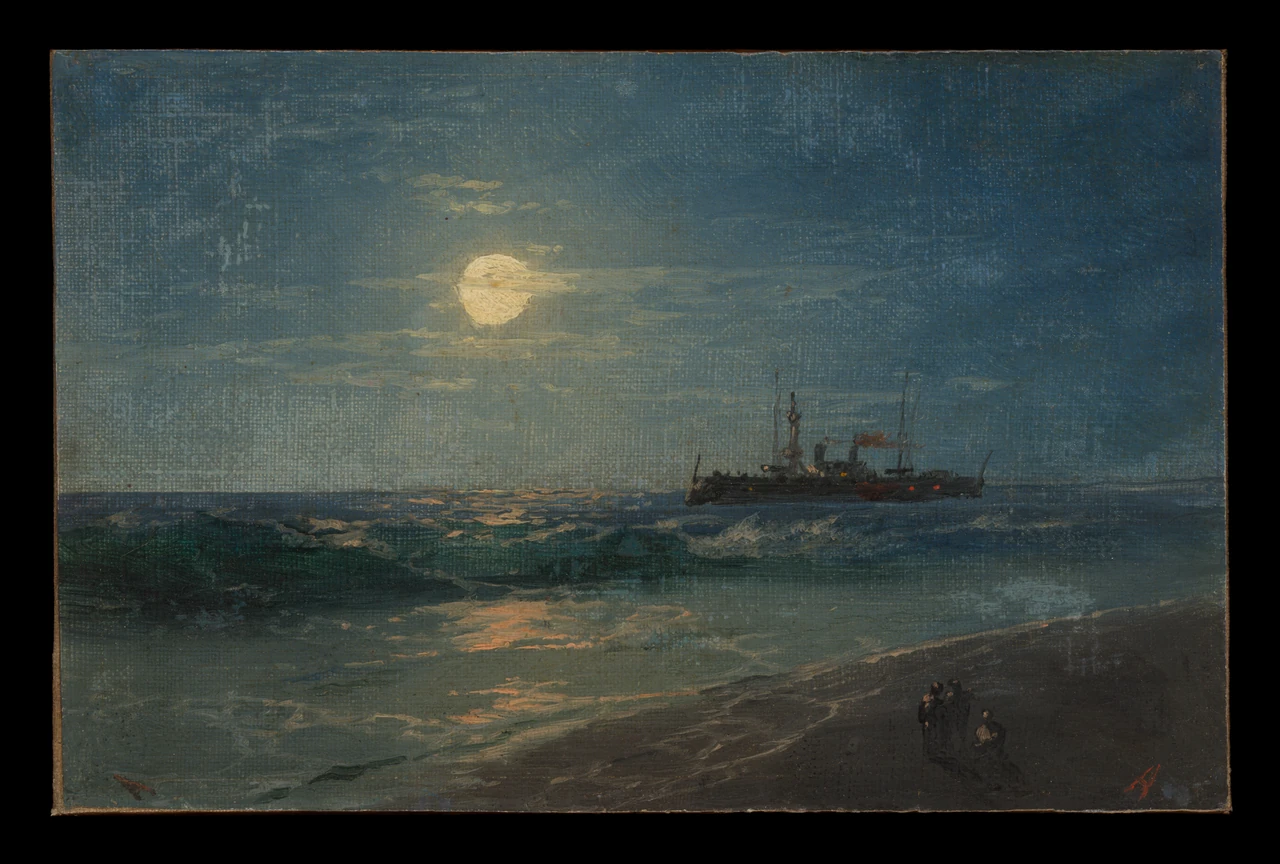
Aivazovsky’s second appearance prevents The Ninth Wave from standing for everything he painted. Here the viewpoint is closer to the shore, and a steamship holds a clear horizontal position beneath the moon. The water moves, but nobody is visibly stranded on wreckage.
The Met identifies the vessel as a modern steamship. Its record supplies no date, and this small canvas measures only 15.9 by 23.5 centimetres. Do not assume that two equally wide images on a web page represent equally large objects.
Compare the people’s position in the two paintings. In The Ninth Wave, they are caught inside the action; here the shore figures offer a position outside it. The artist can make the sea a vast ordeal or a view watched from land. That distinction matters more than describing both paintings simply as Romantic.
Homer’s Gulf Stream connects nature and history
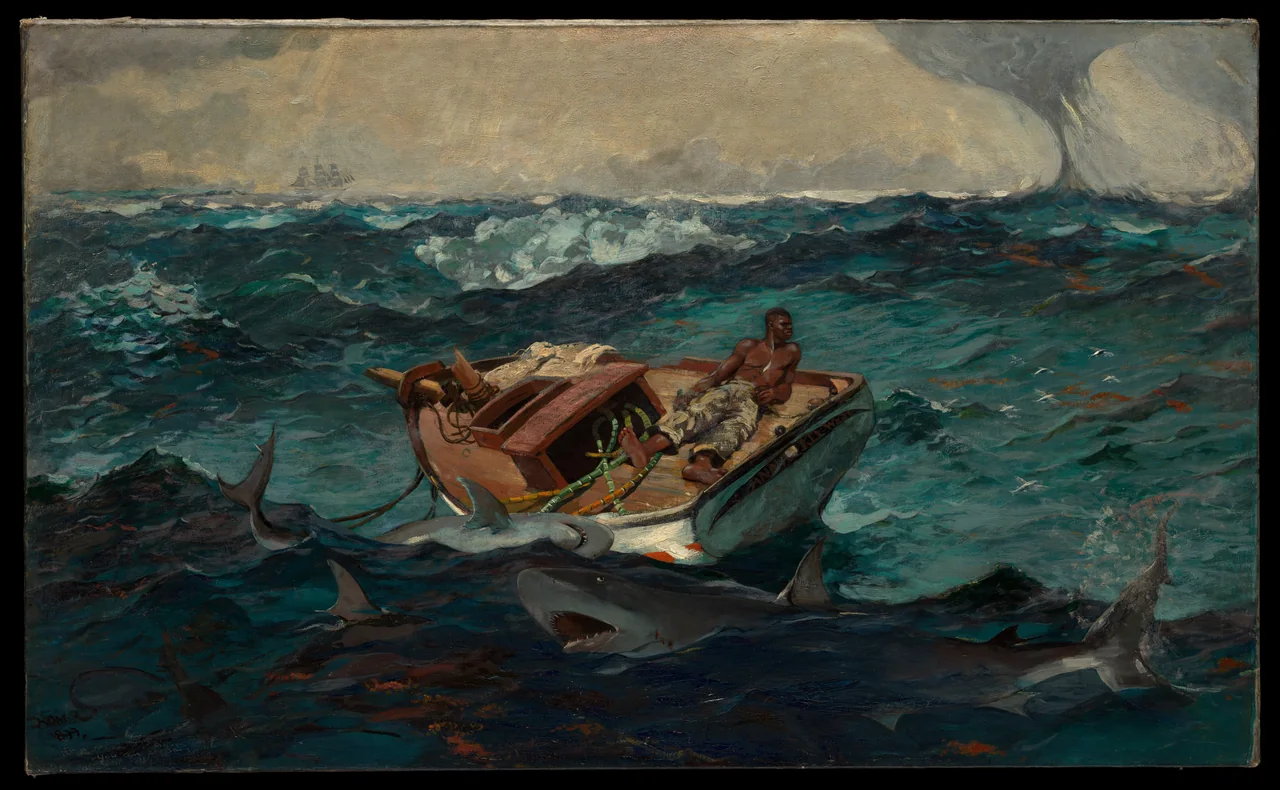
Homer brings us uncomfortably close to the damaged boat. Sharks cut across the foreground, while a waterspout and distant ship extend the situation beyond the central figure. The man’s face does not explain his thoughts to us.
The Met’s interpretation connects the sugarcane, Caribbean current, empire and transatlantic slavery. That historical reading stops the picture becoming only an anonymous struggle against nature. The water also links economies, places and people.
Even with that context, the painting does not offer a simple ending. A ship is visible, but visibility is not rescue. The man’s composure can look resistant, exhausted or watchful; choosing one emotion as fact would close down the image too soon. Unlike Aivazovsky’s golden illumination, Homer’s light gives no obvious promise. We can see the danger very clearly and still remain unable to intervene.
Sorolla moves the sea to the edge of everyday life
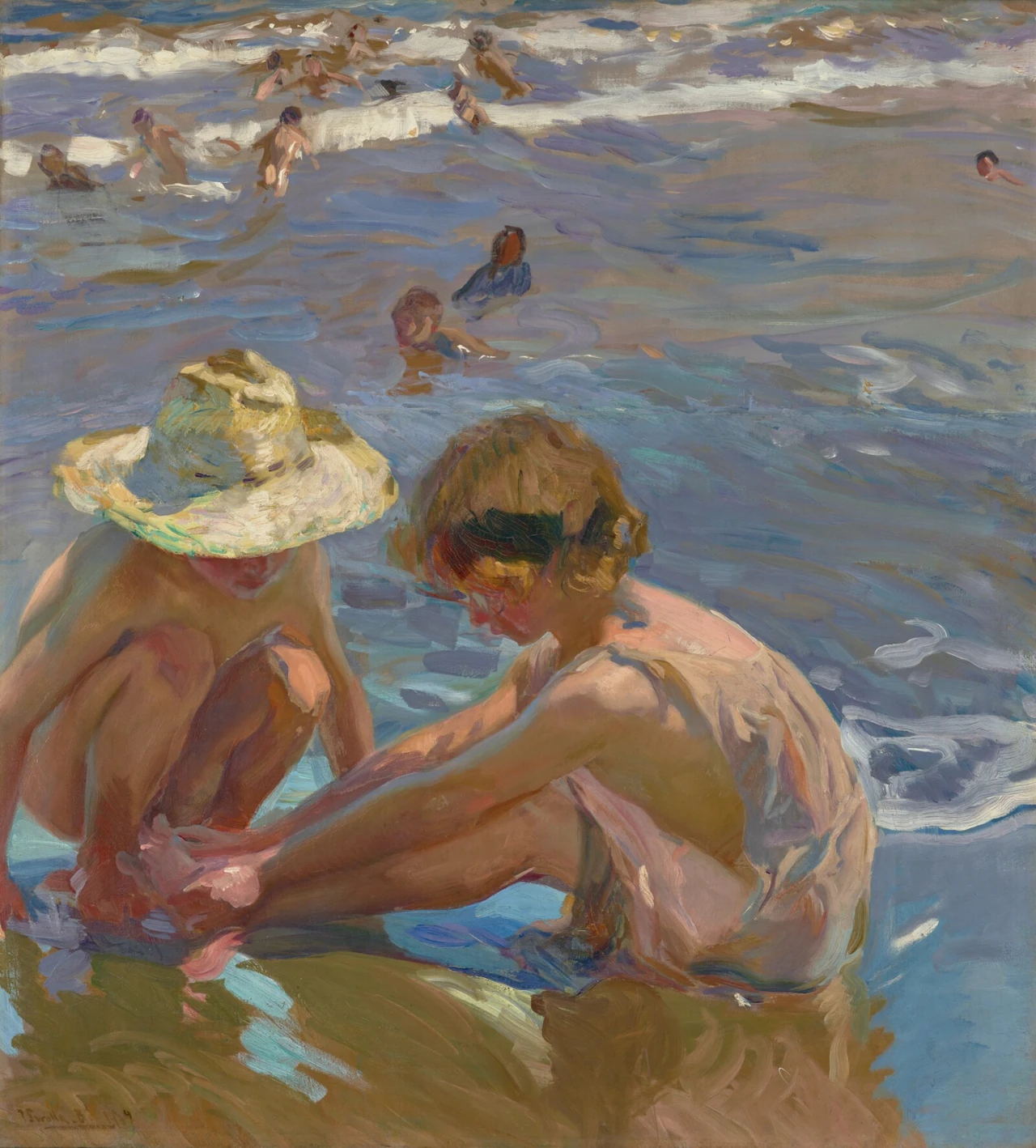
Sorolla removes the horizon and fills the background with bathers and broken reflections. The important event is small: two children pause over a hurt foot while play continues behind them.
The Getty locates the painting among Sorolla’s rapidly made beach pictures at Valencia. It draws attention to the highlights that lead towards the foot and to the abrupt edge cutting through the child at the left. That cut belongs to the painted composition, not to a crop made for this article.
The lavender, blue, cream and brown marks cross between bodies, shallow water and wet sand. They make the boundary between land and sea feel temporary. After the vast dangers in Turner, Aivazovsky and Homer, this interruption of a child’s afternoon offers another scale of experience. The sea can shape everyday life without becoming a catastrophe or a distant view.
Three questions that change a seascape
Ask where you stand, what the people are doing and how the water is made. A high viewpoint, a broken mast or a hard printed contour changes the answer. None of these works simply delivers the sea unchanged; each gives us a position from which to understand it.
Continue with Hokusai, Hiroshige, Turner, Manet and Homer. The Riviera & Sea collection is a separate browsing route, not an inventory of these eight museum objects. For a room-focused choice, see Seascapes and Ocean Art.
Editorial record
About this article
- Author
- Publisher
- GeMarkt
- Published
- Reviewed
- Internal source & rights check. Conducted by GeMarkt Research Review. This is an internal editorial check—not independent peer review.
- Source standard
- Art history source standardPrioritises object records and research sources, distinguishes evidence from interpretation, and states material uncertainty.
Found a claim that needs checking? Report a factual error.