GeMarkt Blog · Essay
Romanticism: Friedrich, Turner and the Sublime
Look closely at eight Romantic paintings: moonlight, rough seas, a river valley and political grief reveal different ways of making emotion visible.

Two people stop to look at the moon. A ship almost vanishes into a pale sea. A man faces a firing squad with his arms raised. These pictures do not resemble one another very much, yet each makes the viewer feel the weight of an experience rather than simply identify a subject.
That is a useful way into Romantic painting. It is not a genre of love stories, and it is not a rule that landscapes must contain a lonely figure. These eight works explore contemplation, attachment, fear, hope and political grief. Friedrich and Turner anchor the route, but six other painters show why Romanticism cannot be reduced to either quiet forests or spectacular storms.
What Romanticism means in a picture
Romanticism developed across Europe around the turn of the nineteenth century and took different forms in different places. Imagination, individual experience and powerful feeling became important ways of understanding the world. The Met’s introduction to Romanticism connects those interests with a growing fascination with nature’s overwhelming power.
The sublime is especially helpful here: an experience of vastness or force that can attract us while making us aware of our limits. It differs from something that is merely pretty. But not every Romantic picture is sublime. A familiar cathedral or a shared moment of looking may matter through intimacy instead.
As you move through the images, notice where the painter puts you. Can you survey the scene comfortably? Are you close to danger? Do another person’s eyes, back or gesture guide your own attention?
Friedrich: Two Men Contemplating the Moon
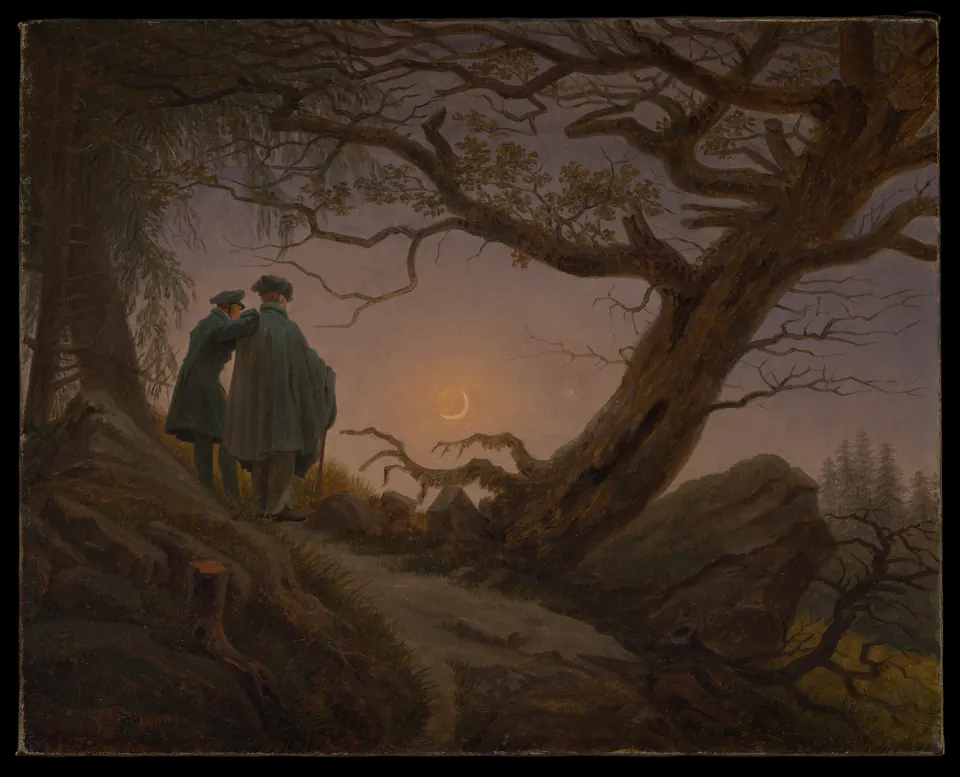
The moon is small; the act of looking is the subject. Two dark figures stand together, partly enclosed by branches. We see their backs rather than their expressions. It is easy to imagine joining them without knowing precisely what either is thinking.
The leaning trunk, exposed roots and uneven ground keep the scene from feeling like an orderly garden. Yet nothing is rushing. This is Romantic intensity at a low volume: dusk changes an ordinary pause into something that seems worth remembering.
The Met identifies this as the third version of the composition, not the 1819 Dresden painting. That distinction matters when a familiar title travels between books and websites. Here the changing tree shapes and the figures’ closeness belong to this particular canvas. The Friedrich guide offers a wider route through his work.
Turner: Whalers
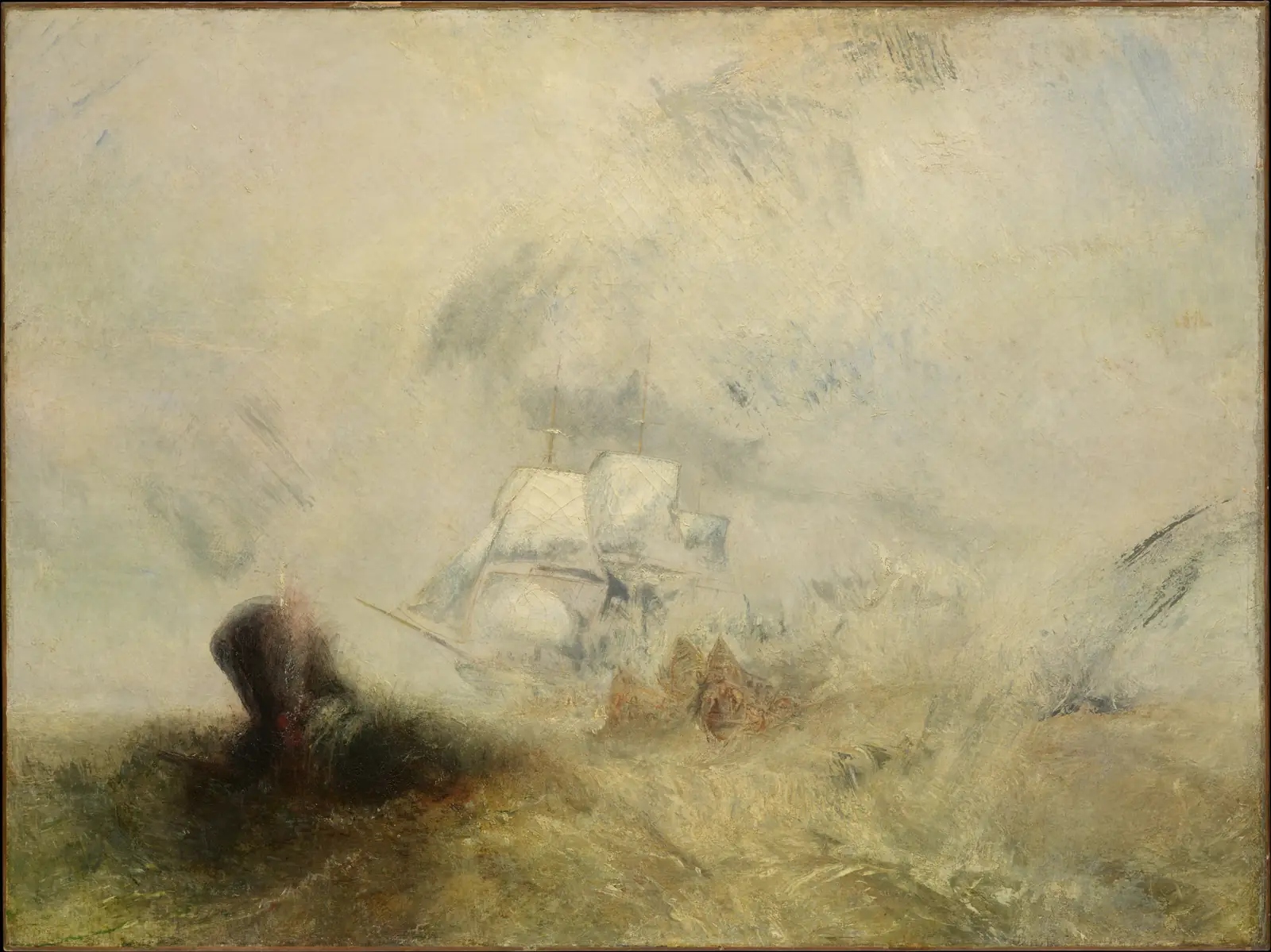
Start at the dark whale on the left, then try to hold the ship clearly in view. Its sails emerge from a mixture of spray, light and paint. The small boats take longer to find. Turner makes recognition feel unstable, as if seeing itself were affected by the sea.
This is not an empty wilderness. People are hunting an animal; the struggle belongs to a working voyage. The Met records the painting’s exhibition at the Royal Academy in 1845. Its difficult visibility is part of the image, not a reason to dismiss it as an unfinished attempt at a tidy seascape.
Compared with Friedrich’s still observers, Turner’s people have little room to contemplate. The picture makes a sublime encounter physical: water surrounds them, and the viewer cannot easily separate danger from dazzling colour.
Constable: Salisbury Cathedral from the Bishop’s Grounds
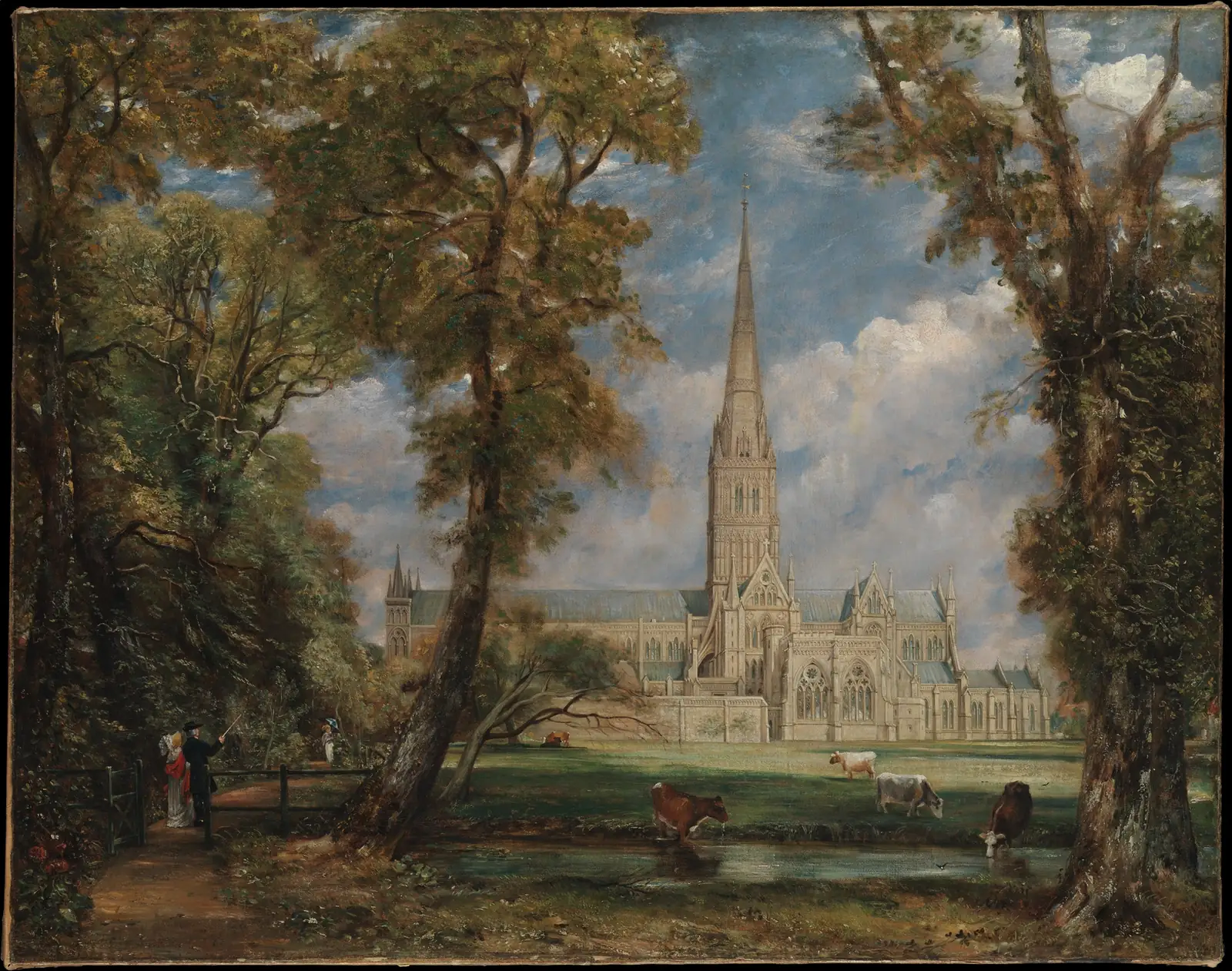
Constable gives us firmer ground. Walkers, cattle and trees make the cathedral part of an inhabited place. Its spire rises through an opening in the foliage; architecture and weather share the same air.
This particular canvas is a full-scale study for the painting completed in 1826 now in the Frick Collection. The Met explains that Constable opened the tree canopy as he developed the composition. What appears to be an effortless glimpse is also a considered arrangement.
Put this beside Whalers. Constable does not need to dissolve the cathedral to make the encounter personal. The building remains legible while the varied foliage, clouds and reflections invite lingering. Romantic landscape can express attachment to a place as readily as fear of its forces. Turner vs Constable examines the contrast more closely.
Cole: The Oxbow
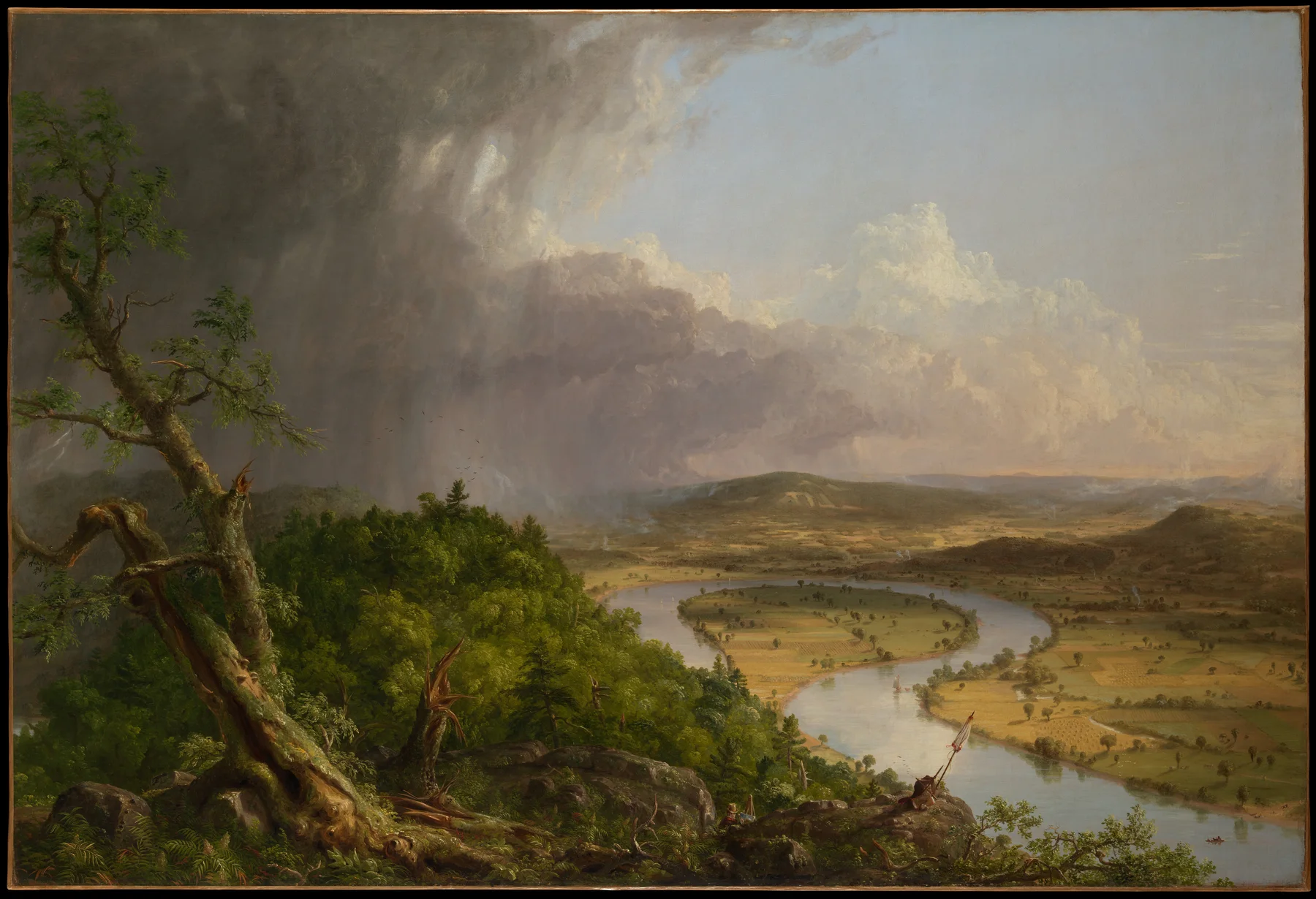
The left side seems rough and exposed; the river valley on the right looks settled and luminous. Cole places both inside one broad view. Follow the curve of the water, then return to the broken trunk in the foreground. The painting lets order and disruption answer each other.
There is also a tiny painter near the bottom, almost lost among the vegetation and equipment. Finding him changes the image from a disembodied panorama into a view someone has chosen to construct. The Met identifies the location as Mount Holyoke in Massachusetts and dates the canvas to 1836.
The contrast does not require a simple verdict that either cultivated land or wooded land is better. It makes the difference visible. This American landscape extends Romantic questions about human scale and belonging into another setting.
Goya: The Third of May 1808
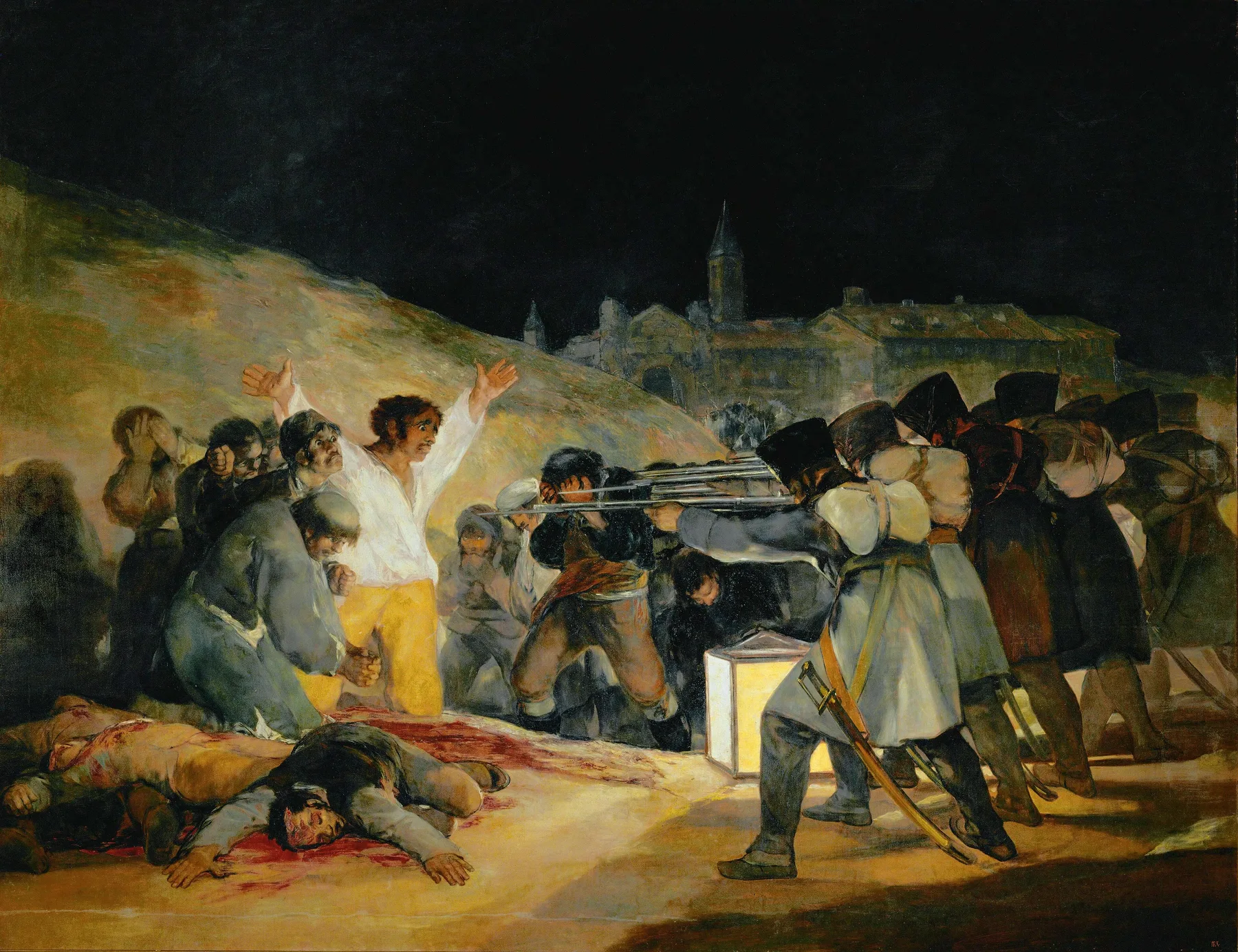

The brightest shirt belongs to someone about to die. The soldiers form a repeated row of backs and weapons; the people facing them respond in different ways. Goya makes the imbalance immediate before we learn a date or a name.
The title names the executions of 1808, but the painting dates from 1814. It is a later representation, not a report drawn on the spot. The Goya Foundation’s record establishes that distinction and describes the victims’ varied gestures.
Goya’s career crosses more than one period label. In this route, his painting shows how Romantic-era intensity can direct attention toward vulnerability rather than military triumph. The open arms do not stop the rifles. Looking at the white shirt and the dark, repeated uniforms reveals how strongly a composition can take a position.
Géricault: a detail of The Raft of the Medusa
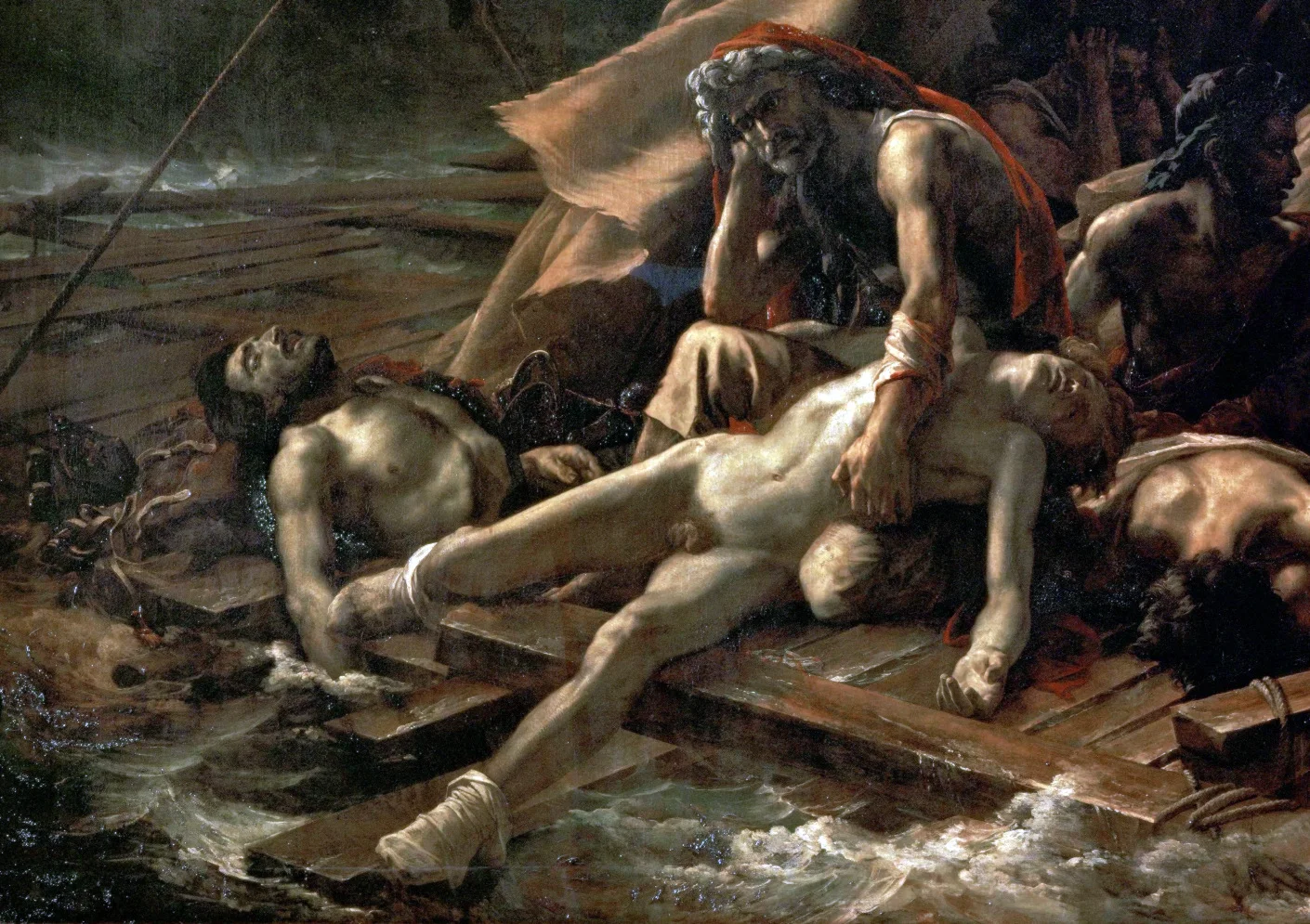

This detail brings us close to the physical cost of a shipwreck. A seated man holds a limp body. Limbs cross the rough boards; the water remains almost within reach. The attention given to flesh and weight prevents the subject from becoming a distant adventure.
The Louvre connects the painting to the wreck of the Méduse in 1816 and records its appearance at the 1819 Salon. This image shows only the lower-left part. The full composition, available through the museum record, also contains survivors trying to attract help; that larger movement should not be inferred from this detail alone.
Seen here, Romantic drama is neither a decorative storm nor a triumphant hero. It gives a recent disaster the scale and bodily presence that painting had often reserved for grand historical or religious subjects.
Delacroix: Greece on the Ruins of Missolonghi
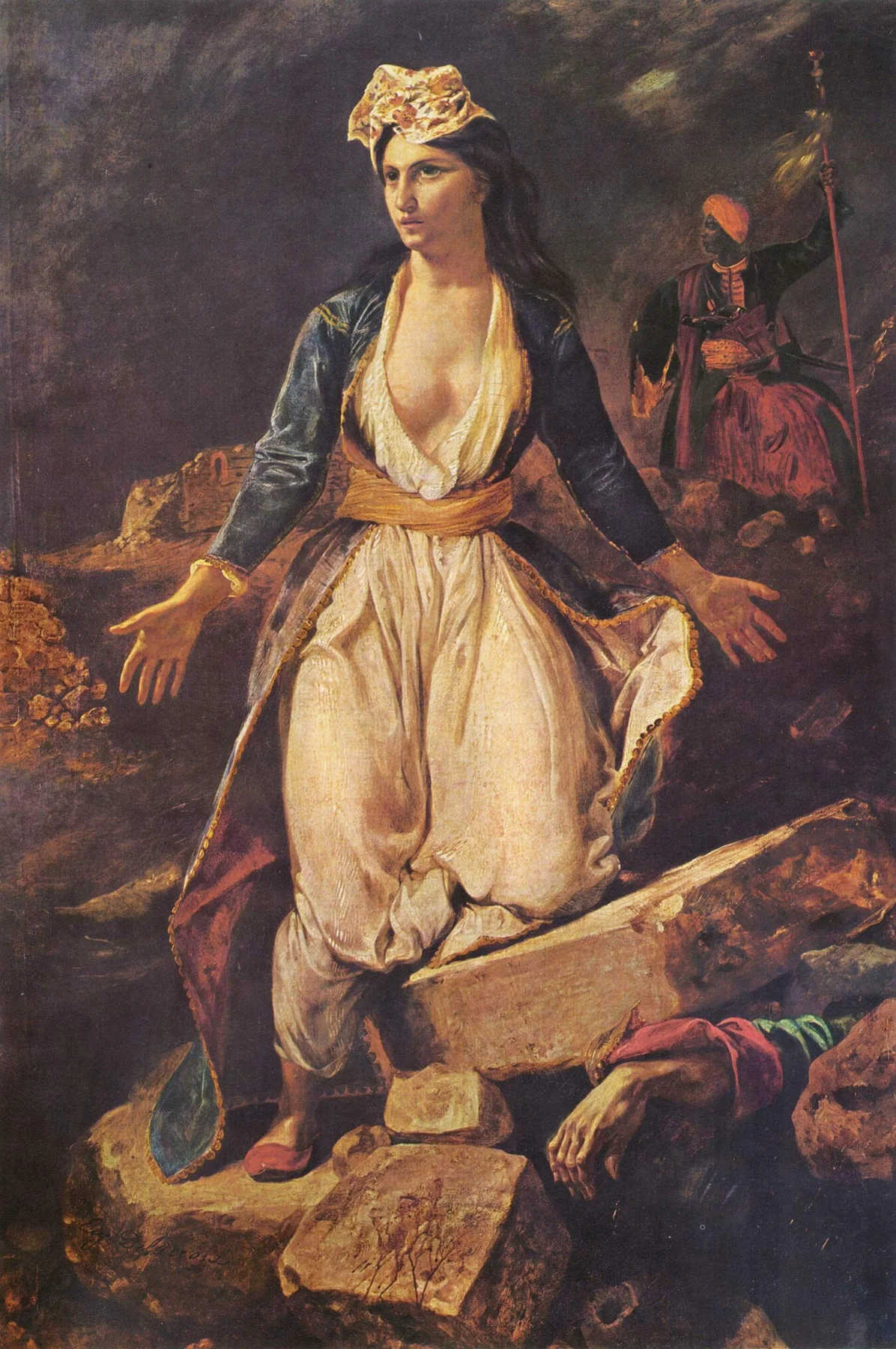

The woman is an allegory: she stands for Greece, not an identified survivor whose portrait Delacroix recorded. Bordeaux’s museum places the work within the Greek struggle for independence and the artist’s support for that cause.
Her open hands offer no weapon. Pale clothing brings her forward while the dark figure behind her raises a standard. Lower down, a hand appears beneath the masonry. Those contrasts make political defeat readable through a single body and its surroundings.
The distinction from Goya is useful. Goya arranges a group awaiting execution; Delacroix makes a nation visible as a person. Both seek an emotional response to violence, but they ask us to read the figures differently. Allegory can be moving without being literal evidence of how an event looked.
Aivazovsky: The Ninth Wave
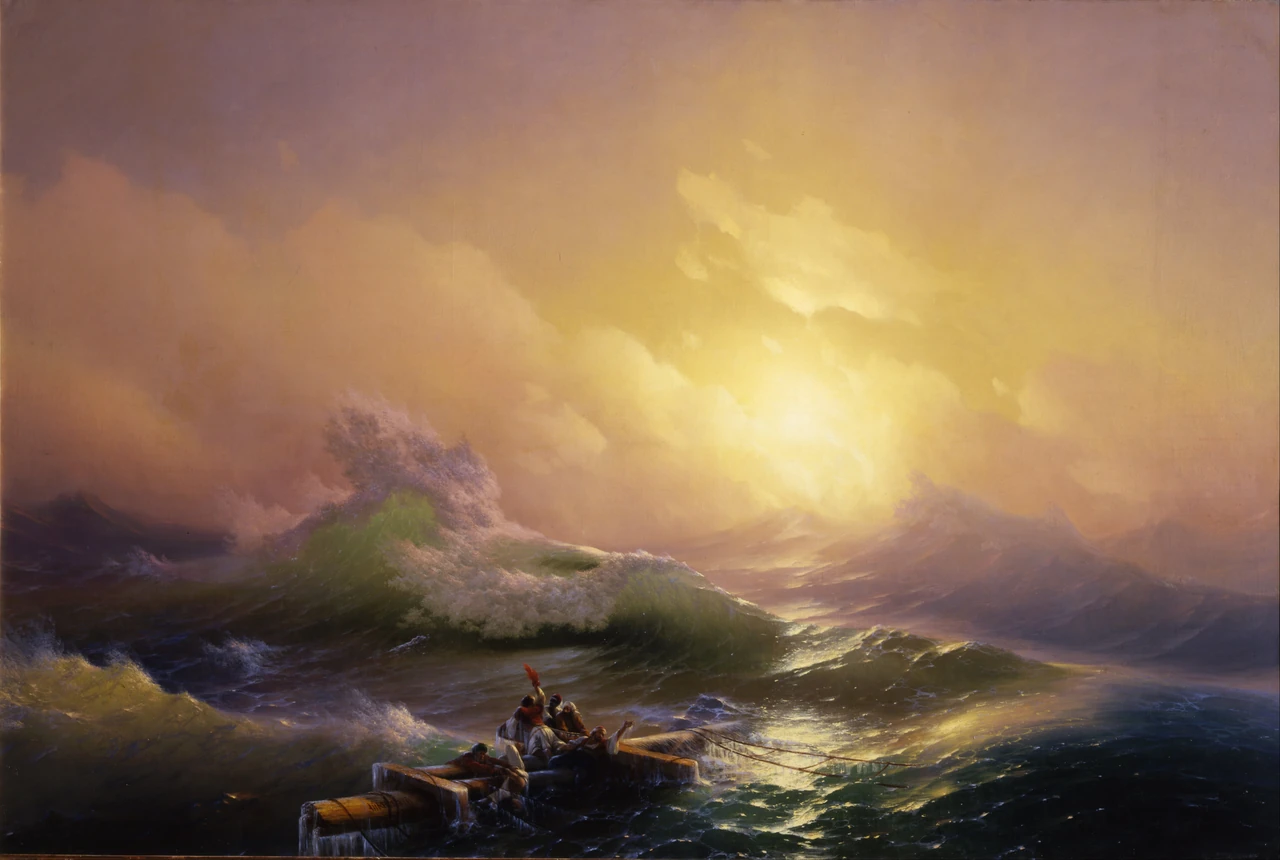

The light is magnificent; the people are still in danger. Aivazovsky places survivors on the remains of a mast below a wave that towers over them. Golden light makes the water glow without making it safe.
The Russian Museum explains the title through a popular legend about a particularly destructive ninth wave. It is not a reliable rule for counting waves at sea. That title helps build the drama, while the dawn introduces the possibility of survival.
Return briefly to Turner. Both artists make people small beside water, but Aivazovsky gives the wave a clear translucent shape, whereas Turner makes the atmosphere harder to separate. Sublimity is an effect on the viewer, not one prescribed way to paint a sea. The Aivazovsky guide follows further examples.
How to recognise Romanticism without a checklist
Look for the relationship between scale and feeling. A tiny moon can concentrate attention; a giant wave can make people fragile. A lighted shirt can become more compelling than an army. Clear drawing and loose paint can both serve those ends.
Then ask what kind of experience the image offers: contemplation, attachment, terror, sympathy or hope. None is a mechanical test. Romanticism is a historical family of approaches, not a filter that turns every cloudy landscape into the same thing.
Follow the artists and keep looking
For more work by painters in this route, see the guides to Turner, Constable and Goya. The Romanticism vs Realism comparison asks what changes when attention shifts toward ordinary working life.
Try choosing two images here with opposite moods. Identify one device they share—a turning back, a bright area, a change of scale—before deciding what makes them different. That small exercise is more revealing than memorising a list of Romantic subjects.
Editorial record
About this article
- Author
- Publisher
- GeMarkt
- Published
- Reviewed
- Internal source & rights check. Conducted by GeMarkt Research Review. This is an internal editorial check—not independent peer review.
- Source standard
- Art history source standardPrioritises object records and research sources, distinguishes evidence from interpretation, and states material uncertainty.
Found a claim that needs checking? Report a factual error.