GeMarkt Blog · Essay
Romanticism vs Realism
Compare Turner’s turbulent Whalers with Millet’s Haystacks: Autumn to see why Romanticism and Realism mean more than emotion versus accuracy.

A ship nearly disappears into spray. Three haystacks stand above a flock of sheep. One painting makes nature feel difficult to grasp; the other asks you to stay with a worked field after the harvest. Both have dramatic skies. Neither is a simple transcription of everything the painter could see.
Romanticism and Realism differ in the kinds of experience and subjects they bring forward—not because one contains feelings and the other contains facts. Looking at Turner’s Whalers beside Millet’s Haystacks: Autumn gives that distinction a visible starting point. It also shows where the familiar shortcut breaks down.
The short answer
Romanticism gave unusual weight to imagination, individual experience and encounters with forces beyond human control. It developed in different forms across Europe around the turn of the nineteenth century and afterwards. The Met’s account of Romanticism includes both terrifying nature and personal responses to familiar landscapes; it does not identify one compulsory appearance.
French Realism, especially prominent around the middle of the century, challenged the idea that ambitious painting needed elevated historical, religious or mythological subjects. Contemporary people and their material surroundings could occupy the centre. The Met’s introduction to French Realism places Courbet and Millet within this changing attention to ordinary life.
These are historical movements, not personality tests. A dramatic person does not necessarily paint Romantic pictures; a carefully observed face does not automatically make a painting part of Realism.
Two outdoor worlds side by side
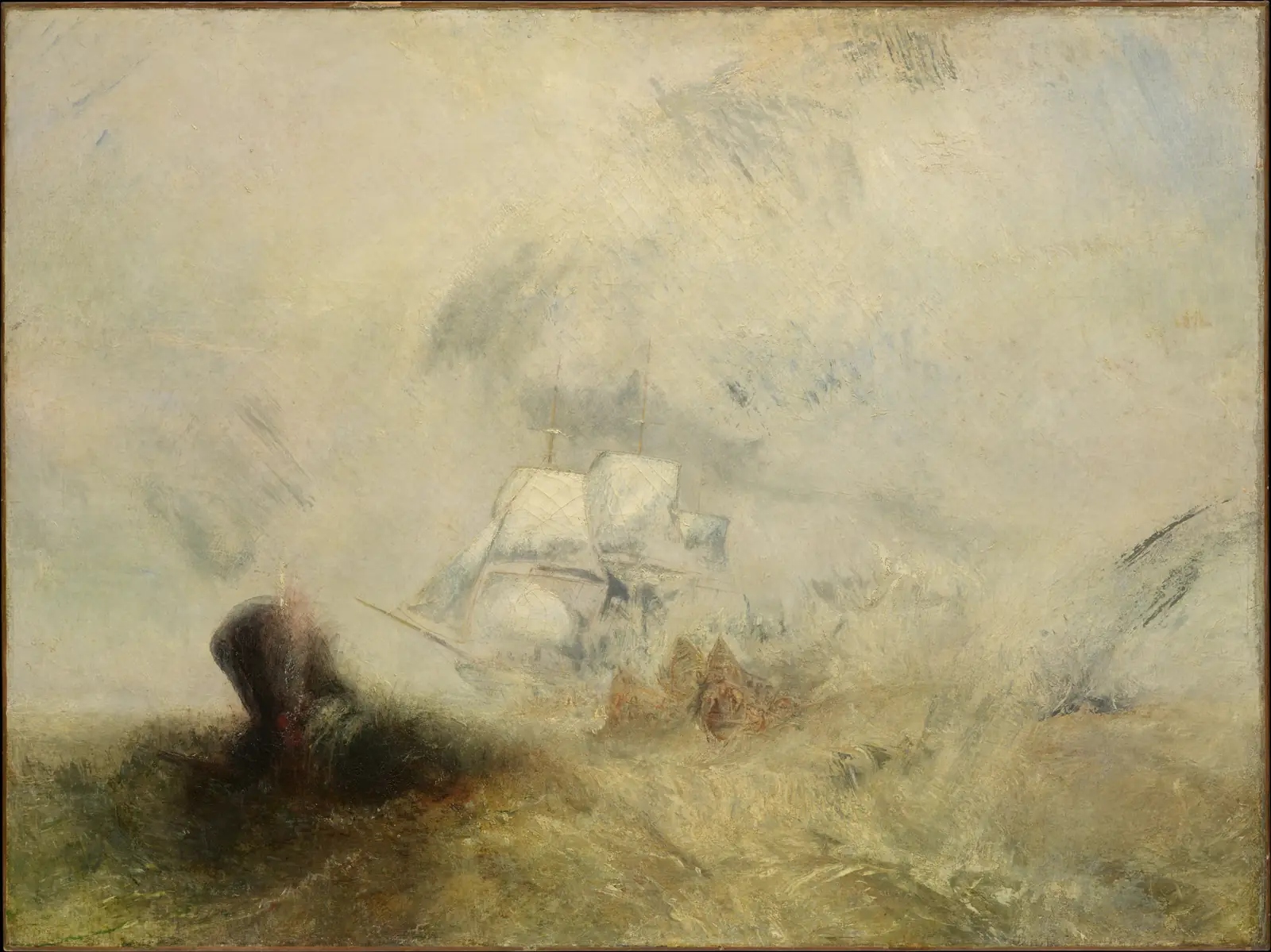
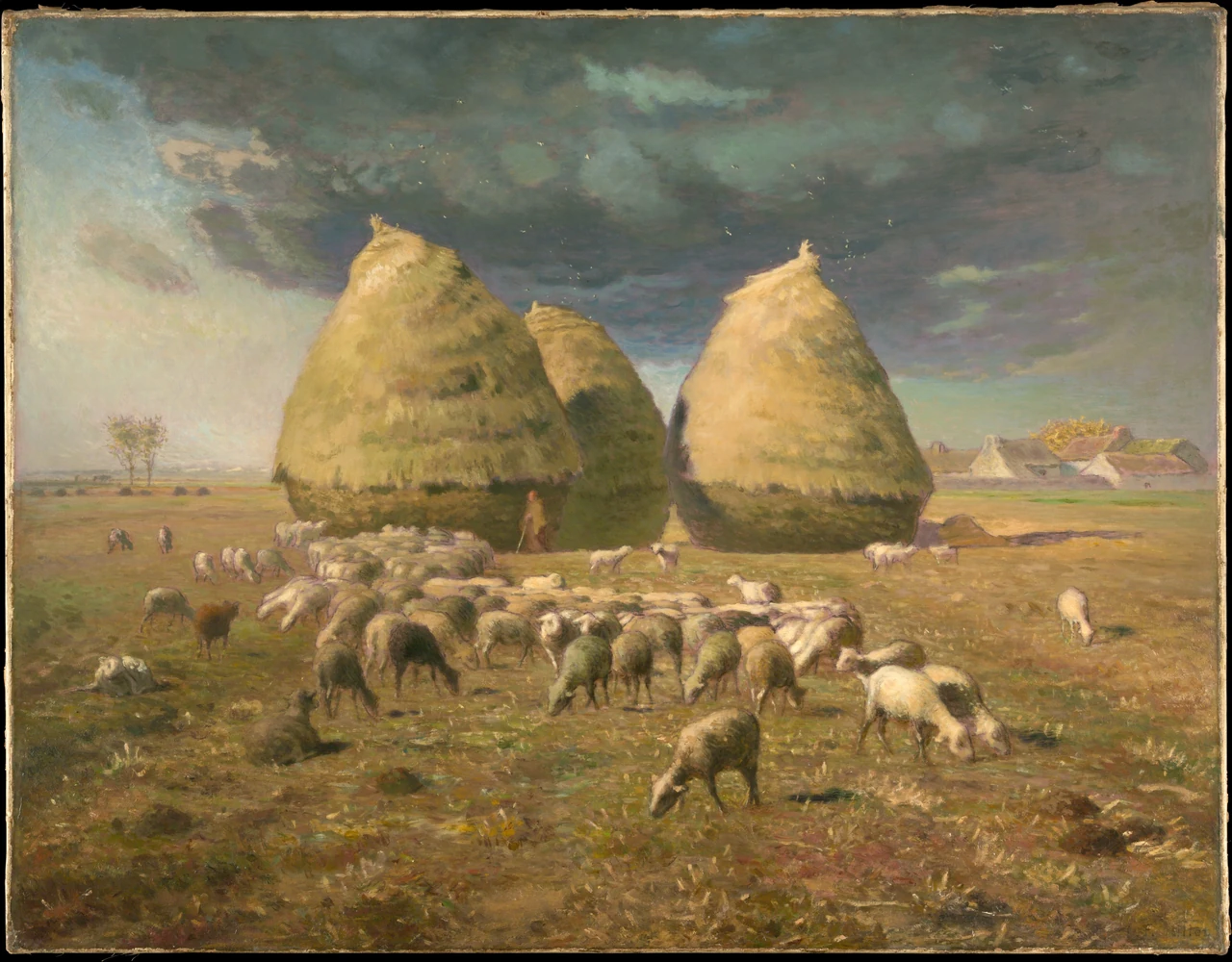
The paintings are separated by about three decades. They are not rival submissions to one exhibition. The pair connects a late work by a British Romantic painter with a late work by a French painter associated with Realism and rural life.
Turner makes seeing uncertain
Start at the lower left of Whalers. The dark form has weight, but its surroundings are hard to separate. Follow the pale sails upwards and the ship almost joins the sky. Sea, spray and atmosphere occupy a continuous field of light.
That uncertainty makes the boats feel exposed. We cannot settle comfortably into a clear map of the action. The picture’s effect depends partly on the gap between sensing disturbance and identifying the things inside it.
The sublime is useful here: an experience of scale or power that overwhelms ordinary comfort. It is not another word for “beautiful sunset”. Romantic art often explores that unsettling mixture of attraction and danger. Turner gives us recognisable human activity, but makes its surroundings harder to master than the people conducting it.
Notice that this is still a scene of work. Whaling belongs to an economic world, not only to an imaginative ocean. A Romantic picture need not abandon contemporary subjects to produce an intense experience.
Millet makes an ordinary field monumental
Millet’s three stacks are unusually commanding. Their broad golden tops rise above the sheep, while the small people and distant roofs establish their scale. The field is not framed as a minor detail within somebody else’s grand adventure. It is the subject worth looking at.
Move down from the stacks to the foreground flock. Individual sheep bend, turn and overlap. Their scattered bodies break up the large shapes above. The ground remains readable, and you can follow the animals through it rather than struggle to decide where land or water begins.
Yet the sky is heavy, not bland. Its green-grey mass strengthens the yellow stacks below. This painting has mood and visual drama without needing a shipwreck, a legendary hero or a supernatural event. Realism does not remove feeling; it can give ordinary surroundings the scale and attention that generate it.
Neither picture is a neutral record
The Met records that Whalers appeared at the Royal Academy in 1845, where viewers did not agree about its difficult handling. It also suggests that Turner undertook the picture for Elhanan Bicknell, a collector whose wealth came from the whale-oil trade. The suggested commission is not certain, but it warns against separating painted nature from patrons and commerce.
Millet’s field had a patron too. Haystacks: Autumn belongs to a four-season commission placed by the industrialist Frédéric Hartmann in 1868. The picture represents the period after harvest, with sheep grazing near Chailly and Barbizon.
Calling a subject ordinary does not make the resulting object unplanned or ownerless. Both paintings select an arrangement, a scale and a way of looking for an audience.
Why Courbet matters to the comparison
Millet helps us look closely, but Gustave Courbet is essential to understanding Realism’s public challenge. His large pictures of provincial life asked why people outside heroic history should receive less space on a canvas.
The Met’s Courbet retrospective account describes the controversy around the works he showed at the Salon of 1850–51. A Salon was an official exhibition selected by a jury. Its decisions affected visibility, reputation and access to buyers.
So the dispute was not simply whether a stone or coat looked convincing. Subject and scale mattered: who deserved a major painting, and who decided? Realism’s ambition becomes clearer when we ask that question rather than treat the movement as a contest in accurate copying.
Realism does not mean a photographic finish
Look again at Millet’s sheep. Some are made from abbreviated marks; their contours are not equally sharp. The Met identifies the picture’s loose finish and exposed coloured ground as features of his late manner.
This is why smoothness is an unreliable sorting tool. A painting can concentrate on everyday existence while leaving its handling visible. Conversely, a fantastic or literary subject may be painted in painstaking detail.
The familiar equation “Romantic equals loose, Realist equals precise” would miss what this pair actually shows. Compare what the marks make you notice before treating their finish as a movement label.
The boundary is permeable
Artists did not erase earlier interests when a new term became useful. The Met’s Courbet exhibition connects his early self-portraits with Romantic self-exploration. Realism’s leading figure had a history that crossed the tidy boundary.
Likewise, Romantic landscape could be rooted in sustained observation of a familiar place. Our Turner and Constable comparison shows how different that attention could look within one generation. Neither emotional intensity nor close observation belongs exclusively to a single movement.
How to look without forcing a label
Ask what the painting makes important. Is it an overwhelming encounter, an ordinary task, a remembered place, a public argument—or several at once? Then look at how scale, light and the handling of paint support that emphasis.
For these two works, remember an ocean that makes secure seeing difficult and a harvested field made large enough to hold your attention. That is more useful than dividing art into imagined worlds and truthful ones. It leaves room for both pictures to be observed, composed and felt.
Editorial record
About this article
- Author
- Publisher
- GeMarkt
- Published
- Reviewed
- Internal source & rights check. Conducted by GeMarkt Research Review. This is an internal editorial check—not independent peer review.
- Source standard
- Art history source standardPrioritises object records and research sources, distinguishes evidence from interpretation, and states material uncertainty.
Found a claim that needs checking? Report a factual error.