GeMarkt Blog · Essay
Turner vs Constable
Compare Turner's Whalers with Constable's Salisbury Cathedral to see how two British painters made light, weather and human presence work differently.

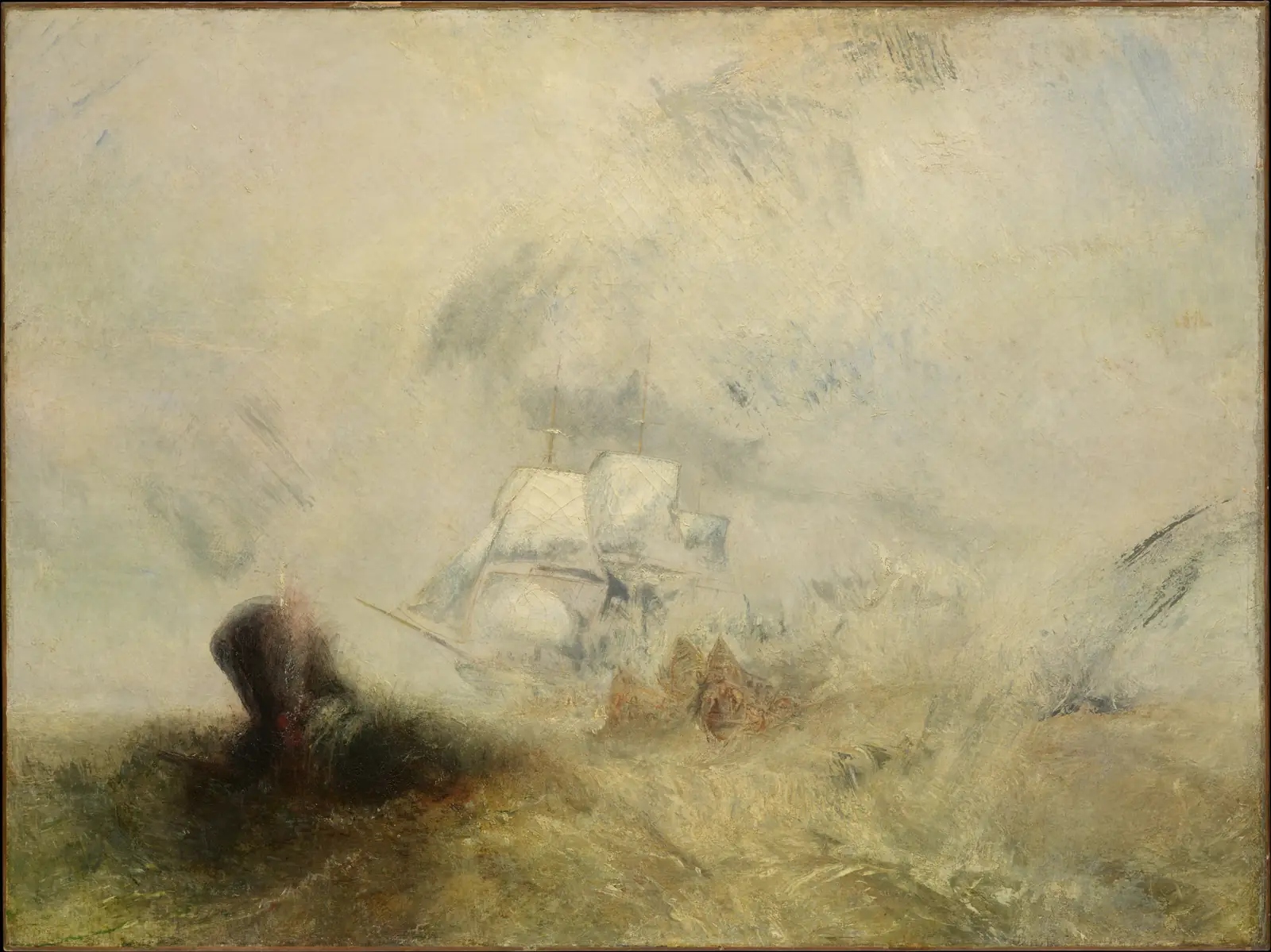
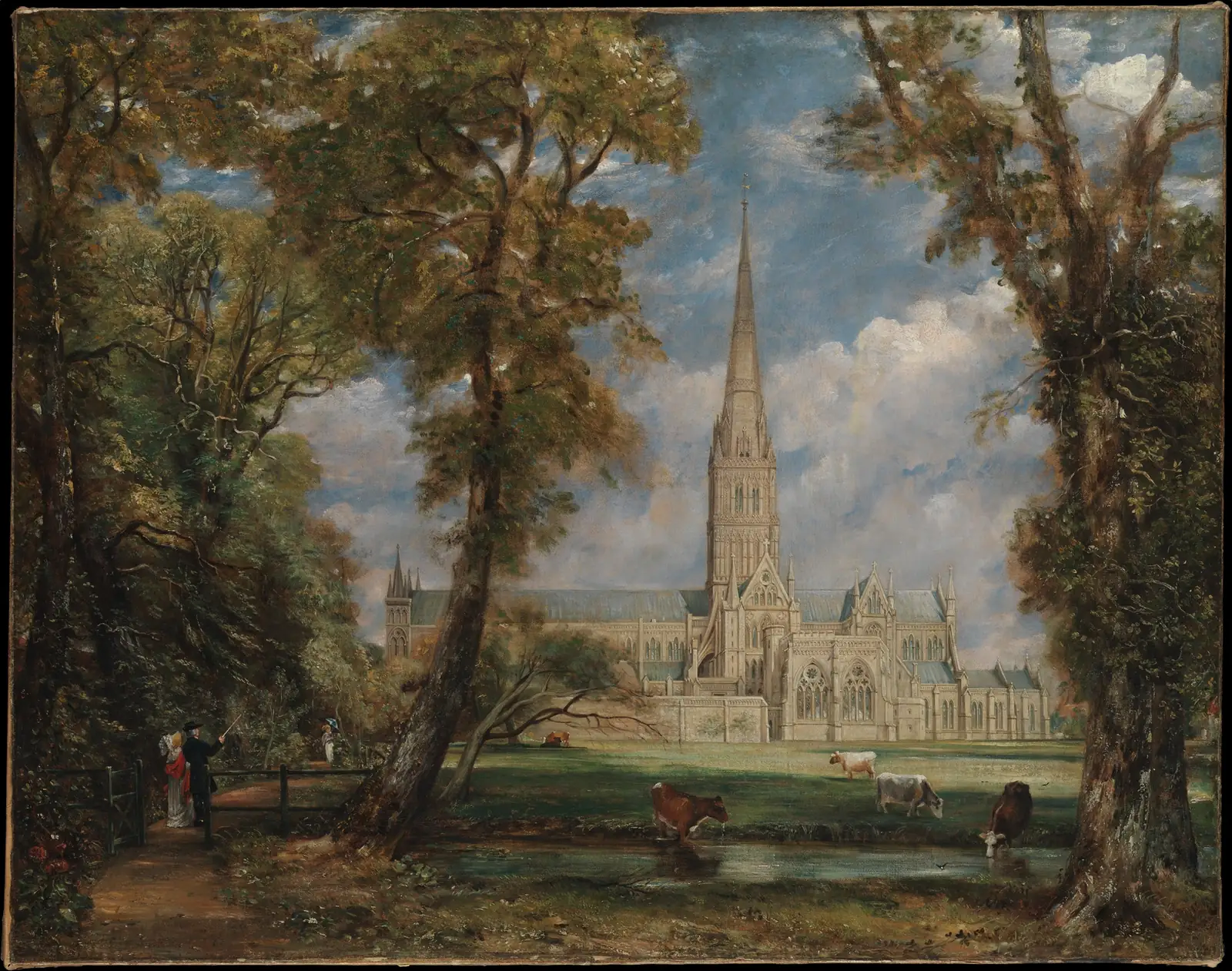
A sailing ship nearly disappears into pale spray. A cathedral stands between two dark trees. Place these paintings together and Turner and Constable seem easy to separate: one dissolves the world, while the other holds it still.
That first impression is useful, but incomplete. Turner and Constable both studied nature and carefully built their pictures. Their difference is not imagination versus accuracy; it is how they turn observation into a painted experience. Turner’s Whalers makes seeing difficult and urgent. Constable’s Salisbury Cathedral from the Bishop’s Grounds gives the eye a more secure route through a richly worked landscape.
The short comparison
J. M. W. Turner (1775–1851) and John Constable (1776–1837) belonged to the same generation of British painters. The Met’s Turner account describes his extensive travels and work in oils, watercolours and prints. Its Constable account emphasises his sustained attention to English places, especially the countryside around his native Stour Valley.
The pair below is not a contest staged in the same year. The Constable is a full-scale study from about 1825; the Turner dates to about 1845, late in his life. Their different purposes belong in the comparison alongside their different appearances.
| Question | Turner: Whalers | Constable: Salisbury Cathedral |
|---|---|---|
| What catches the eye? | Pale atmosphere and a dark foreground disturbance | A clear spire framed by trees |
| How secure is the space? | Sea, spray and sky are difficult to separate | Ground, water, trees and architecture remain distinguishable |
| Where are the people? | In small boats amid maritime danger | Walking in the cathedral grounds |
| What kind of object? | Oil painting exhibited in 1845 | Full-scale oil study for another version |
Two oil paintings side by side
Turner makes you search through light
Look first for the ship. Its sails sit slightly left of centre, but their pale surfaces almost merge with the surrounding atmosphere. Next locate the dark whale in the lower left and the smaller boats nearer the middle.
The order in which these forms become legible is part of the experience. You encounter a broad disturbance before you can confidently name everything inside it. The scene does not offer a clean division between an object and the conditions in which someone sees it.
This difficulty was noticed when the painting was new. The Met’s object account records mixed responses at its Royal Academy debut in 1845. Contemporary criticism struggled to reconcile apparently scattered marks with the whale, boats and ship they represented.
So the picture is not simply a failed clear illustration—or a wholly abstract painting before its time. It contains recognisable maritime action, but asks us to work through the light and paint to find it.
Constable gives you a place to stand
In the Salisbury picture, dark trees at both sides establish a foreground. Water and grazing cattle lead towards the sunlit building. The spire rises into an opening in the canopy, giving the eye a destination.
Try tracing the route from the visitors at the lower left to the cathedral. The space can be explored in stages. The building does not need to be outlined against an empty background; its pale stone becomes especially readable because of the darker vegetation around it.
Yet the foliage is not a catalogue of individually drawn leaves. Small, broken touches make many of its surfaces shimmer. A stable arrangement and active brushwork can coexist. Constable’s legibility is not the same thing as a smooth, mechanically detailed finish.
The cows also prevent the cathedral from floating free as a perfect architectural diagram. They put ordinary life between us and the landmark. The monumental and the everyday share the same ground.
Both paintings are constructed
The Met identifies this Salisbury canvas as a full-scale study for the 1826 version now at the Frick Collection. During the development of the composition, Constable opened the tree canopy and introduced a sunnier sky. The view was revised, not simply copied untouched from one moment outdoors.
The V&A’s study of Constable’s sketches shows how drawings, smaller oil studies and exhibition paintings could belong to an extended process. A sketch can preserve a fresh observation without being the finished picture’s complete blueprint.
Turner’s apparently freer inventions were also grounded in accumulated looking. His travelling sketchbooks recorded places and structures that could inform later compositions, as the Met’s biography explains. “Invented” does not mean “made without observing”, any more than “observed” means “left unedited”.
Look at the paint, not only the subject
Both examples are oil on canvas, so this is not a comparison between two different basic media. What changes is the handling of edges, contrasts and coloured marks within that shared medium.
In Whalers, many boundaries are difficult to hold: sail against sky, spray against sea, a boat against the water around it. In Salisbury, the spire, tree trunks and foreground bank give you firmer landmarks, even while the foliage remains lively.
That is more precise than saying Turner is “blurry” and Constable is “realistic”. A photograph may be blurry because it failed to focus. Here, the organisation of visibility contributes to what the painting does.
On a screen you can compare those large relationships. You cannot fully recover the thickness, gloss or physical scale of either painted surface. The two works are of broadly comparable size in the museum; reproductions should not make you assume that Turner’s more overwhelming scene is necessarily the larger object.
People change what the landscape means
Cover the small figures mentally and both pictures lose something important. Turner’s boats supply the human stakes of the scene. They also stop the pale turbulence from becoming only an attractive arrangement of colour.
Constable’s visitors provide a different relationship to the place. They stand on a path and look towards the building, closer to our own position as viewers than the exposed crews in Whalers.
The result is a contrast between participation in danger and a comparatively sheltered act of looking. That is our reading of this pair’s arrangement—not proof that either artist had one permanent emotional attitude towards nature.
Why Romantic does not mean unreal
Both artists appear in histories of Romantic landscape, but the label can mislead if it is taken to mean dreamy scenery with no practical world in it. Ships, work, buildings, weather and familiar ground are all present here.
The useful question is how a place becomes more than its inventory of objects. Turner’s uncertain outlines can make exposure feel immediate. Constable’s framing can make a particular building feel discovered through a living setting. Neither effect requires the scene to stop containing recognisable things.
A better way to remember the difference
Remember the ship you have to find and the spire you are guided towards. Then test that contrast against other works, rather than expecting every Turner to dissolve and every Constable to remain calm.
The Turner and Constable guides offer further examples and exact source records. For the preparation behind a finished picture, see sketch versus study versus finished painting. The most revealing comparison is not which painter was “better at nature”, but how each made looking at it into an experience.
Editorial record
About this article
- Author
- Publisher
- GeMarkt
- Published
- Reviewed
- Internal source & rights check. Conducted by GeMarkt Research Review. This is an internal editorial check—not independent peer review.
- Source standard
- Art history source standardPrioritises object records and research sources, distinguishes evidence from interpretation, and states material uncertainty.
Found a claim that needs checking? Report a factual error.