GeMarkt Blog · Practical guide
Is Ivan Aivazovsky’s Art Public Domain? Seascapes and Image Sources
Look closely at Aivazovsky’s moonlight and storm scenes, with twelve museum records and separate checks for the painting, country and exact image file.
Rights check · reviewed
The short answer
The Met supplies the exact Ship by Moonlight image under CC0. The selected Ninth Wave file carries Commons PD-Art/Public Domain Mark. Aivazovsky’s ordinary EU/UK author term has elapsed, but independent U.S. publication histories remain unresolved and these file labels do not clear every reproduction or local commercial use.
| What is being checked | Result | Why |
|---|---|---|
| European Union — ordinary artist term | Ordinary artist term has elapsed | Aivazovsky died in 1900; the ordinary life-plus-70 term has elapsed. This limited conclusion does not resolve every national exception, moral right, later first publication, adaptation or separately authored image. |
| United Kingdom — ordinary artistic-work term | Ordinary artist term has elapsed | Older unpublished works and separate photographs require their own assessment. This is not a catalogue-wide file permission. |
| United States — all twelve research objects | Independent publication histories unresolved | Museum and Commons file designations are attributed. No independent original-publication chain is established here, including for the displayed paintings. A date of painting, exhibition or museum acquisition is not automatically publication. |
| Russia and other local conditions | No universal local commercial clearance | A file designation does not by itself settle separate local museum, contractual or other non-copyright conditions. No museum permission for every commercial use in Russia is asserted. |
| Selected digital files | One Met CC0 image and one Commons PD-Art file | Met 1975.280.2 is expressly Open Access / CC0. The Ninth Wave, Russian Museum Ж-2202, uses the exact Google Art Project reproduction hosted on Commons with Public Domain Mark. PDM is not CC0 and is not independent proof of the asserted early publication. |
| Other works and files | Ten display HOLDs | The other objects are identified research references without selected display files. HOLD does not mean a finding that the historical painting is copyrighted. |
Twelve exact institutional research objects, two selected images and ten display HOLDs. Ship by Moonlight remains undated; the 1846 and 1882 Constantinople paintings, 1875 and 1879 Cape Aya versions, and miniature versus monumental seascapes are not conflated.
This is a documented research summary, not legal advice. Copyright and moral-rights rules can vary by country and by the history of a particular work.

What we’ll look at
Which Aivazovsky painting and which reproduction can you identify and use?
Short answer: Aivazovsky’s ordinary EU/UK author term has elapsed. The Met supplies the illustrated Ship by Moonlight image under CC0; the Ninth Wave reproduction below carries Wikimedia Commons’ PD-Art/Public Domain Mark designation. Those are specific file decisions, not worldwide clearance of every Aivazovsky painting or download. Independent U.S. publication histories remain unresolved here.
Aivazovsky painted water as a place where people travel, work, fight and struggle to survive. Even his quietest sea is rarely empty. A dark vessel, a line of buildings or a tiny group on shore gives the light something to reveal—and gives the viewer a measure of the space.
A painter between shores
Ivan Konstantinovich Aivazovsky, also known as Hovhannes Aivazian, lived from 1817 to 1900. He was an Armenian artist born in Feodosia, Crimea, then within the Russian Empire. His career crossed several countries and coastlines. The Met’s account is a useful introduction to this background without reducing him to a single modern national label.
His range is wider than the familiar towering wave. Mediterranean ports, moonlit cities and naval scenes sit alongside imagined catastrophes. Compare the 1841 Coast at Amalfi with the biblical Deluge of 1864: water can organise a recognisable place or threaten to erase the world entirely.
When looking at one of his pictures, start with the horizon. Then find the brightest passage and the smallest human presence. Their relationship often explains the composition more clearly than beginning with the ships’ names or the location.
Moonlight on a small canvas
The opening image, Ship by Moonlight, measures only 15.9 × 23.5 cm in the Met’s record. Its compact size is easily lost on a screen. The museum does not currently give it a creation date, so it should not acquire a confident year merely because another website supplies one.
Look at the bright reflection extending across the water. It makes the moon feel connected to the sea instead of sitting separately in the sky. The dark ship interrupts that luminous passage, while the figures at the lower right occupy a much narrower strip of solid ground.
The small image also rewards a close look at the painted surface. Brush marks remain visible; this is not a seamless photographic night. The reproduction retains the irregular outer canvas edges and surrounding dark area supplied by the museum. Those edges help distinguish this exact file from a tightly cropped decorative version.
The Ninth Wave
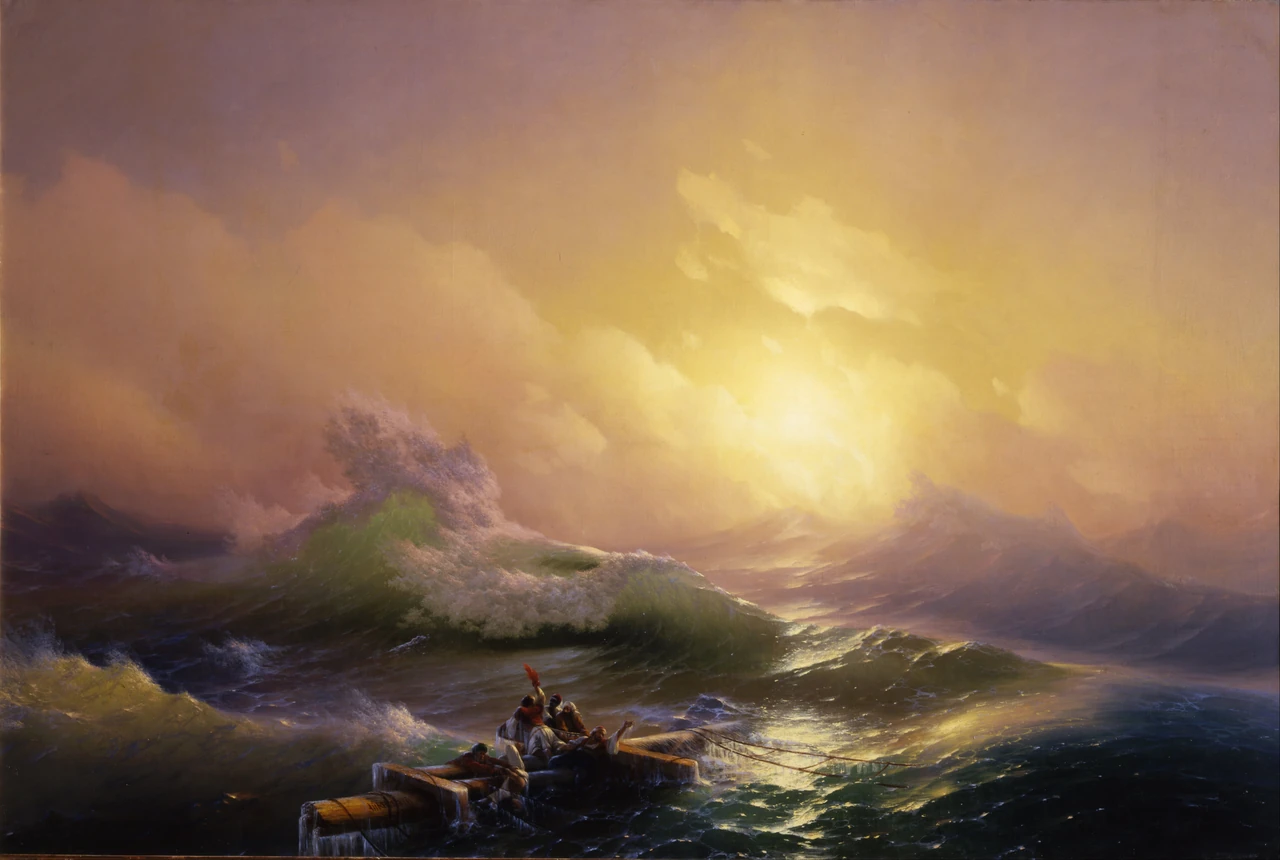

The Russian Museum’s Ninth Wave is a very different physical proposition: an 1850 canvas measuring 221 × 332 cm. A screen makes it and the little Met moonlight painting appear more similar in scale than they are.
Here the brightest light belongs to the sky beyond the immediate danger. Green water rises between that luminous distance and the survivors clinging to wreckage. Notice how little space the people occupy. Their smallness makes the surrounding water feel immense without requiring every part of it to be equally detailed.
The colour is not simply descriptive. Warm gold above and green shadow below pull your attention in different directions. You can read hope in the light while still seeing how precarious the survivors’ position is. That is a visual reading of the painting, not proof of a particular historical shipwreck.
Ports and repeated subjects
Place names require care. The Russian Museum’s View of Constantinople by Moonlight is a large 1846 painting. Its Constantinople of 1882 is another object, with different dimensions and lighting. A download labelled only “Aivazovsky Constantinople” does not settle which one you have.
The same problem affects storms. The museum distinguishes its 1875 Storm off Cape Aya from a later 1879 treatment elsewhere. Repetition is part of the artist’s practice, not evidence that one record can stand in for every version.
Scale varies just as dramatically. Tretyakov’s A Rough Sea, painted in 1887, is an 11 × 7.8 cm work on cardboard. The Russian Museum’s Wave of 1889 is 304 × 505 cm. Check the object before describing the experience of standing in front of it.
Twelve works to identify
These are research references, not twelve cleared downloads. Only the two images displayed above have a selected file in this guide; the other ten remain image-use checks.
| Work | Date in the institution’s record | Collection or distinguishing detail |
|---|---|---|
| Ship by Moonlight | Undated | Met, 1975.280.2; CC0 image shown |
| The Ninth Wave | 1850 | Russian Museum, Ж-2202; Commons reproduction shown |
| The Wave | 1889 | Russian Museum; 304 × 505 cm |
| Storm off Cape Aya | 1875 | Russian Museum; not the 1879 version |
| View of Constantinople by Moonlight | 1846 | Russian Museum; 124 × 192.5 cm |
| View of Odessa on a Moonlit Night | 1846 | Russian Museum; not the later repetition |
| The Coast at Amalfi | 1841 | Russian Museum |
| The Port of Valletta on the Island of Malta | 1844 | Russian Museum |
| Constantinople | 1882 | Russian Museum; 53.3 × 71 cm |
| The Brig Mercury Rejoins the Russian Squadron after the Battle | 1848 | Russian Museum |
| The Deluge | 1864 | Russian Museum; biblical subject |
| A Rough Sea | 1887 | Tretyakov, Ж-1745; small cardboard painting |
Copyright and the exact file
The ordinary named-artist term has expired under the EU’s life-plus-70 framework and the UK’s ordinary artistic-work rule. That is not a ruling on every unpublished object, later adaptation or museum photograph.
For the United States, the Copyright Office’s duration guidance makes publication history important. In 2026, publication through 1930 can be decisive; a painting’s creation or exhibition is not automatically publication. Older unpublished works can follow different rules. This guide does not independently establish that history for the twelve objects, including the illustrated ones.
The file labels also differ. The Met’s designated Open Access images use CC0. Commons’ Public Domain Mark identifies a claimed public-domain status; it is not the museum issuing a CC0 licence. Neither label replaces checks on separate contractual conditions or commercial permissions in the country where a project operates.
Choosing an image
Begin with the object’s title, date, institution and dimensions. Save the exact file page and its rights statement alongside the image. For a printed reproduction, inspect both the water’s fine detail and the smooth sky at the intended size: a large pixel count does not guarantee that every area is equally sharp.
Avoid quietly changing the picture to make it more dramatic. A brighter sky, stronger green wave or missing canvas edge may produce an attractive variation, but it is no longer the same reproduction. Aivazovsky already gives the light a precise job. Seeing what it does is a better starting point than adding more of it.
Sources and review method
We checked the artist chronology against museum records, treated each named jurisdiction separately, and recorded the provider policy for the image set. These sources support the legal framework and artist dates used above; the source file for any individual image still needs its own record.
- Ship by Moonlight, 1975.280.2 — The Metropolitan Museum of Art. Exact undated oil painting, dimensions, artist background and public-domain image designation.
- Open Access — The Metropolitan Museum of Art. CC0 applies to designated public-domain images, not automatically every museum asset.
- The Ninth Wave, Ж-2202 — State Russian Museum. 1850 object, exact accession and monumental dimensions; not a museum CC0 release.
- The Ninth Wave, Google Art Project file — Wikimedia Commons. Exact reproduction provenance and PD-Art / Public Domain Mark designation. Independent publication chain remains unresolved.
- Storm off Cape Aya — State Russian Museum. 1875 collection painting distinguished from the 1879 version in a different museum.
- View of Constantinople by Moonlight — State Russian Museum. Exact 1846 painting and exhibition history; exhibition is not silently converted to publication.
- A Rough Sea, Ж-1745 — State Tretyakov Gallery. 1887 miniature on cardboard, not a monumental storm painting; mount contains a separate photograph.
- Copyright in the EU — European Union, Your Europe. Ordinary artist term and last surviving joint author; not a universal file licence or every national exception.
- How long copyright lasts — UK Intellectual Property Office. Ordinary artistic-work duration, with older-work and unpublished-work qualifications kept separate.
- Duration of Copyright, Circular 15A — U.S. Copyright Office. Publication-based terms and conditional older-unpublished rules; neither creation nor exhibition alone establishes publication.
Editorial record
About this article
- Author
- Publisher
- GeMarkt
- Published
- Reviewed
- Internal source & rights check. Conducted by GeMarkt Research Review. This is an internal editorial check—not independent peer review.
- Source standard
- Rights guide source standardSeparates the underlying work from the source file, records the review date, and links the evidence used for the conclusion.
Found a claim that needs checking? Report a factual error.