GeMarkt Blog · Essay
Horses in Art: From Bonheur to Franz Marc
Explore six horses in art through real pictures: Bonheur’s market, Géricault’s rider, Manet and Degas at the races, Pissarro’s labour and Marc’s blue horse.

Rosa Bonheur’s horses push against their handlers, crowd one another and turn a Paris market into a spectacle. Franz Marc’s blue horse has no handler at all. Between those pictures lie very different ways of thinking about an animal: as a valuable working body, a trained partner, a performer in sport and a vehicle for expressive colour.
The six works here are not a complete history of horses in art. They follow a particular change in nineteenth- and early twentieth-century European pictures, with a glance back to Géricault before Bonheur. They also include a pastel and a lithograph, because the horse’s movement can be described by a chalk mark or printed line as well as by oil paint.
Watch the space around each animal. Is somebody holding a rein? Is there a spectator, a job or a destination? Those visible relationships help explain why two equally recognisable horses can make such different pictures.
Bonheur turns a market into a monument
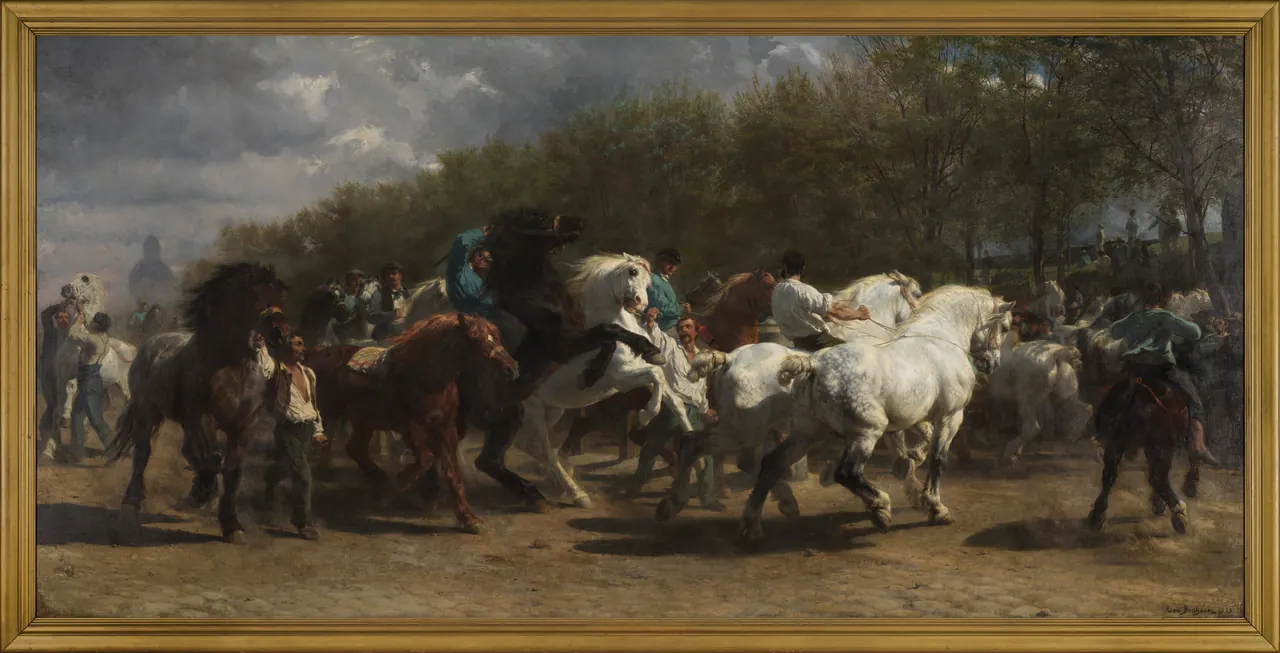
The first surprise is the scale. The Met’s version of The Horse Fair is more than five metres wide. Bonheur gave the buying and selling of horses a size capable of confronting the viewer bodily, rather than treating the animals as small additions to a landscape.
The subject is the horse market on the Boulevard de l’Hôpital in Paris. The museum records her repeated visits to sketch it, wearing men’s clothing to attract less attention. This was a working urban setting, not a timeless herd galloping free.
Look across the animals instead of picking a favourite immediately. A raised dark neck meets a white head; broad flanks turn away while other horses face towards us. Handlers repeatedly interrupt the flow. You can follow a circulating movement through the picture, but individual legs and heads resist any simple, tidy procession.
The contrast matters. Human beings are organising the display, yet the horses’ weight and energy remain evident. Calling it merely a celebration of freedom misses the ropes, riders and commercial setting. Calling it merely livestock documentation misses its carefully staged drama. Bonheur’s artist guide also distinguishes this monumental Met canvas from the smaller London version.
Géricault balances energy and control
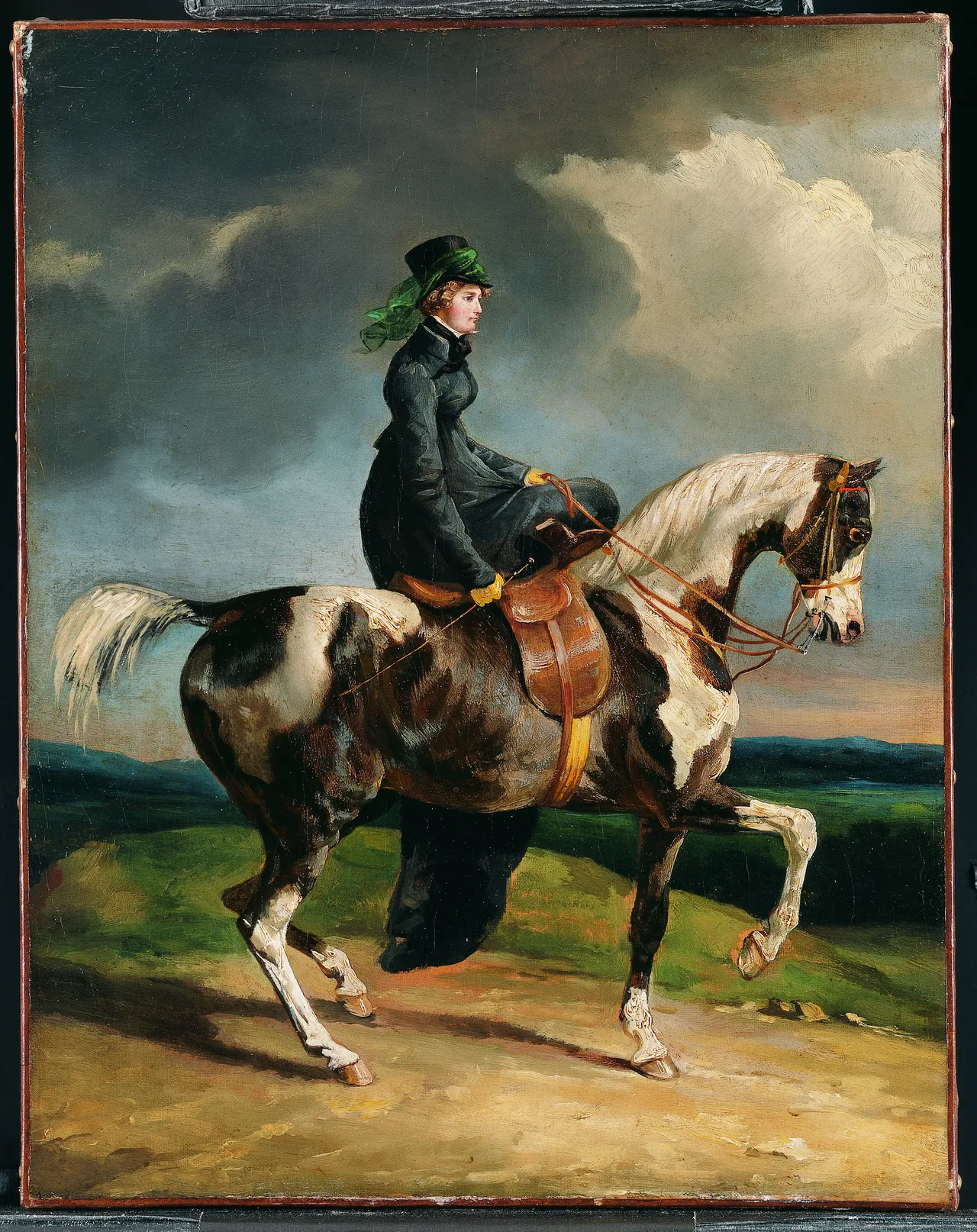
Before Bonheur’s crowded market, Géricault isolated a horse and rider against a troubled-looking sky. The woman’s upright body forms a steady vertical above the animal’s lifted leg. Her dark riding habit contrasts with its patches of white, while the thin reins connect their movements.
The Met dates Horsewoman to 1820 or later, relating it to Géricault’s interest in riding and sport around his stay in England in 1820–21. The sitter’s identity remains uncertain. We should not give her a famous name simply because the picture looks like a portrait.
The horse is shown largely from the side, allowing us to see the relationship between its curved neck, chest and raised foreleg. That clear profile differs from the overlapping bodies in Bonheur. Yet this is not a diagram of anatomy: the shining coat, sweeping tail and restless clouds make the surface active.
Try following the reins from the rider’s hands to the horse’s head. They are visually slight compared with the animal’s body. The contrast makes the idea of trained control tangible without requiring a story about a dangerous incident. Nothing in the picture establishes that rider or horse is panicking.
Manet puts us in the path of the race
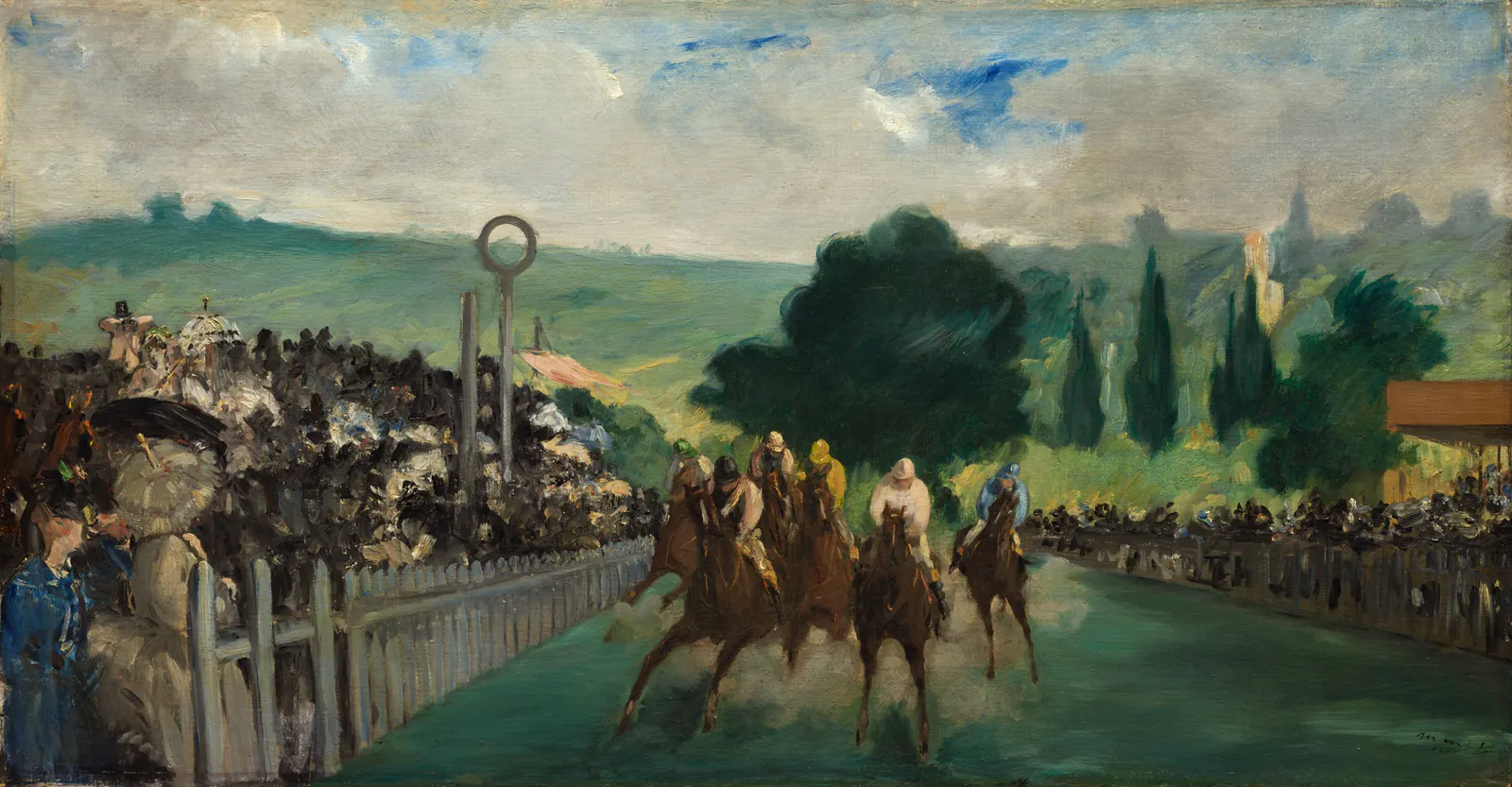
In The Races at Longchamp, the riders do not pass politely across our view. They come towards us. Fences running into the distance create a channel that seems about to deliver the horses directly to the foreground.
The Art Institute of Chicago describes this frontal approach as a departure from conventional side-on racing pictures. The course was a place of modern entertainment, with crowds as well as competitors. Notice how spectators fill the edges: the event is being watched within the picture as well as by us.
Manet’s loose marks make distant faces hard to distinguish. Nearer horses are clearer, but their legs still do not resolve into a sequence of neatly described steps. The picture asks us to experience an approaching group rather than inspect a single animal’s polished anatomy.
There is an important distinction between the painting and its reproduction. Chicago records that Manet cut down the original, larger canvas. The image shown here reproduces the surviving composition; it is not a new editorial crop designed to make the action more dramatic. That surviving width gives the race its concentrated rush. For Manet beyond this sporting subject, see his artist guide.
Degas makes the pause worth watching
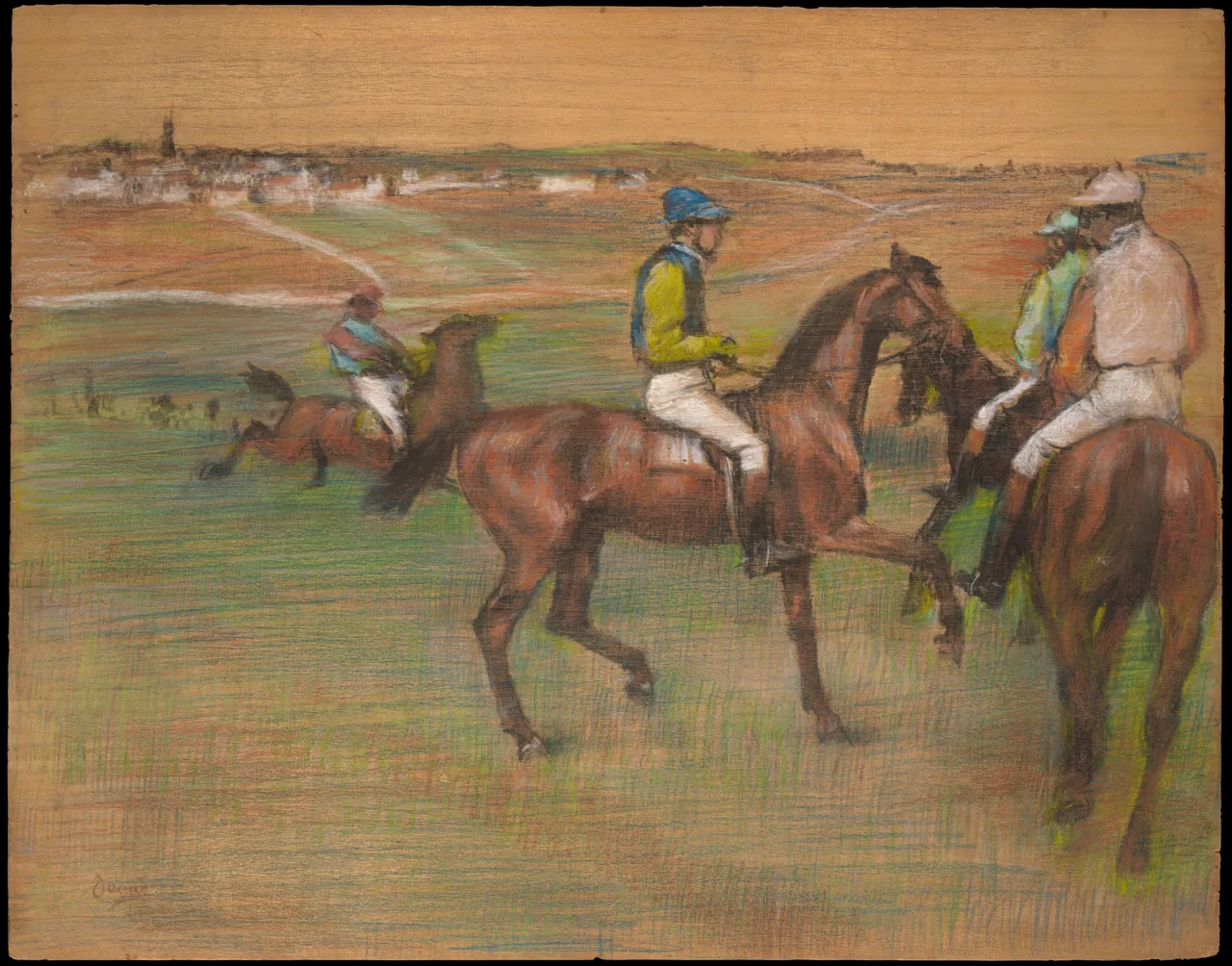
Degas supplies a useful counterpoint to Manet’s forward rush. His horses face several directions. One prominent head turns towards another animal, while the large horse at the right presents its hindquarters. We are close to a shifting gathering rather than watching a clearly defined finish.
This work is pastel on wood, not oil on canvas. The Met’s account of Race Horses explains that areas of the unvarnished support contribute colour to the sky and landscape. The warm brown behind the strokes is part of how the picture works, not simply missing paint.
Its apparent spontaneity also has a longer history. According to the same record, Degas reused figures from earlier works; the central horse and rider derive from a Gozzoli fresco that he had copied in 1859. A modern sporting scene can therefore contain remembered forms from Renaissance art.
Look at the bright yellow and blue jacket against the chestnut horse. The rider is compact, while the animal occupies a much larger, irregular shape. Small shifts of neck and leg make that shape feel unsettled. Degas does not need a gallop to make a horse an interesting subject.
Pissarro follows the working horse
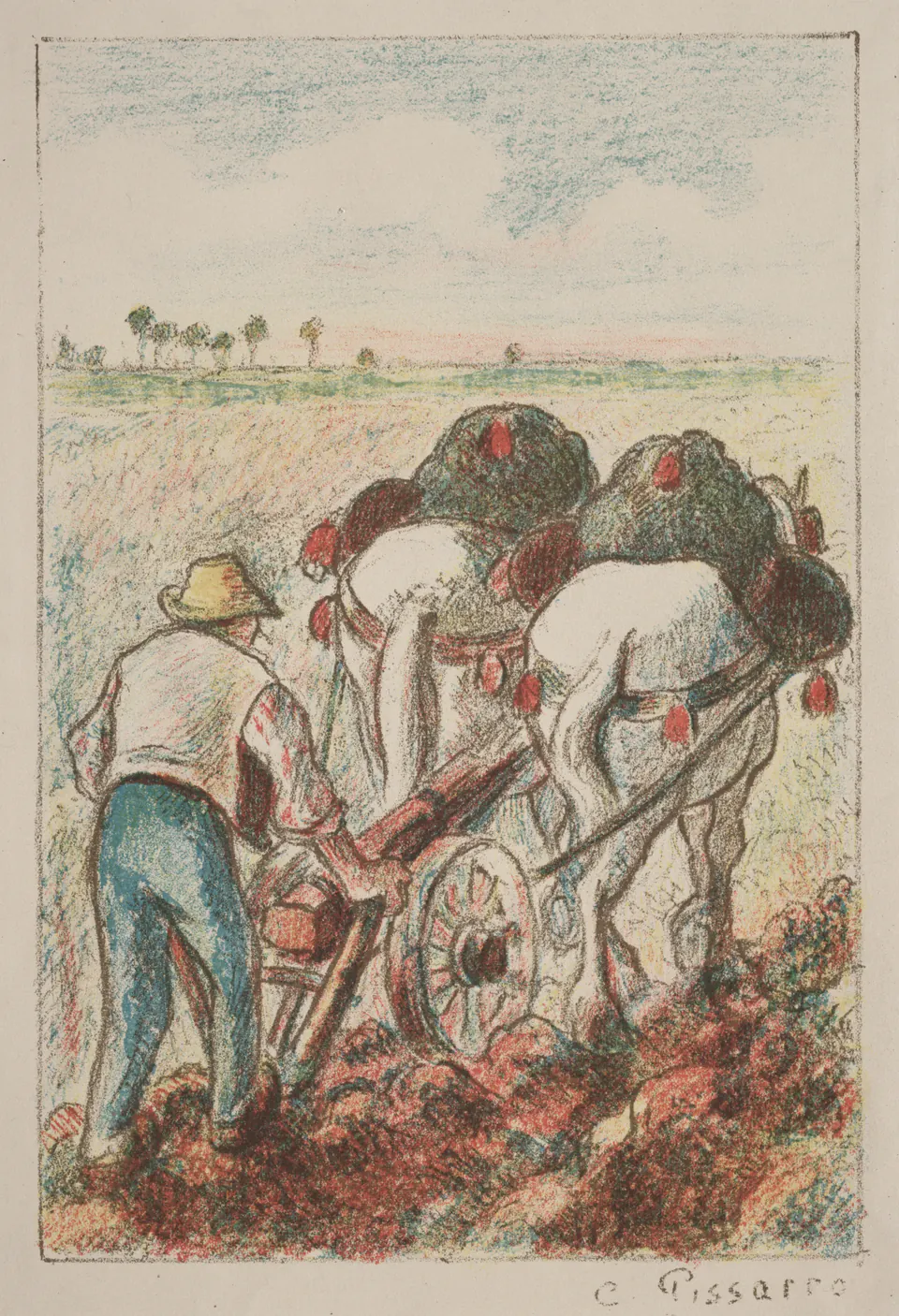
Racecourses turn equine energy into entertainment. In Pissarro’s The Plow, that energy becomes agricultural work. Two horses move away from us with a worker and the implement following close behind. We are placed behind the group, as though entering the furrow rather than standing apart to admire a profile.
The Cleveland Museum of Art records this as a colour lithograph from 1901. It is a print, not a small oil painting. Grainy marks and pale paper allow the field, harness and bodies to emerge without a continuously painted surface. The displayed image is Cleveland’s particular impression, including its margins.
The horses’ rounded hindquarters dominate the middle of the sheet. Curving lines repeat in the harness, tails and wheel below them. Red accents draw attention through the largely muted scene, but no spectator or winning post waits at its centre.
The low horizon leaves substantial space above the animals. Below it, overlapping bodies, equipment and soil make their task look physically connected. This is a useful reminder that the history of horses is not only a history of sport, military prestige or elegant ownership. Pissarro’s printmaking could give ordinary labour a prominent place in the image.
Marc makes a horse blue
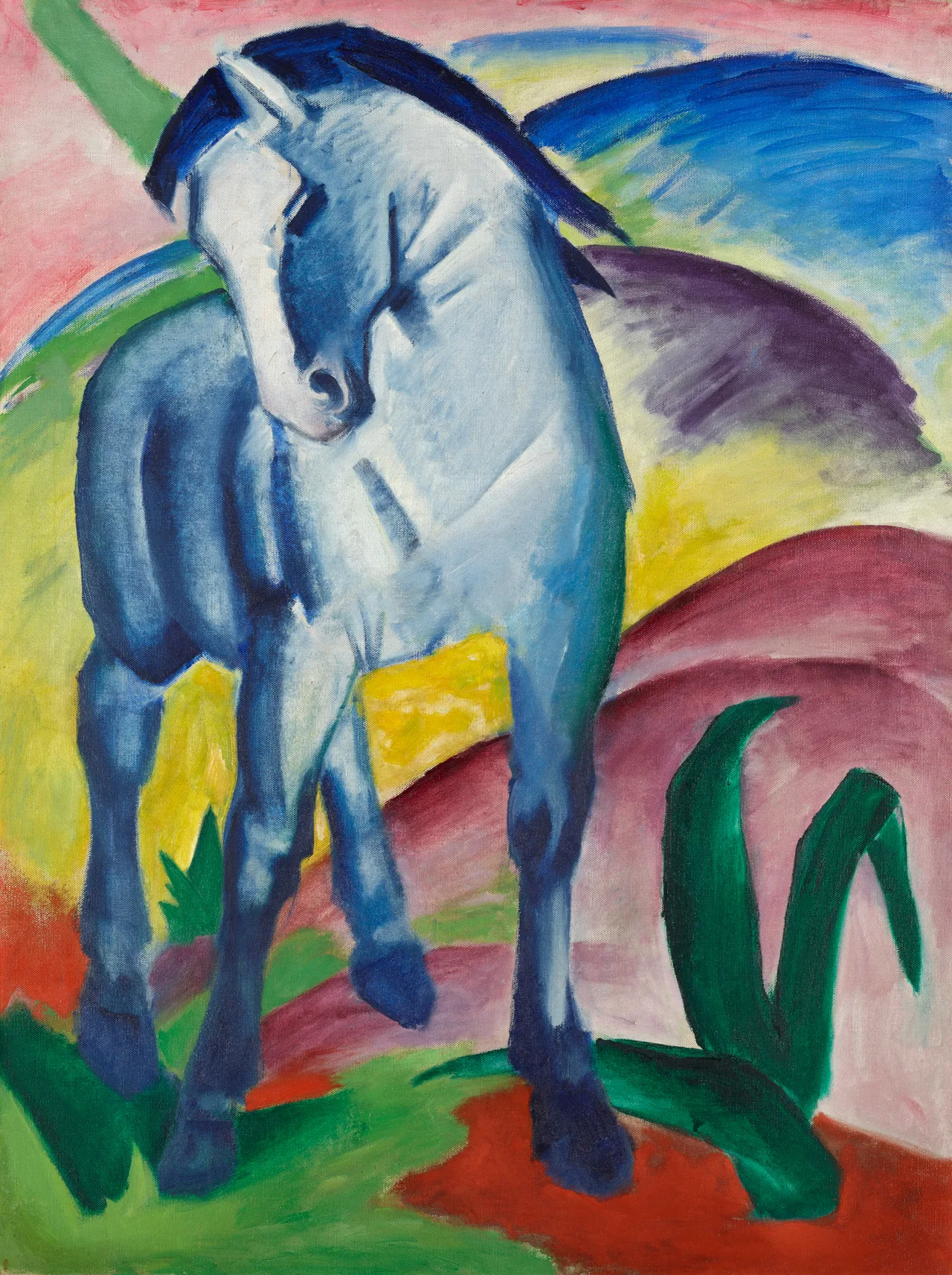
Marc removes the harness, rider and task. The horse stands close to us with its head inclined, while rounded bands of landscape echo the curves of its body. Blue no longer describes a natural coat. It helps organise the relationship between animal and surroundings.
This is Blue Horse I, 1911, in Lenbachhaus, not The Large Blue Horses or another similarly named Marc painting. The museum connects its colour with Marc’s interest in spiritual expression and discusses a letter to August Macke from December 1910. Such historical colour ideas belong to Marc’s particular thinking; they are not universal psychological rules about what blue does to everyone.
Look for the darkest blue in the mane and lower legs, then the near-white passages across the head and chest. The horse is neither one flat silhouette nor an anatomically detailed study. Its recognisable posture survives a radical change in the way colour builds the body.
Bonheur’s handlers are concerned with managing powerful animals in public. Marc offers a horse without that visible human economy. The shift is striking, but it is not a simple story of painting becoming progressively freer or better. Both artists construct a relationship between an animal and the world around it.
What changes when we follow the horse
Across these six works, the same subject opens onto trade, riding, spectacle, waiting, labour and expressive colour. There is no need to turn every horse into a symbol of freedom. A rein, a plough or a crowded track can make that reading inadequate.
Return to one picture and follow three things: the direction of the animal’s head, the weight suggested by its legs, and the person or landscape nearest it. Then compare another work. Those specific differences are a firmer starting point than assuming that all artists admired horses for the same reason.
The Franz Marc guide extends the comparison to his deer and woodcuts. The Degas collection offers a separate route through his work; it should not be read as a stock list for the particular works discussed here.
Editorial record
About this article
- Author
- Publisher
- GeMarkt
- Published
- Reviewed
- Internal source & rights check. Conducted by GeMarkt Research Review. This is an internal editorial check—not independent peer review.
- Source standard
- Art history source standardPrioritises object records and research sources, distinguishes evidence from interpretation, and states material uncertainty.
Found a claim that needs checking? Report a factual error.