GeMarkt Blog · Practical guide
Is Rosa Bonheur's Art Public Domain? Check the Work and File
Three documented Bonheur examples show how to check early publication and exact museum files, while keeping unresolved prints, bronzes and versions separate.
Rights check · reviewed
The short answer
Bonheur’s original paintings and drawings are beyond ordinary life-plus-70 economic copyright in the EU, UK and Türkiye. Three compositions match reproductions in a 1909 volume and have affirmative museum image terms. Other works, engravings and cast histories retain their own questions.
| What is being checked | Result | Why |
|---|---|---|
| European Union, United Kingdom & Türkiye | Ordinary term expired | Bonheur died in 1899. Her ordinary economic term is separate from moral rights, a first-publication right, a later maker’s original expression and file conditions. |
| United States — three matched compositions | Reproduced in 1909 | Klumpke’s illustrated volume matches Weaning the Calves (p. 377), A Limier Briquet Hound (p. 339) and Return from the Horse Fair (p. 283, with an arrival title on the plate). The checked compositions were published before 1931. |
| Other works, reproductive prints and bronzes | Specific histories unresolved | The Horse Fair versions, Pratt’s Sheep and Lambs, later publication histories and the two model/cast records are not cleared by Bonheur’s death year or a museum image label. |
The positive examples are Weaning the Calves, A Limier Briquet Hound and Cleveland’s Return from the Horse Fair. The Met’s large Horse Fair is not the National Gallery’s smaller version. The full twelve-record research set is not an approved commercial-reuse collection.
This is a documented research summary, not legal advice. Copyright and moral-rights rules can vary by country and by the history of a particular work.

What we’ll look at
What makes a Bonheur work and its museum image a documented choice for reuse?
Yes—Rosa Bonheur’s original paintings and drawings are beyond the ordinary life-plus-70 copyright term in the EU, UK and Türkiye. For U.S. reuse, check the particular work’s publication history. Then check the actual image you intend to download.
That distinction produces a useful answer, not just a warning. The three examples at the centre of this guide—Weaning the Calves, A Limier Briquet Hound and Cleveland’s Return from the Horse Fair—can be matched to reproductions in a 1909 book. Their museums also supply explicitly open-access image files. Other candidates have less complete histories, including an engraving after Bonheur and two bronzes. They are not given the same reuse conclusion simply to complete a list.
What Bonheur’s death date answers
Bonheur died in 1899. Her own ordinary author-based economic copyright term has therefore expired in the life-plus-70 markets considered here. That does not make every object carrying her name, every later edition, or every modern photograph legally identical.
| Market | The useful answer | What still needs checking |
|---|---|---|
| European Union | Bonheur’s ordinary life-plus-70 term has expired. | A first lawful publication or communication of a previously unpublished, out-of-copyright work can carry a separate 25-year right; later original contributions also require attention. |
| United Kingdom | The ordinary term for her paintings and drawings has expired. | Specific historical rules for unpublished engravings can differ. Do not apply them indiscriminately to paintings and drawings—or assume they never matter for a print after Bonheur. |
| Türkiye | Bonheur’s ordinary life-plus-70 economic term has expired. | A separately original adaptation, other surviving rights and the selected image’s terms remain distinct. |
| United States | The three positively matched 1909 reproductions establish that those compositions were published before 1931. | Another work may have a different publication history, including the special rules for old works first published much later. |
The sources for these distinctions are the EU term directive, including Articles 1 and 4, the UK IPO’s duration notice, Türkiye’s Law No. 5846, and the U.S. Copyright Office’s duration guidance. These are specified-country conclusions, not a promise that every use is free worldwide.
Three works with an early publication trail
An old catalogue is most useful when its illustration can be connected to the exact work. A similar title is not enough. For these examples, the museum image was compared with the relevant plate in the Getty Research Institute’s digitised copy of Anna Klumpke’s Rosa Bonheur; sa vie, son œuvre, 1909.
Weaning the Calves: a strong starting point
The Met’s 1879 painting, accession 87.15.109, appears on printed page 377. The book identifies the Metropolitan Museum, and the arrangement of the animals, fence and landscape matches the modern museum file.
This is stronger publication evidence than the museum’s 1887 acquisition date alone. It also gives the image a specific identity: a particular oil painting, not any Bonheur scene of calves. The Met’s supplied JPEG is the feature used here; its Open Access designation was checked separately.

A Limier Briquet Hound: follow the object, not just a breed label
The Met’s A Limier Briquet Hound, accession 87.15.77, is currently dated about 1856. Klumpke’s plate on printed page 339 identifies the Met, and the dog’s stance, markings and surrounding forms match the selected painting.
An older publication can document circulation without replacing the museum’s current dating. Keep the modern object record’s qualified date in the caption; use the historical plate for the narrower claim it establishes. The exact Open Access image belongs to this painting, not to a later engraving of the dog.

Return from the Horse Fair: one composition, two titles
Cleveland’s 1873 drawing, accession 2008.410, matches the illustration on printed page 283. The historical plate calls it L’Arrivée au marché aux chevaux—arrival at the horse market—while the museum and the book’s index use return wording.
That discrepancy should remain visible. The identification depends on the picture’s arrangement and the institutional record, not on quietly changing the historical caption to fit a modern title. The Cleveland JPEG is supplied under CC0. Its modern colour values are not verified by an old black-and-white plate.
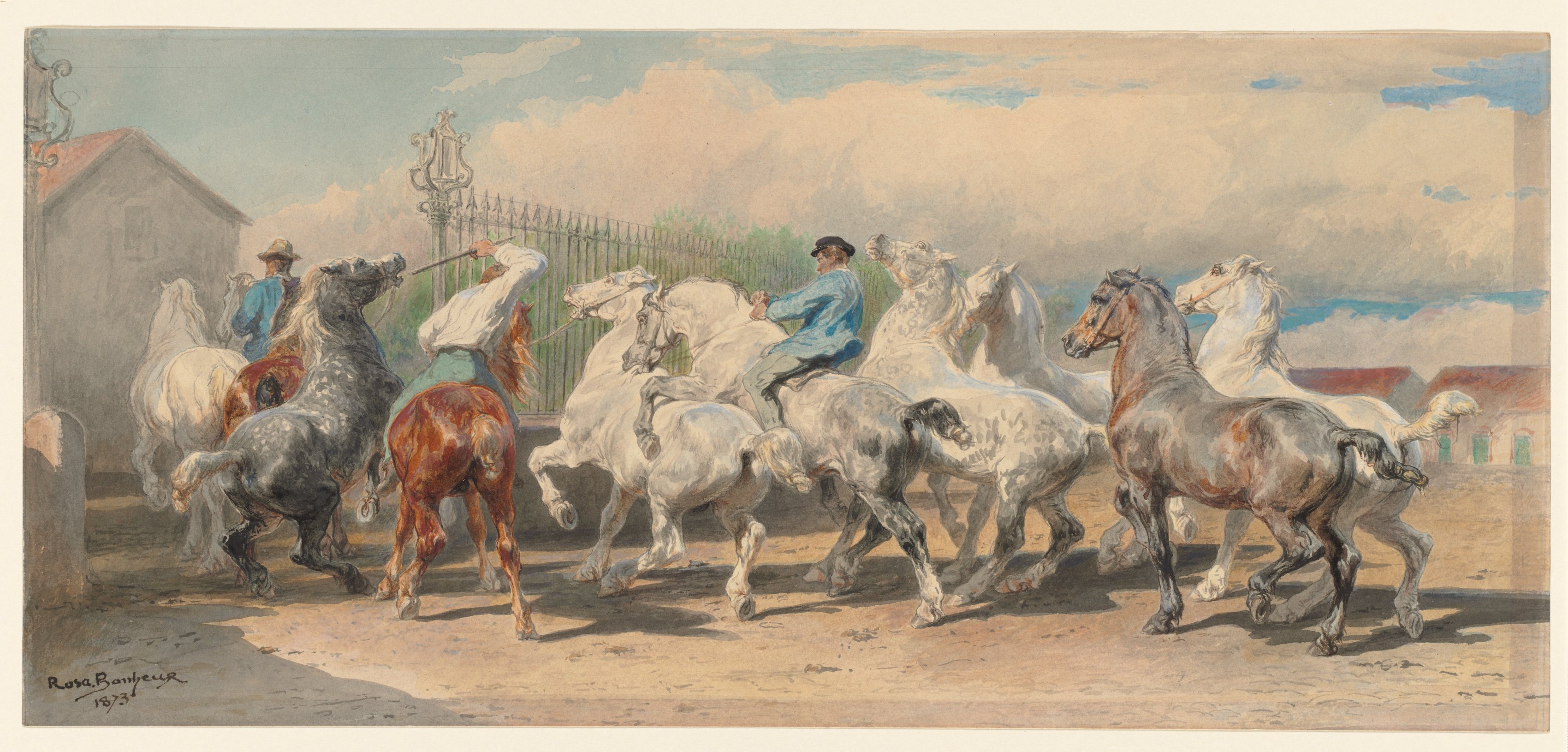
Is The Horse Fair public domain?
Bonheur’s ordinary economic term has expired, but first identify which Horse Fair you mean. The Met’s monumental canvas, accession 87.25, dates to 1852–55 and measures 244.5 × 506.7 cm. The National Gallery’s smaller 1855 version, NG621, measures 120 × 254.6 cm.
The National Gallery records that its version was made for Ernest Gambart for the engraver Thomas Landseer. That is unusually helpful production history: this smaller painting was connected to the making of reproductive prints. It is not a reason to treat every print as a reproduction of every detail in the Met’s final canvas.
For a reuse project, choose an institution and accession before choosing a download. A photograph of the large Met painting, the smaller London painting, and an engraved translation may differ in details, credited makers and file terms. A label saying only “The Horse Fair, Rosa Bonheur” leaves those questions unanswered. This guide does not borrow the London print history to close the U.S. history of the Met canvas.
Why an engraving or bronze needs another line in the caption
Cleveland’s Sheep and Lambs, 1943.130, is an 1893 etching by Joseph Bishop Pratt after Rosa Bonheur. That “after” matters. Bonheur supplied the source design; Pratt made the reproductive print. Their ordinary author terms have expired, but the bounded review did not find an exact original issue or publisher establishing this plate’s first distribution. Its creation date is not silently promoted to a publication date.
The UK also has a historical rule that can preserve copyright until the end of 2039 for certain qualifying unpublished works, including engravings. This is a reason to check an engraving’s history, not a finding that Pratt’s particular sheet is protected until then.
Bronze introduces a different distinction. The Met dates Walking Bull, 52.126.1, to a model made in 1846; that is not an established casting date for the selected bronze. Its Shorn Ewe, 1986.256, is modelled about 1842 and was probably cast before 1891. Keep that qualification.
An unknown cast date does not automatically mean a new copyright. A faithful later cast may simply reproduce an earlier model. The missing questions are when the model was published, which edition or cast is pictured, whether anyone added original expression, and what rights attach to the modern photograph. Those questions should be answered separately rather than collapsed into “bronze by Bonheur.”
What remains unresolved in the twelve-work research set
The three matched reproductions above are the guide’s positive examples. The wider research set remains visible so that an unresolved candidate is not mistaken for a recommendation.
| Candidate | What the available record establishes—and does not |
|---|---|
| The Farm at the Entrance of the Wood, Cleveland 1978.73 | Named in the 1900 estate-sale history as lot 884. That is meaningful distribution evidence, but no historical illustration was visually matched in this review. |
| Stag Lying Down, Cleveland 1977.3 | Connected to the 1900 estate sale, lot 934. It is not treated as though the present image had been matched to a contemporary reproduction. |
| Sheep, Cleveland 1915.716 | The 1861 drawing entered through Hurlbut’s estate in 1915. The available record does not establish an early publication event. |
| Wild Boars in the Snow, Cleveland 1980.231 | A 1976 dealer purchase and a 1981 illustrated museum bulletin are recorded. They do not establish a first authorised publication before 1931. |
| Tree Study, Cleveland 2009.124 | The recorded provenance begins with the Butkin estate in 2008. No exact earlier publication was established. |
| The Horse Fair, Pratt’s Sheep and Lambs, Walking Bull and Shorn Ewe | The version, issue or model/cast questions discussed above remain distinct from their museums’ affirmative image labels. |
“Unresolved” does not mean that a work is necessarily protected. It means the evidence gathered here does not support the stronger reuse assurance. For some old works, 17 U.S.C. §303 can preserve copyright through 2047 if first publication occurred during 1978–2002. Conversely, not finding an early publication is not proof that a work remained unpublished. Neither outcome should be guessed.
The museum image is a second check
Cleveland’s Open Access programme makes its designated images available under CC0. The Met’s Open Access policy likewise covers designated public-domain collection images. The exact files linked in this research set had affirmative institutional rights signals and responded successfully when checked on 3 October 2026.
Those are useful permissions, not disposable footnotes. Record the exact file URL and accession, retain the museum credit, and note the terms and review date. Do not replace the file with an auction photograph, a scanned modern book page or somebody else’s colour restoration and assume the same record still applies. Photographs of sculpture especially call for a file-specific check rather than an assumption based on the model’s age.
CC0 does not authorise the use of museum trademarks or an implication of museum endorsement. Attribution is valuable even where it is not a licence condition: it lets another reader identify the version and retrace your decision.
A practical way to choose an image
Start with the work, not a search-result thumbnail. Write down the institution, accession, medium and qualified date. If it is a print, preserve the engraver, printer and publisher where identified; if it is a sculpture, separate model and cast information.
Next, record the evidence relevant to your target countries. A dated, identified reproduction is different from an exhibition, a gift or a modern website upload. Use the U.S. statutory publication definition when that distinction affects the conclusion. Then save the exact provider terms and describe any crop, colour adjustment or other alteration you make.
For a straightforward project, the three matched examples here provide a better starting point than filling a collection with works whose histories remain open. If a particular unresolved work is essential to a commercial project, obtain a work- and country-specific assessment before relying on it.
For the broader method, see How to cite art and images and How provenance changes an object’s story. Bonheur’s place in nineteenth-century visual culture also connects to Realism, labour and the modern city. This guide does not announce a Bonheur product, collection or download service.
This is general rights research, not legal advice. Moral rights, contracts, trademarks and the circumstances of a particular use can require further consideration even after an economic copyright term has expired.
Sources and review method
We checked the artist chronology against museum records, treated each named jurisdiction separately, and recorded the provider policy for the image set. These sources support the legal framework and artist dates used above; the source file for any individual image still needs its own record.
- Weaning the Calves, 87.15.109 — The Metropolitan Museum of Art. Feature identity, 1879 date, exact supplied JPEG and Open Access designation.
- A Limier Briquet Hound, 87.15.77 — The Metropolitan Museum of Art. Exact painting matched to the 1909 illustration; current qualified dating is retained.
- Return from the Horse Fair, 2008.410 — Cleveland Museum of Art. Exact drawing and CC0 file, matched to the historical plate despite its arrival title.
- Rosa Bonheur; sa vie, son œuvre (1909) — Anna Klumpke; Getty Research Institute digitised copy. Source review visually compared the three relevant historical illustrations with the exact modern museum files.
- The Horse Fair, NG621 — National Gallery. The smaller 1855 painting’s print-production history is not transferred to the Met canvas.
- Copyright notice: duration of copyright — UK Intellectual Property Office. The historical 2039 rule can apply to qualifying unpublished engravings, not ordinary paintings and drawings indiscriminately.
- Image and Data Resources — The Metropolitan Museum of Art. The Met makes files marked Public Domain available under Open Access CC0.
- Open Access — Cleveland Museum of Art. Cleveland releases eligible collection images and metadata under CC0.
- Directive 2006/116/EC, Article 1 — EUR-Lex. The EU term for an artistic work is the author’s life plus 70 years.
- How long copyright lasts — UK Government. UK guidance gives 70 years after the author’s death for artistic works.
- Law No. 5846 on Intellectual and Artistic Works, Article 27 — WIPO Lex. The Turkish economic-rights term is the author’s life plus 70 years.
- Circular 15A: Duration of Copyright — U.S. Copyright Office. Applying the maximum 95-year publication term to 2026 places works published before 1931 outside that term.
- 17 U.S.C. Chapter 3, including §303 — U.S. Copyright Office. Section 303 keeps the unpublished-work transition and the 1978–2002 first-publication floor separate.
- Visual Artists: Publication — U.S. Copyright Office. Distribution can publish visual art; public display alone does not establish publication.
- Copyright notice: digital images, photographs and the internet — UK Intellectual Property Office. The old work and the exact modern digital file remain separate checks.
Editorial record
About this article
- Author
- Publisher
- GeMarkt
- Published
- Reviewed
- Internal source & rights check. Conducted by GeMarkt Research Review. This is an internal editorial check—not independent peer review.
- Source standard
- Rights guide source standardSeparates the underlying work from the source file, records the review date, and links the evidence used for the conclusion.
Found a claim that needs checking? Report a factual error.