GeMarkt Blog · Practical guide
Is Franz Marc’s Art Public Domain? Animals, Prints and Exact Files
Look closely at Marc’s deer and a tiger woodcut, with two exact CC0 museum files and separate checks for artworks, countries, print impressions and photographs.
Rights check · reviewed
The short answer
Lenbachhaus supplies Deer at Dusk and Cleveland supplies this Tiger woodcut image under CC0. Marc’s ordinary EU/UK term has elapsed. His 1916 death does not independently establish U.S. publication histories or permission for every later impression, edition or photograph.
| What is being checked | Result | Why |
|---|---|---|
| European Union — ordinary author term | Ordinary named-artist term has elapsed | Marc died in 1916. The ordinary life-plus-70 author term has elapsed; national exceptions, moral rights, other contributors and later first-publication rights remain separate. |
| United Kingdom — ordinary artistic-work term | Ordinary artist term has elapsed | The ordinary artistic-work term has elapsed. Specific unpublished-material exceptions, another contributor’s work and later reproductions must not be silently cleared. |
| United States — independent publication history | Publication evidence remains work-specific | This guide does not independently establish U.S. publication histories for its displayed works or other research objects. Artist death, creation date and an institutional file designation do not replace that chain. Provider statements are explicitly attributed. |
| Selected digital files | Two exact institutional CC0 files | Lenbachhaus G 12763, Rehe in der Dämmerung (1909), and Cleveland 1961.157, Tiger (1912), are the two exact CC0 files. Original JPEGs, complete institutional metadata and SHA-256 hashes are preserved. No CC0 claim is transferred to an unrelated sculpture photograph or a different Tiger work. |
| Other works, editions and files | Ten research references remain display HOLDs | HOLD means no approved local display file in this guide, not necessarily that the historical work is protected. The twelve-record matrix is not twelve permissions. No worldwide or whole-catalogue clearance. |
Twelve exact research records across paintings, prints, drawing and sculpture; two displayed CC0 images, ten display HOLDs. Chicago’s 1919 bibliography for The Bewitched Mill is a lead, not an independently inspected publication plate or a whole-catalogue clearance.
This is a documented research summary, not legal advice. Copyright and moral-rights rules can vary by country and by the history of a particular work.

What we’ll look at
Which Marc object, impression or photograph do you want to reproduce?
Short answer: There are openly usable museum files for particular Franz Marc works, including the two illustrated here. His ordinary EU and UK author term has elapsed, but “Marc died in 1916” is not enough to clear every work in every country. This guide does not independently establish U.S. publication histories for the selected works; it attributes the museums’ exact-file CC0 designations.
Marc’s blue horses are famous, but colour is only part of his appeal. Compare a softly painted pair of deer with a sharply cut tiger and you meet an artist who could make an animal seem at home in the landscape—or turn the whole landscape into a field of tension.
More than blue horses
Marc lived from 1880 to 1916 and worked within the Munich Blue Rider circle. Lenbachhaus describes that circle as an exchange among artists including Marc, Wassily Kandinsky, Gabriele Münter, Maria Franck-Marc and August Macke, rather than the invention of one isolated painter. Its story was interrupted by the First World War. Marc died at Verdun on March 4, 1916, as the Cleveland Museum of Art records.
The familiar Blue Horse I dates to 1911 and belongs to Lenbachhaus, accession G 13324. The young horse is blue because the painting is not trying to be a field guide to natural coat colours. The museum connects its colour and bowed posture with Marc’s search for spiritual expression. That does not mean every blue patch in every Marc work has one fixed translation.
Begin instead with a practical question: how does the animal fit its setting? Does its back repeat a hill? Do plants shelter it, or seem to cut across its body? These are things you can see before learning the details of a movement or colour theory.
Two deer close to the ground
The opening painting is Rehe in der Dämmerung, or Deer at Dusk, from 1909. Lenbachhaus records an oil painting measuring 70.5 by 100.5 centimetres. It entered the collection as a gift from Gabriele Münter and is distinct from Marc’s other paintings of deer in woods.
Both animals bend towards the earth. Their pale backs make two broad arcs against the darker brown ground. The right-hand deer turns its neck inward; the left one stretches across the width of the picture. Their bodies do not look pasted onto a separate background. Similar sweeping strokes shape fur, plants and soil.
Notice the cool mauve and pale pink across the animals, then the short yellow touches near their feet. You can still recognise the subject immediately, yet the surface insists that you are looking at paint. From close by, a leg or ear breaks into directional strokes. From farther away, those strokes gather into a living posture.
This quieter work makes a useful starting point before Marc’s stronger colour contrasts. It also rewards keeping the full rectangular image. Cropping to one deer would remove the relationship between their two lowered heads and make the composition feel like an individual animal study.
A tiger made of black and white
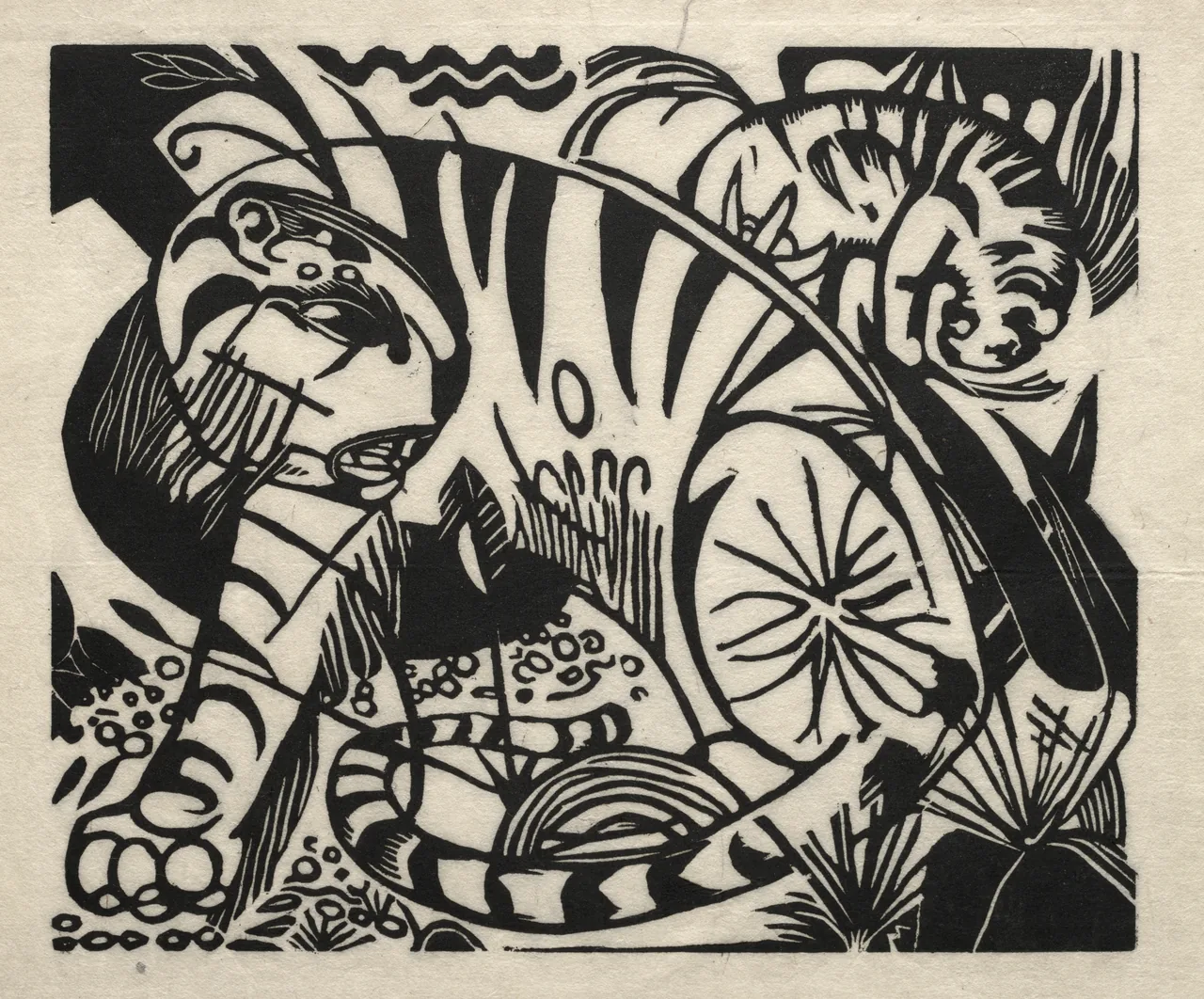
Franz Marc, Tiger, 1912, woodcut. The Cleveland Museum of Art, Gift of The Print Club of Cleveland, 1961.157. Exact impression and CC0 source.
Cleveland’s Tiger is a woodcut, not a monochrome photograph of a painting. Its record identifies this impression with accession 1961.157 and Lankheit catalogue number 833. These details matter because the generic title “Tiger, 1912” is not enough to distinguish every object or reproduction.
The big animal curves around the centre of the sheet. Stripes cross its back, while leaves and pointed shapes compete with the same black bands. The mouth on the left is open; a smaller creature is compressed into the upper-right corner. Cleveland interprets the encounter as threatening rather than harmonious.
Try following only the unprinted pale areas. They describe a flank, an eye and gaps between plants. Then follow only the black. The animal and its surroundings become difficult to separate. Where the deer painting builds bodies from soft strokes, the print makes its impact through abrupt changes from dark to light. Neither approach depends on anatomical detail alone.
The cream paper is part of the photograph’s appearance. Turning it brilliant white, smoothing the ink or filling small irregularities would change this reproduction. A clean digital tracing might be attractive, but it should not be mistaken for the museum’s image of the historical impression.
Twelve specific objects
The following records offer routes into Marc’s range. Two images are displayed above; the other ten remain research references rather than cleared local downloads. “Undated” and broad date ranges are preserved instead of replaced with guesses.
| Work | Date | Exact collection record |
|---|---|---|
| Tiger, woodcut | 1912 | Cleveland 1961.157 |
| Genesis II, colour woodcut | 1914 | Cleveland 1959.228 |
| Horse, woodcut | 1895–1916 | Cleveland 1998.89 |
| The Bewitched Mill | 1913 | Chicago 1931.522 |
| Sleeping Shepherdess | Undated | Chicago 1956.654 |
| The Bull, woodcut | 1912 | Chicago 1947.649 |
| Horse, ink and wash drawing | 1913 | Chicago 2012.85 |
| An Animal Legend | 1912 | Chicago 1947.575 |
| Genesis I | 1914 | Chicago 1947.576 |
| Deer at Dusk | 1909 | Lenbachhaus G 12763 |
| Blue Horse I | 1911 | Lenbachhaus G 13324 |
| Two Horses, bronze | 1908/09 | Lenbachhaus G 13319 |
The two works called Horse are not interchangeable: one is a woodcut with a broad museum date range, the other a dated drawing. The bronze introduces another distinction. A sculpture is three-dimensional, and a particular photographer chooses its lighting and viewpoint. Do not use rules about flat painting scans as automatic permission for every sculpture photograph.
Why 1916 is not the whole answer
Under the ordinary EU rule and UK artistic-work rule, life plus seventy years has elapsed for Marc. That conclusion concerns his ordinary author term, not every later edition, contributor or national exception.
For U.S. research, establish publication rather than substituting the date painted. The Copyright Office’s 2026 guidance confirms that works published in the United States before January 1, 1931 are public domain. A museum exhibition or a date in a catalogue is not automatically evidence of that kind of publication. For older unpublished material, section 303 has separate conditions, including a possible 2047 floor in particular circumstances.
An early bibliography is a lead, not the end of the check. Chicago lists a 1919 book reference for The Bewitched Mill, but this guide has not inspected the original page and does not turn that citation into an independently proven publication event.
From the object to a usable image
Lenbachhaus’s image guidance explains its designated CC0 downloads and asks users to retain accurate sources and identify alterations. Cleveland’s policy similarly identifies the files it releases through open access. Those are useful, specific starting points; they are not permissions for unrelated websites’ photographs.
For these two displayed examples, the exact museum file, object page and CC0 statement remain connected. We have preserved the full supplied image and used proportional resizing for the page, without invented detail. For another work, repeat that small check: correct object, correct impression where relevant, correct country and correct file. This is general research guidance, not legal advice.
Sources and review method
We checked the artist chronology against museum records, treated each named jurisdiction separately, and recorded the provider policy for the image set. These sources support the legal framework and artist dates used above; the source file for any individual image still needs its own record.
- Rehe in der Dämmerung, G 12763 — Lenbachhaus. Exact 1909 oil painting, dimensions, Münter gift and CC0 download.
- Tiger, 1961.157 — The Cleveland Museum of Art. 1912 woodcut, exact impression, Lankheit 833 and CC0 source; Marc’s death date and attributed interpretation.
- Blue Horse I, G 13324 — Lenbachhaus. Specific 1911 painting; full official HTML saved. Symbolic reading attributed, no image acquired.
- Two Horses, G 13319 — Lenbachhaus. 1908/09 bronze, named photographer and exact object; no image acquired.
- The Blue Rider — A New Language — Lenbachhaus. Institutional account of collaborative circle and wartime interruption; official indexed result checked.
- The Bewitched Mill, 1931.522, official metadata — Art Institute of Chicago. Exact 1913 painting and 1919 bibliographic lead; page access denied, accessible API preserved, no image or first-publication proof claimed.
- Collection glossary and image terms — Lenbachhaus. Exact designated CC0 download terms and source/alteration guidance; not a universal statement of national law.
- Open Access — The Cleveland Museum of Art. Exact museum-supplied CC0 image terms, without endorsement or unrelated-rights waiver.
- Copyright in the EU — European Union, Your Europe. Ordinary life-plus-70 author term; no worldwide or national-exception clearance.
- How long copyright lasts — UK Intellectual Property Office. Ordinary artistic-work term, not all archival categories or later contributors.
- Circular 15A: Duration of Copyright, April 2026 revision — U.S. Copyright Office. Pre-January-1931 U.S. publication cutoff in 2026; publication is not creation or exhibition.
- 17 U.S.C. Chapter 3, including section 303 — U.S. Copyright Office. Older unpublished works have conditional rules, not an automatic 2047 term for every painting.
Editorial record
About this article
- Author
- Publisher
- GeMarkt
- Published
- Reviewed
- Internal source & rights check. Conducted by GeMarkt Research Review. This is an internal editorial check—not independent peer review.
- Source standard
- Rights guide source standardSeparates the underlying work from the source file, records the review date, and links the evidence used for the conclusion.
Found a claim that needs checking? Report a factual error.