GeMarkt Blog · Essay
Famous Dog Paintings Through History
Meet six painted dogs, from Van Eyck’s watchful companion to Cassatt’s sleeping pet, and see how they change portraits, stories and everyday scenes.

A dog can be the smallest figure in a painting and still change everything. Remove the little animal from The Arnolfini Portrait and the room becomes more ceremonious. Remove the sleeping puppy from Manet’s The Railway and its human figures seem a little more isolated. In Rosa Bonheur’s hound portrait, there is no human figure to remove: the dog has the picture to itself.
These six works follow dogs through selected European and American painting from the fifteenth to the nineteenth century. Some are famous paintings with dogs rather than paintings famous only for their dogs. Together they show why that distinction is useful. An animal might help construct a family’s public image, make a scene feel intimate, or hold our attention as an individual.
Begin with the simplest question: what is this particular dog doing? Its position, gaze and relationship to the people usually tell us more than a ready-made list of symbols.
Van Eyck’s dog meets the visitor
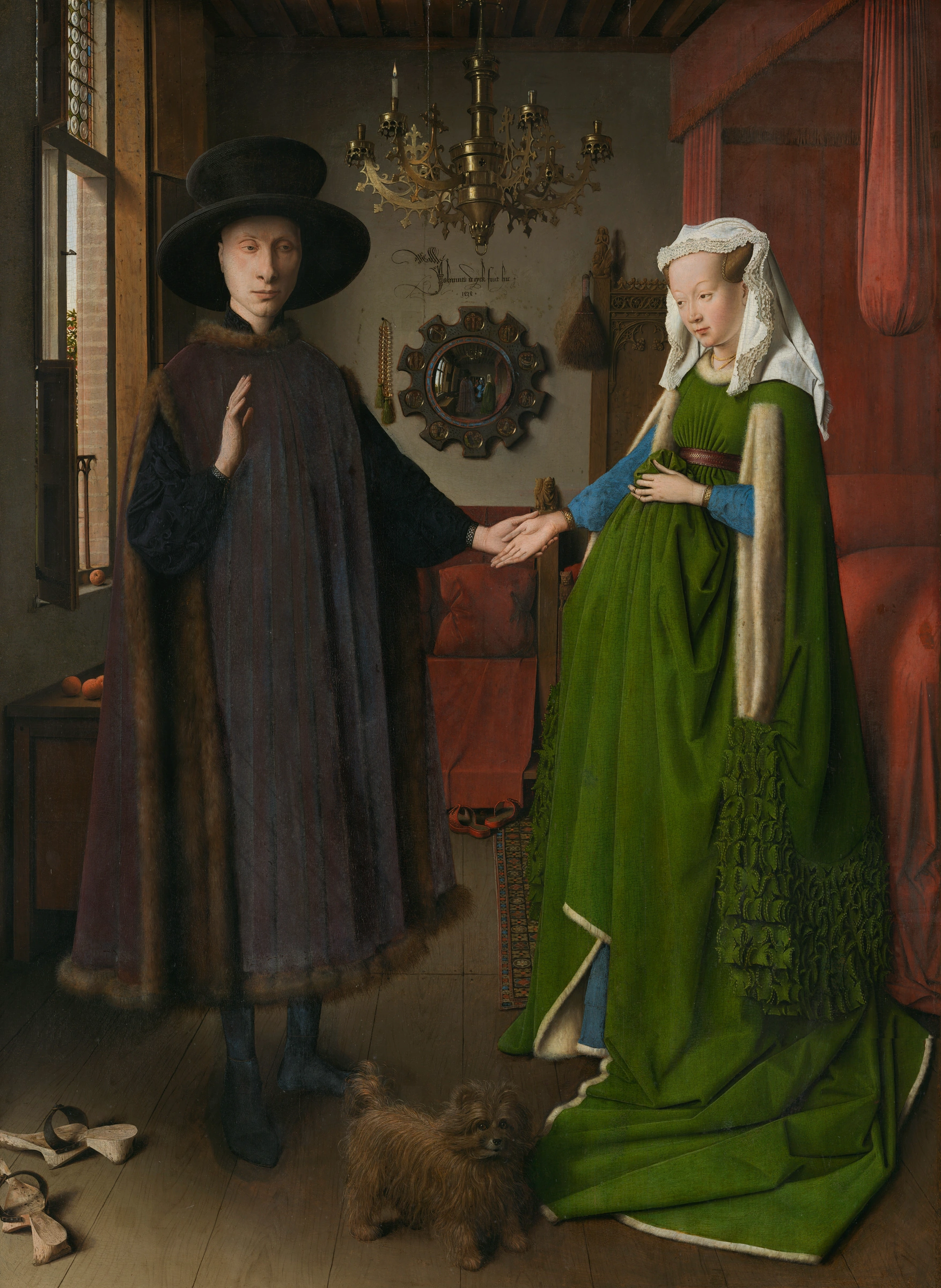

At the bottom of this carefully furnished room, the little brown dog stands almost directly below the couple’s joined hands. The people turn towards one another; the animal looks out. Its bright eyes and uneven fringe of fur offer an immediate point of contact with us.
The National Gallery’s account of the painting notes the traditional association of dogs with marital faithfulness. But that does not prove that this picture records a wedding ceremony. The same museum explains that the ceremony interpretation is no longer accepted and that the sitters’ identification contains uncertainties. A familiar symbol cannot settle every question surrounding the scene.
There is also a useful material clue. Technical examination shows that the dog was added after the initial underdrawing. It was a deliberate part of the developing composition, not simply an incidental pet captured in a painted snapshot.
Look at how its warm fur interrupts the long, dark robe and heavy green dress. The animal makes the floor feel inhabited, bringing a small living presence into a room full of expensive things. Our Arnolfini story follows the larger scene without treating its details as a single secret code.
Fragonard’s companion shares a secret
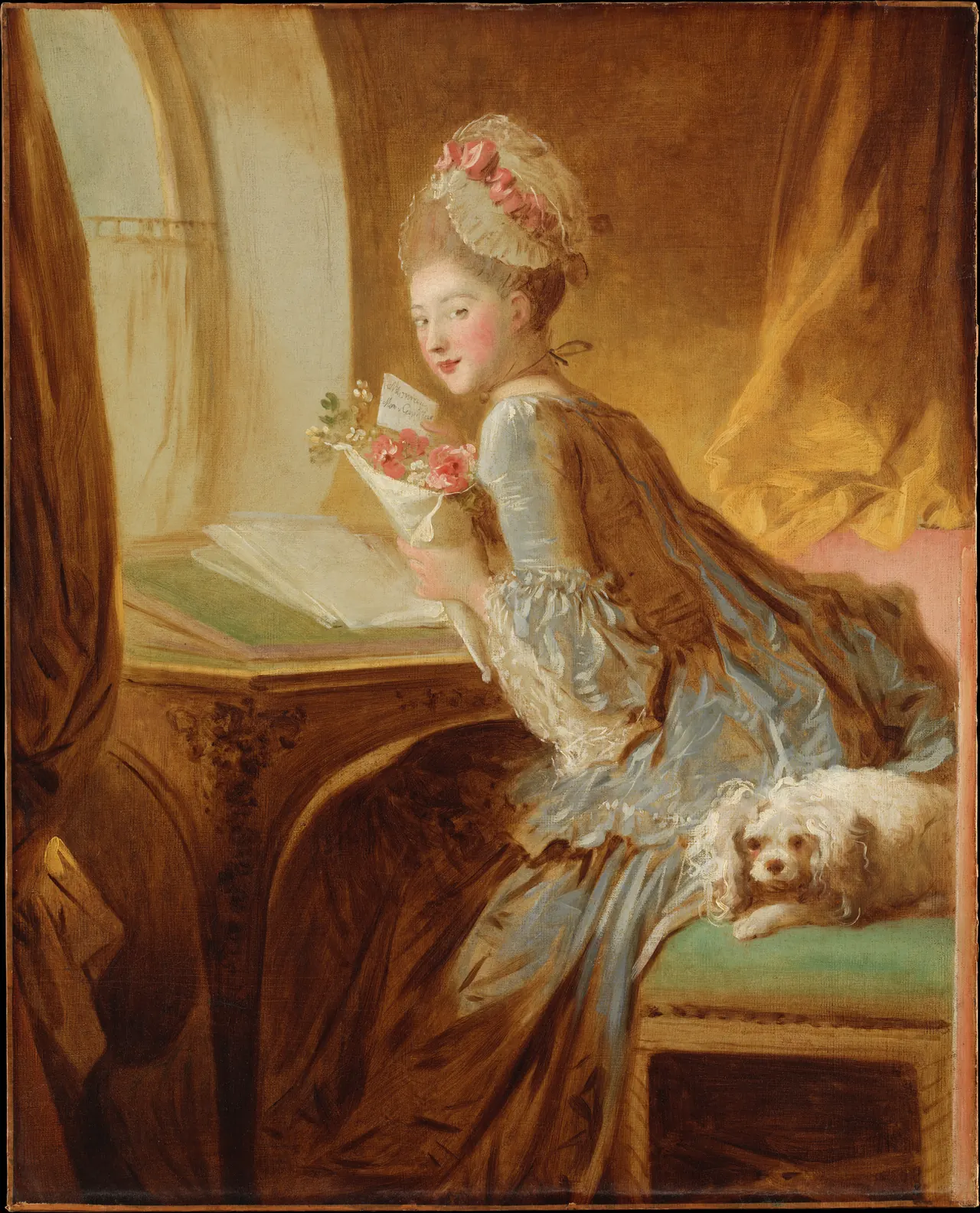
Fragonard’s dog is easy to overlook because its pale coat blends with the woman’s sleeve and dress. Follow the line of her arm down towards the green chair, however, and another face appears. The small animal looks out from a much lower level than its human companion.
The Met identifies this as a genre scene, meaning an imagined scene of everyday life, rather than a portrait of a known sitter. The letter and bouquet suggest a story extending beyond the picture. They do not tell us exactly who sent the flowers or what the woman will do next.
The dog contributes to that inviting incompleteness. It lies comfortably close to her, sharing the furniture rather than occupying a separate space. Its gaze makes it feel like another witness to our arrival. That is a reading of the arrangement, not evidence that the animal is guarding a particular romantic secret.
Compare its loose curls with Van Eyck’s painstaking hairs. Fragonard does not need to describe every strand to make us recognise a small, soft body. Quick pale marks connect fur, lace and reflected light across the painting.
Bonheur gives the dog its own portrait
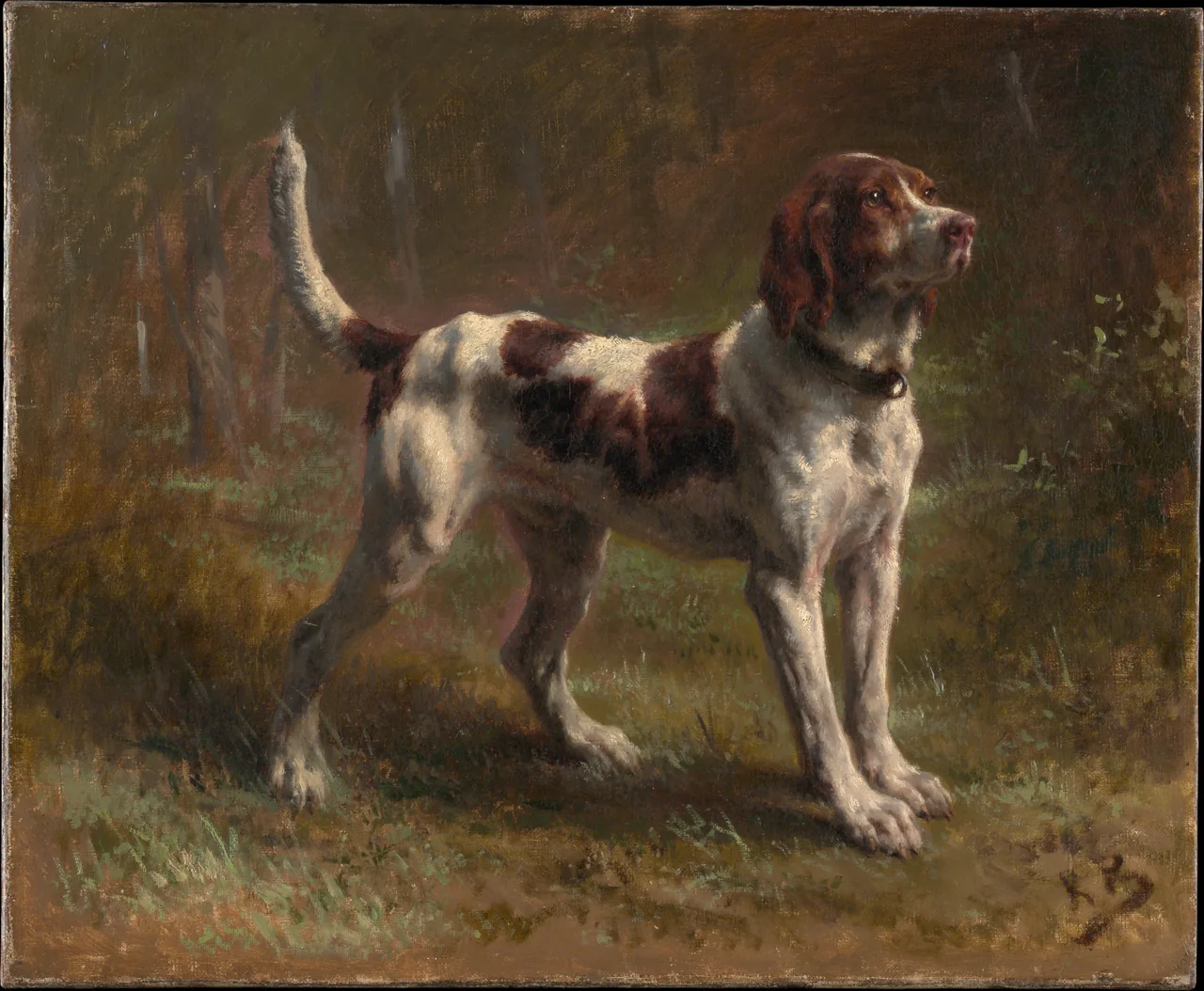
Here the surrounding people have disappeared. The hound stands across almost the full width of the canvas, with enough space around its paws and tail for us to follow its entire stance. A bright patch on the chest draws attention towards the raised head.
The Met records that Bonheur painted the animal from life, around 1856, and that it belonged to the Vicomte d’Armaille. That gives this dog a documented connection to a particular household. It is not merely an anonymous illustration of a breed.
Bonheur combines firm weight with alertness. The paws appear planted, while the eyes and lifted nose direct attention above and beyond the right-hand edge. We cannot see what has attracted it. There is no need to invent a hunt about to begin: the incomplete action is already enough to hold us.
Notice the irregular patches, folds around the neck and different textures of the ears and body. This is animal portraiture built from attentive distinctions. Bonheur’s wider practice included both pets and working animals; their familiarity never made close observation unnecessary.
Manet’s puppy sleeps through modern Paris
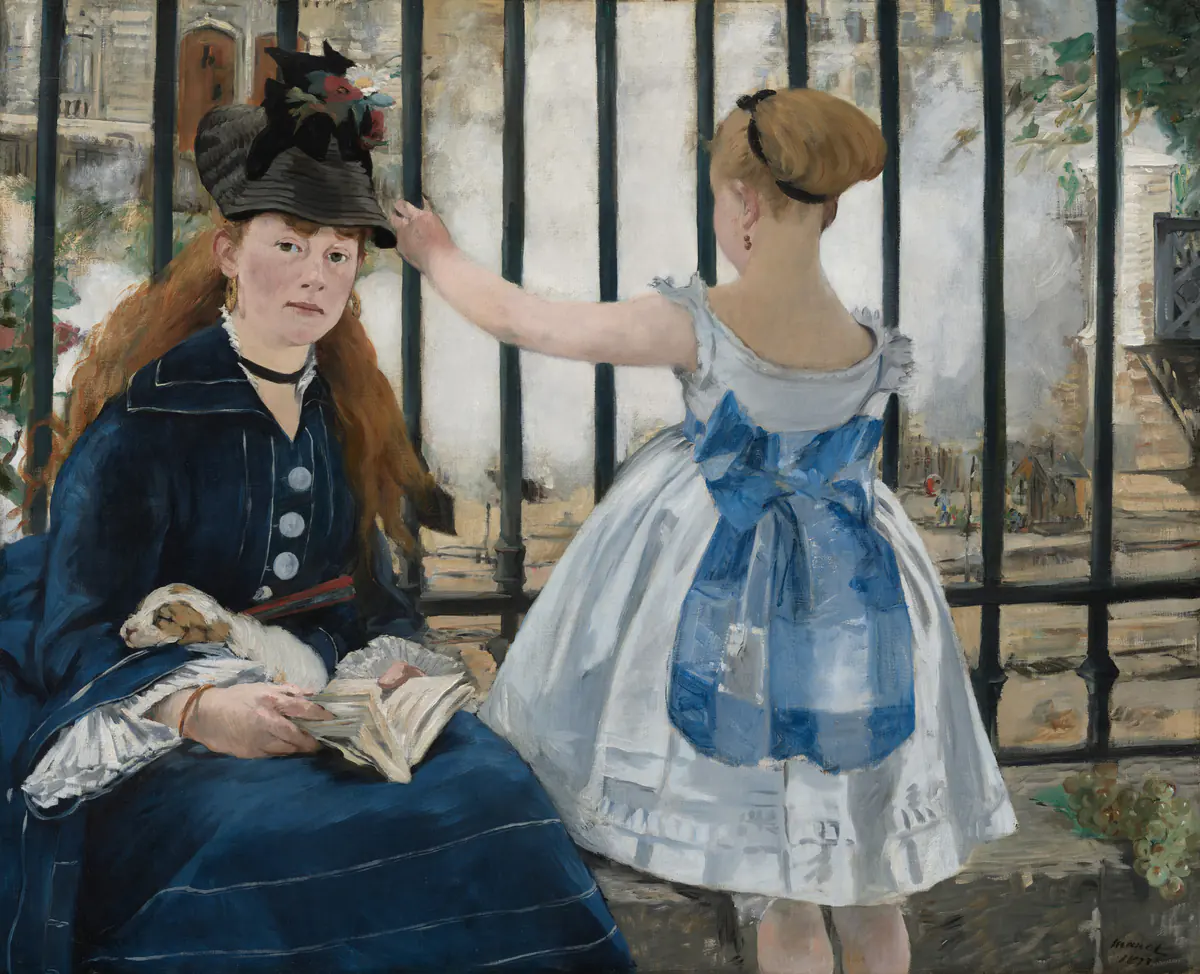
The puppy occupies the woman’s lap beside her open book, sheltered within an otherwise busy setting. Beyond the iron fence, railway steam obscures our view. The girl faces that hidden activity; the seated woman faces us. The dog participates in neither exchange.
In the National Gallery of Art’s discussion, the relationship between the two people remains ambiguous. They should not automatically be called mother and daughter. The sleeping animal supplies a more immediate, visible fact: someone has made room for a resting body.
Its pale coat is particularly effective against the deep blue dress. It belongs to the foreground cluster of hand, book and fabric rather than to the hard vertical bars behind. While the girl’s turned back carries our attention into the distance, the puppy brings it back to the lap.
This is a useful example of a dog doing very little while accomplishing a great deal pictorially. Sleep gives the scene another pace. We can read stillness beside movement without assigning the puppy a fixed symbolic role or inventing its thoughts about the railway.
Renoir makes the dog part of the family
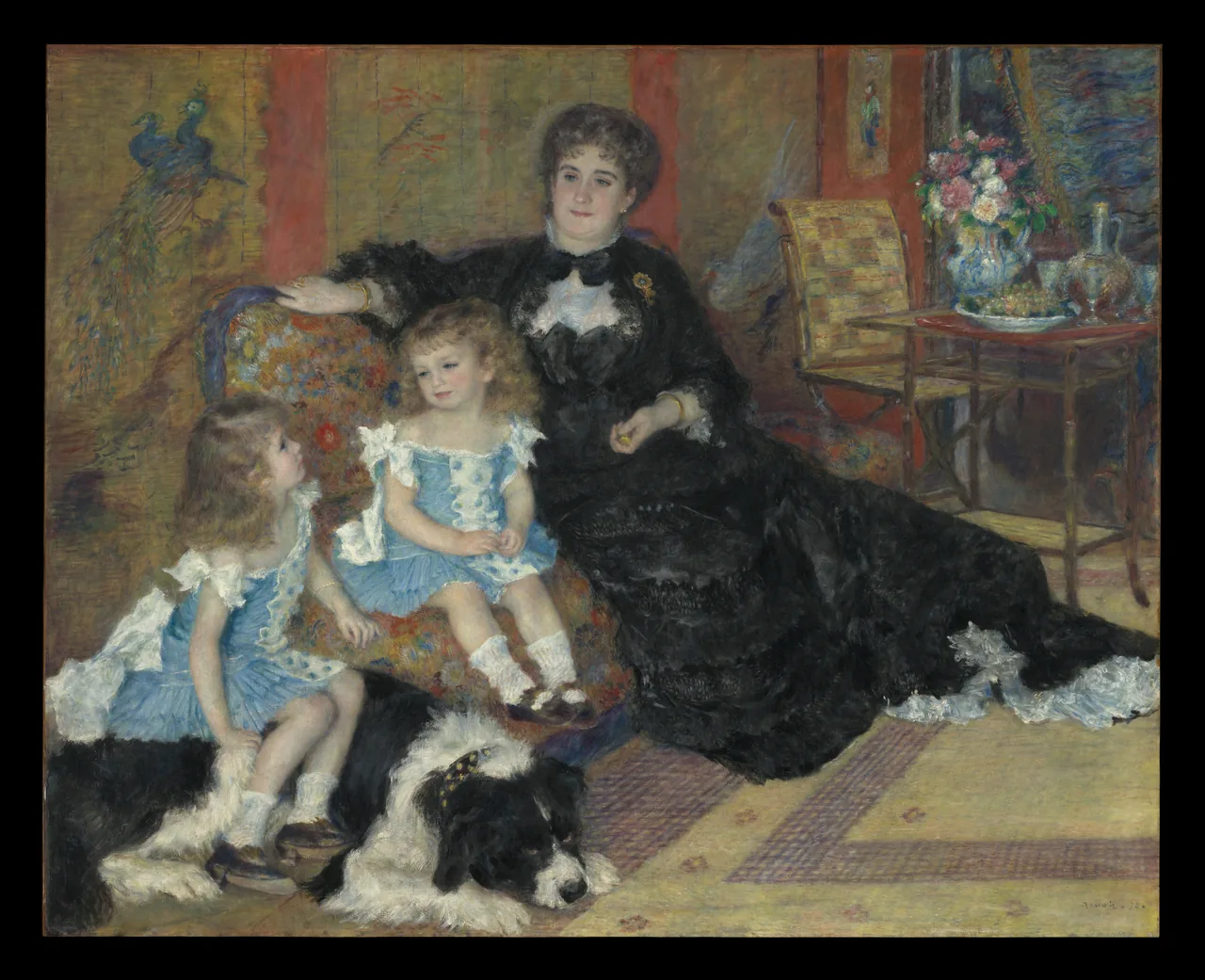
This dog is no tiny accessory. Its broad black-and-white body anchors the lower-left corner, with Georgette Charpentier sitting on its back. The other child, Paul, sits beside his mother. Their similar clothes can mislead a modern viewer; the Met’s record identifies both children and explains the contemporary fashion behind their matching appearance.
Renoir made a commissioned family portrait in an elaborately decorated setting. Marguerite Charpentier’s literary connections and role in securing a prominent Salon position for the picture belong to its documented history. The relaxed dog contributes to the portrait’s cultivated informality: wealth is displayed, but so is ease at home.
The animal’s white fur answers the white trim of the mother’s dress and the children’s light clothing. Its resting head turns a potentially rigid group into a scene with different levels and bodily attitudes. We look from an adult seated high to children and then to the floor.
A painted child sitting on a dog is historical imagery, not advice about handling a living animal. The interesting question here is how Renoir uses the arrangement to make an official family image feel unforced.
Cassatt gives a pet its own chair
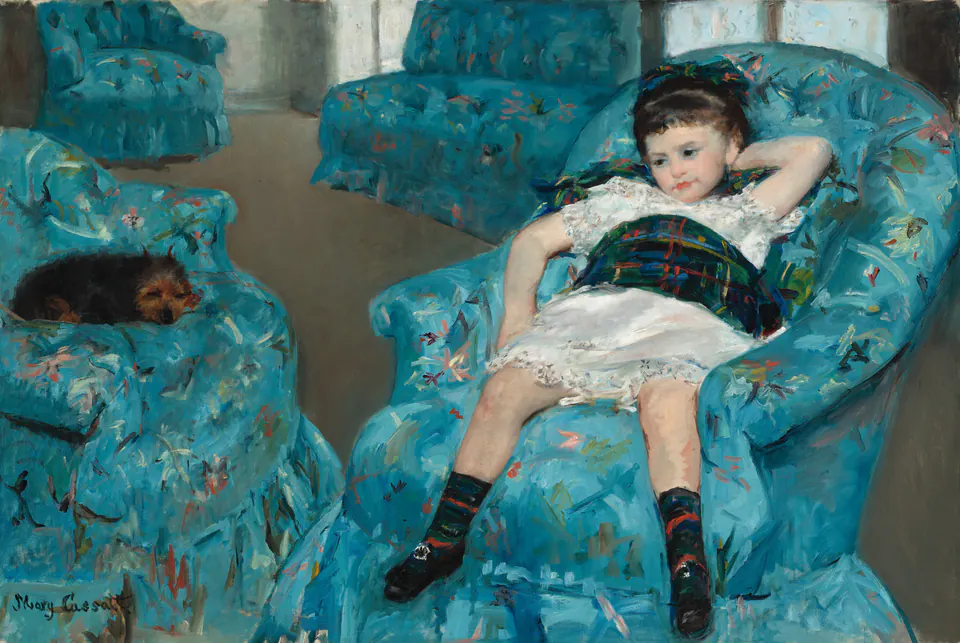
Cassatt’s dog has a whole chair, opposite the girl who sprawls in its companion. The vivid blue upholstery almost overwhelms both occupants. One body spreads out; the other curls into a compact dark patch.
The National Gallery of Art identifies the dog as Baptiste, Cassatt’s Brussels Griffon, and records Degas’s involvement in helping her find the pet. That name makes the dog more than a convenient decoration. It also reminds us that a work now encountered in a museum could emerge from quite specific personal relationships.
The girl’s posture can suggest boredom or tiredness, but the picture does not supply a complete explanation. Rather than deciding what she has just been told, compare how she and the dog occupy the room. Both interrupt the upholstered furniture’s formality with an unmistakably individual position.
Painted in the same year as Renoir’s Charpentier portrait, this scene offers a revealing contrast. Renoir gathers family members around their mother; Cassatt leaves open floor between child and pet. Companionship need not mean touching, performing or even looking at one another.
Look at the dog before decoding it
These dogs do not share a single meaning. They meet a visitor, rest beside a letter, stand for an individual animal, sleep through urban activity, join a family group and occupy their own chair. Their significance grows from what surrounds them.
On a second look, cover the dog with your hand and see what the composition loses. Then uncover it and follow its gaze, the direction of its body and the colour relationships linking it to the people. This small exercise separates something visible from a story we may be tempted to invent.
For a different set of animal encounters, continue with famous cat paintings. The Renoir collection is another route into his work, rather than a promise that this particular family portrait is available as a product.
Editorial record
About this article
- Author
- Publisher
- GeMarkt
- Published
- Reviewed
- Internal source & rights check. Conducted by GeMarkt Research Review. This is an internal editorial check—not independent peer review.
- Source standard
- Art history source standardPrioritises object records and research sources, distinguishes evidence from interpretation, and states material uncertainty.
Found a claim that needs checking? Report a factual error.