GeMarkt Blog · Essay
Famous Cat Paintings and the Stories Behind Them
Explore 14 famous cat paintings with pictures and clear stories, from Goya and Renoir to Kahler’s My Wife’s Lovers, Franz Marc and Paul Klee.

Some painted cats are asleep. Others are one second away from causing trouble. In these 14 paintings, they stalk birds, interrupt portraits, knock over flowers and sometimes take over the whole picture.
Each work appears below beside its story, so you can find the cat and see what it is doing. The stories draw on museum and collection records, with interpretations kept separate from known facts. There is no single secret meaning shared by every cat in art.
Judith Leyster: a prank about to go wrong
A Boy and a Girl with a Cat and an Eel, about 1635.
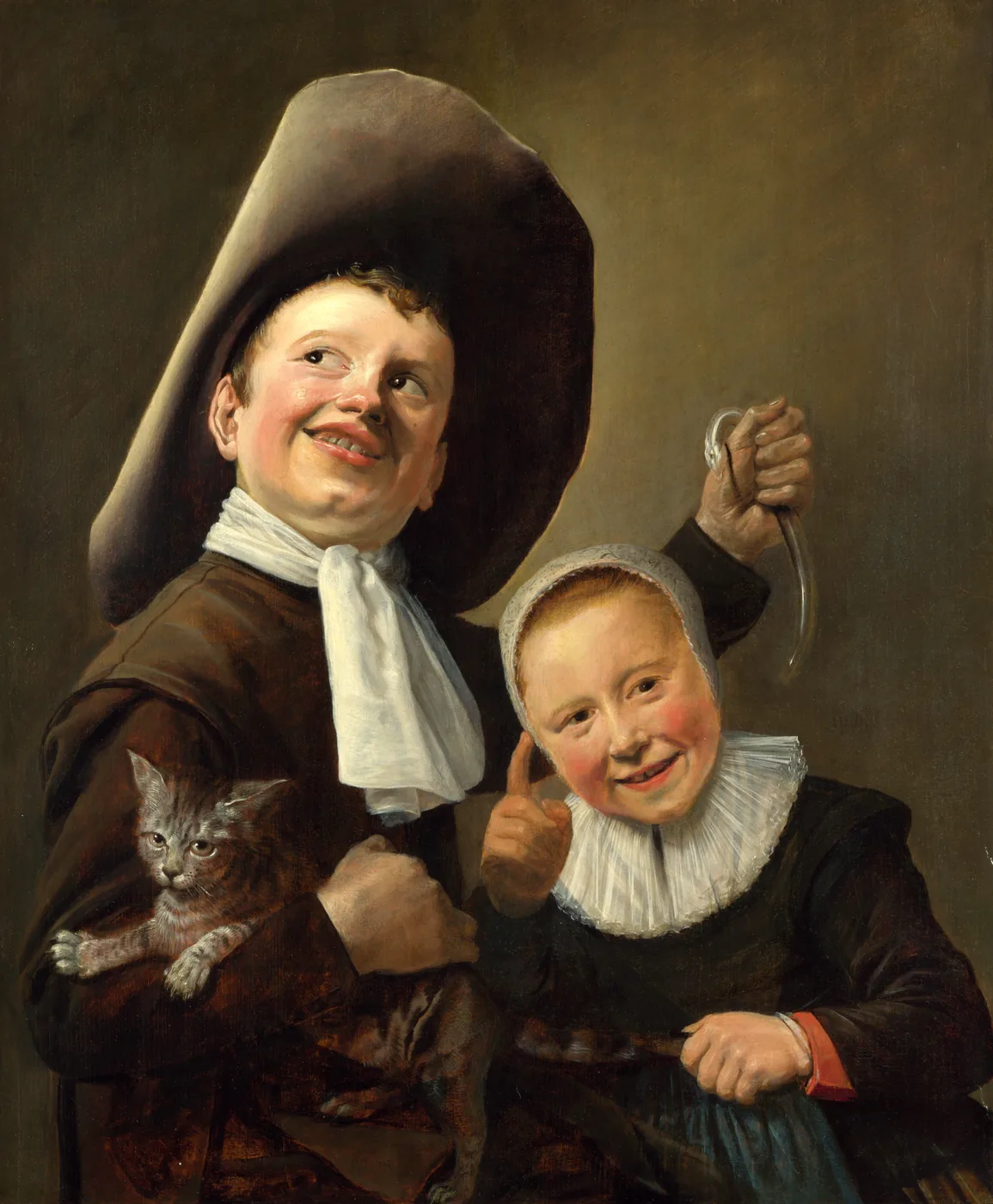

Judith Leyster catches a joke just before it goes wrong. A boy grips a cat and holds an eel beyond its reach, while a girl curls her fingers around the animal’s tail. The cat’s ears and tense body make the children’s amusement look much less harmless from its point of view.
The National Gallery’s object record offers an old Dutch motto—“he who plays with cats gets scratched”—as a possible source. It also explains that badly behaved children could warn adult viewers about foolish conduct. That context supports a moral reading, but it does not turn the painting into a code with one certain translation. Leyster’s oil-on-wood picture works because the warning and the comedy arrive together.
William Hogarth: play and loss
The Graham Children, 1742.
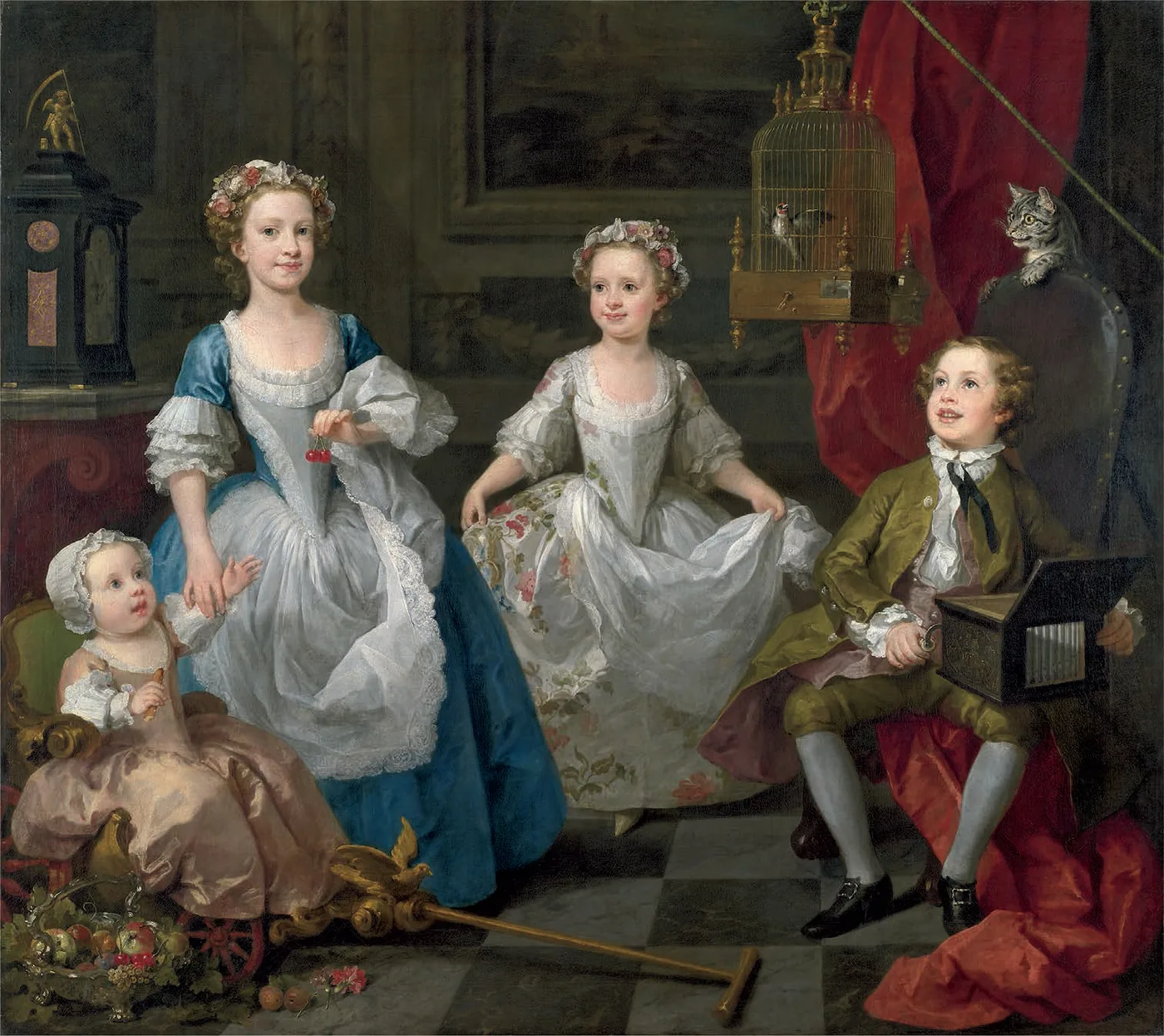

At first, Hogarth’s life-size group portrait seems full of music and play. Four well-dressed siblings gather in a prosperous London home. At the right, however, a cat climbs the back of a chair towards a goldfinch in a cage.
The detail becomes darker when the picture’s history is known. The National Gallery records that the youngest child, Thomas, had died by the time Hogarth was working on the painting. Crossed carnations, a clock topped with an hourglass and scythe, and the threatened bird all contribute to the Gallery’s reading of childhood’s fragility. Here the cat is not proof that cats meant death in eighteenth-century art. It is one carefully placed part of this particular family’s memorial portrait.
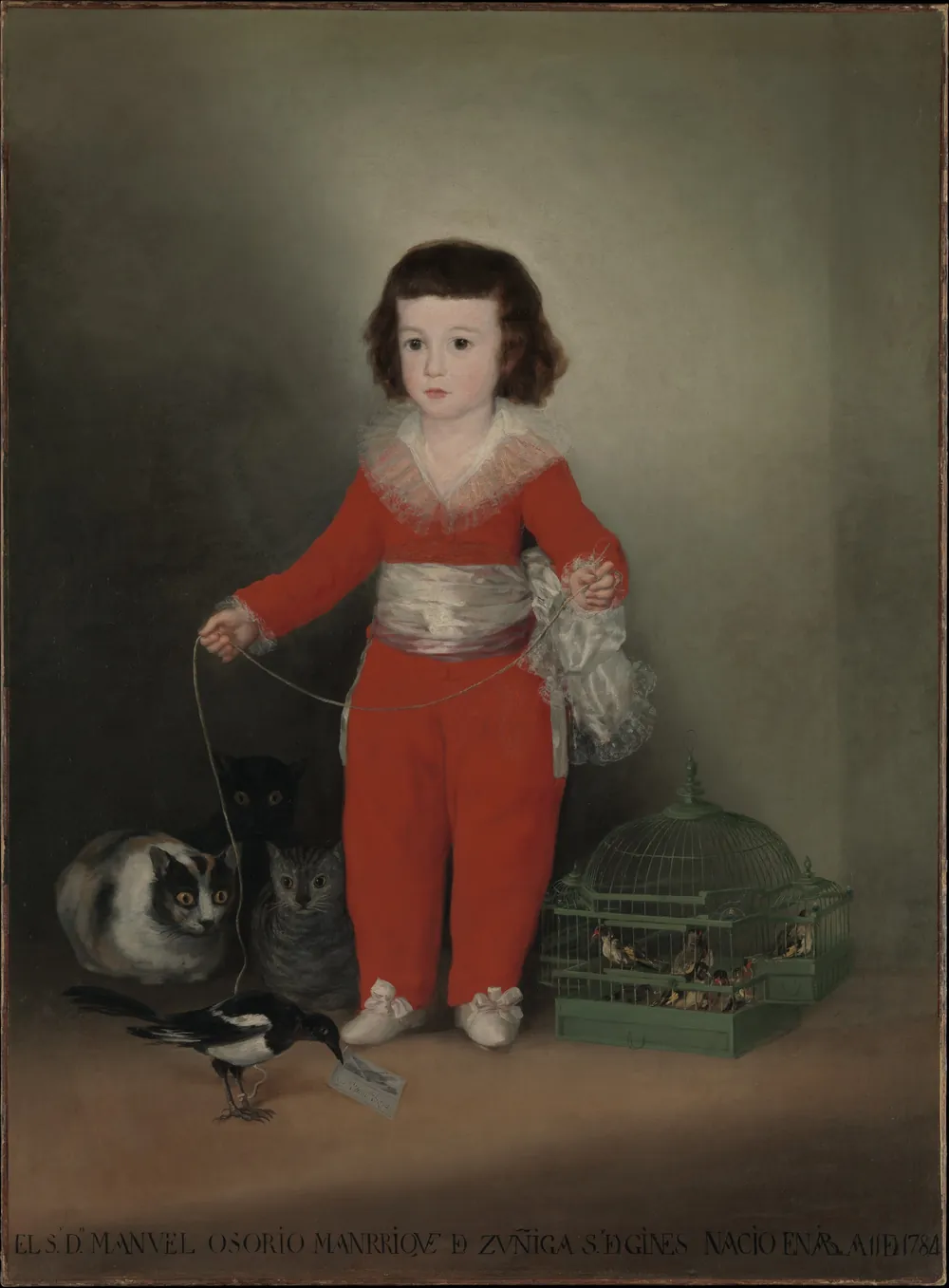
Francisco de Goya: watching the magpie
Manuel Osorio Manrique de Zúñiga, 1787–88.
Goya places a young aristocratic boy in brilliant red between several animals. A magpie holds the artist’s calling card in its beak. Three cats crouch in shadow and stare at the bird, while finches occupy a cage on the other side.
The Metropolitan Museum of Art says Goya may have intended the animals to suggest the fragile boundary between childhood and threatening forces, or the fleeting nature of youth. That “may” matters. Manuel died at eight, a few years after the portrait was made, but the painting should not be presented as a supernatural prediction. Its unease is already visible without inventing one: the child stands still while the cats’ attention makes the next movement feel dangerously close.
Édouard Manet: the cat in Olympia
Olympia, 1863.
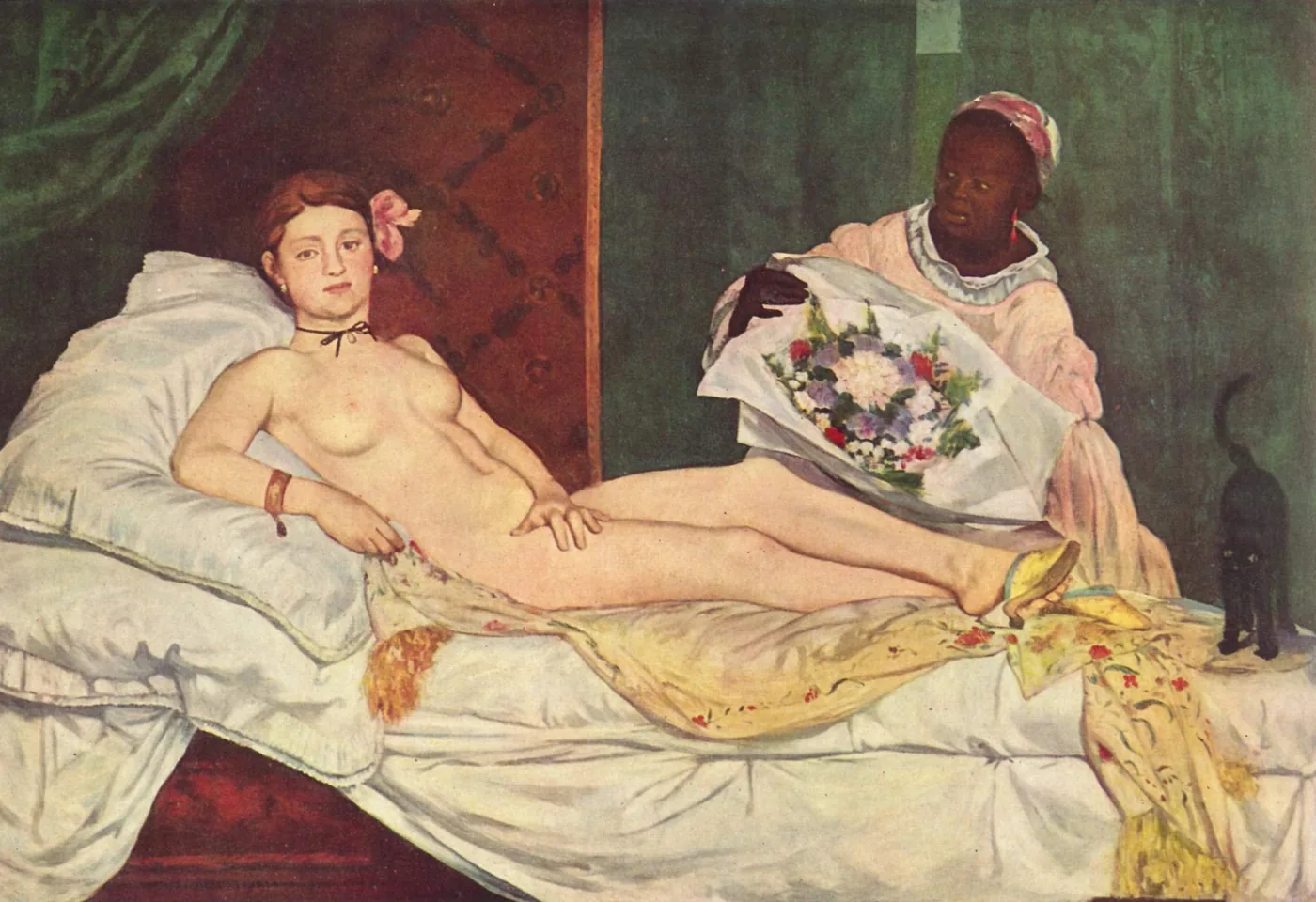

The black cat at the foot of Olympia is small, but it sharpens an already confrontational picture. Its raised tail and arched outline interrupt the pale bedding as the reclining woman looks directly towards the viewer. A servant brings flowers from an admirer, yet Olympia controls the encounter rather than drifting into an idealised dream.
The Musée d’Orsay’s record explains that Manet reworked the tradition of the female nude and that the painting provoked scandal at the 1865 Paris Salon exhibition. It identifies references including Titian’s Venus of Urbino, but it does not assign one official meaning to the cat. It is reasonable to describe what the animal does visually—adding alertness, contrast and a note of disruption—without claiming that this proves a fixed symbol.
Auguste Renoir: Julie and her cat
Julie Manet, also called The Child with a Cat, 1887.
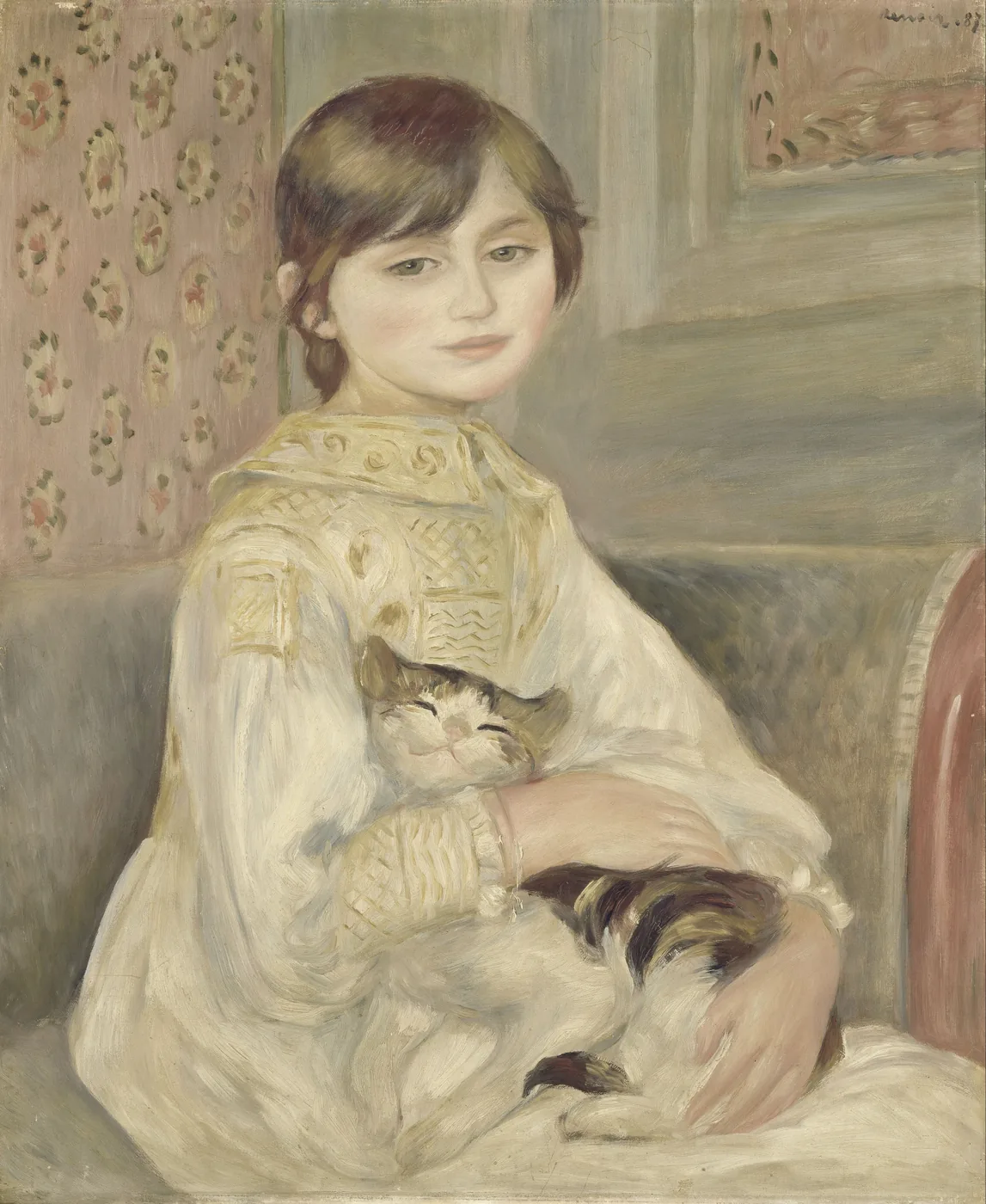

Julie Manet was the daughter of the painter Berthe Morisot and Eugène Manet, Édouard’s brother. Her parents knew Renoir and commissioned this portrait when Julie was nine. She sits in a carefully finished interior with a cat held close to her chest.
The Musée d’Orsay documents at least four preparatory drawings and preserves Julie’s later memory that Renoir painted the portrait in small sections. The cat does not need an elaborate symbolic role to matter. It gives the child something living to hold, breaks the stillness of a formal sitting and helps the portrait feel connected to a remembered family relationship. The museum also records the alternative French title L’Enfant au chat—“The Child with a Cat.”
Pierre Bonnard: The White Cat
The White Cat, 1894.
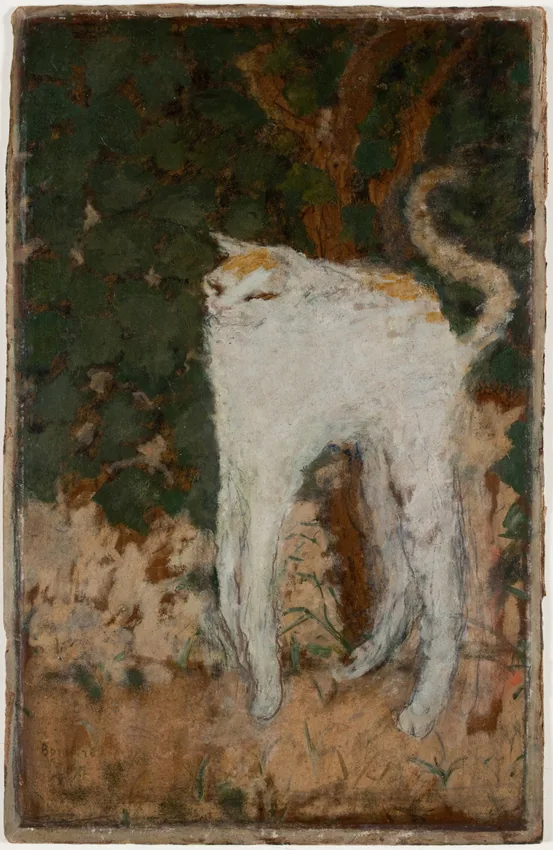

Bonnard makes the cat itself the event. Its back rises into an exaggerated arch, its legs seem implausibly long, and its small head sinks between its shoulders. The result is recognisable as feline behaviour but deliberately unlike an anatomical study.
This distortion was worked out rather than dashed off. According to the Musée d’Orsay, preparatory drawings and an X-ray reveal repeated changes to the paws and pose. The museum describes the image as humorous and places its flattened space, curving lines and asymmetry in the context of the Nabis—a late-nineteenth-century group of artists who emphasised decorative colour and flattened design—and Bonnard’s interest in Japanese prints. That evidence gives the painting’s odd body a practical story: Bonnard revised observation until it became a designed comic shape.
Cecilia Beaux: Sita and Sarita
Sita and Sarita, about 1921; the later Washington version.
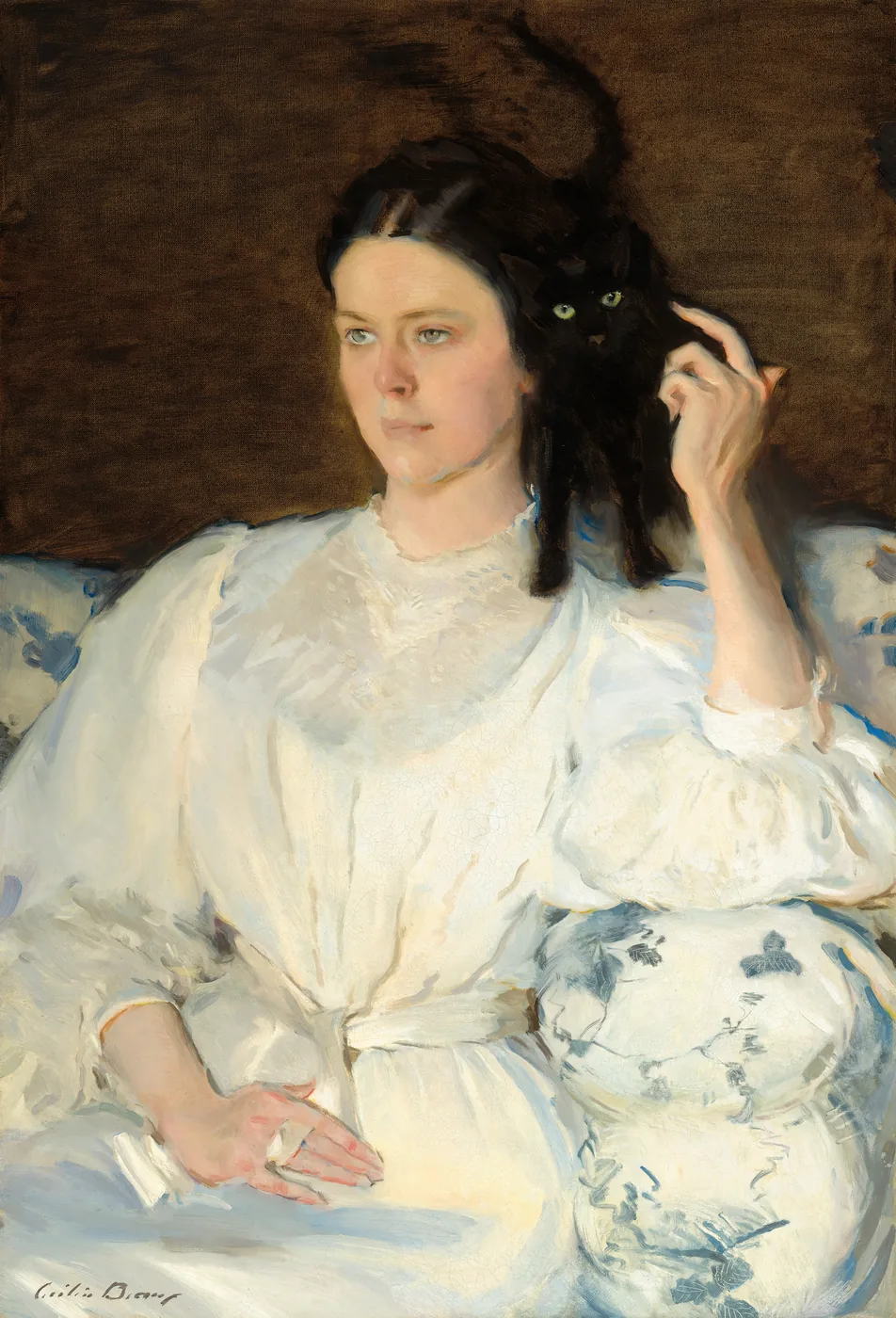

Cecilia Beaux’s cousin Sarah Allibone Leavitt wears a white dress against a dark background. A black cat perches across her shoulder and nearly disappears behind her, except for its eyes and silhouette. The shared title joins sitter and animal rather than treating the cat as a loose accessory: “Sarita” refers to Sarah and “Sita” to the cat.
The painting at the National Gallery of Art is a later replica, or second version, of an original Beaux painted in 1893. The museum reports that Beaux made it for her own satisfaction before the original went permanently to France; that first version is now at the Musée d’Orsay. Keeping the versions distinct prevents a common catalogue error: the Washington painting is not the 1893 canvas, even though it repeats the composition.
Henriëtte Ronner: Cat at Play
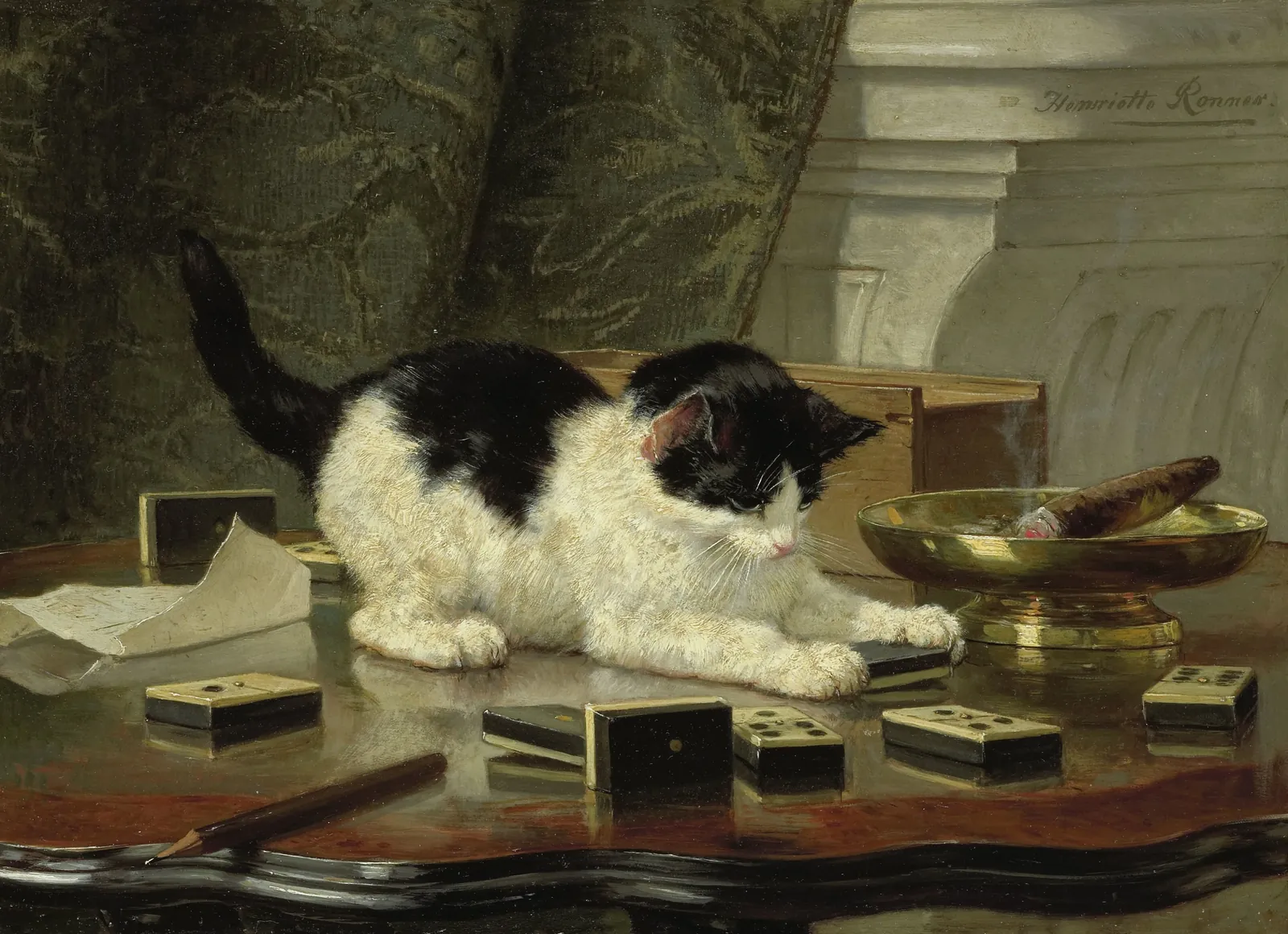
Cat at Play, about 1860–78.
A young cat bats at dominoes on a tabletop. Nearby, an ashtray holds a burning cigar, so one energetic move could turn a small game into a household accident. The painting is affectionate, but its suspense comes from recognising exactly how cats test the stability of arranged objects.
The Rijksmuseum record identifies the work as oil on panel and dates it broadly between about 1860 and 1878. It also notes that scenes like this helped make Ronner one of the most successful Dutch artists of her time, appealing to contemporary affection for pets. Unlike the threatened birds in Goya or Hogarth, nothing here needs to stand for an abstract idea. The near-mishap is story enough.
Carl Kahler: a grand portrait of 42 cats
My Wife’s Lovers, commissioned in 1891.
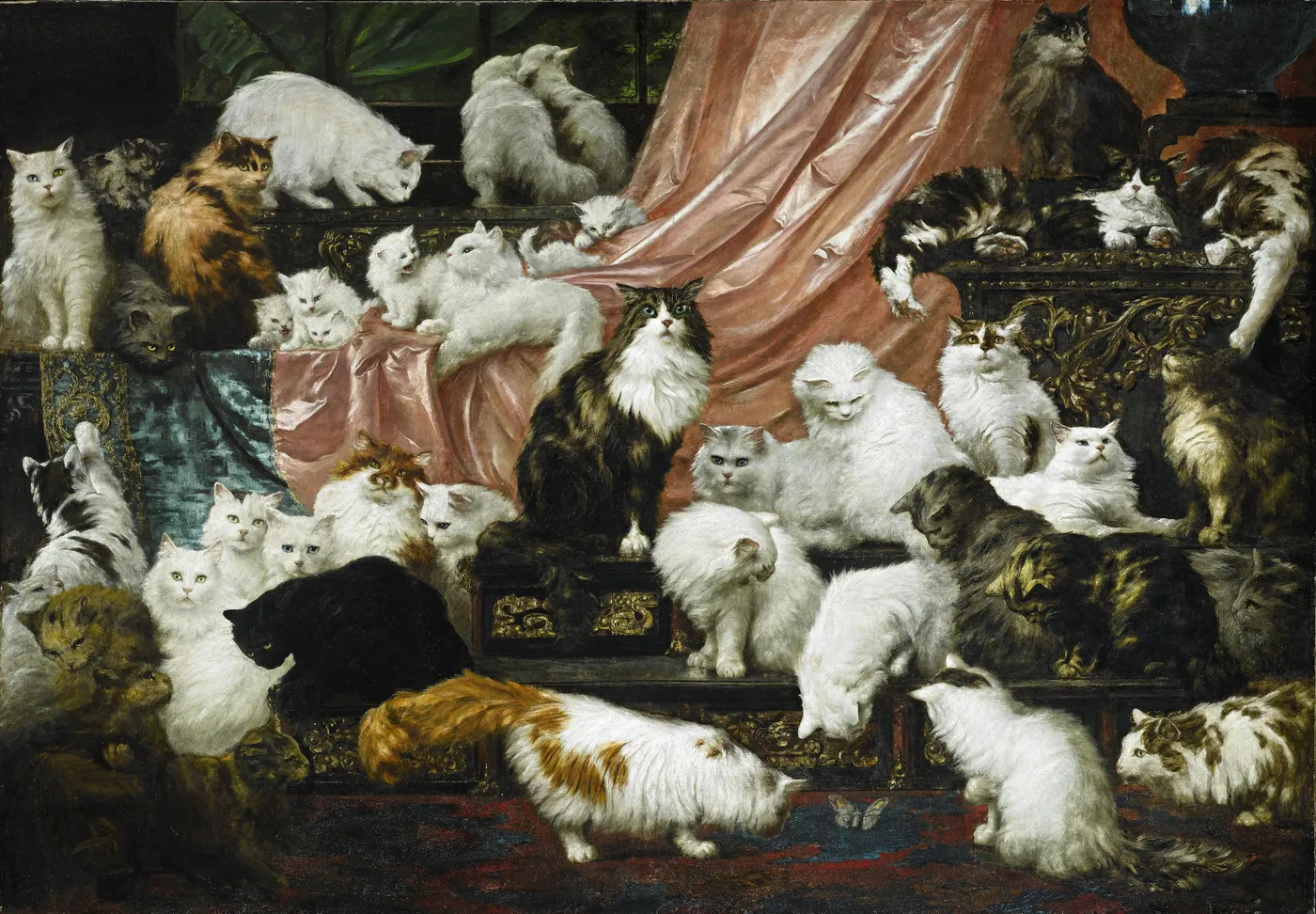

This is a grand group portrait with no human sitter. Cats lounge across pink drapery, climb the furniture and turn in almost every direction. The large Persian sitting upright near the centre is Sultan; the others form smaller groups around him rather than behaving like an orderly class photograph.
The Portland Art Museum records that San Francisco philanthropist Kate Birdsall Johnson commissioned Kahler to commemorate 42 Persian and Angora cats. He studied the animals before painting them, and the finished work appeared at the 1893 Chicago World’s Fair. Its history has attracted some tall tales. The museum’s curator rejects the claims that Johnson kept 350 cats or left them $500,000. The real commission was extravagant enough without those additions.
Abraham Mignon: a still life about to fall
The Overturned Bouquet, 1660–79.
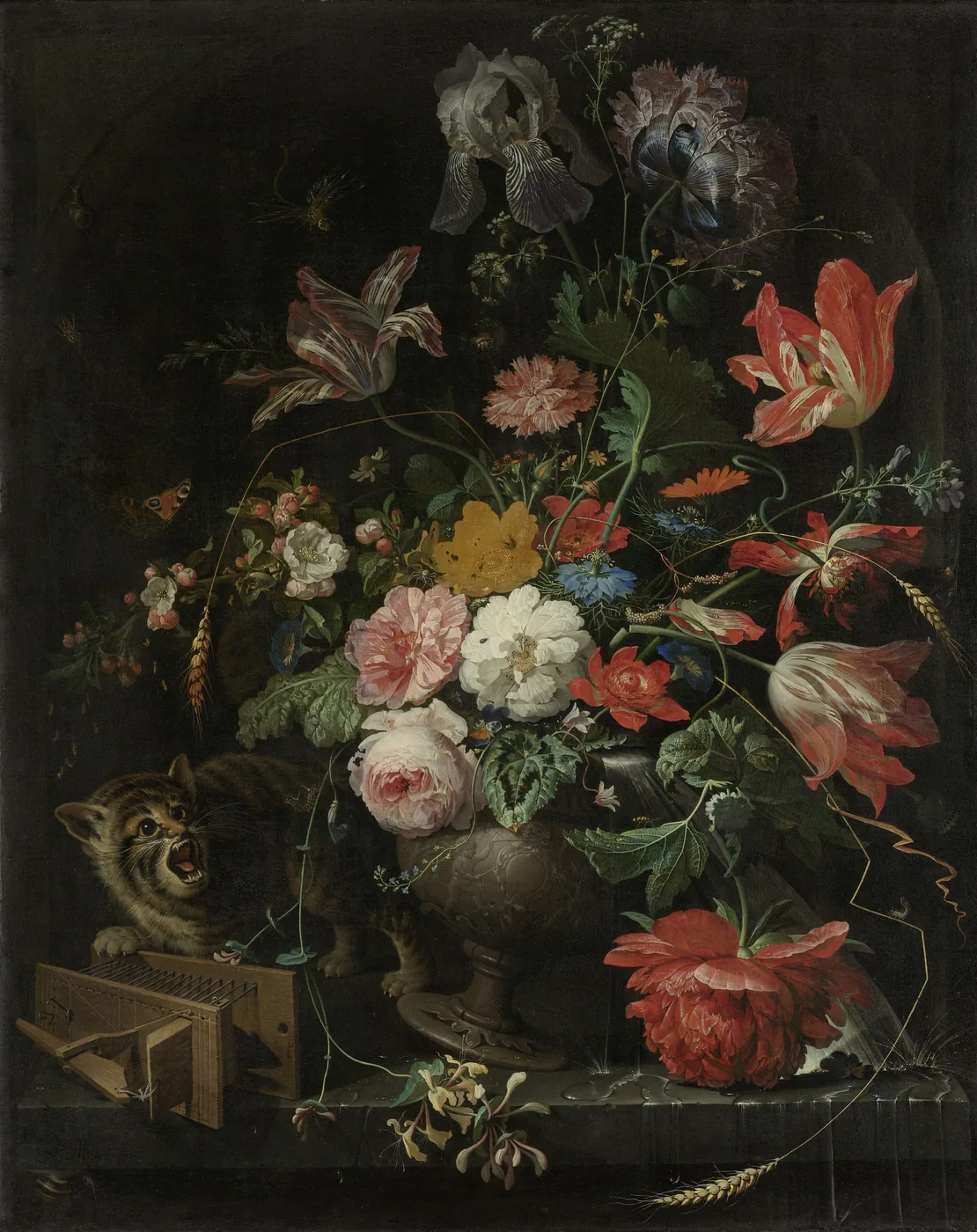

Look below the flowers, at the lower left. A cat has become caught up in a game with a mousetrap. Beside it, the great bouquet is tipping: the neat arrangement has become a household mishap. The Rijksmuseum explicitly connects the overturned vase to the cat’s play.
That small incident changes how we look at everything above it. Petals, twisting stems, butterflies and other tiny creatures ask for patient attention, but the cat supplies a sudden burst of movement. A still life is a painting of arranged objects, often flowers or food; Mignon gives this one a before and an after. We can admire his detailed flowers while imagining the crash that may follow. The cat is not a decorative extra. It is the reason the arrangement will not stay still.
Chardin: the cat beside the ray
The Ray (La Raie), 1728.
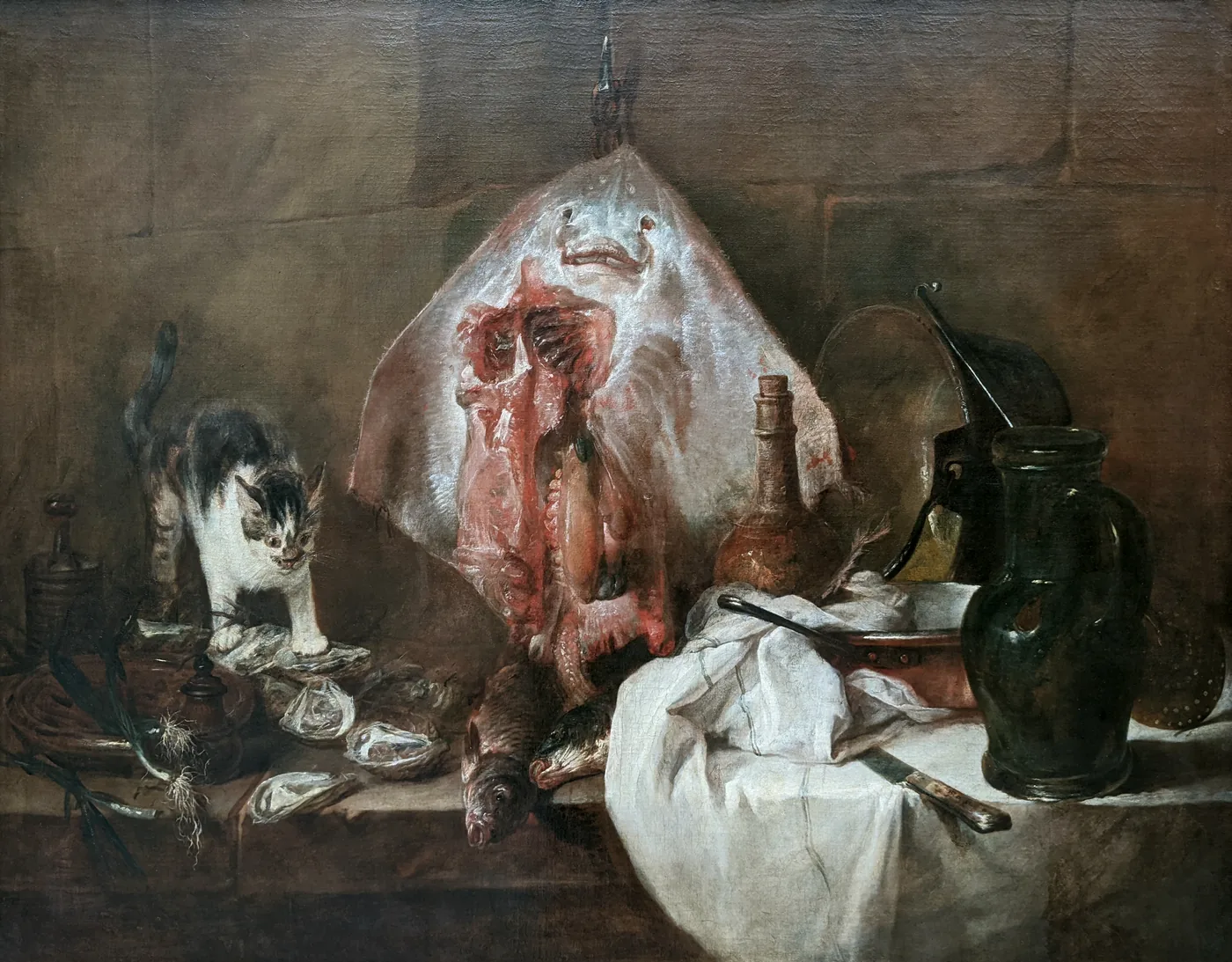

The hanging ray dominates this kitchen scene, but look left for the only living animal. The cat stands among the seafood with its back raised and its eyes fixed downward. Its tense pose contrasts with the fish laid out on the table and the heavy, motionless cookware on the right.
The Louvre dates the painting to 1728 and records it as Chardin’s reception piece for the Royal Academy: a work presented as part of his admission. That is a striking career milestone for a picture of kitchen things rather than a grand historical event. The fur, wet seafood, metal and cloth show what he could do with paint. The cat makes those differences feel immediate: here is a breathing, alert creature stepping into a display of objects and food.
Franz Marc: a white cat at rest
The White Cat (Cat on a Yellow Cushion), about 1912.
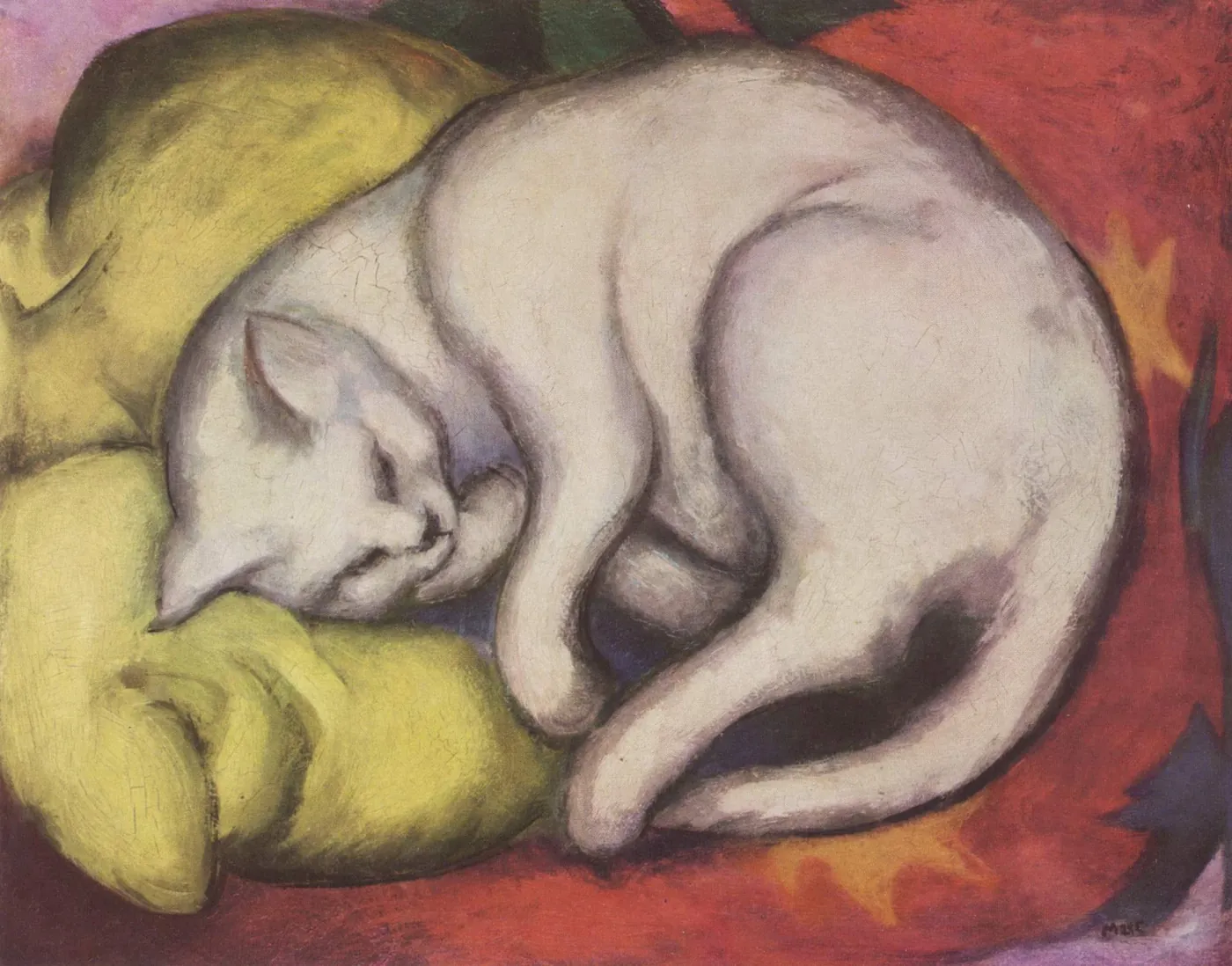

After so much feline mischief, Marc gives us a sleeping cat. Its white body curls into a compact shape on a yellow cushion. The tail follows that curve, and the closed eyes leave no doubt about the mood. Compare it with Bonnard’s awkwardly stretched white cat above: the subject is similar, but the effect is very different.
The Kunstmuseum Moritzburg’s collaboration with ZDF places the painting around 1912 and explains the importance of animals to Marc’s work. Here he keeps the body easy to recognise. Strong yellow and red surround the pale fur, making a quiet scene feel warm and vivid. There is no prank, hunt or falling object to follow; the resting animal and the colours around it carry the picture.
Paul Klee: a bird on the cat’s mind
Cat and Bird, 1928.
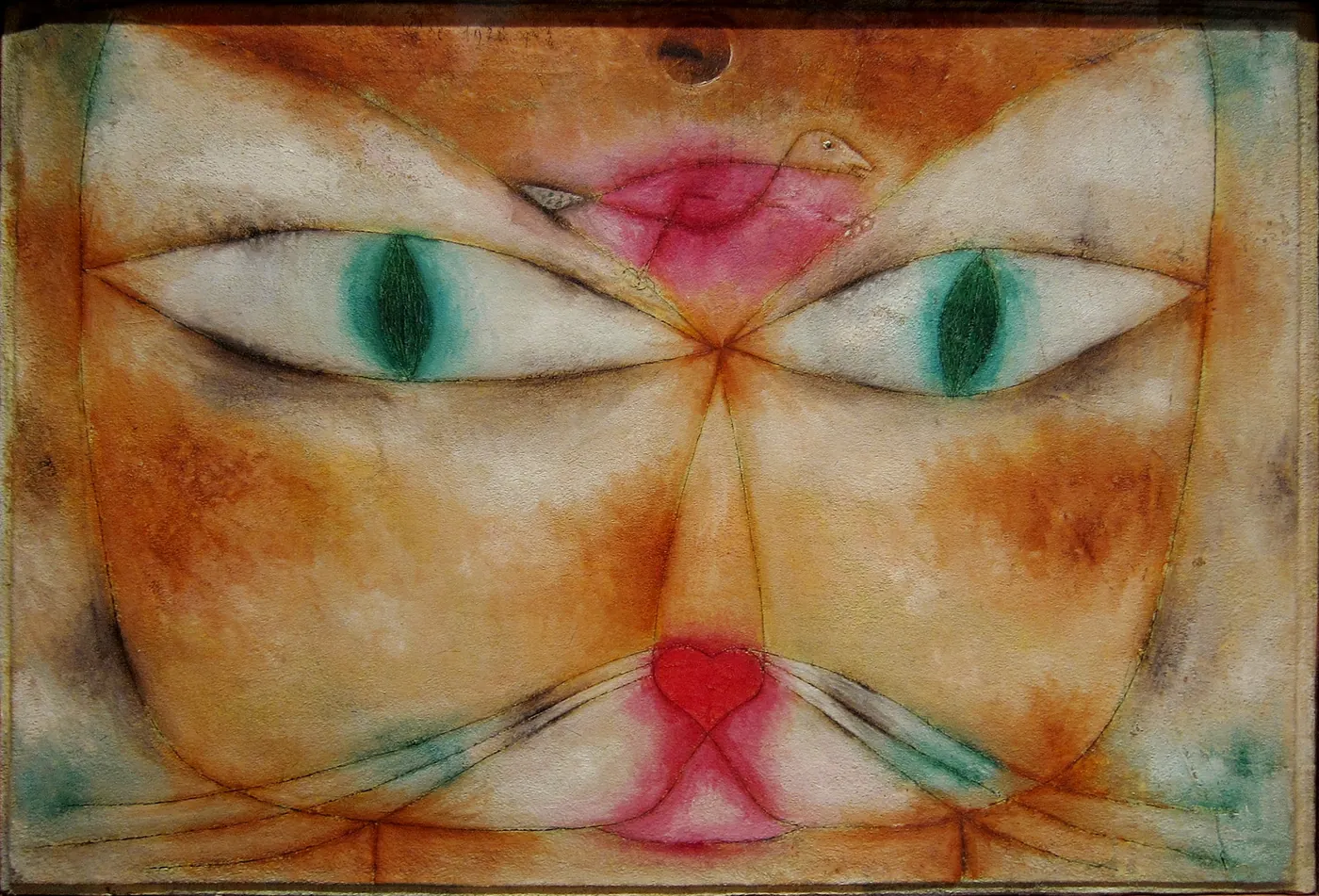

Klee removes the room and almost the whole cat, leaving a large face and a tiny bird. The bird seems to float between the cat’s ears. Is it perched there? MoMA’s interpretation suggests something more playful: we are seeing what is on the cat’s mind. The bird represents its appetite, not a literal meeting between two animals.
The oval eyes, triangular ears and red, heart-shaped nose make the face easy to recognise. Klee uses very simple shapes, yet the staring eyes give the picture an uneasy intensity. MoMA connects this approach to his interest in children’s drawings and in making thoughts visible. Unlike Goya’s cats watching a real magpie, this cat’s hunt is happening inside its imagination.
Jan Steen: a dancing lesson nobody asked for
Children Teaching a Cat to Dance, known as The Dancing Lesson, 1660–79.
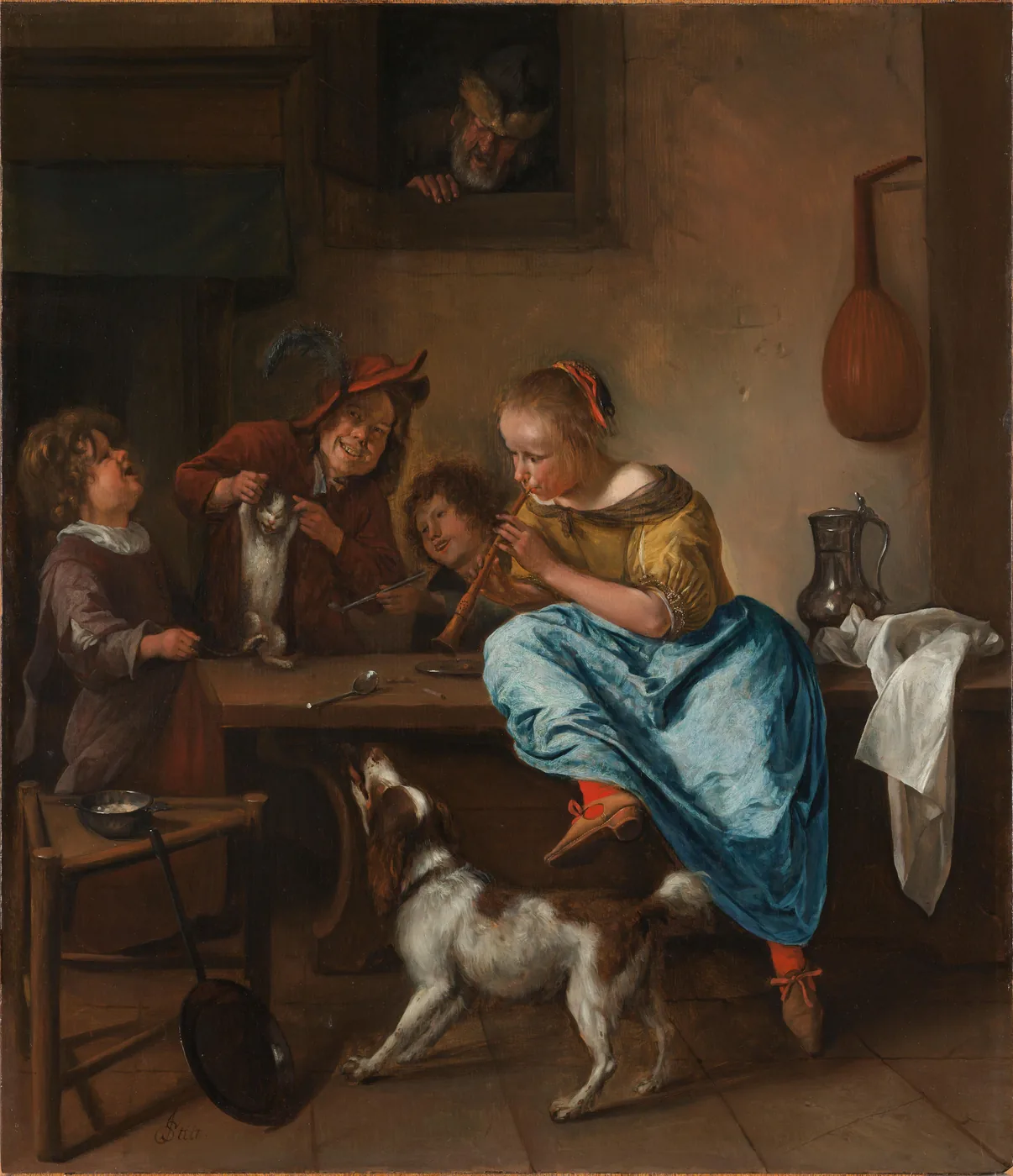
The children seem delighted with their idea. They have stood a cat on its hind legs and are giving it a dancing lesson. A girl supplies the music, a dog joins the commotion and an older man looks through a small window above them. The cat’s awkward body makes it clear who has the least control over the entertainment.
The Rijksmuseum identifies the instrument as a shawm, a loud wind instrument that preceded the oboe and was used for dancing and ceremonies. Knowing that helps us imagine how noisy this room might be. Like Leyster, Steen turns children’s play into a scene with an uncomfortable edge. We can recognise the joke while noticing that the animal has not volunteered for it.
What changes when the cat becomes the subject?
Across these paintings, cats move from the edge of a scene to its centre. In Hogarth, Goya and Manet, a small animal changes the mood of a much larger picture. Mignon and Steen turn movement into comedy. Renoir and Beaux make closeness part of a portrait, while Kahler gives the cats a grand portrait of their own. Bonnard, Marc and Klee show how far one familiar animal can be transformed through shape, colour and imagination.
The safest way to read any cat painting is therefore specific rather than symbolic. First identify the exact object, date and version. Then describe what the cat is visibly doing. Only after that should you consider a museum’s historical interpretation—and keep words such as “possible,” “may” and “suggests” when the evidence is uncertain. Cats are compelling in art partly because artists could make them tender, comic, disruptive or threatening without making them mean the same thing every time.
Editorial record
About this article
- Author
- Publisher
- GeMarkt
- Published
- Reviewed
- Internal source & rights check. Conducted by GeMarkt Research Review. This is an internal editorial check—not independent peer review.
- Source standard
- Art history source standardPrioritises object records and research sources, distinguishes evidence from interpretation, and states material uncertainty.
Found a claim that needs checking? Report a factual error.