GeMarkt Blog · Essay
The Story Behind the Arnolfini Portrait
What Van Eyck's tiny mirror reveals, why the sitters' identities remain uncertain, and how the famous wedding interpretation came under debate.


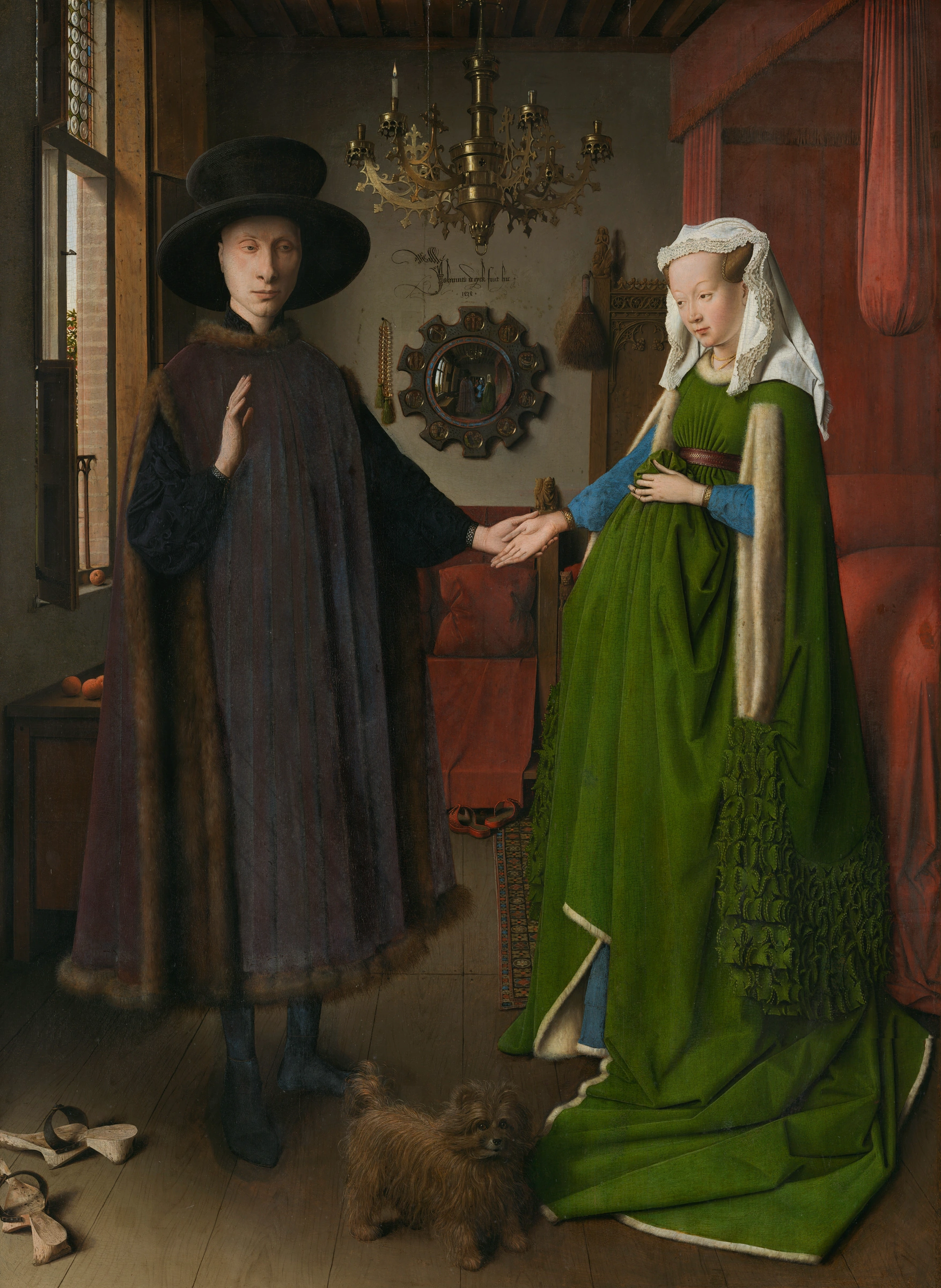
At the centre of the back wall hangs a convex mirror—a mirror with glass that curves outward. It reflects the room from behind: the backs of the couple, an open doorway, and two tiny figures entering. The device makes the space seem to continue beyond the painting.
Jan van Eyck dated the Arnolfini Portrait 1434. The National Gallery’s object record describes an oil painting on a wood panel, probably oak, with a painted surface 82.2 by 60 centimetres. It is full of things that appear exact enough to solve a mystery. Instead, five centuries of looking have produced several competing stories.
The mirror opens another room
The mirror is both a technical display and a clue that refuses to settle into one meaning. Its curved glass compresses the room and reverses it. Around the frame, ten small medallions show scenes from the Passion of Christ. Above it, an elaborate inscription declares, in Latin, “Jan van Eyck was here. 1434.”
One of the reflected visitors, the figure in blue, may be the painter. There is no proof. What is certain is that Van Eyck has built additional acts of looking into the picture. We see the couple; the mirror shows people seeing them; the inscription announces the artist’s presence.
That structure helped inspire the famous idea that the painting records a legal ceremony. It also supports a simpler reading: Van Eyck wanted to demonstrate how completely paint could hold a room, including what lies outside the viewer’s direct line of sight.
Who are the two people?
Even the title now carries a question mark. The National Gallery calls the work Portrait of Giovanni(?) Arnolfini and his Wife.
Inventories from the early sixteenth century describe a man called “Hernoul le Fin” or “Arnoult Fin” with his wife. Those names point toward the Arnolfini family, Italian merchants active in the Low Countries. The Gallery’s preferred candidate is Giovanni di Nicolao Arnolfini, documented in Bruges from 1419, but no surviving commission connects him directly to this panel.
The woman is even harder to name. An older identification called her Giovanna, or Jeanne, Cenami and paired her with Giovanni di Arrigo Arnolfini. Archival research showed that those two married in 1447—thirteen years after the date on the painting and six years after Van Eyck’s death.
Giovanni di Nicolao’s first wife, Costanza Trenta, had died by early 1433. The woman may represent a second wife whose marriage has not been documented, but that remains a proposal. The safest language is a probable Arnolfini man and an unidentified woman, very likely presented as his wife.
Why this is not securely a wedding scene
In 1934, art historian Erwin Panofsky developed an interpretation that became enormously influential. He read the joined hands as a marriage oath, the two people in the mirror as legal witnesses, and Van Eyck’s inscription as a signature on a visual marriage certificate. Many later retellings converted that interpretation into fact.
The National Gallery’s detailed catalogue entry explains why the case is now disputed. The couple’s right hands are not joined in the form expected for a legal oath. The man’s raised hand can be read as a greeting. The Latin phrase fuit hic—“was here”—does not follow the formula of a marriage document, and it gives only the year rather than a full legal date. The early inventories call the image a portrait of a man and his wife, not a wedding.
The picture could mark marriage, betrothal, status, or another important occasion. None has been proved. It is most accurate to begin with what the object securely is: a double portrait of a married couple whose precise identities and occasion remain partly unresolved.
The dress does not prove pregnancy
The woman’s rounded silhouette has often been taken as evidence of pregnancy. Her pose does not establish that.
She holds up a large quantity of heavy green fabric in front of her abdomen. Similar gathered dresses appear in fifteenth-century images of women who are not pregnant, including Van Eyck’s saints. The style valued long folds and a high-belted shape. Pregnancy could have mattered to the couple, but it cannot be diagnosed from this silhouette.
A room built to look real
Van Eyck’s room feels recorded down to the grain of the floorboards. Yet it is not necessarily a literal copy of one interior.
A bed could stand in a reception room, so its presence does not make the setting a private bedroom. Other details fit together less comfortably. There is little space for the chandelier, no fireplace is visible, the bed appears unusually short, and the mirror is very large for its type. The artist has selected and adjusted the parts of an affluent urban interior to make a more convincing painting.
This is realism as construction. The room persuades because its light and textures agree, not because every object was measured in one place.
Objects that show wealth before symbolism
The couple’s clothing is the clearest sign of status. His dark outer garment is edged with fur. Her green gown uses a great amount of fabric and has a fur-lined train. Oranges sit by the window and on the chest; a fine rug lies near the bed; the brass chandelier, glass mirror, and amber prayer beads were costly possessions.
Some objects can carry associations. A dog may suggest fidelity. A single burning candle may invite religious or memorial readings. The carved figure near the bed has been linked to Saint Margaret, protector of childbirth. But an association is not a fixed password.
Objects in the fifteenth century were useful, expensive, devotional, fashionable, and symbolic at once. Reading all of them as one secret wedding code produces more certainty than the evidence permits. The firmest shared message is prosperity displayed with extraordinary care.
Evidence of a changing plan
Technical examination makes a rigid symbolic programme even harder to assume. Infrared reflectography published by the National Gallery —imaging that can reveal drawing beneath the paint—shows that Van Eyck changed the faces, hands, and feet as he worked.
Several memorable objects—including the dog, chandelier, beads, oranges, and discarded outdoor shoes—do not appear in the first underdrawing. They were added during painting. That does not make them meaningless. The painting developed through revision, but technical evidence alone cannot tell us when any symbolic meanings were conceived.
Van Eyck also left physical traces of making: a finger or thumbprint beside the shadow of the dog’s hind leg, and scratched lines describing the brush hanging by the bed. He did not invent oil paint, a common myth, but his control of translucent layers and tiny highlights made its possibilities startlingly visible.
Van Eyck was here
The inscription above the mirror does not simply say that Van Eyck painted the picture. It says that he was present. The wording has the casual force of writing left on a wall, though the letters are carefully designed.
Perhaps the line turns the artist into a witness. Perhaps it celebrates his social presence in the household. Perhaps it draws attention to the feat below: a painted room so complete that the maker appears inside it by reflection and above it by name. The sentence is factual in one sense—Van Eyck made and dated the panel—but its role within the scene remains open.
The painting later moved through important European collections before the National Gallery bought it in 1842. It became the Gallery’s first Netherlandish painting and helped make Van Eyck’s precision central to the public story of northern European art.
What uncertainty adds
The Arnolfini Portrait does not need to be a marriage certificate to be extraordinary. Its unresolved identities, revised objects, and constructed room encourage slower looking.
Start with the mirror and the couple, then notice how many kinds of presence Van Eyck creates: bodies in the room, visitors in reflection, an artist in an inscription, and a viewer positioned at the doorway. We may never recover the exact occasion. What survives is a portrait that turns seeing itself into part of the event.
For wider context on Van Eyck, oil painting, merchants, and urban culture, continue with GeMarkt’s Northern Renaissance art guide.
Editorial record
About this article
- Author
- Publisher
- GeMarkt
- Published
- Reviewed
- Internal source & rights check. Conducted by GeMarkt Research Review. This is an internal editorial check—not independent peer review.
- Source standard
- Art history source standardPrioritises object records and research sources, distinguishes evidence from interpretation, and states material uncertainty.
Found a claim that needs checking? Report a factual error.