GeMarkt Blog · Essay
Dance and Music in Art: Degas to Toulouse-Lautrec
Look at eight works about rehearsal, music-making and performance, from Vermeer and Osman Hamdi Bey to Degas, Renoir and Toulouse-Lautrec’s Paris posters.

A picture cannot play a note or repeat a dancer’s step, but it can make us anticipate both. Fingers approach strings, a body holds its balance, and an audience turns towards something beyond our own view. Often the most revealing moment is not the performance itself. It is the tuning, waiting or watching around it.
Degas and Toulouse-Lautrec make those surrounding activities especially conspicuous. To see how much their choices matter, it helps to look beyond the familiar ballet skirt and Parisian poster. These eight works by seven artists include a Dutch room awaiting a duet, a deliberately unruly lesson and two musicians in an Ottoman setting.
They do not form a complete history of music or dance. They offer a more manageable question: who performs, who watches, and where does the artist put us? That question lets us compare a painting with a printed advertisement without pretending they were made to do the same job.
Degas and Renoir: practice and presence
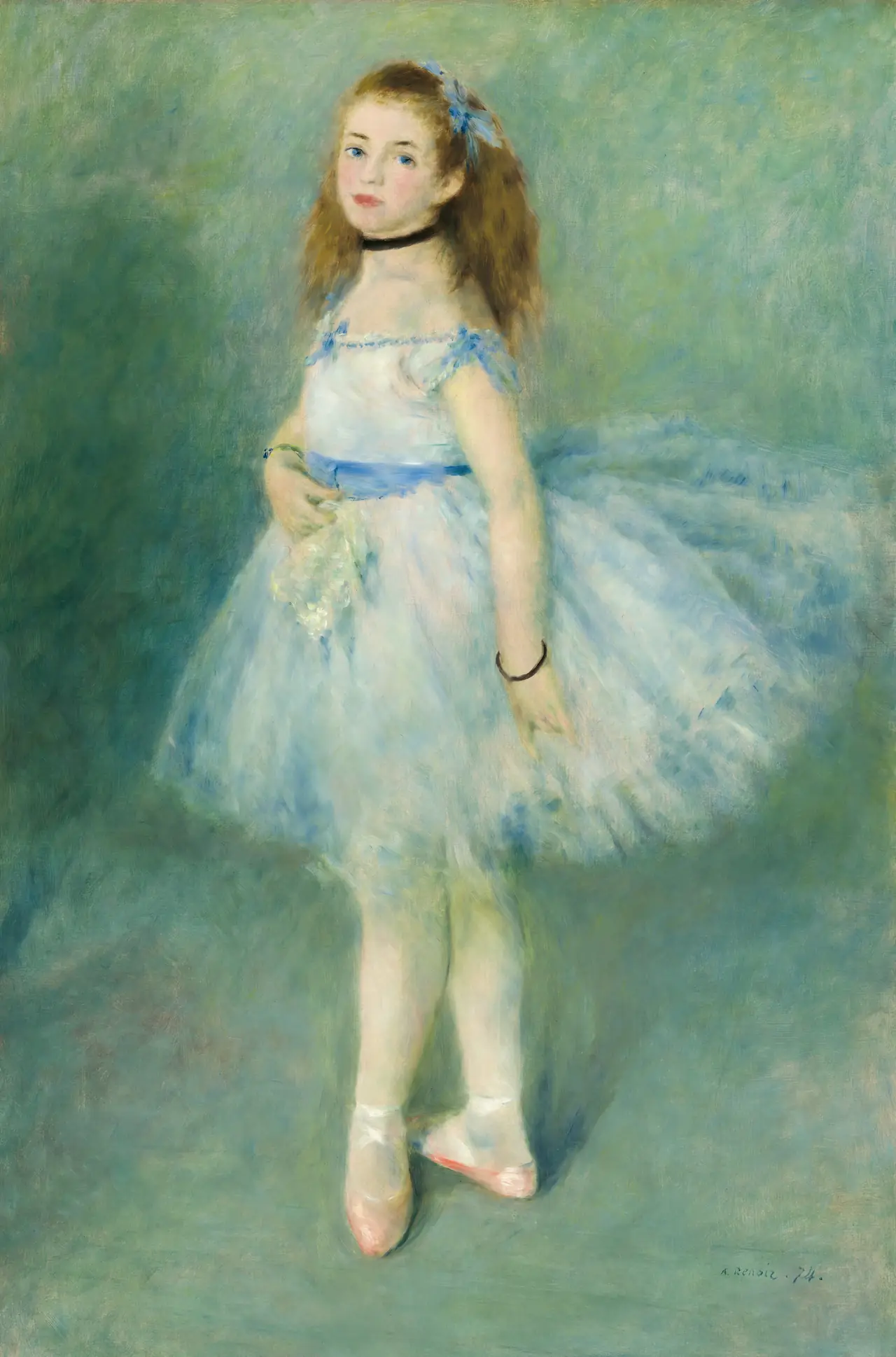
Two oil paintings dated 1874 establish different kinds of encounter. Edgar Degas’s The Dance Class at the Met is an imagined rehearsal scene in the old Paris Opéra, not a documentary snapshot. Renoir’s The Dancer at the National Gallery of Art brings a single figure directly before us.
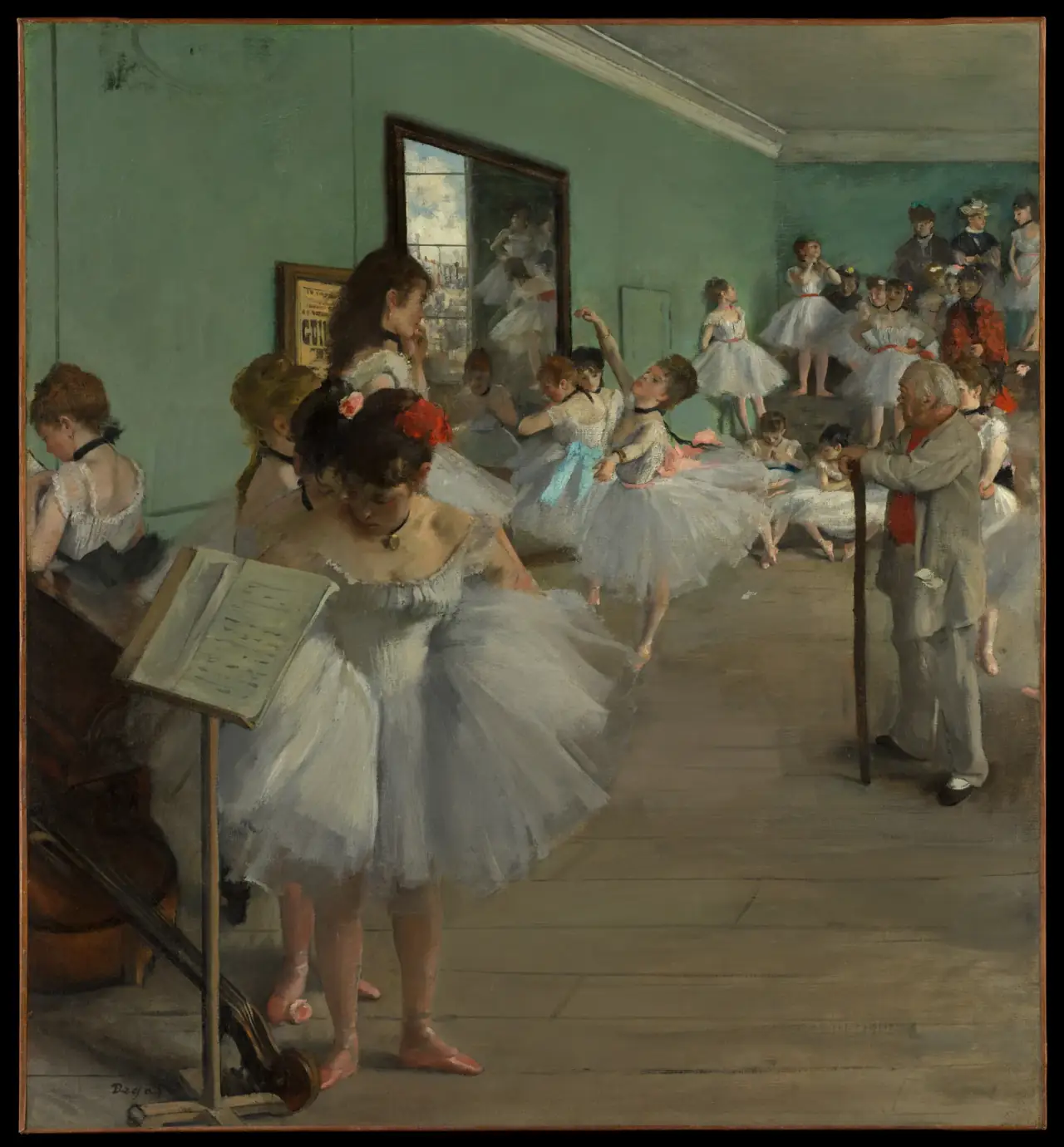
Degas distributes attention unevenly. One dancer performs before the ballet master Jules Perrot, while others wait, adjust themselves or look elsewhere. The open floor separates the foreground figures from the examination. It gives the eye a route through the room instead of presenting everyone in one neatly aligned row.
That difference between being watched and waiting matters. Ballet appears as organised work, with a teacher, a task and time spent outside the central action. The picture does not tell us every dancer’s private feelings, but it gives us more to consider than a finished stage pose.
Renoir removes almost all that surrounding activity. The crossed feet, pale costume and turned head establish a full-length figure rather than a roomful of relationships. Softly painted fabric blends into the green-blue background, while the face remains a point of contact with the viewer.
The painting appeared in the first Impressionist exhibition in 1874. Yet its central figure also draws on the established format of portraiture. “Modern subject” does not mean every older pictorial convention has vanished. Our Degas–Renoir comparison takes this pair further; the Degas and Renoir artist guides widen the view beyond these two dancers.
Lautrec: two ways to enter a night out
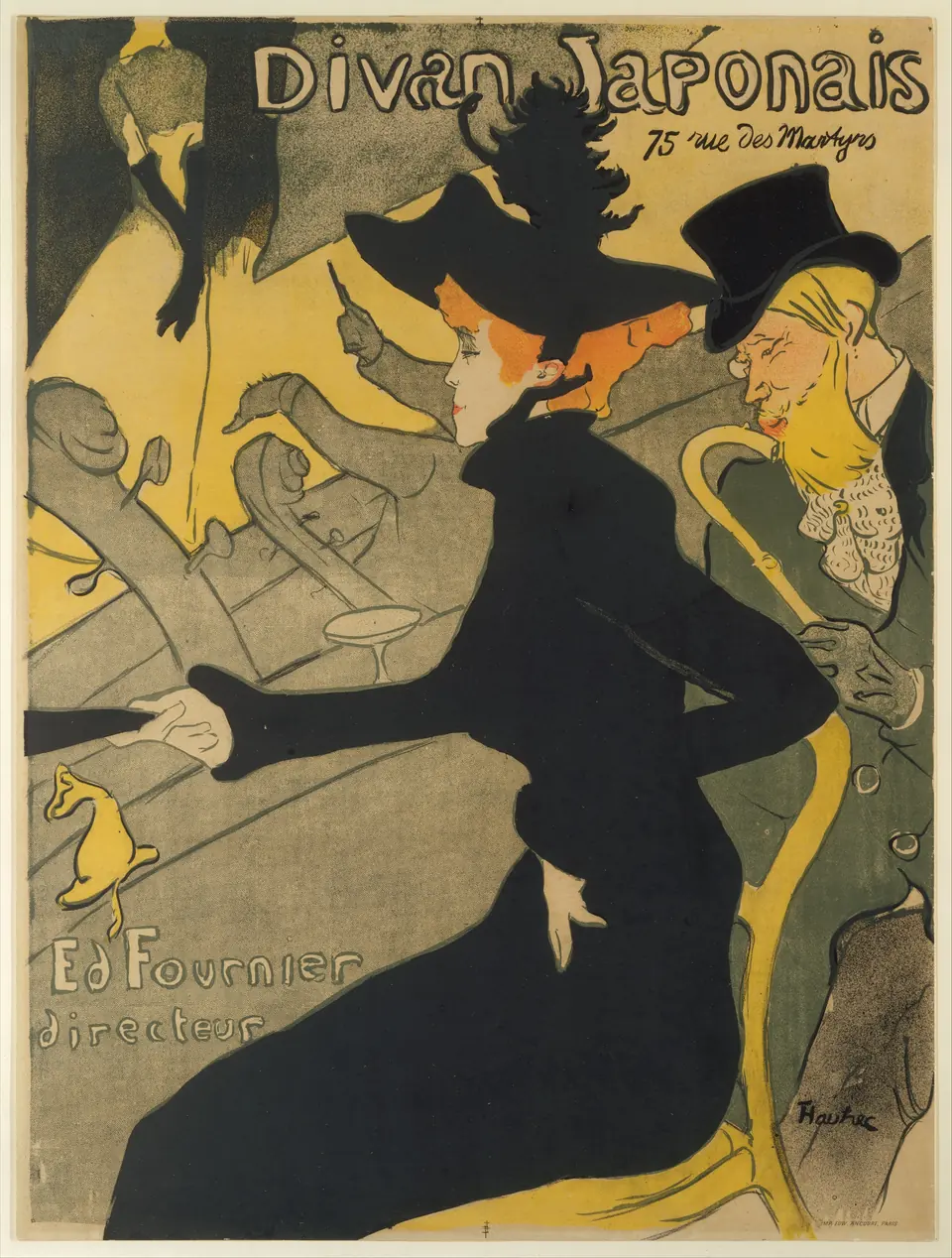
Henri de Toulouse-Lautrec’s Moulin Rouge: La Goulue, 1891, and Divan Japonais, 1892–93, were advertisements. Their lettering and emphatic shapes are not incidental decoration around independent pictures. They help connect a performance, a venue and an audience.
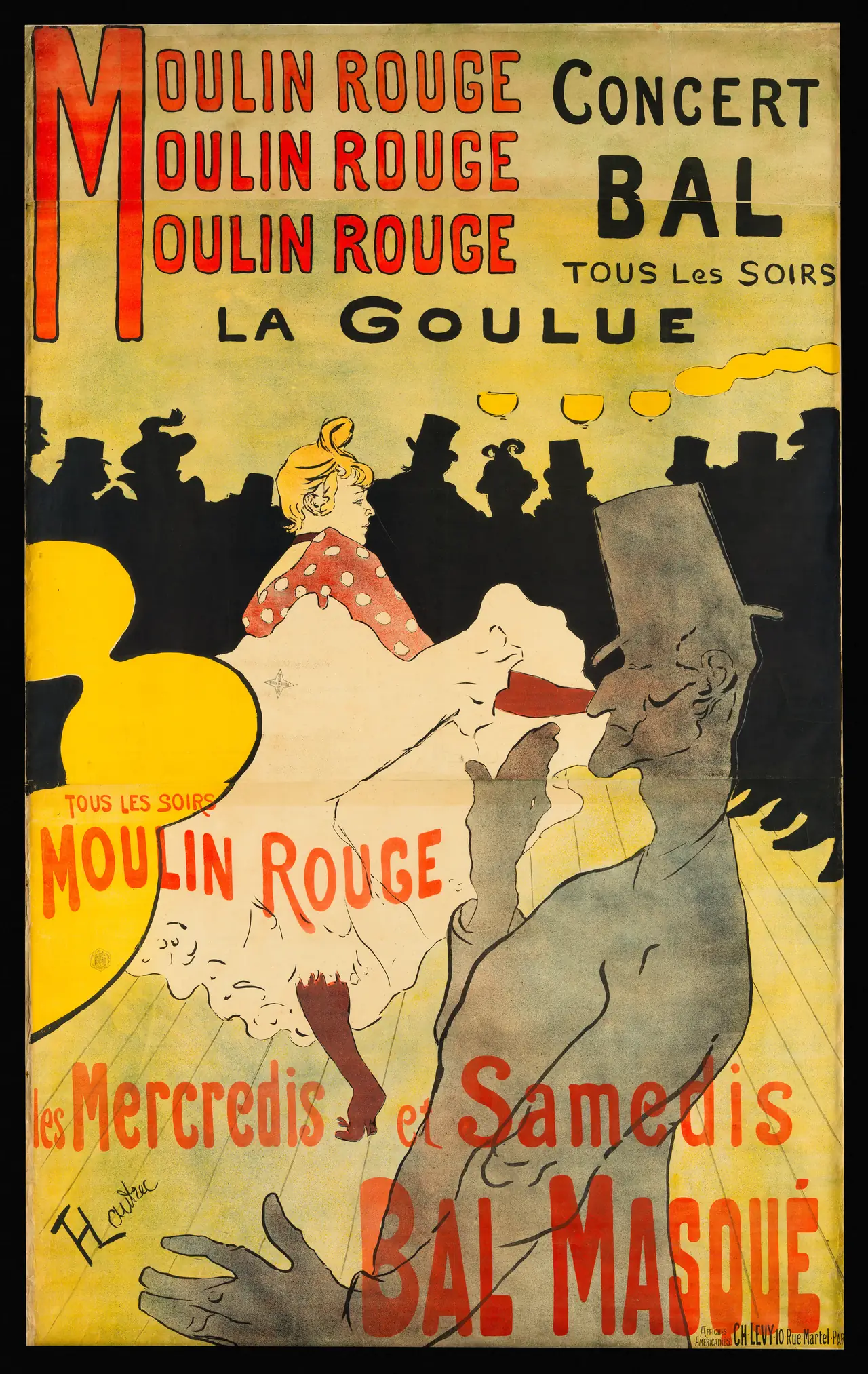
In Moulin Rouge, the Met identifies La Goulue and Valentin le Désossé as the featured performers. Her expanding pale skirts occupy the middle distance; his much larger grey silhouette cuts across the front. Behind them, spectators become a nearly continuous dark band.
The changes in scale give the design its force. We do not see every spectator’s expression, yet the black crowd makes the bright movement stand out. The repeated venue name above is part of that insistence. This is an invitation to a particular commercial entertainment, not an anonymous celebration of dance.
Divan Japonais moves our attention towards a spectator. Jane Avril sits in black beside the writer Édouard Dujardin. Yvette Guilbert performs at the upper left, identifiable by her long black gloves even though the composition excludes her head.
That missing head is Lautrec’s design, not a fault in the reproduction. It redirects attention towards the act of attending: the spectator’s silhouette, the orchestra’s instruments and a partial view of the stage. The two posters show that depicting entertainment can mean depicting the people who recognise and consume it. See the Toulouse-Lautrec guide for more of his printed work.
Vermeer: the music has not started yet
Johannes Vermeer’s Young Woman with a Lute, about 1662–63, offers a much less public situation. The Met identifies the action as tuning. Songbooks and the bowed string instrument on the floor suggest preparation for a duet.
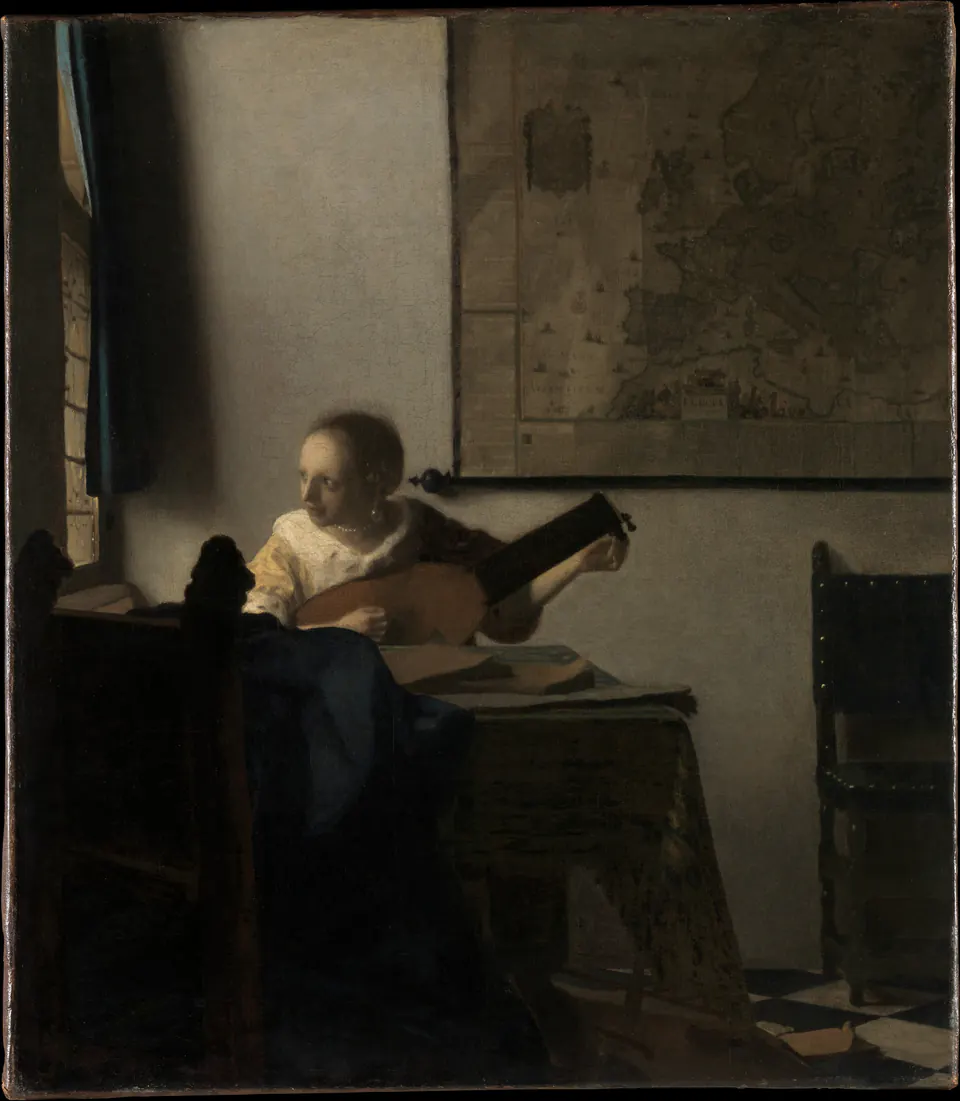
The instrument’s neck runs towards her raised hand while her face turns in another direction. Those competing lines keep the scene from becoming a straightforward illustration of someone playing. We appear to arrive during preparation, with another participant potentially still absent.
Music-making could provide opportunities for social interaction and courtship in the Dutch Republic, as the museum explains. That context is useful; it is not proof of a particular romance or a known person outside this window. The Vermeer guide compares the room with his other carefully arranged interiors.
Leyster: a musician inside a painter’s portrait
Judith Leyster’s Self-Portrait, about 1630, contains a second performance on the easel. A laughing violinist appears on the canvas as the artist turns towards us with brush and palette. The National Gallery of Art’s record identifies the work and its place in her practice.
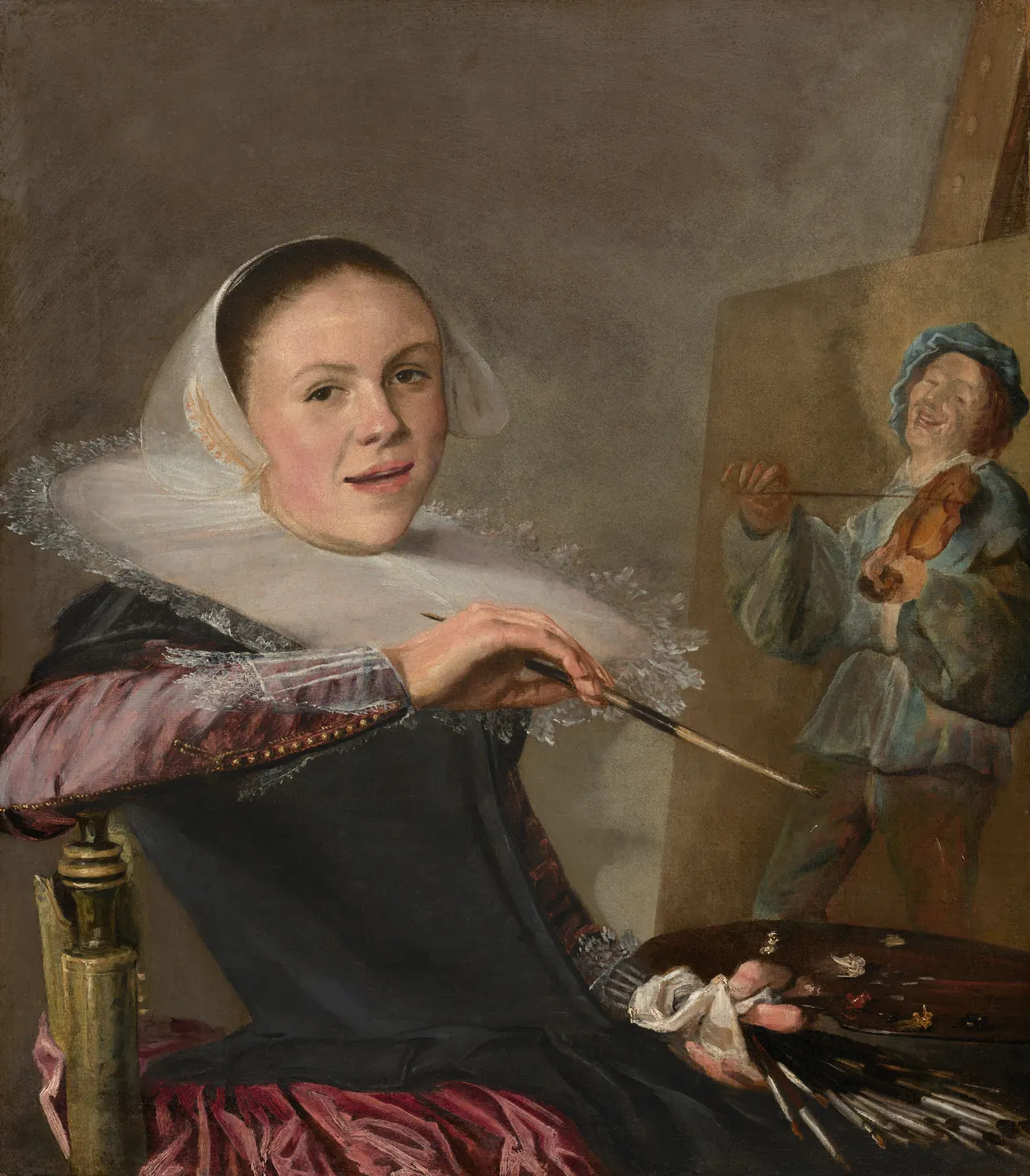
The violinist is not physically sharing the studio with her: he belongs to the picture she is showing. The distinction is easy to overlook because his open expression answers her own lively face. Her extended brush points into the space between these two kinds of presence.
Music here helps demonstrate a painter’s ability to represent animation. We can compare the violinist’s raised bow with the painter’s working hand without imagining that a literal duet is taking place. The portrait asks us to notice the maker as well as the entertaining subject she can create.
Steen: the dancing lesson is a bad idea
Jan Steen’s Children Teaching a Cat to Dance, 1660–79, turns coordinated music and movement into disorder. The Rijksmuseum identifies the children, the wind instrument, the barking dog and the man watching from the opening above.
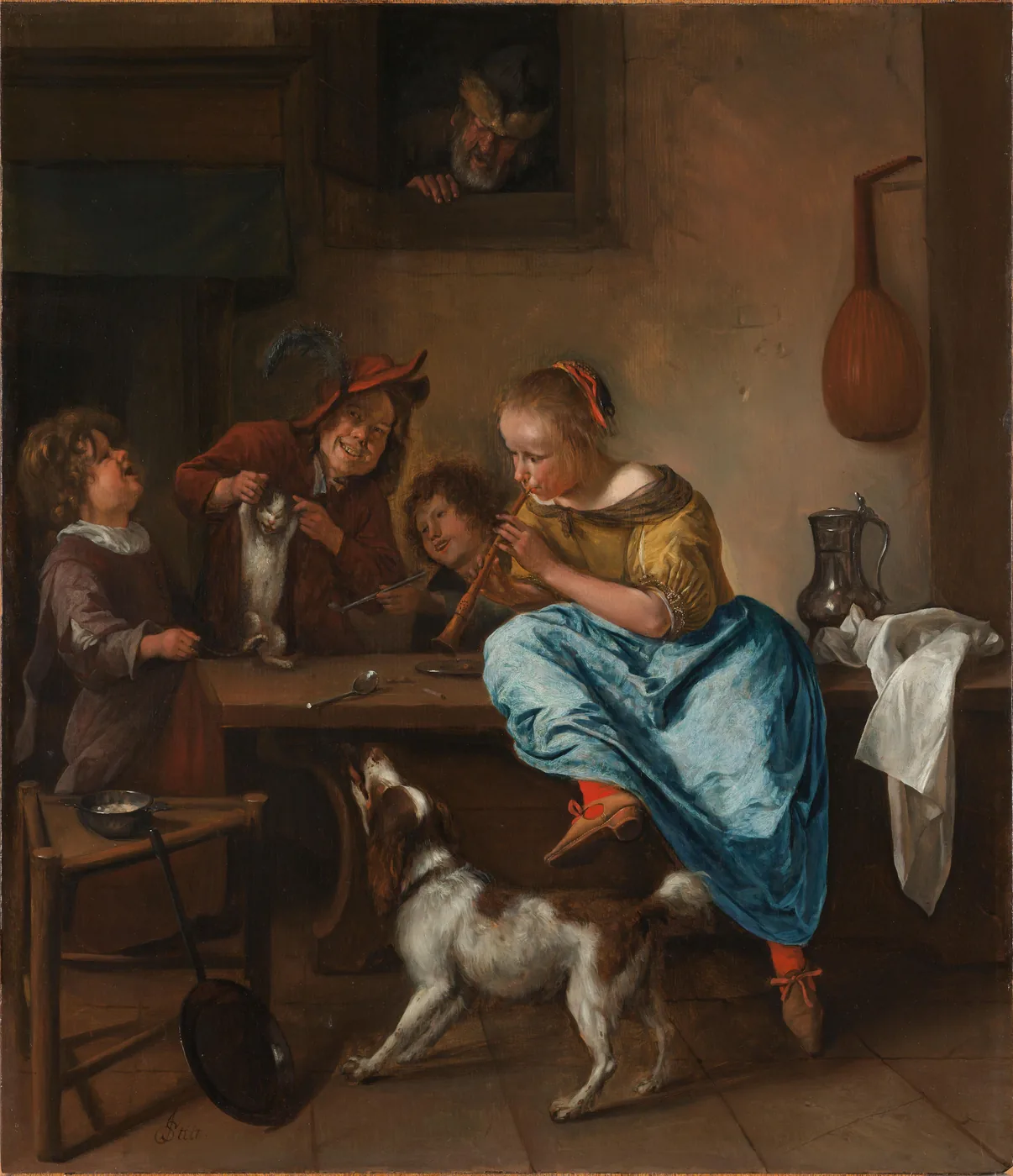
The child holding the cat supplies its supposed dance; the animal is not willingly demonstrating a learned step. Around it, faces, hands and instruments compete for attention. The empty pan near the floor and the instrument hanging on the wall extend the potential noise beyond the active musician.
Read the scene as a constructed comic disorder, not a recommendation for treating animals. Its uncomfortable joke also sharpens a question raised by the other pictures: who controls the performance? Here the answer is visible in the hands holding the cat, whereas the title’s polite “lesson” makes the action sound more orderly than it looks.
Osman Hamdi Bey: instruments, bodies and architecture
In Two Musician Girls, 1880, one figure stands with a long-necked string instrument while the other sits with a tambourine. Pera Museum identifies architectural elements drawn from Bursa’s Green Mosque within the painting.
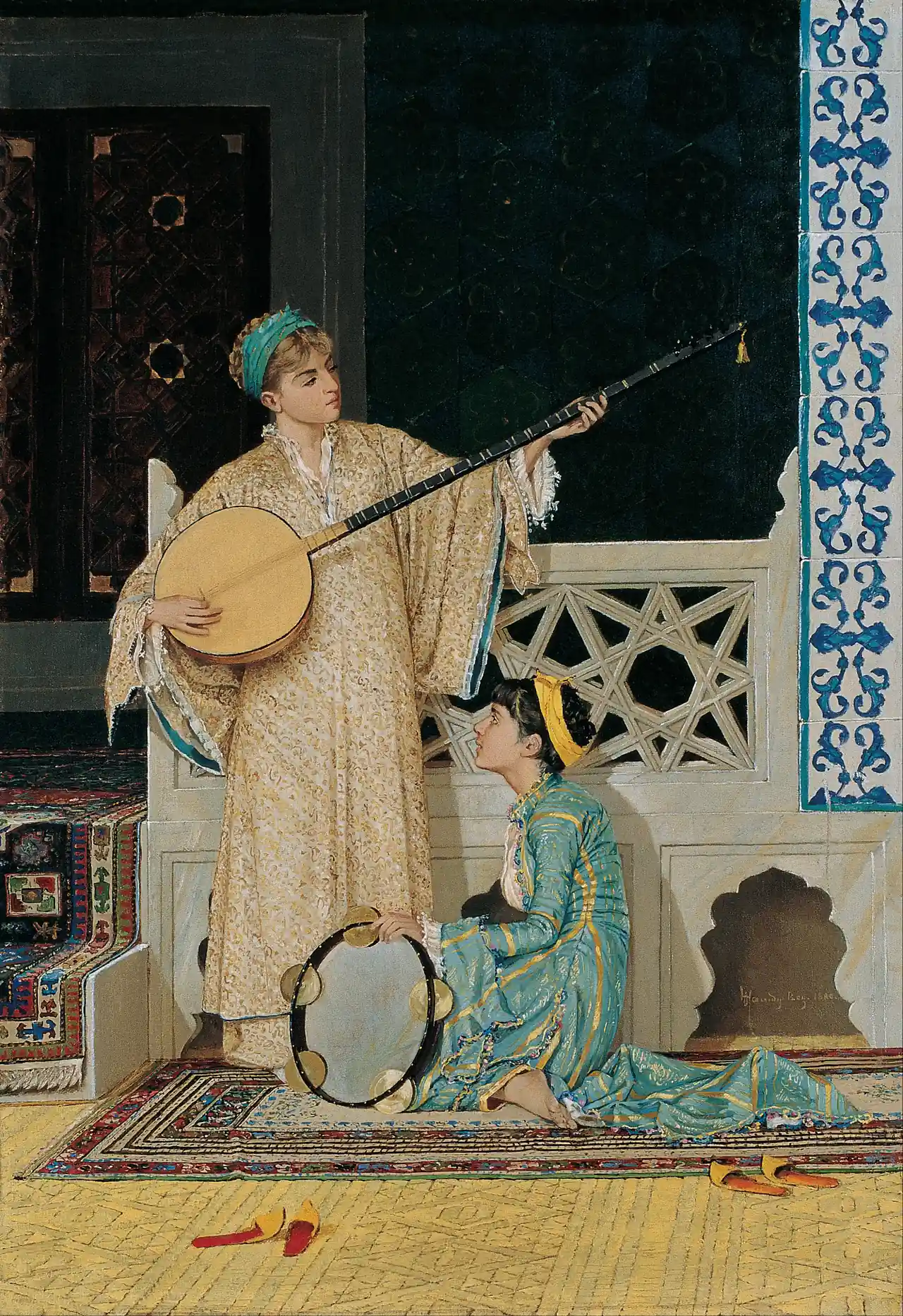

The instrument’s long diagonal crosses a large dark area, while the round tambourine repeats its body at a lower level. Those clear shapes remain legible among the elaborate textile and architectural patterns. The seated musician’s upward gaze links the two figures without requiring an invented conversation.
This is a composed painting, not automatic evidence of an observed concert in that mosque. Recognisable architectural details can be selected and rearranged within an artistic setting. The Osman Hamdi Bey guide supplies a wider context without treating every Ottoman interior as the same place or social situation.
Listen to the picture without inventing its sound
None of these images lets us recover a complete tune. What they preserve instead is a relationship: pupil and teacher, performer and spectator, painter and pictured musician, or people preparing to play together. Even an advertisement can make that relationship unusually vivid.
Try following the hands before the faces. Then ask whether the picture shows work, leisure, preparation or deliberate disorder. Our collection directory offers further artist-led browsing, but no purchase is needed for that exercise. The most useful next step is simply to return to one image and notice who else is taking part.
Editorial record
About this article
- Author
- Publisher
- GeMarkt
- Published
- Reviewed
- Internal source & rights check. Conducted by GeMarkt Research Review. This is an internal editorial check—not independent peer review.
- Source standard
- Art history source standardPrioritises object records and research sources, distinguishes evidence from interpretation, and states material uncertainty.
Found a claim that needs checking? Report a factual error.