Is Henri de Toulouse-Lautrec's art public domain? A collector's guide
Toulouse-Lautrec died in 1901, placing his work firmly in the public domain. His dated, mass-printed posters make an even clearer copyright case than most paintings.
From the guide to the collection
Explore the Toulouse-Lautrec collection → · Shop all art → · Free Toulouse-Lautrec wallpapers — the complete paintings at 4K ↓
From the studioToulouse-Lautrec prints — 350+ restored works, curated and annotated →
A short life in Montmartre
Henri de Toulouse-Lautrec was born in Albi, in the south of France, in November 1864, into a family that traced its title back to the medieval counts of Toulouse. The aristocratic future ended early: he fractured his right femur at thirteen and his left at fourteen, the breaks never healed properly, and his legs stopped growing. As an adult he stood about five feet tall. Riding and hunting — the pursuits his father lived for — were closed to him, and drawing, which had been a pastime, became the work of his life.
He settled in Montmartre in the 1880s and painted its dance halls, café-concerts, brothels, and circus rings from the inside, as a regular rather than a visitor. One of the first canvases to show what he could do was The Laundress (1886–87), a portrait of Carmen Gaudin, a working girl he stopped on a Montmartre pavement and hired on the spot for her red hair. In November 2005 that painting sold at Christie’s for $22.4 million — still the auction record for the artist, and a useful reminder that the man once dismissed as a poster-maker is priced among the masters.
The life burned fast. His health gave way to alcoholism and illness, and he died at his mother’s estate, Château Malromé, on 9 September 1901. He was thirty-six.
The poster that made him famous overnight
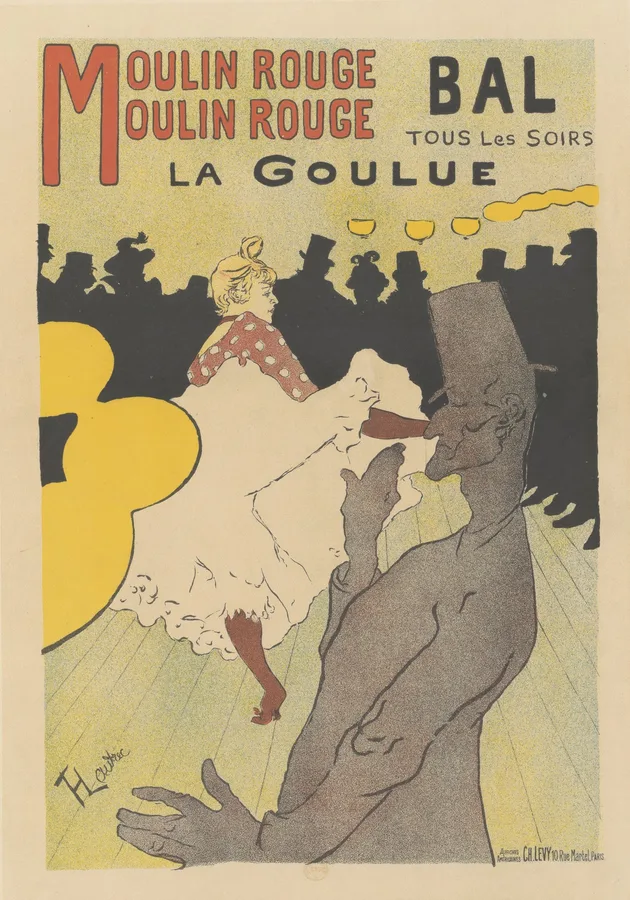
In 1891 the Moulin Rouge commissioned a poster from him — his first attempt at the medium. Moulin Rouge: La Goulue, with the dancer kicking above a crowd reduced to one flat black silhouette, was printed in roughly three thousand copies and pasted across Paris. Almost overnight, the name Lautrec became as famous as the dance hall it advertised.
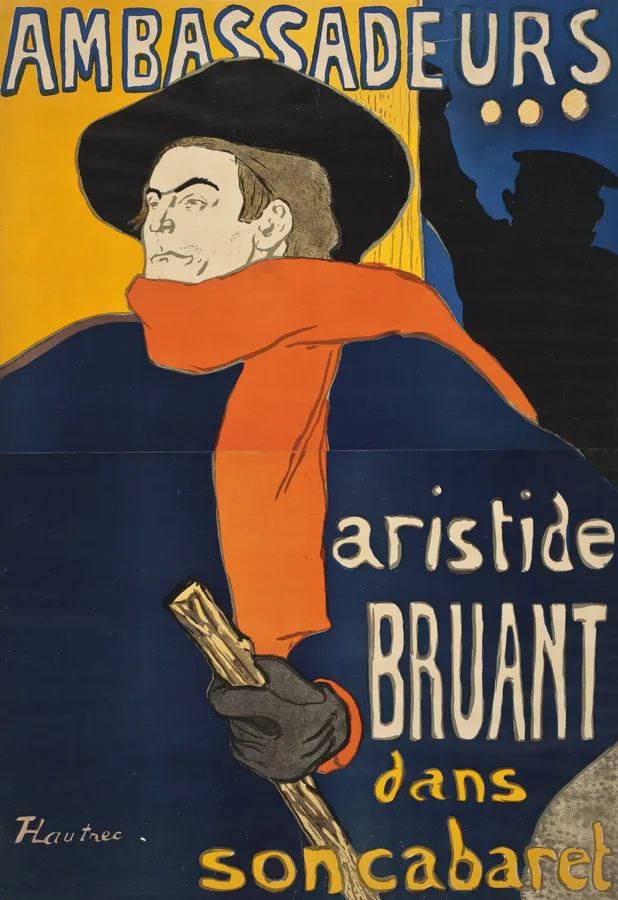
The follow-ups came with better stories attached. When the café-concert Les Ambassadeurs engaged the singer Aristide Bruant in 1892, Lautrec designed the poster — red scarf, black cape, a stare with no apology in it. The venue’s manager loathed it. Bruant simply refused to perform unless it went up, so up it went, outside the theatre and on the stage itself.
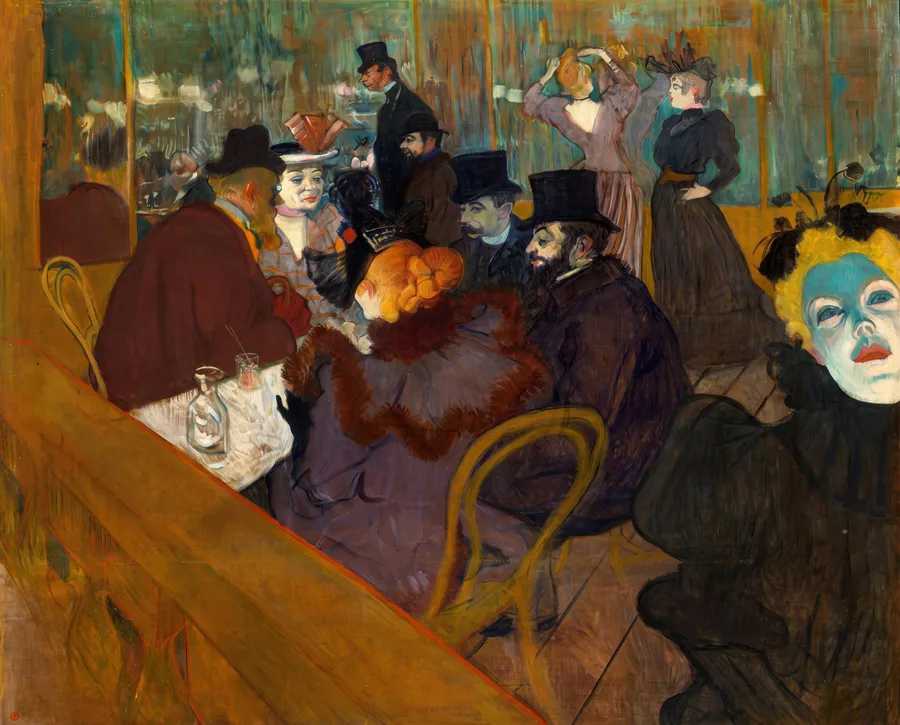
The paintings could unsettle people just as much. At the Moulin Rouge (1892–95) originally carried, at its right edge, the gas-lit face of the singer May Milton, lit a shocking acid green. At some point the canvas was cut down and that strip removed — by the artist or, more likely, a dealer who judged the picture easier to sell without her. By 1914 the section had been rejoined, and the painting now hangs whole, green face and all, at the Art Institute of Chicago.
Is Toulouse-Lautrec’s art public domain?
Yes — everywhere, and by a comfortable margin under both of the world’s major copyright systems.
Most countries protect a work for the life of the author plus seventy years. Toulouse-Lautrec died in September 1901, so the life-plus-seventy clock ran out by the end of 1971 — more than half a century ago, and earlier still in countries that historically used shorter terms.
The United States calculates differently for old works: not from the artist’s death but from publication, with a term of roughly ninety-five years. Since Lautrec died in 1901, nothing he made can postdate that year, and anything published before 1902 cleared the American bar decades ago. There is no estate holding residual rights, no jurisdiction where the term is still running, no edge case to argue about.
One honest caveat belongs here: copyright terms vary by country and are occasionally revised, and this page is general information, not legal advice. For an artist dead since 1901 none of the variations change the answer — but if a commercial decision hangs on the question, ask a lawyer in your own jurisdiction.
Why his posters are an even cleaner case than his paintings
With a nineteenth-century painting, the old American publication rule can turn into a historian’s puzzle: when exactly does a canvas that hung in private rooms count as “published”? Lautrec’s posters skip the puzzle entirely. They were commercial, mass-printed ephemera — lithographs run off by the thousands, distributed publicly, pasted on walls, with commissioning venues and print dates on record. For copyright purposes, that is about as clean as evidence of nineteenth-century publication ever gets.
The same fact explains something collectors often wonder about: why original Lautrec lithographs sit in major museums at all. They survive because they were never rare to begin with. Most of the three thousand La Goulue sheets perished on the walls of Paris, but enough were kept — by printers, by admirers, by people who understood early what they were looking at — that institutions around the world hold originals today.
Public domain artwork is not the same as a public domain file
A distinction worth keeping sharp: the artwork being free does not make every digital copy of it free. Museums and image libraries sometimes claim rights, or attach contractual conditions, to their own photographs of public-domain works. The strength of those claims varies by country, but the practical lesson is constant — before an image is used, the file’s origin matters, not just the painting’s status. That is why the restorations we sell are our own work, and why we verify the rights status of every individual piece before it is listed.
Toulouse-Lautrec in our collection
Our Toulouse-Lautrec collection holds over 350 restored works — the famous posters, the paintings behind them, and the quieter studies in between. The curated dozen includes Moulin Rouge: La Goulue and the Bruant poster from the stories above, At the Moulin Rouge with its once-severed green face kept deliberately cold, and The Laundress, the record-setter, with the whites of her blouse held as the dozen tinted greys they really are.
Every piece comes in the same four formats: rolled poster, stretched canvas, framed canvas, and framed paper print. The rolled poster suits collectors with a framer they already trust — and there is something fitting about buying a Lautrec that way, since a rolled lithograph is exactly how Paris first met him. Browse the Toulouse-Lautrec collection — twelve works chosen and annotated by the studio, and a door to the other 350-plus behind them.
Editorial record
About this article
- Publisher
- GeMarkt
- Published
Found a claim that needs checking? Report a factual error.