GeMarkt Blog · Practical guide
Is Osman Hamdi Bey’s Art Public Domain? Paintings and Image Sources
Explore Osman Hamdi Bey’s musicians, portraits and Tortoise Trainer, with twelve museum records and separate checks for the painting and image file.
Rights check · reviewed
The short answer
The ordinary author term has elapsed in Türkiye, the EU and the UK. The three selected Google Art Project reproductions carry Commons PD-Art / Public Domain Mark, not museum CC0. Independent U.S. publication histories remain unresolved, including those three paintings; other files require separate checks.
| What is being checked | Result | Why |
|---|---|---|
| Türkiye — ordinary author term | Ordinary economic-right term has elapsed | The Ministry describes life plus 70 with calendar-year calculation. Osman Hamdi Bey died in 1910. This limited conclusion is not permission for every unpublished work, adaptation, modern photograph or contractual use. |
| European Union — ordinary author term | Ordinary artist term has elapsed | Life plus 70 has elapsed; national exceptions, moral rights, later first publication and separately authored reproductions are not universally cleared. |
| United Kingdom — ordinary artistic-work term | Ordinary term elapsed; older unpublished rules separate | No conclusion that every unpublished painting or modern image is free merely because the painter died in 1910. |
| United States — all twelve research objects | Independent publication histories unresolved | Creation and exhibition alone are not publication. Commons asserts early publication for the selected files; that assertion is attributed, not independently established. Orsay lists a reproduced 1903 Salon catalogue as a lead, not a plate examined here. |
| Selected digital files | Three exact Commons PD-Art / PDM reproductions | Two Musician Girls, Portrait of Naile Hanım and the 1906 Tortoise Trainer use exact Google Art Project reproductions. PDM is not CC0 or a museum-issued commercial permission. The portrait source already excludes a modern frame; GeMarkt adds no crop. |
| Other works and files | Nine display HOLDs | The remaining objects are research links, not nine cleared downloads. The Met loan At the Mosque Door expressly lacks a download; the Orsay photographer credit is not an open licence. No restricted museum assets were acquired. |
Twelve exact institutional research objects, three selected files and nine display HOLDs. Naile Hanım and the Petitioner remain undated; the 1906 Pera Tortoise Trainer is not combined with other versions. Museum photographs, archival reproductions and the historical paintings are distinct.
This is a documented research summary, not legal advice. Copyright and moral-rights rules can vary by country and by the history of a particular work.

What we’ll look at
Which Osman Hamdi Bey painting and which reproduction can you identify and use?
Short answer: Osman Hamdi Bey’s ordinary author term has elapsed in Türkiye, the EU and the UK. The three reproductions shown here carry Wikimedia Commons’ PD-Art/Public Domain Mark designation. That is not worldwide permission for every painting or download: independent U.S. publication histories remain unresolved, and a museum’s modern photographs can have different conditions.
His best-known image is The Tortoise Trainer, but there is more to explore: women making music, a close family portrait, a letter writer and an archaeological excavation. Looking at that range also helps avoid a common search mistake—treating every result under an artist’s name as the same kind of image.
An artist and museum director
Osman Hamdi Bey lived from 1842 to 1910. An Ottoman painter trained in Paris, he also directed the Imperial Museum and helped establish Istanbul’s fine-arts academy. The Musée d’Orsay’s account places his paintings alongside his archaeological and institutional work. He was involved in representing Ottoman culture, not merely observing it as a visiting traveller.
That does not make his canvases unedited photographs of everyday life. Architecture, costumes and poses could be assembled into a carefully arranged scene. For The Nippur Excavations, dated 1903 in Penn Museum’s account, he worked from a photograph by John Henry Haynes. A painting can be attentive to detail while still depending on selection and reconstruction.
This is a useful way into the work: ask what each person is doing, then look at how the surrounding objects direct your attention. A book, an instrument or an architectural threshold is often an active part of the picture.
Two Musician Girls
In the opening image, the standing musician holds a long-necked instrument while her seated companion supports a tambourine. The diagonal neck carries the eye upward; the round drum draws it back towards the floor. Their hands make the instruments believable as things being used, not simply decorative accessories.
Pera Museum dates the painting to 1880 and records a relatively small canvas, 58 × 39 cm. Its architectural elements draw on Bursa’s Green Mosque. Pera interprets the women as capable participants in cultural life, contrasting them with passive figures in some Western Orientalist images.
Look at how much happens around them: the star-shaped openings in the stone screen, the narrow tile strip, overlapping carpets and shoes on the foreground floor. Yet the light clothing and instruments keep the figures readable. For a reproduction, preserve the full vertical composition. A tight square crop would lose the lower drum, patterned floor and the spatial relationship between the musicians.
Portrait of Naile Hanım
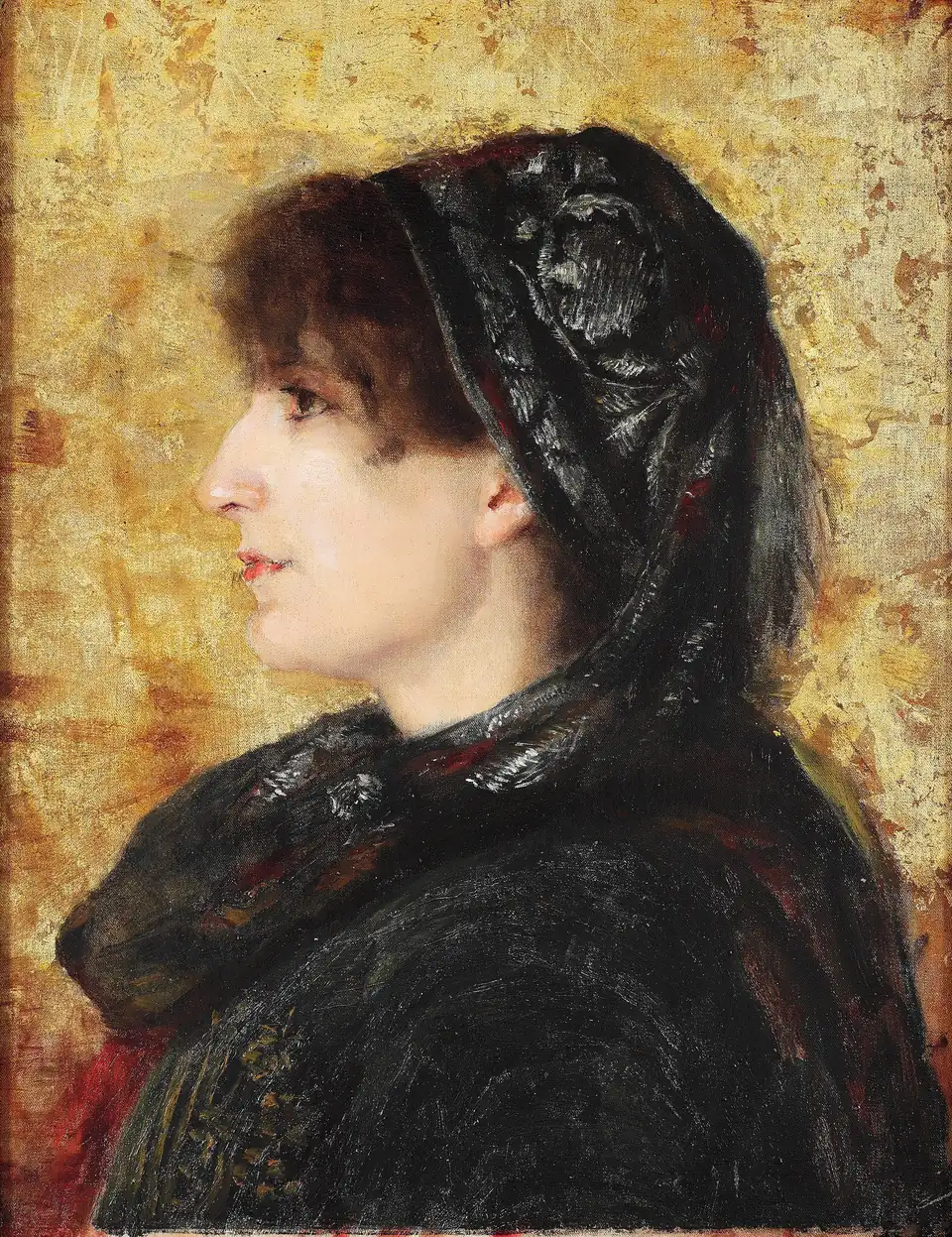

The museum identifies the sitter as the artist’s wife, born Marie Palyart, and records the painting as undated. Some online image metadata says 1910; that should not silently replace the museum’s dating.
This portrait works differently from the musicians. There is no tiled room to explore. The gold-coloured field presses the dark profile forward, while the clothing spreads into broad, lively marks. Look at the edge where forehead, nose and lips meet the background: a small change in contour carries more weight here than a whole ornamental panel would in the larger scene.
The current Commons file already excludes a modern frame. It presents the painting, not a frame-and-painting product. Keep that distinction when choosing a print preview: an attractive frame surrounding a web image is not necessarily part of the historical artwork or the downloadable file.
The Tortoise Trainer
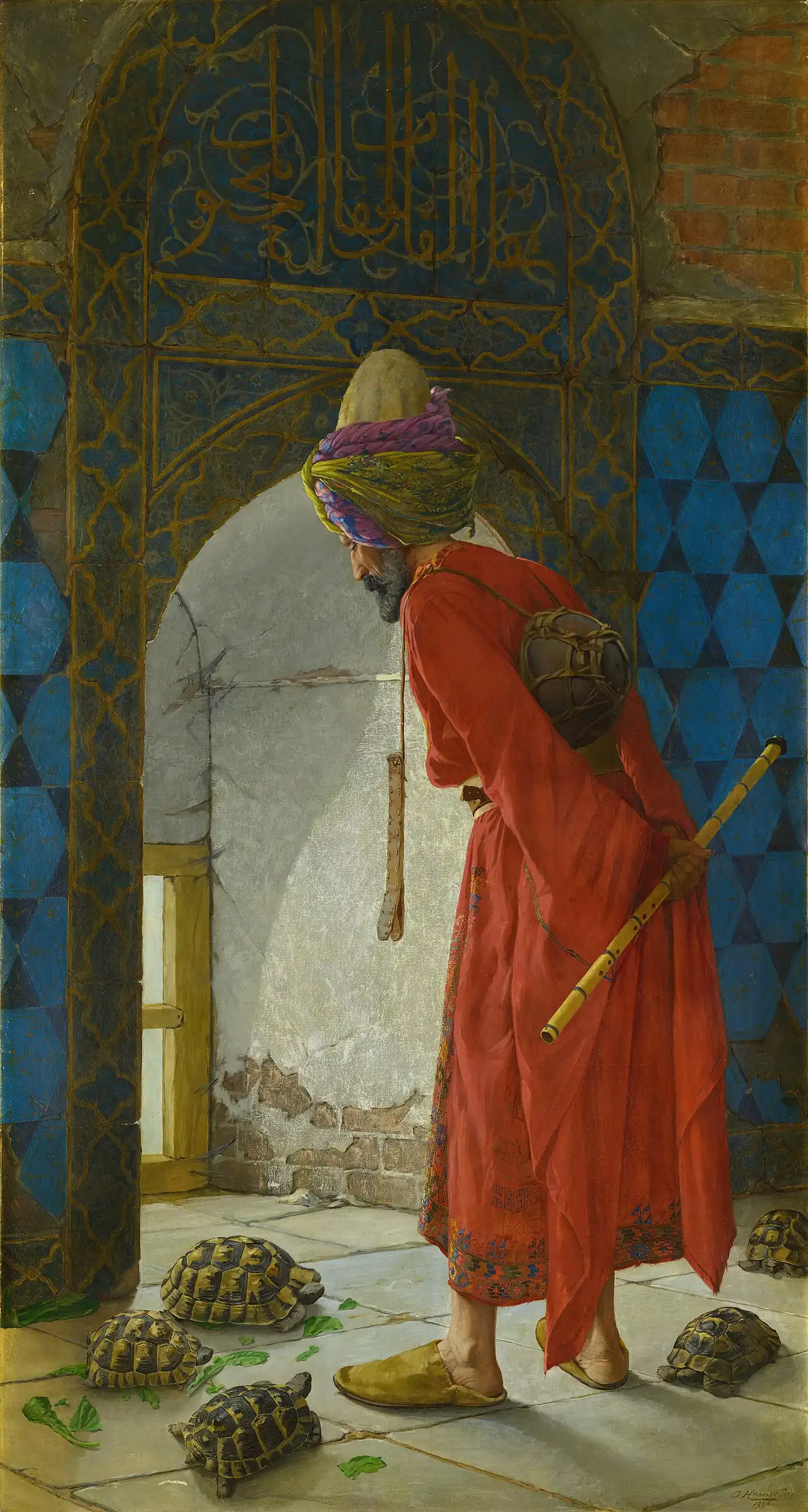

The Pera collection’s 1906 painting measures 221.5 × 120 cm. Its tall format gives a single, slightly bent figure room to stand above the small animals. The museum connects the setting with an upper chamber of the Green Mosque and identifies the figure as the artist modelling for himself.
He holds a reed flute behind his back and carries a small drum. Pera reads the scene as an attempt to teach through art rather than force. The costume combines elements associated with dervishes; it should not be labelled as an exact uniform of one particular order.
The contrast between an intent teacher and unhurried animals makes the painting memorable without requiring a single political explanation. Start with those visible relationships before treating any interpretation as the artist’s documented intention. For image searching, retain the 1906 Pera object and its dimensions rather than merging every similarly titled version.
Twelve works to identify
These are research references, not twelve cleared downloads. “Image not selected” means no display file has been approved for this guide; it does not declare the painting copyrighted.
| Work | Museum record | Image here |
|---|---|---|
| Two Musician Girls, 1880 | Pera Museum; 58 × 39 cm | Opening image |
| Portrait of Naile Hanım, undated | Sakıp Sabancı Museum, 200-0352-OHB | Above |
| The Tortoise Trainer, 1906 | Pera Museum; 221.5 × 120 cm | Above |
| Kokona Despina, 1906 | Sakıp Sabancı Museum, 200-0280-OHB | Not selected |
| Hodja Reading the Koran, undated | Sakıp Sabancı Museum, 200-0087-OHB | Not selected |
| The Petitioner, undated | Sakıp Sabancı Museum | Not selected |
| Flowers in a Vase, 1876 in the conservation account | Sakıp Sabancı Museum | Not selected |
| The Mosque, undated | Sakıp Sabancı Museum | Not selected |
| The Nippur Excavations, 1903 in Penn’s account | Penn Museum | Not selected |
| At the Mosque Door, 1891 | Islamic Arts Museum Malaysia; loan to the Met | Not selected |
| Derviche au türbe des enfants, 1903 | Musée d’Orsay, INV 20736 | Not selected |
| Young Woman Reading, 1880 | Islamic Arts Museum Malaysia | Not selected |
The Sabancı conservation exhibition discusses The Petitioner and Flowers in a Vase individually. It calls the former unsigned and undated, and reports a signature and 1876 date on the latter. Those distinctions are more useful than assigning every uncertain work the artist’s final year.
Copyright and image files
Türkiye’s Ministry of Culture, the EU and the UK describe ordinary author terms that have elapsed for an artist who died in 1910. That limited conclusion does not settle every unpublished-work exception, moral right, later adaptation or separate photograph.
The U.S. requires another check. In 2026, works published in 1930 have reached the end of the ordinary 95-year term, but a painting’s creation date is not its publication date. Copyright Office guidance also distinguishes older unpublished works. This guide does not independently establish U.S. publication histories for the twelve paintings, including the three illustrated works.
For Two Musician Girls, Naile Hanım and The Tortoise Trainer, the exact Commons file records identify faithful reproductions and carry public-domain designations. Their early-publication assertions are attributed to Commons, not presented as independently examined historical evidence. Public Domain Mark describes a status; it is not a museum-issued CC0 dedication.

Choosing a reproduction
Keep the object title, museum record and exact file page together. Check whether the file includes a frame, crops the painted edges or differs from the museum’s dating. Match the composition before comparing resolution: a large file of a different portrait is still the wrong image.
For commercial reuse, resolve the country and file conditions that apply to your intended use rather than borrowing an assurance from a product listing. For looking, begin with the hands and the objects they touch. That simple route reveals how much of Osman Hamdi Bey’s painting is about attention, skill and the work of learning.
Sources and review method
We checked the artist chronology against museum records, treated each named jurisdiction separately, and recorded the provider policy for the image set. These sources support the legal framework and artist dates used above; the source file for any individual image still needs its own record.
- Two Musician Girls within Ottoman Music and Entertainment — Pera Museum. 1880, 58 × 39 cm, instrument and architectural context. Not an image-licence release.
- Two Musician Girls exact Google Art Project file — Wikimedia Commons. Exact file, PD-Art and Public Domain Mark; early-publication assertion remains attributed.
- Portrait of Naile Hanım, 200-0352-OHB — Sakıp Sabancı Museum. Undated portrait and exact dimensions override Commons 1910 label.
- Naile Hanım exact Google Art Project file — Wikimedia Commons. PD-Art / PDM and existing frame removal, not museum CC0.
- The Tortoise Trainer — Pera Museum on Google Arts & Culture. Exact 1906 version, dimensions and museum interpretation, separate from file rights.
- The Tortoise Trainer exact Google Art Project file — Wikimedia Commons. PD-Art / PDM designation and Commons-provided 1280-pixel source rendition; independent publication unresolved.
- Osman Hamdi Bey Beyond Vision — Sakıp Sabancı Museum. Individual object and conservation accounts; inconsistent labels retained as uncertainties.
- At the Mosque Door, 907909 — The Metropolitan Museum of Art. Current IAMM lender and 1891 object; image explicitly unavailable to download.
- Derviche au türbe des enfants, INV 20736 — Musée d’Orsay. 1903 object and historical reproduced-catalogue lead; credited modern photograph not acquired.
- Copyright duration — Republic of Türkiye Ministry of Culture and Tourism. Ordinary life-plus-70 duration and separate original/adaptation terms.
- Copyright in the EU — European Union, Your Europe. Ordinary author term, not worldwide file clearance.
- How long copyright lasts — UK Intellectual Property Office. Ordinary artistic-work duration; older unpublished works remain a separate branch.
- Duration of Copyright, Circular 15A — U.S. Copyright Office. Publication and older-unpublished conditions; creation and exhibition not interchangeable with publication.
Editorial record
About this article
- Author
- Publisher
- GeMarkt
- Published
- Reviewed
- Internal source & rights check. Conducted by GeMarkt Research Review. This is an internal editorial check—not independent peer review.
- Source standard
- Rights guide source standardSeparates the underlying work from the source file, records the review date, and links the evidence used for the conclusion.
Found a claim that needs checking? Report a factual error.