GeMarkt Blog · Essay
Degas vs Renoir: Two Ways to Paint Dancers
Two paintings from 1874 reveal different ways to picture ballet: Degas's crowded rehearsal room and Renoir's single dancer, with both works shown side by side.

At first, both pictures offer what we expect from ballet: pale skirts, pink shoes and carefully placed feet. Then their differences take over. In Degas’s The Dance Class, we look past one dancer to another, across a floor and into a group. In Renoir’s The Dancer, one figure holds almost the entire picture and looks towards us.
Degas builds a scene of practice, waiting and observation; Renoir turns a dancer’s costume and pose into a full-length encounter with a single figure. Neither approach gives us an unfiltered record of ballet life. Both turn bodies, clothes and space into a deliberate painted arrangement.
Two paintings from the same year
Edgar Degas (1834–1917) and Pierre-Auguste Renoir (1841–1919) are associated with Impressionism, but that shared label does not make their methods interchangeable. Comparing two works dated 1874 lets us put aside a broad story of “early” and “late” styles and look at choices made around the same moment.
Their exhibition histories differ. Renoir showed The Dancer at the first Impressionist exhibition in April 1874, according to the National Gallery of Art. The Met records that Degas’s The Dance Class was lent to the group’s 1876 exhibition. A painting’s date and its public debut are not automatically the same date.
The dancers side by side
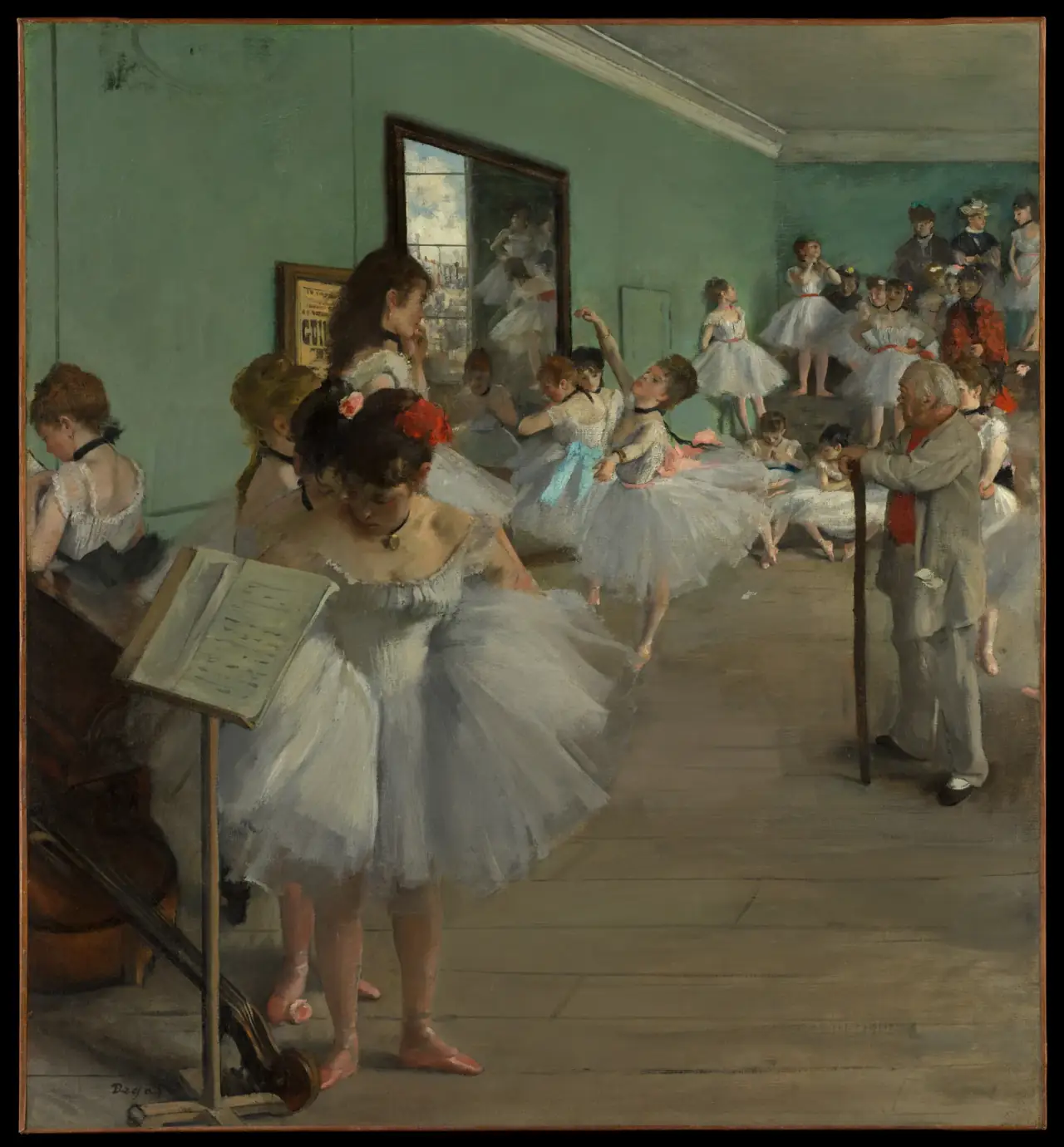
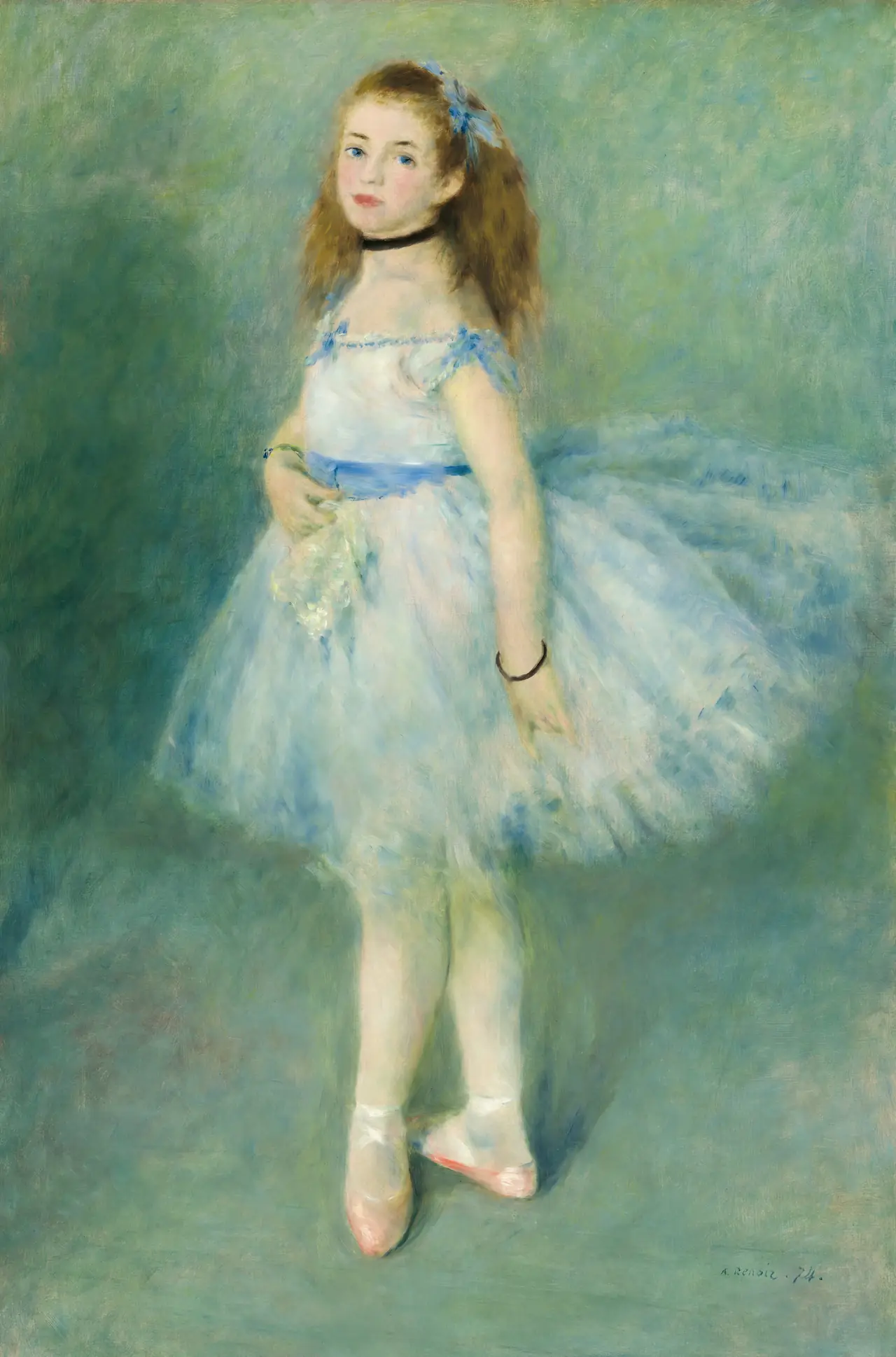
The figures appear at convenient reading sizes here, not at one common physical scale. Renoir’s canvas is substantially taller. In a gallery, its single dancer makes a more imposing presence than a small reproduction might suggest.
Degas makes your eye cross a room
Begin in the lower-left corner with the music stand. The nearby dancer almost bumps against our viewing position. Now find the dancer wearing the pink sash nearer the centre, then the older man at the right. The space between them is as important as any one figure.
That open floor gives the central movement room to read. The other bodies gather along its edges, some looking towards the action and others turned away. We can scan several different kinds of attention without settling on one central face.
The Met identifies the teacher as Jules Perrot and the central action as an examination. Its account also explains that this is an imaginary scene set in a rehearsal room of the old Paris Opéra, which had already burned down. The sense of being present does not make it a picture taken on one recoverable afternoon.
Renoir brings one figure forward
Renoir gives the dancer much more space around her head and fewer competing objects. Her body turns slightly away, but her face returns towards us. There is no visible teacher, audience or line of waiting dancers. The viewer becomes the person before whom the pose is held.
Compare her feet with her head. At the bottom, the crossed shoes establish a trained position; at the top, the gaze makes the picture feel like a portrait. Between them, the skirt expands sideways into the green around it.
The surrounding colour does not describe a room with Degas’s clarity. There is no comparably legible route from foreground floorboards to a rear wall. Instead, the background supports the figure through changing light and colour, allowing parts of the costume to soften into it.
A dance position is not a personal biography
The Frick’s exhibition entry identifies Renoir’s crossed feet as ballet’s fifth position. That gives a name to a visible arrangement; it does not establish the sitter’s profession or the circumstances of a performance.
The National Gallery considers the model almost certainly Henriette Henriot, an actress who posed for Renoir, while noting that the artist did not identify her. It is therefore safer to distinguish the person who modelled from the dancer represented. A costume picture can be convincing without being a documentary portrait of someone at their day job.
This distinction also protects the sitter from invented stories. A hand near a skirt might look hesitant to us, but it cannot prove stage fright, ambition or unhappiness.
Neither picture is an unplanned snapshot
Degas’s crowded edges and angled room can feel accidental, as though the scene continued before we arrived and will continue after we leave. Yet the space is organised around gaps, overlaps and changes of scale. Its informality is made, not merely found.
Renoir’s central pose announces its arrangement more openly. That does not make it less modern or less observant. Positioning a whole person against an unsettled background lets us notice how a strong outline can coexist with loose paint.
The Met’s history of ballet connects Degas’s classroom subjects with the movement between formal steps and ordinary bodily actions. Practice includes waiting, adjusting, watching and beginning again. Painting those intervals can show something a spectacular leap would hide: the repeated work around a performance.
Compare the white fabric
Look at the skirts without immediately naming them white. Degas places warm and cool patches beside one another, separates layers with darker touches, and lets ribbons punctuate the gathering of pale forms. Across the room, several skirts make an uneven rhythm rather than one continuous band.
Renoir’s blue ribbons and cool shadows spread the colour through a single costume. The Frick points out the unexpected blue, green and yellow touches in the flesh as well. Skin and fabric share a painted atmosphere rather than remaining sealed inside separate colour categories.
Try following the outside edge of each skirt. In Degas, overlapping bodies repeatedly interrupt it. In Renoir, portions become difficult to separate from the background. One effect comes from crowded space; the other from softened transitions. Both keep pale fabric from turning into a flat white cut-out.
Movement can happen without a leap
Neither canvas needs an airborne figure to feel active. In Degas, our attention keeps moving between people who are doing different things. The empty floor becomes a space in which an action might happen next.
Renoir’s figure is more contained. The turn from body to head, the skirt projecting behind, and the diagonal relationship between the feet provide small changes of direction within a held pose. Stillness becomes something maintained rather than an absence of effort.
That is a useful way to look at other pictures of dancers: ask whether movement belongs to the represented body, to the arrangement around it, or to your own journey through the painting.
What the comparison cannot tell you
These works do not prove that Degas cared only about labour while Renoir cared only about pleasure. Such labels flatten two long careers into a pair of moods. They also encourage us to read faces as evidence for claims the paintings cannot settle.
The narrower conclusion is stronger. Here, Degas distributes attention across a working environment; Renoir concentrates it on an individual presented for looking. Both make ballet visible through selection, staging and paint.
Where to look next
On a second pass, ignore the faces and compare the spaces around the bodies. Then restore the faces and notice how your relationship with each picture changes. That small exercise reveals more than deciding which dancer looks happier.
Continue with Morisot vs Cassatt for another comparison in which the placement of a figure changes our sense of proximity, privacy and attention.
Editorial record
About this article
- Author
- Publisher
- GeMarkt
- Published
- Reviewed
- Internal source & rights check. Conducted by GeMarkt Research Review. This is an internal editorial check—not independent peer review.
- Source standard
- Art history source standardPrioritises object records and research sources, distinguishes evidence from interpretation, and states material uncertainty.
Found a claim that needs checking? Report a factual error.