GeMarkt Blog · Essay
Snow and Winter Scenes in Art
Explore eight winter works by Bruegel, Hiroshige, Sisley, Pissarro and others, from inhabited ice and snowy roads to a photograph and Klee’s imagined carnival.


Snow does more than turn a landscape white. It hides familiar surfaces, makes dark branches conspicuous and changes where people can walk. Frozen water can become a road or a place to play; a busy street can remain recognisably wintry without a blanket of snow at all.
Artists have used those changes for very different purposes. The eight works here move from Bruegel’s inhabited valley to Japanese woodblock prints, French streets, an American photograph and Klee’s improbable performers. Together they offer a history of looking at winter rather than a single story about what the season means.
Start with a small question: what has the cold made visible in this particular picture? It might be a route, a social encounter, a band of colour or an otherwise unremarkable patch of ground. The answer often lies somewhere quieter than the most obvious white area.
Bruegel: a season shared by workers and skaters
In Hunters in the Snow (Winter), 1565, the returning hunters are substantial dark figures, but they occupy only one part of an extensive world. The Kunsthistorisches Museum’s account places the painting within Bruegel’s seasonal cycle.
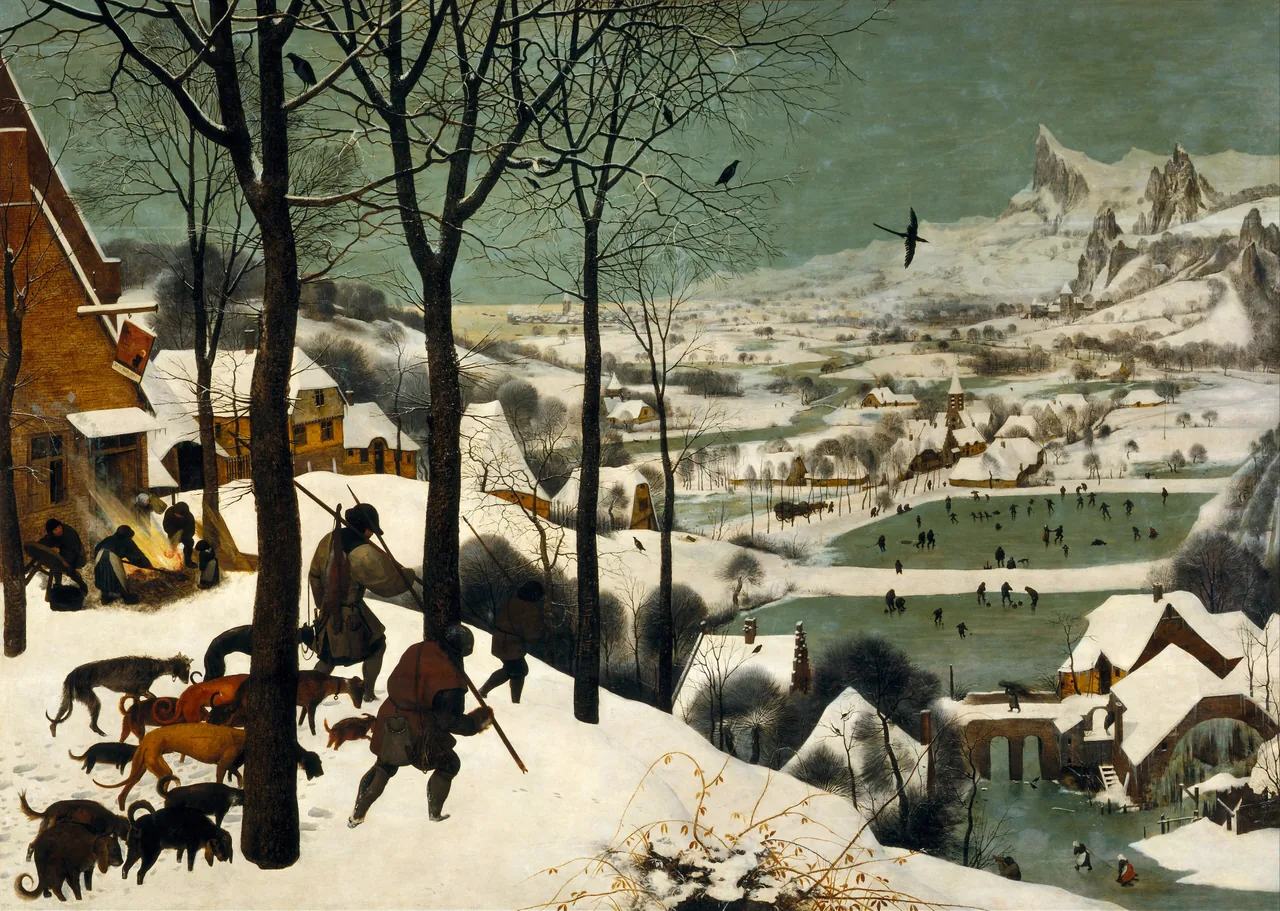
Follow the slope from the dogs towards the ponds. Large, distinct bodies give way to tiny marks on the ice. At the left, a fire introduces a sharp warm accent into a landscape dominated by pale ground, brown buildings and green-grey water and sky.
Winter connects activities that are not emotionally identical: returning from a hunt, tending a fire and skating do not amount to one universal mood. Nor is this simply a photograph of an identifiable village. The sweeping arrangement makes us compare different kinds of life at different distances. Our Bruegel guide places this ambitious landscape beside his other subjects.
Van Goyen: the river becomes a meeting place
Jan van Goyen’s 1651 River Landscape in Winter with Figures Skating and Sleds exchanges Bruegel’s large painted panorama for a small drawing. The Met’s exact sheet uses black chalk and grey wash and measures only about 10.5 × 20.4 centimetres.
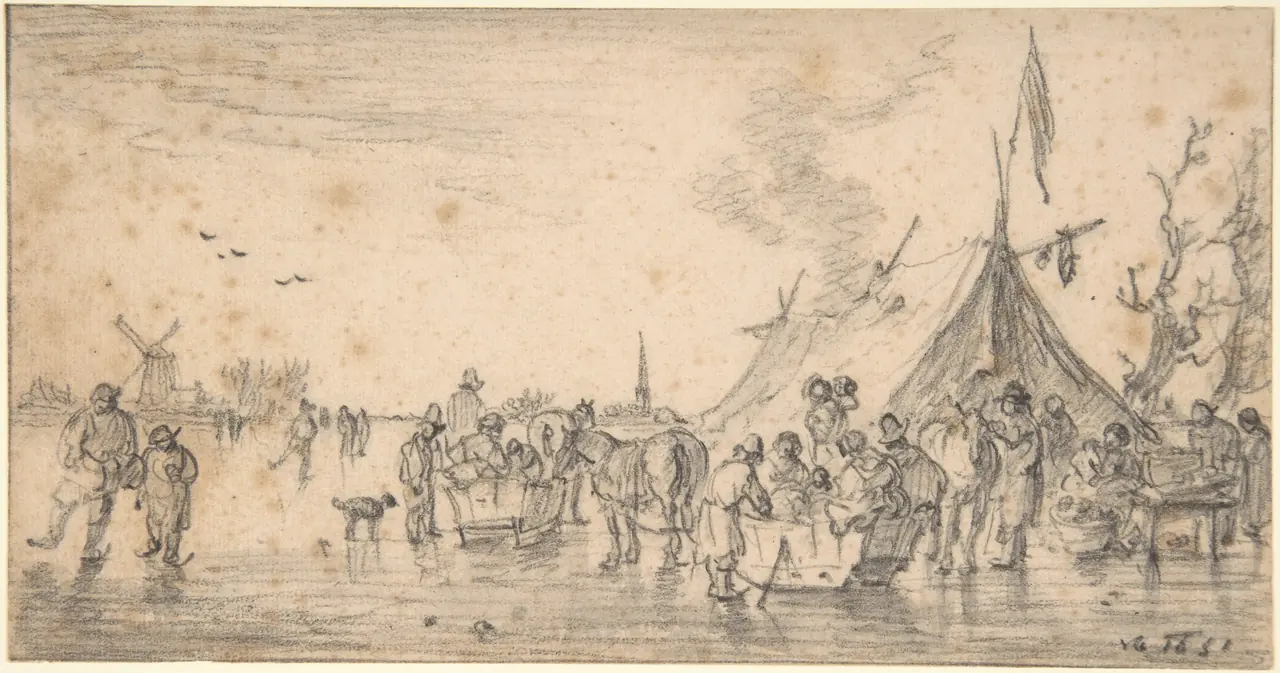
The tent and gathered figures make the ice feel like a temporary public place. Look at the bent knees, tilted backs and loose curves used for heads and hats. A few economical marks establish differences in movement without supplying a finished portrait of anyone.
The broad, lightly worked distance is as important as the crowded foreground. Winter is legible through what people are doing on the river, not through thick applications of white. Comparing this sheet with Bruegel also restores a useful sense of scale: the two reproductions on a screen are not evidence that the original objects are equally large.
Hiroshige: two journeys through snow
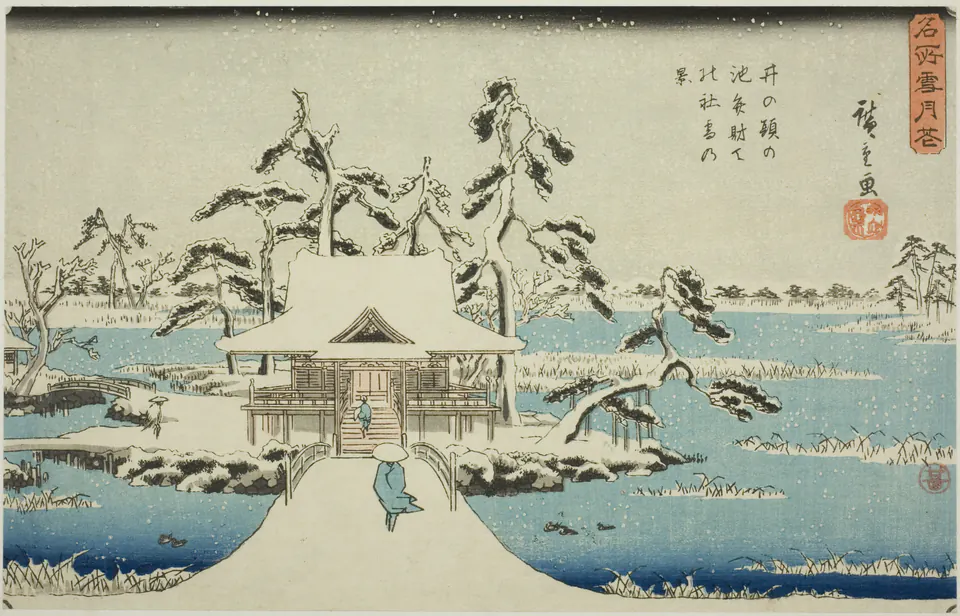
Utagawa Hiroshige’s Kanbara: Evening Snow, about 1833–34, comes from the Fifty-three Stations of the Tokaido. Snow at Benzaiten Shrine in Inokashira Pond, about 1844–45, belongs to a different series, Snow, Moon, and Flowers at Famous Places. The Kanbara record and shrine record identify the two Art Institute of Chicago impressions shown here.
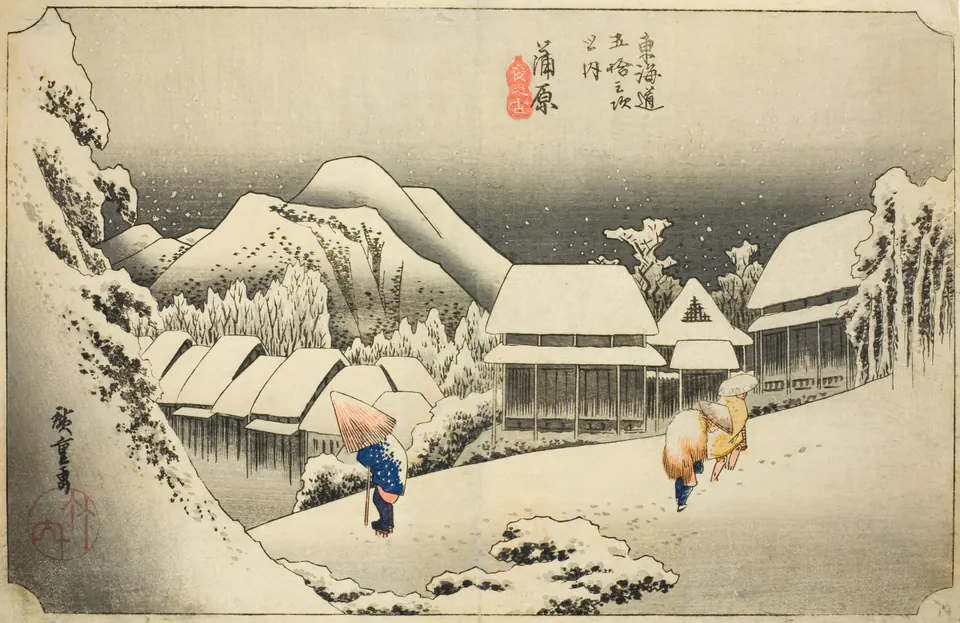
At Kanbara, the travellers’ hunched bodies give the snow physical consequences. Their small patches of blue and yellow stand out against a much larger structure of pale roofs, ground and hills. The dark band of sky helps the snow-covered forms remain distinct, even where their surfaces contain little detail.
The shrine print offers a different route. A broad white approach narrows towards the building, and the visitor ahead gives that path a human scale. Blue water separates the snow-covered banks; twisting trees disrupt the apparent symmetry. Winter has not removed colour from the scene.
Put the two side by side and follow the feet: Kanbara sends travellers across the picture, while the shrine leads a visitor into it. That contrast comes from the placement of paths, bodies and buildings, not from an assumption that Japanese snow pictures all express the same serenity. The Hiroshige guide follows his weather subjects beyond these two prints.
Sisley and Pissarro: two different winter streets
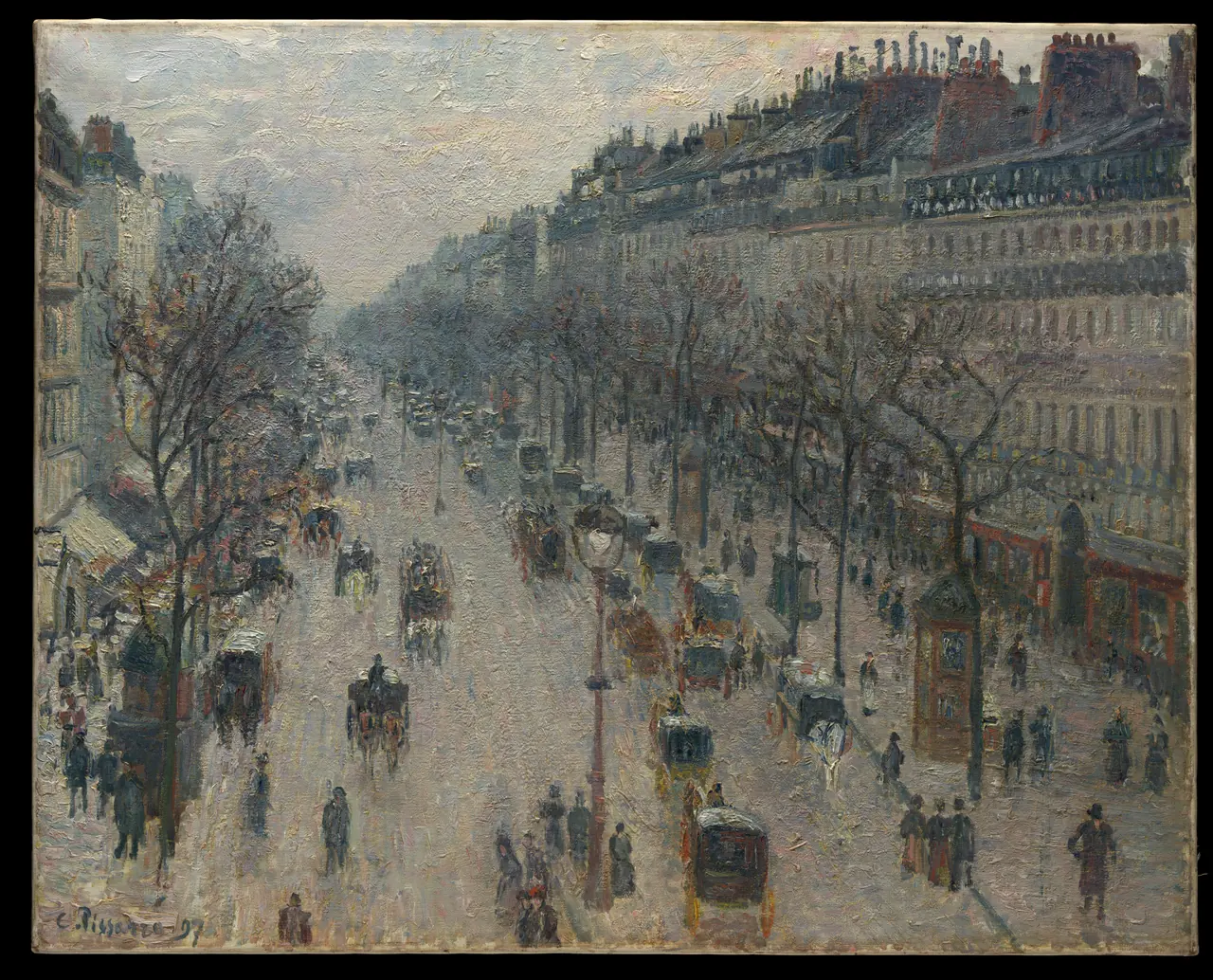
Alfred Sisley’s Rue Eugène Moussoir at Moret: Winter, 1891, brings us down to the level of a street. The Met identifies the long wall as that of the village hospital. Camille Pissarro’s The Boulevard Montmartre on a Winter Morning, 1897, looks down on Paris from the artist’s hotel accommodation, as the museum’s record explains.
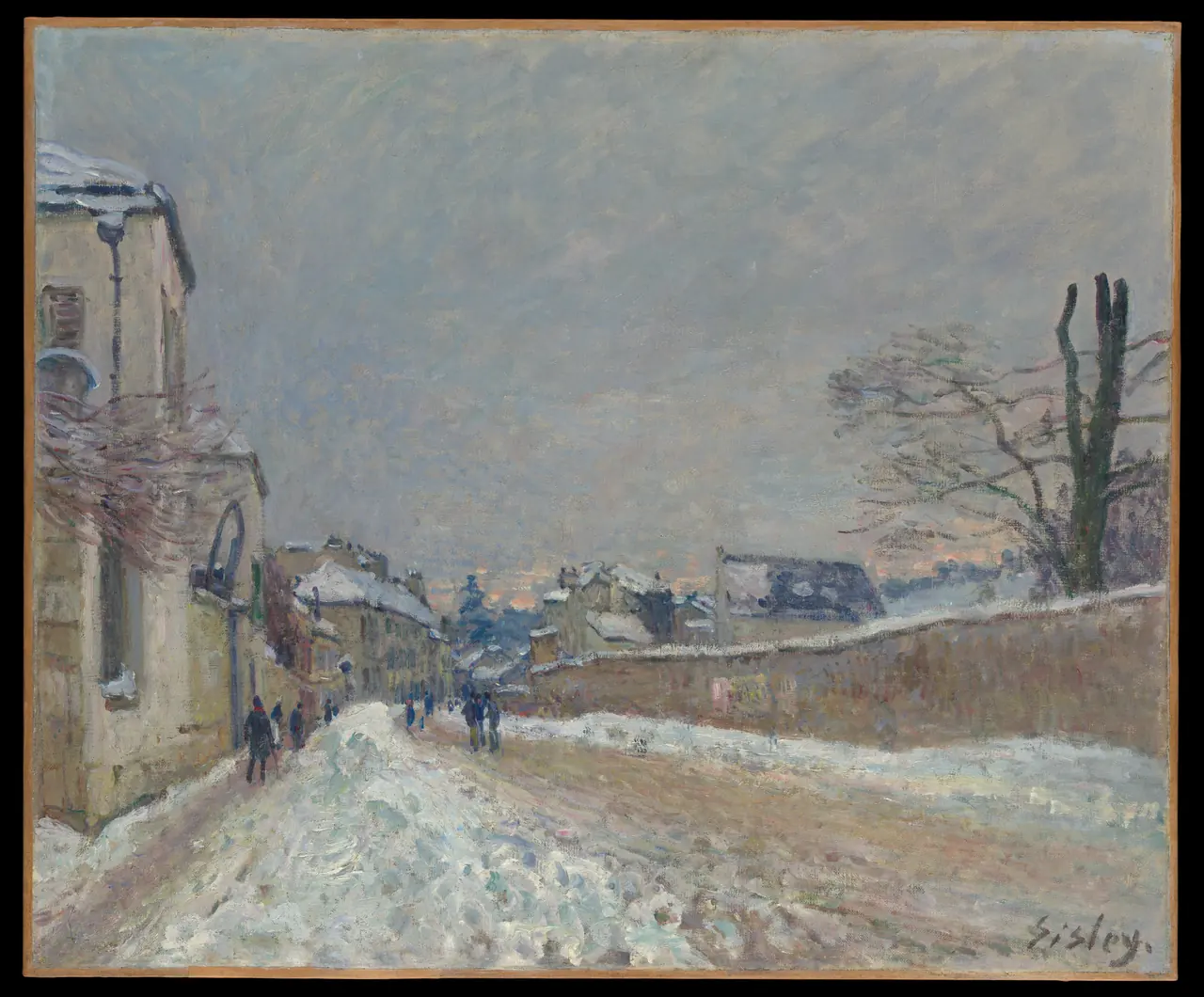
Sisley’s road is not an unbroken white carpet. Brown tracks run between irregular pale banks, and small pink and blue notes interrupt the greys. The buildings and wall funnel us towards the walkers. Above them, the sky occupies an unexpectedly large area, making the street feel exposed beneath it.
Pissarro’s avenue is densely active instead. Bare branches spread across repeated windows; carriages establish a procession down the centre. The roadway is not buried under the bright snow we see in Hiroshige. Calling it a winter picture does not require pretending otherwise: season also appears through light, leafless trees and the painting’s documented subject.
Their different viewpoints matter as much as their weather. Sisley invites an imagined walk along the road; Pissarro offers the observation of many simultaneous journeys. Neither should stand for an entire artistic movement. The Sisley and Pissarro guides offer other settings against which to compare these choices.
Post: a photographer arranges the distance
William B. Post’s Untitled (Winter Landscape), about 1900, is a platinum print, not a monochrome painting. The Cleveland Museum of Art connects his winter photography with the landscape around his home in Fryeburg, Maine; the title itself does not name this particular site.
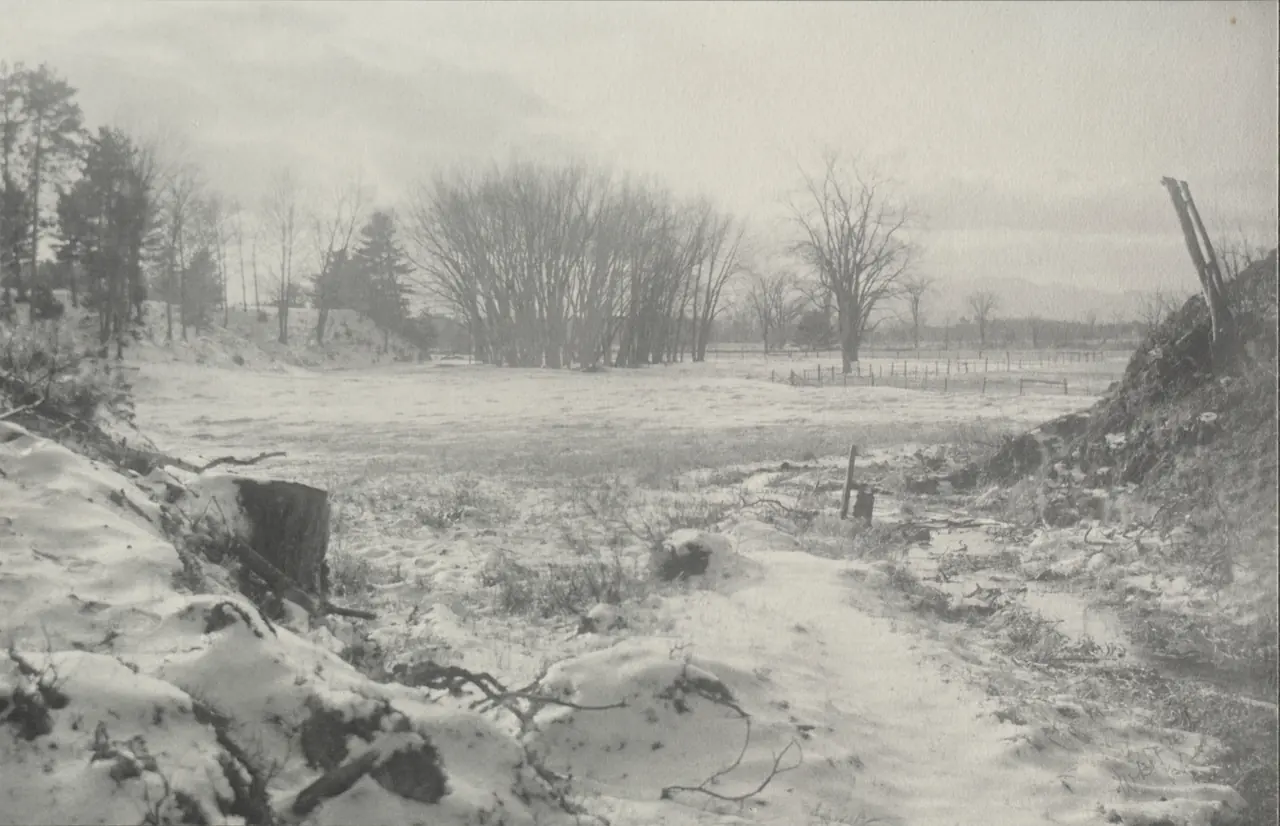
The rough foreground banks open onto a flatter field. Fences and trees then divide the distance into successive layers. Unlike Bruegel’s valley, it contains no conspicuous human gathering, but the fence lines still register an inhabited landscape.
Softness is part of this particular photographic image, not a reason to imagine a sharper hidden painting underneath it. Notice how a dark clump of trees can remain visually strong without every branch becoming equally clear. The photograph makes a useful interruption in this sequence: composing a winter landscape was not an activity restricted to painters and print designers.
Klee: winter becomes an imagined performance
Paul Klee’s Carnival in the Snow, 1923, abandons the expectation of a recognisable snowy location. The Cleveland record identifies acrobats and jugglers emerging from geometric forms. Two of them share parts of a body: ordinary anatomy is not the rule organising this performance.
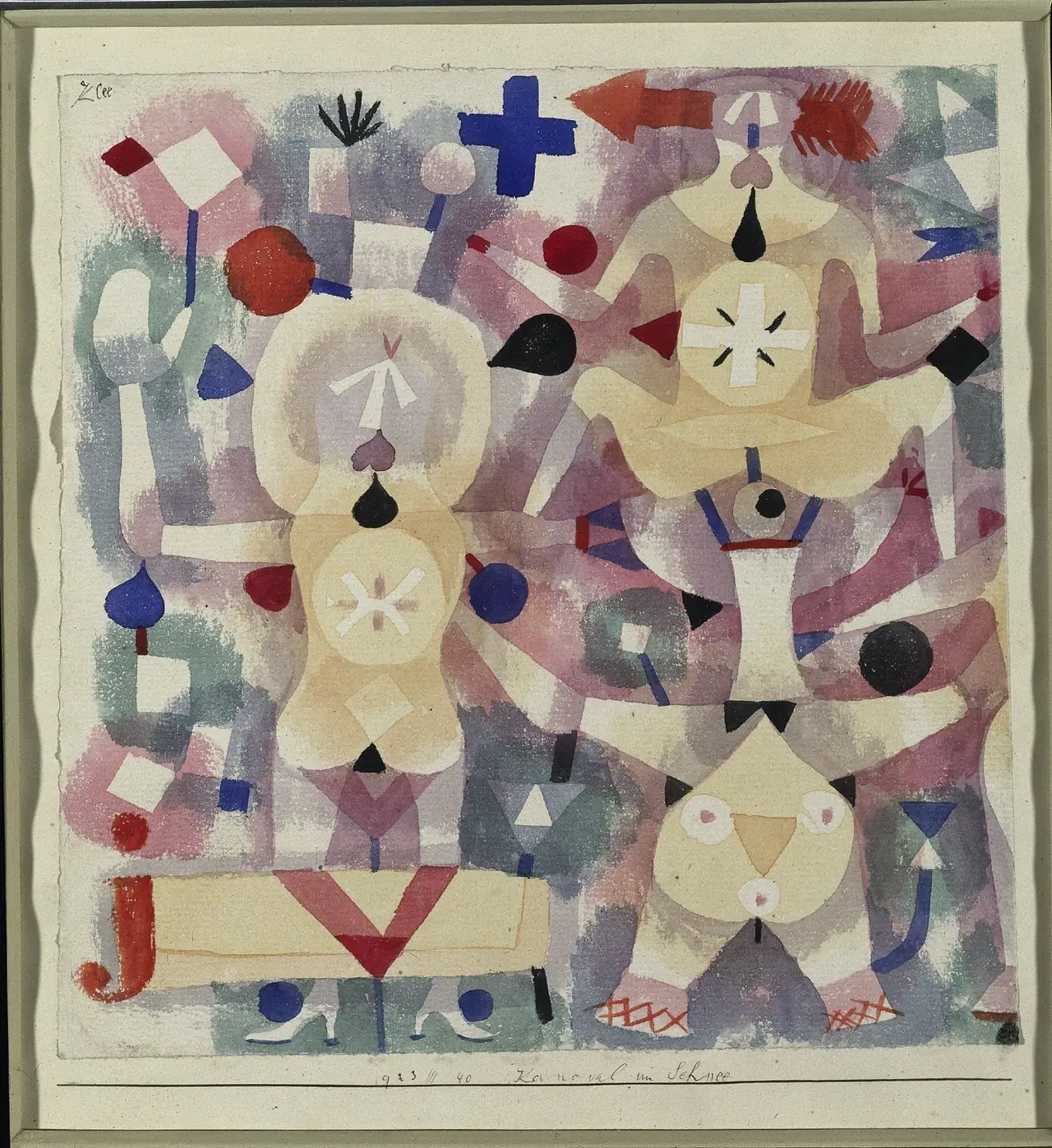
Pale bodies and small white marks sit among pinks, blues and reds. The title encourages us to connect them with snow, but there is no need to identify every shape as a piece of winter scenery. A cross can remain a cross; an arrow can lead the eye without describing a road.
After the previous landscapes, the change is striking. Winter can name an imagined situation as well as observed weather. That does not make Klee’s work the inevitable destination of everything before it. It adds another possibility to the subject, explored further in the Klee guide.
Look for what winter changes
Return to one picture and temporarily ignore its title. Follow the route into the scene, then look for the smallest sign of human activity. Compare a pale area with its immediate neighbours: snow may be defined by blue water, dark clothing, muddy tracks or almost bare paper.
These works reward comparison because they do not agree on what winter should look like. If you want to continue browsing by artist, our collection directory provides existing routes; it is not a claim that every work illustrated here is for sale. The art-history question remains the same: what did this artist choose to make the season do?
Editorial record
About this article
- Author
- Publisher
- GeMarkt
- Published
- Reviewed
- Internal source & rights check. Conducted by GeMarkt Research Review. This is an internal editorial check—not independent peer review.
- Source standard
- Art history source standardPrioritises object records and research sources, distinguishes evidence from interpretation, and states material uncertainty.
Found a claim that needs checking? Report a factual error.