GeMarkt Blog · Practical guide
Is Pieter Bruegel the Elder’s Art Public Domain? Work and Image Checks
Three illustrated Bruegel examples with historical publication evidence and Met CC0 files, plus nine research references with clearly stated limits.
Rights check · reviewed
The short answer
Bruegel’s own paintings and designs are beyond the ordinary EU author-life-plus-70 term. Historical publication evidence supports a U.S. public-domain finding for The Harvesters and the two named first-state engravings illustrated here; their selected Met images are Public Domain / CC0. The other nine research examples remain unassessed for U.S. publication and exact-file reuse.
| What is being checked | Result | Why |
|---|---|---|
| European Union — Bruegel’s own contribution | Ordinary author term expired | The Met records Bruegel’s death in 1569, centuries beyond the ordinary life-plus-70 term. This concerns his own historic expression, not an unidentified copyist, new creative changes, a separate first-publication right, moral rights or image-file conditions. |
| United States — three depicted compositions | Publication evidence before 1931 | The Harvesters appears as a complete reproduction in the Met Bulletin of May 1921: published by then, not necessarily first published then. NGA records the matching first states of Big Fish Eat Little Fish and Prudence as published in 1557 and 1559. The finding concerns those compositions and states, not every impression or other work. |
| United States — individual works | Publication history not independently closed | The other nine Bruegel research examples remain unresolved for U.S. publication history; none inherits the three depicted compositions’ result. Making, exhibition and acquisition dates are not publication evidence. Section 303 can preserve qualifying previously unpublished works first published in 1978–2002 through 2047; unresolved does not mean current copyright has been demonstrated. |
| Selected Met feature image | Provider designates Public Domain / CC0 | The exact object record, API image URL and local master are identified for this feature. The Met’s affirmative file designation is retained as the provider’s position; it is not an independently reconstructed U.S. publication history or a licence for another museum’s image. |
| Other files, editions and later contributions | Check the particular source | The ordinary author-term finding does not clear modern photographs, restoration films, critical editions, later creative contributions or every download. UK and Türkiye rules are outside this bounded EU/U.S. guide; no all-country clearance is asserted. |
This is a bounded guide to three documented compositions, not an approved twelve-image commercial-reuse collection. The linked twelve-record research set is not wholly cleared. Bruegel’s sons, print engravers, publishers and later makers are not interchangeable with the artist; a print’s issue date does not establish every surviving sheet’s printing date.
This is a documented research summary, not legal advice. Copyright and moral-rights rules can vary by country and by the history of a particular work.

What we’ll look at
Which work is this, and what evidence supports reuse of this particular image?
Short answer: Yes for Bruegel’s ordinary EU copyright term, and there are documented public-domain image sources for the three illustrated examples here. Bruegel died in 1569. For U.S. use, this guide also identifies historical publication evidence for those three works—not for his entire catalogue. Check the particular work, country and digital file before extending that answer to another picture.
Pieter Bruegel the Elder painted crowded villages, landscapes and religious stories in the sixteenth-century Low Countries. People skate, dance, eat and work. A biblical event can be easy to miss among the ordinary activity: his pictures reward looking slowly.
Pieter Brueghel the Younger and Jan Brueghel the Elder were his sons, not alternative names. Bruegel also designed images for other people to engrave and publish. The Met’s Bruegel essay introduces this wider practice.
What “public domain” settles—and what it does not
Under the EU’s ordinary life-plus-70 rule, the named artist’s economic copyright is no obstacle here. A museum’s ownership of a panel is not ownership of an everlasting copyright in its composition.
For the United States, do not turn a painting’s date into a publication date. Title 17, section 303 includes special treatment of certain formerly unpublished old works. Below, an actual museum reproduction and issued-print records supply evidence for three specific compositions. They are not a first-publication chain for every Bruegel painting. The modern Met files have a separate Open Access statement.
There is also a separate practical question: what file are you downloading? A faithful painting image, an installation photograph, a book page with modern writing and an artist’s new interpretation are different things. Keep the source’s terms with the chosen file. This is general information, not clearance for a particular project.
Three illustrated examples with an identified open file
The Harvesters, 1565
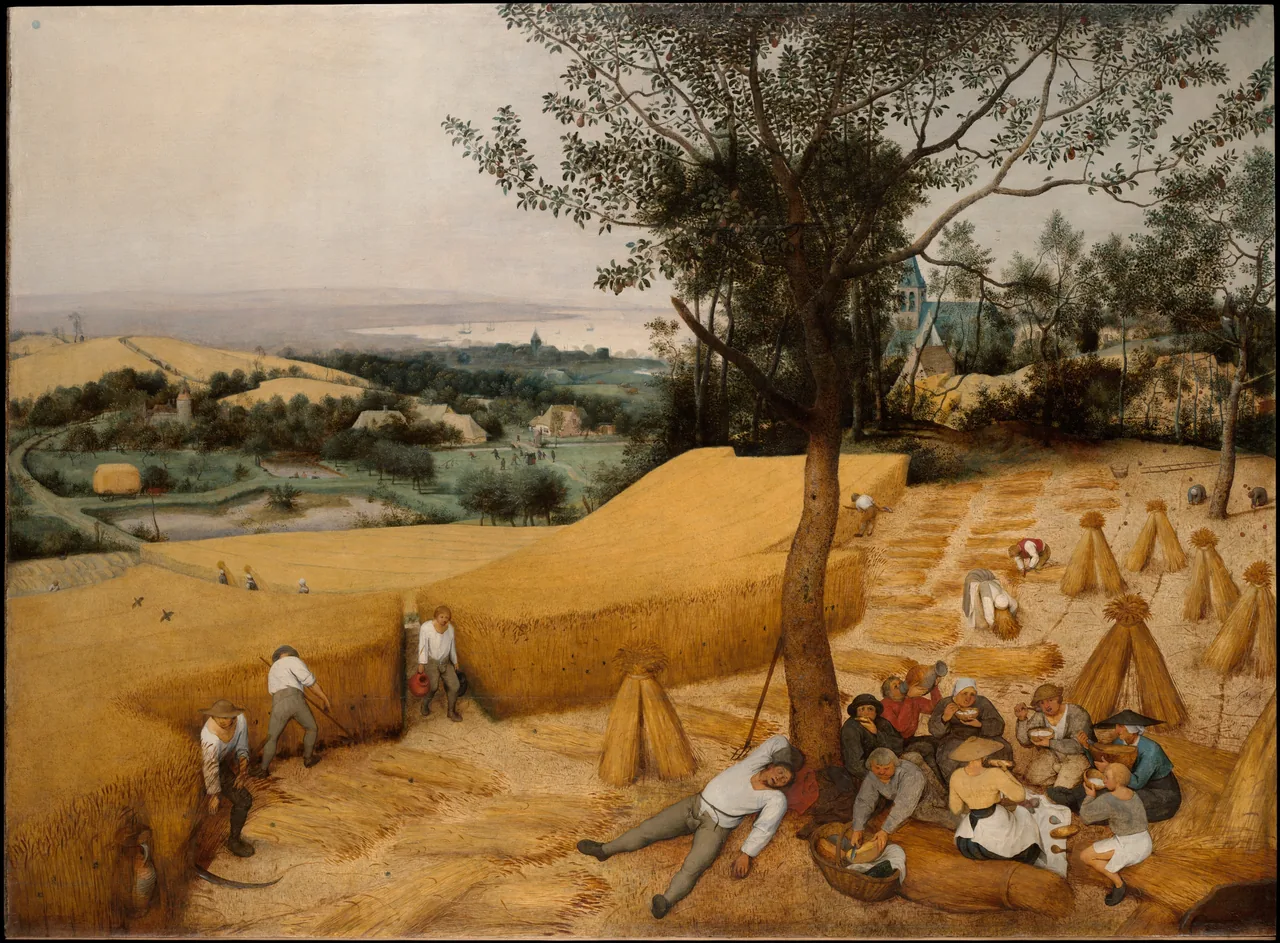
Pieter Bruegel the Elder, The Harvesters, 1565. The Metropolitan Museum of Art, Rogers Fund, 1919, 19.164. Object and image source; Met Open Access / CC0.
Workers rest and eat beneath a tree while others cut and carry grain. Follow the field towards the distant water: this is a whole working landscape, not just a group having lunch. The Met’s painting offers a summer counterpoint to Hunters in the Snow.
A black-and-white reproduction of the full painting appeared in the Met’s bulletin in May 1921. The scanned plate accompanies Bryson Burroughs’s article, pages 96–103. This establishes reproduction by 1921, not a claim that its first publication happened then. The current colour file shown here is separately designated public domain by the Met.
Big Fish Eat Little Fish, 1557
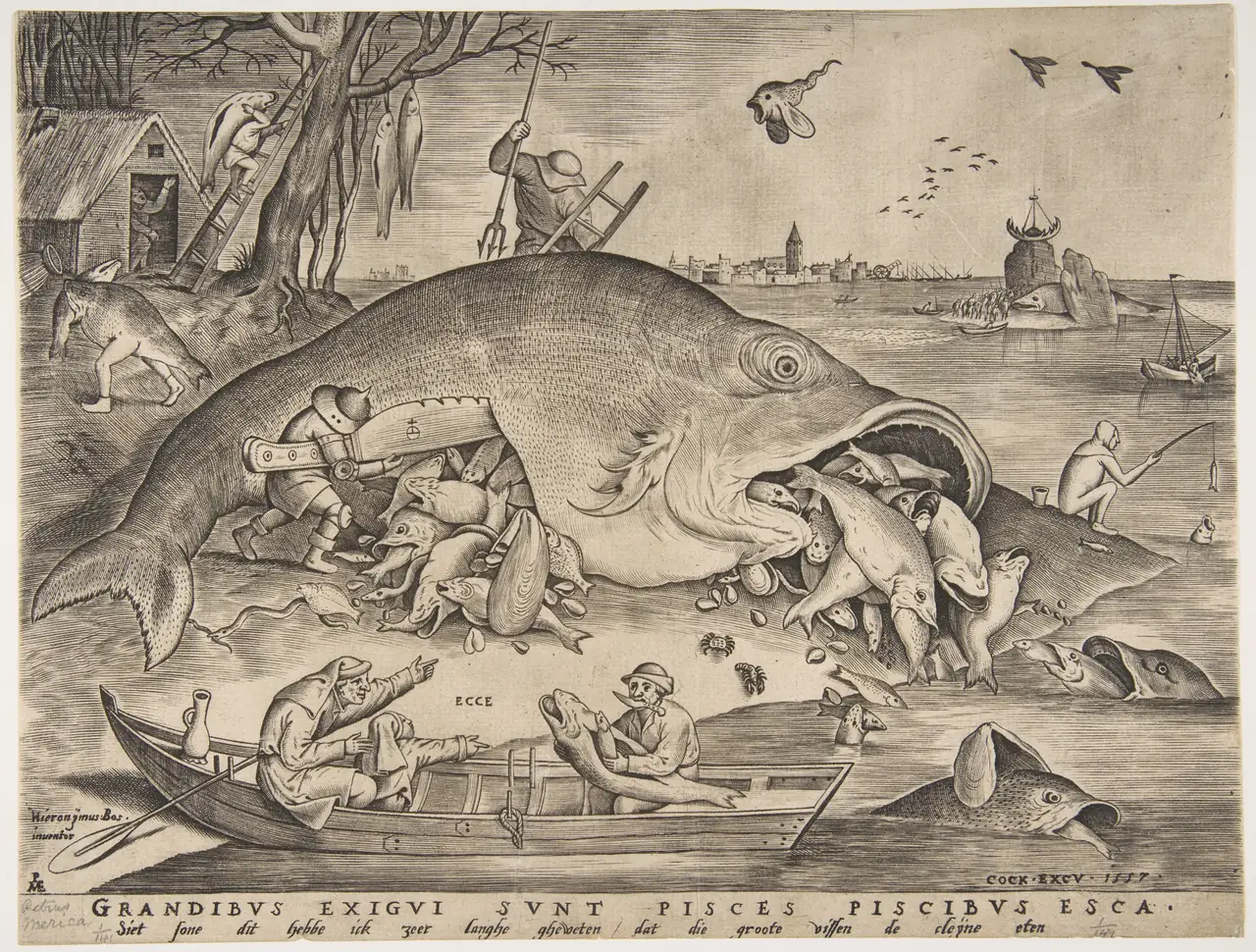
Pieter van der Heyden, after Pieter Bruegel the Elder; published by Hieronymus Cock, Big Fish Eat Little Fish, 1557. The Metropolitan Museum of Art, Harris Brisbane Dick Fund, 1917, 17.3.859. Object and image source; Met Open Access / CC0.
The proverb becomes a crowded scene of creatures consuming one another. A man cuts open the great fish’s belly, revealing more fish inside. Bruegel designed the composition; Pieter van der Heyden engraved it. The inscription invokes Bosch, but it does not turn this sheet into a drawing by Bosch.
The Met identifies its impression as the first state of four. Washington’s record of the same first state explicitly gives publication in 1557, with Cock as publisher. This is evidence about the issued composition and state, not proof of the exact day the Met’s individual sheet was printed.
Prudence, about 1559–60
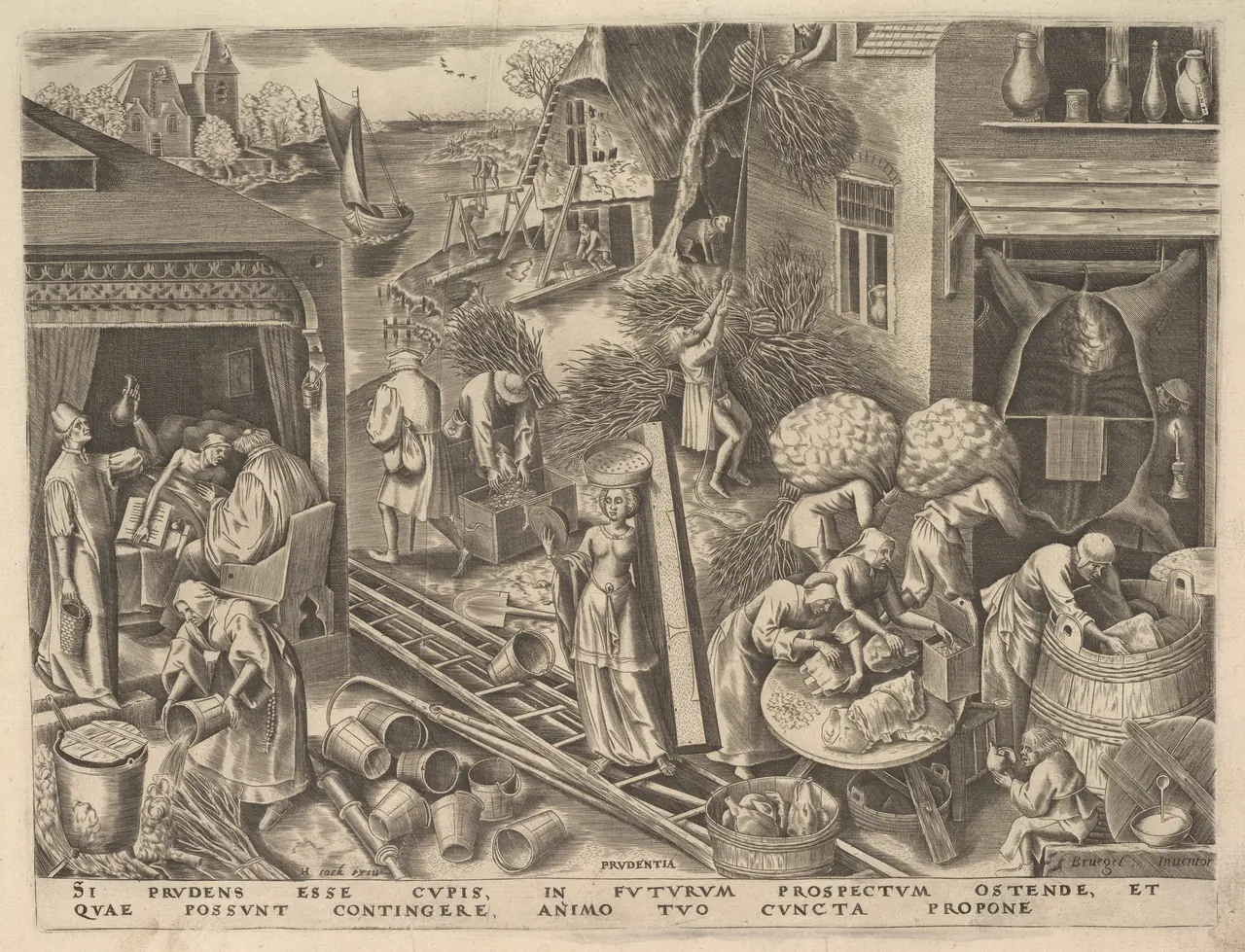
Philips Galle, after Pieter Bruegel the Elder; published by Hieronymus Cock, Prudence, from The Virtues, about 1559–60. The Metropolitan Museum of Art, Harris Brisbane Dick Fund, 1928, 28.4(26). Object and image source; Met Open Access / CC0.
Here a virtue takes shape through objects and practical activities. Start with the central figure, then look at people preparing and storing things around her. The scene rewards the same close attention as Bruegel’s crowded village paintings, but the artwork is an engraving by Philips Galle after his design.
The Met dates its first-state impression about 1559–60. Washington’s matching first-state record gives publication in 1559. Keep both descriptions: the published engraving and an individual surviving impression need not have identical date fields.
Nine further works: research links, not cleared downloads
The following records help identify other important Bruegel pictures. This guide has not completed their individual U.S. publication checks or selected unrestricted image files. Their inclusion is not a download licence.
The Tower of Babel, 1563
In the Vienna painting, a gigantic unfinished tower rises beside a busy port. The contrast makes the building’s scale immediately understandable. This is the Kunsthistorisches Museum’s panel, not another version of the subject. Its website’s image conditions must be checked separately; an old painting is not a blanket commercial-download permission.
Hunters in the Snow, 1565
Hunters and dogs return above a frozen village in this winter scene. Small people on the ponds are as important to the picture’s rhythm as the dark foreground figures. It belongs to Bruegel’s seasonal paintings. A crop of the hunters can lose much of that relationship with the valley below.
The Peasant Wedding, late 1560s
The wedding feast takes place indoors: guests sit along a table while servers bring food into the room. It is not a generic picture of outdoor dancing. Keep the museum’s title and the particular panel attached to the image. Museum publications vary in their dating within the late 1560s; unnecessary precision adds little here.
Children’s Games, 1560
Children fill a street and square with separate games. Start with one group and follow the activity across the panel. A detailed file matters: shrinking the scene can turn its small actions into indistinct marks.
The Peasant Dance, about 1568
KHM’s outdoor dance brings large figures close to the viewer. The painting is a different object from both the indoor Peasant Wedding and Detroit’s Wedding Dance. Similar English titles are a reason to check the holding museum and inventory number, not to combine their image permissions.
Christ Carrying the Cross, 1564
In this large panel, Christ is a small figure within a sprawling procession. The scene looks different when you notice how much attention the surrounding crowd receives. A selected detail should be labelled as a detail, so readers do not mistake a fraction of the procession for the full composition.
The Triumph of Death, 1562–63
An army of skeletons overwhelms the living in the Prado’s painting. Its subject is mortality, not a securely identified snapshot of one epidemic. The Prado also documents its restoration. Images made before and after treatment can differ; identify the source and version rather than silently mixing them.
The Adoration of the Kings, 1564
The National Gallery’s panel brings the biblical visitors into a tightly crowded scene. It is not the similarly titled work by Jan Brueghel in the same museum. London’s gallery applies different licences to images and collection data; its image is not interchangeable with a Met Open Access file.
The Wedding Dance, 1566
Detroit’s painting shows an outdoor gathering of dancers. Compare it with Vienna’s Peasant Dance as a separate work, not a differently coloured scan of one picture. This guide has not established an unrestricted licence for the Detroit image. An accessible object page is evidence about the painting, not permission to download any file from it.
The simplest reliable download route
For an initial Bruegel image project, the three illustrated examples have an advantage: identifiable historical publication evidence and specific Met files under its Open Access programme. Save the object record, image identifier and source statement together. Check the downloaded image against the record before using it.
For the other works, establish the actual file’s terms instead of borrowing a licence from a different painting. In particular, the National Gallery in London’s licensing page distinguishes its images from its open collection data. Museum conditions and the legal copyright status of a faithful reproduction are separate questions; neither should be misreported as the other.
“Every Bruegel picture online is free” is not a dependable conclusion. Name the work, the country and the file.
Sources and review method
We checked the artist chronology against museum records, treated each named jurisdiction separately, and recorded the provider policy for the image set. These sources support the legal framework and artist dates used above; the source file for any individual image still needs its own record.
- The Harvesters, 19.164 — The Metropolitan Museum of Art. Exact 1565 painting, artist life dates, current attribution and Public Domain image designation for the feature.
- The Harvesters — public collection API, object 435809 — The Metropolitan Museum of Art. Binds accession 19.164 and isPublicDomain: true to the exact DP119115.jpg source asset preserved in the acquisition manifest.
- Big Fish Eat Little Fish, 17.3.859 — The Metropolitan Museum of Art. Pieter van der Heyden’s engraving after Bruegel, published by Hieronymus Cock; the Bosch inscription is not an autograph Bosch attribution.
- Prudence (Prudentia), from The Virtues, 28.4(26) — The Metropolitan Museum of Art. Philips Galle’s engraving after Bruegel; preserves designer, engraver, publisher and impression distinctions.
- The Harvesters by Pieter Bruegel the Elder, Met Bulletin 16(5), May 1921, pp. 96–103 — The Metropolitan Museum of Art; Internet Archive digitised copy. The inspected plate opposite page 96 reproduces the full painting in monochrome. It establishes reproduction by May 1921, not a first-publication date or the source of the modern colour file.
- The Big Fish Eat the Little Fish, 1980.45.222 — National Gallery of Art, Washington. Published 1557, New Hollstein 31, state i/iv: matches the Met’s first state of four. Dates the issued composition and state, not every surviving impression.
- Prudence, 1980.45.232 — National Gallery of Art, Washington. Published 1559, New Hollstein 313, state i/ii: matches the Met’s first state of two. The Met’s about 1559–60 object date remains separately qualified.
- Circular 15A: Duration of Copyright — U.S. Copyright Office. Maximum terms for older published works; connects the documented historical reproductions and print issues to the bounded U.S. term conclusion.
- Directive 2006/116/EC, Articles 1, 4, 8 and 9 — EUR-Lex. Ordinary author-life-plus-70 term and calendar calculation; first-publication rights and national moral rights remain separate.
- 17 U.S.C. Chapter 3, including section 303 — U.S. Copyright Office. Separate rules for older published and formerly unpublished works; a qualifying first publication in 1978–2002 can preserve protection through 2047.
- Open Access at The Met — The Metropolitan Museum of Art. CC0 reuse of the public-domain images designated by the museum, not permission for every image on its website or another provider’s file.
- CC0 1.0 Universal — Creative Commons. Terms of the CC0 dedication used for the selected Met images; third-party rights and implied endorsement remain separate questions.
Editorial record
About this article
- Author
- Publisher
- GeMarkt
- Published
- Reviewed
- Internal source & rights check. Conducted by GeMarkt Research Review. This is an internal editorial check—not independent peer review.
- Source standard
- Rights guide source standardSeparates the underlying work from the source file, records the review date, and links the evidence used for the conclusion.
Found a claim that needs checking? Report a factual error.