GeMarkt Blog · Practical guide
Is Paul Klee’s Art Public Domain? Start with the Exact Work
Explore Klee through two museum-supplied CC0 images, then separate the artist’s copyright term, U.S. publication history and the exact file you want to use.
Rights check · reviewed
The short answer
Cleveland supplies the exact Carnival in the Snow and With the Dot images under CC0. Klee’s ordinary EU/UK author term has elapsed, but this guide does not independently establish the works’ U.S. publication histories or clear every Klee work and reproduction.
| What is being checked | Result | Why |
|---|---|---|
| European Union — ordinary author term | Ordinary named-artist term has elapsed | Klee died in 1940. The ordinary life-plus-70 author term has elapsed; national exceptions, moral rights, other contributors and later first-publication rights remain separate. |
| United Kingdom — ordinary artistic-work term | Ordinary artist term has elapsed | The ordinary artistic-work term has elapsed. Specific unpublished-material exceptions, another contributor’s work and later reproductions must not be silently cleared. |
| United States — independent publication history | Publication evidence remains work-specific | This guide does not independently establish U.S. publication histories for its displayed works or other research objects. Artist death, creation date and an institutional file designation do not replace that chain. Provider statements are explicitly attributed. |
| Selected digital files | Two exact institutional CC0 files | Cleveland 1969.46, Carnival in the Snow (1923), and 1961.50, With the Dot (1916), have preserved exact API records and supplied print JPEGs designated CC0. Full boundaries are retained, including the Carnival photograph’s frame and the drawing’s mount; no redraw or recolouring. |
| Other works, editions and files | Ten research references remain display HOLDs | HOLD means no approved local display file in this guide, not necessarily that the historical work is protected. The twelve-record matrix is not twelve permissions. No worldwide or whole-catalogue clearance. |
Twelve exact research objects; two displayed Cleveland CC0 files and ten display HOLDs. Cleveland explicitly marks two unacquired examples Copyrighted, while Chicago does not flag its four research files as public domain. Neither a late nor an early creation date settles the whole question.
This is a documented research summary, not legal advice. Copyright and moral-rights rules can vary by country and by the history of a particular work.

What we’ll look at
Which Klee work and which image file are you trying to use?
Short answer: Check the particular Klee work, country and image. His ordinary EU and UK author term has elapsed, but his death in 1940 is not a blanket U.S. clearance. The Cleveland Museum of Art supplies the two images shown here under CC0. This guide does not independently establish U.S. publication histories for those works or the other examples below.
That leaves plenty to look at. Klee could make a face out of a few lines, turn a town into a pattern, or give a small drawing an unexpectedly disturbing charge. Understanding what the object actually is helps both your looking and your rights research.
A colourful name is not enough
Klee was born near Bern in 1879 and developed his career across Switzerland and Germany. He exhibited in the second Blue Rider exhibition in 1912, travelled to Tunisia with August Macke and Louis Moilliet in 1914, and taught at the Bauhaus from 1921 to 1931. Under Nazi pressure, he lost his Düsseldorf teaching position and returned to Bern in 1933. These dates come from the Zentrum Paul Klee’s biography, not from the often simplified idea of Klee as a maker of cheerful abstract posters.
His works move between drawing, painting and print. A title alone rarely tells you which. Carnival in the Snow is a watercolour; Tightrope Walker is a colour lithograph; With the Dot is a pen-and-ink drawing. A modern print of the watercolour is a reproduction, while a historical lithograph is itself an original printed artwork. Those are different objects with different file histories.
A circus built from shapes
The opening image, Carnival in the Snow, dates to 1923. Its painted sheet measures only 24 by 23.5 centimetres. Cleveland identifies circus performers in the overlapping shapes, including two jugglers sharing a face and torso. That description gives you a way into a scene that first looks like a shower of coloured signs.
Start at the bottom rather than trying to decode everything at once. Little blue feet anchor a long horizontal form. Above it, pale bodies bend and turn; black teardrops, blue crosses and red arrows interrupt the soft background. Follow an arm and it can become another figure’s boundary. The pleasure is in switching between a recognisable performer and a flat shape.
The small scale matters. This is not a monumental stage set painted with sharply ruled outlines. Its washes, uneven paper edge and handwritten title remain visible in the complete museum photograph. A crop that removes those margins produces a different encounter with the work. It can make the image look more like a seamless contemporary pattern than a particular watercolour on an artist’s mount.
For another circus subject, open Cleveland’s Tightrope Walker, also from 1923. The museum records a colour lithograph, catalogue number Kornfeld 95, state IVc. Its tiny performer occupies only part of a pink field crossed by delicate structures. Cleveland connects this subject with the tension and balance of making art. The state designation is useful: “Klee tightrope print” is not a precise enough description of an impression.
The drawing behind the playfulness
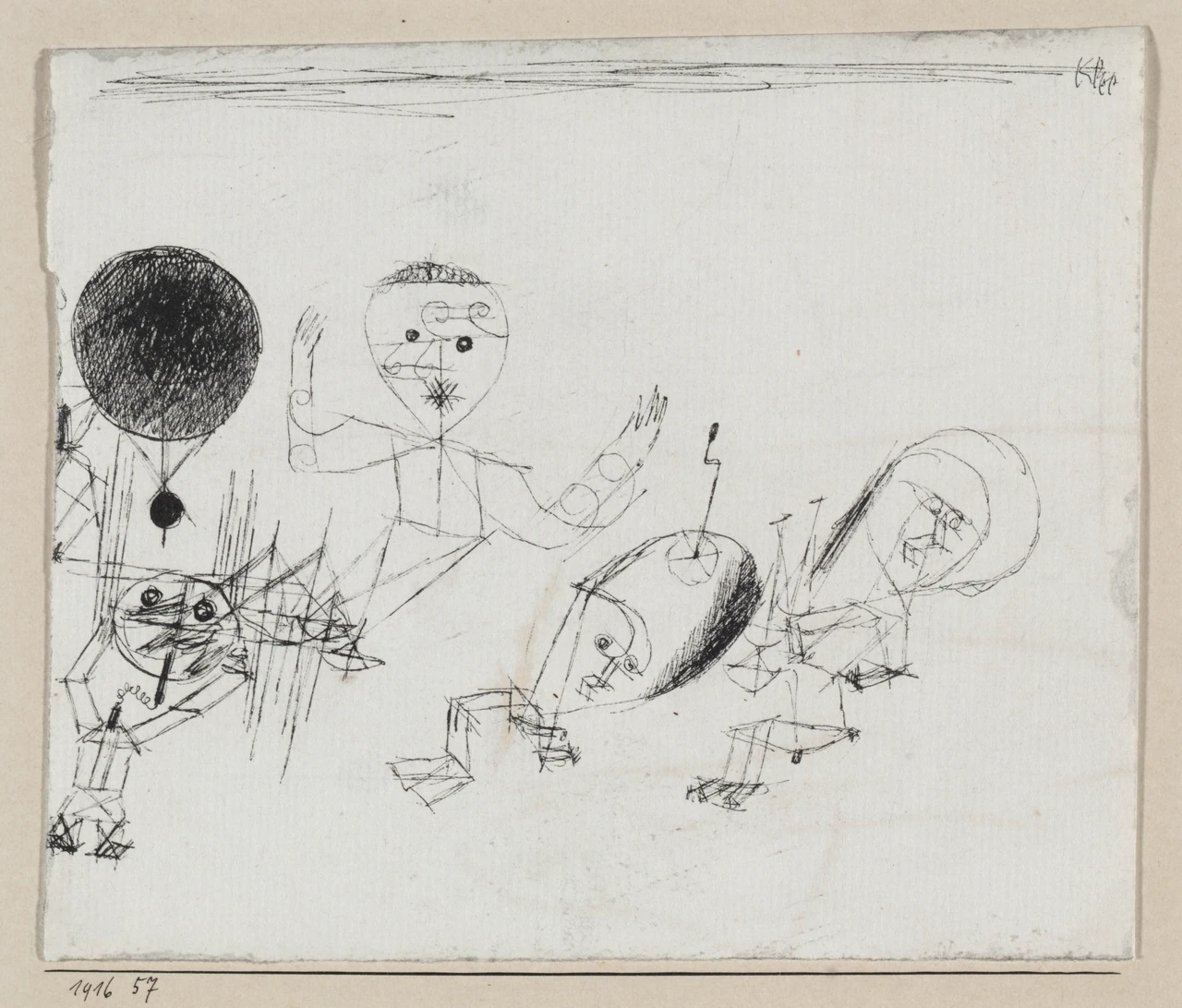
Paul Klee, With the Dot, 1916, pen and black ink. The Cleveland Museum of Art, Contemporary Collection, 1961.50. Exact object and CC0 source.
With the Dot interrupts any easy description of Klee as simply playful. Cleveland reads this wartime drawing as a scene containing a zeppelin, a fallen soldier and threatening or recoiling figures. It leaves the hovering figure’s character open: saintly or demonic. That uncertainty is worth keeping rather than replacing it with a confident invented story.
Look at how differently the ink behaves from the watercolour. The large black circle has weight; bodies below seem almost unable to hold together. A head tilts sideways without a convincing neck. Arms curl into loose springs. There is plenty of blank paper, but the figures do not feel comfortably spaced. A few fine lines can suggest vulnerability more forcefully than a fully modelled body.
The drawing itself measures just 12.4 by 14.5 centimetres. Its inscription and surrounding support belong to the supplied record, not to an empty area we have filled with a new background. A very large reproduction would amplify paper texture and tiny marks as much as it enlarged the figures.
Twelve works to explore
These links identify actual collection objects. Only Carnival in the Snow and With the Dot are illustrated here. The other ten are research references, not a bundle of approved image downloads.
| Work | Date | Exact collection record |
|---|---|---|
| Carnival in the Snow | 1923 | Cleveland 1969.46 |
| Tightrope Walker | 1923 | Cleveland 1961.154 |
| With the Dot | 1916 | Cleveland 1961.50 |
| God of War | 1937 | Cleveland 1992.278 |
| The Calculating Old Man | 1929 | Cleveland 1978.18 |
| Small World | 1914 | Cleveland 1984.227 |
| Ghost Rider Late in the Evening | 1929 | Cleveland 2007.195 |
| Was lauft er? | 1932 | Cleveland 1963.238 |
| Sunset | 1930 | Chicago 1981.13 |
| Dancing Girl | 1940 | Chicago 1959.172 |
| In the Magic Mirror | 1934 | Chicago 1991.321 |
| Two Men Meet, Each Believing the Other to be of Higher Rank | 1903 | Chicago 1970.236 |
The provider’s designations differ even within this list. Cleveland marks God of War CC0 but marks Ghost Rider and Was lauft er? “Copyrighted.” That is a reason to inspect the particular record, not to infer either that every work after 1930 is protected or that every older work is free.
What changes between countries
The ordinary EU author term and ordinary UK artistic-work term are life plus seventy years. Klee’s ordinary term has therefore elapsed. National exceptions, moral rights and rights belonging to other contributors still need their own consideration.
In the United States, the Copyright Office’s current duration guide places works published in the United States before January 1, 1931 in the public domain. Published is the important word: a 1930 painting date is not proof of a qualifying publication. Foreign works and formerly unpublished material may need additional analysis. Section 303 can preserve protection through 2047 for certain older works published by the end of 2002; it does not give every old painting that expiry date.
Choosing a file without changing the work
Use the museum’s own download alongside its title, accession and rights statement. Cleveland’s Open Access policy applies CC0 to designated files, not to every image you can find by searching the artist’s name. The two photographs here keep their original boundaries; we have resized them proportionally for the page, without repainting, recolouring or generating missing detail.
For unfamiliar editions or titles, the Zentrum Paul Klee’s research resources are a better next step than an anonymous “copyright-free” folder. Its archive preserves the artist’s handwritten catalogue, correspondence and teaching material, while the research database links works to publications. Finding a useful record there does not itself grant permission to reproduce a modern book or photograph.
A good Klee file should let you name what you are seeing, not merely recognise the style. Keep that identity and its evidence together. This guide is research information, not legal advice for a particular project.
Sources and review method
We checked the artist chronology against museum records, treated each named jurisdiction separately, and recorded the provider policy for the image set. These sources support the legal framework and artist dates used above; the source file for any individual image still needs its own record.
- Carnival in the Snow, 1969.46 — The Cleveland Museum of Art. 1923 watercolour, physical dimensions and mount, circus interpretation, exact CC0 image.
- With the Dot, 1961.50 — The Cleveland Museum of Art. 1916 wartime pen-and-ink drawing, small sheet and larger mount; interpretation qualified, exact CC0 image.
- Tightrope Walker, 1961.154 — The Cleveland Museum of Art. 1923 colour lithograph, Kornfeld 95 state IVc; print example linked, not displayed.
- Paul Klee biography — Zentrum Paul Klee. 1879–1940 life, 1912 Blue Rider exhibition, Tunisia, teaching and 1933 return to Bern.
- Archive and Research — Zentrum Paul Klee. Artist’s own catalogue, correspondence, teaching archive and publication-linked database; not a general image licence.
- Open Access — The Cleveland Museum of Art. CC0 applies to designated exact images; some object data remains accessible without image permission.
- Copyright in the EU — European Union, Your Europe. Ordinary life-plus-70 author term; no worldwide or national-exception clearance.
- How long copyright lasts — UK Intellectual Property Office. Ordinary artistic-work term, not all archival categories or later contributors.
- Circular 15A: Duration of Copyright, April 2026 revision — U.S. Copyright Office. Pre-January-1931 U.S. publication cutoff in 2026; publication is not creation or exhibition.
- 17 U.S.C. Chapter 3, including section 303 — U.S. Copyright Office. Older unpublished works have conditional rules, not an automatic 2047 term for every painting.
Editorial record
About this article
- Author
- Publisher
- GeMarkt
- Published
- Reviewed
- Internal source & rights check. Conducted by GeMarkt Research Review. This is an internal editorial check—not independent peer review.
- Source standard
- Rights guide source standardSeparates the underlying work from the source file, records the review date, and links the evidence used for the conclusion.
Found a claim that needs checking? Report a factual error.