GeMarkt Blog · Practical guide
Is Alfred Sisley Public Domain? Start with the Exact Image
Two documented Sisley print designs and three CC0 museum files show how to check publication, impressions and image rights without clearing every landscape.
Rights check · reviewed
The short answer
Sisley’s established work is beyond ordinary life-plus-70 economic copyright in the EU, UK and Türkiye. Two historic print designs have checked pre-1931 publication evidence, and Cleveland supplies three matching files under CC0. This does not clear every Sisley painting or drawing.
| What is being checked | Result | Why |
|---|---|---|
| European Union, United Kingdom & Türkiye | Ordinary term expired | Sisley died in 1899. This concerns his established work, not separate publication rights, new original contributions, moral rights or another provider’s image. |
| United States — two illustrated print designs | Pre-1931 publication documented | Delteil’s 1923 volume reproduces designs 5 and 6, matching Cleveland 1925.1054, 1956.648 and 1942.1053. An unchanged later printing does not restart the historic design’s term. |
| Other paintings, drawings, editions or files | Work-specific review remains | The wider twelve-record set is not cleared. A title, creation date, exhibition or accession alone does not settle U.S. publication; qualifying first publication in 1978–2002 can make §303 material. |
Three museum sheets represent two compositions, not three independently published designs. Delteil’s illustrated 1923 entries establish the historic designs; the printing dates of the individual Cleveland sheets remain open. The original twelve-record research set is not an approved reuse collection.
This is a documented research summary, not legal advice. Copyright and moral-rights rules can vary by country and by the history of a particular work.

What we’ll look at
Is a Sisley image reusable, and what connects its historic design to the exact museum file?
Yes: Alfred Sisley’s established work is beyond ordinary life-plus-70 copyright in the EU, UK and Türkiye. The United States needs a work-specific publication check, and the image you download needs its own terms.
That distinction produces a useful answer, not just a warning. The two print designs examined here have documented publication before 1931, and the Cleveland Museum of Art supplies three matching image files under CC0. Several paintings and drawings in the wider research set still have incomplete publication histories. They do not receive the same conclusion merely because Sisley signed them.
Begin with a riverbank, not a blanket permission
The geese make the foreground lively; beyond them, the river opens into a broad band of blue, with buildings gathered on the far bank. It is recognisably a landscape, but it is not a photograph of one of Sisley’s oil paintings. This is a colour lithograph: a particular printed design, held in a particular impression.
The distinction matters if you want a book illustration, website image or art print. A painting and a lithograph can share a place or an idea while remaining different works. Even matching printed compositions can arrive online through different museum photographs, scans or later alterations.
For this image, the record can be followed in both directions: back to a historic print catalogue and forward to the exact Cleveland download. That is the basis of the answer here.
Which countries does the answer cover?
Sisley died in 1899. The ordinary economic copyright term for an identified artist’s work has therefore expired in the life-plus-70 markets considered below. The relevant rules are the EU term directive, UK duration guidance and Article 27 of Türkiye’s Law No. 5846.
| Market | Conclusion for this guide | Important boundary |
|---|---|---|
| European Union | Sisley’s established works are beyond the ordinary life-plus-70 term. | First lawful publication or communication of a previously unpublished, out-of-copyright work can create a separate 25-year right. |
| United Kingdom | The ordinary artistic-work term has expired. | Unpublished material and publication rights need the applicable rule; the special 2039 provision is not a blanket extension for ordinary paintings and drawings. |
| Türkiye | The ordinary life-plus-70 economic-rights term has expired. | Attribution, integrity and other applicable rights are separate from the economic term. |
| United States | The two historic print designs discussed here have pre-1931 publication evidence. | Other paintings, drawings, states and adaptations need their own chronology. |
These are not worldwide conclusions, and they do not make a museum’s name or logo available for branding. Ownership of a physical object, access conditions, moral rights, contracts and newly created material can raise other questions. For a consequential commercial use, obtain advice about the actual object, file, country and use rather than relying on the artist’s death year alone.
The publication evidence for The River Bank or Geese
Loys Delteil’s Le peintre-graveur illustré, volume XVII, was published in Paris in 1923. Its Sisley entry 6 reproduces Bords de rivière ou Les Oies and identifies it as a colour lithograph published in an album issued by Ambroise Vollard. The entry records 100 impressions apart from trial proofs. The Getty Research Institute’s digitised copy provides the historic evidence; Cleveland catalogues its sheet as Delteil 6, state I/I.
The National Gallery of Art’s separate impression also identifies Delteil 6 and the Vollard album, and credits Auguste Clot as printer. That second museum is useful corroboration, but its accession and file must not be substituted for Cleveland’s. Nor does its printer credit prove an inscription or numbered edition on the Cleveland sheet.
The important U.S. fact is that the historic design was published, not simply painted, before the current cutoff. Applying the maximum 95-year term described by the Copyright Office, works published before 1931 are beyond that term in 2026. The album history and the inspected 1923 reproduction support the conclusion for this design.
The precise printing date of Cleveland’s individual sheet has not been established here. That is a limit on its object history, not a reason to restart copyright in an unchanged published design. A later recut or creative adaptation would need a separate assessment.
Two Loing sheets, one documented composition
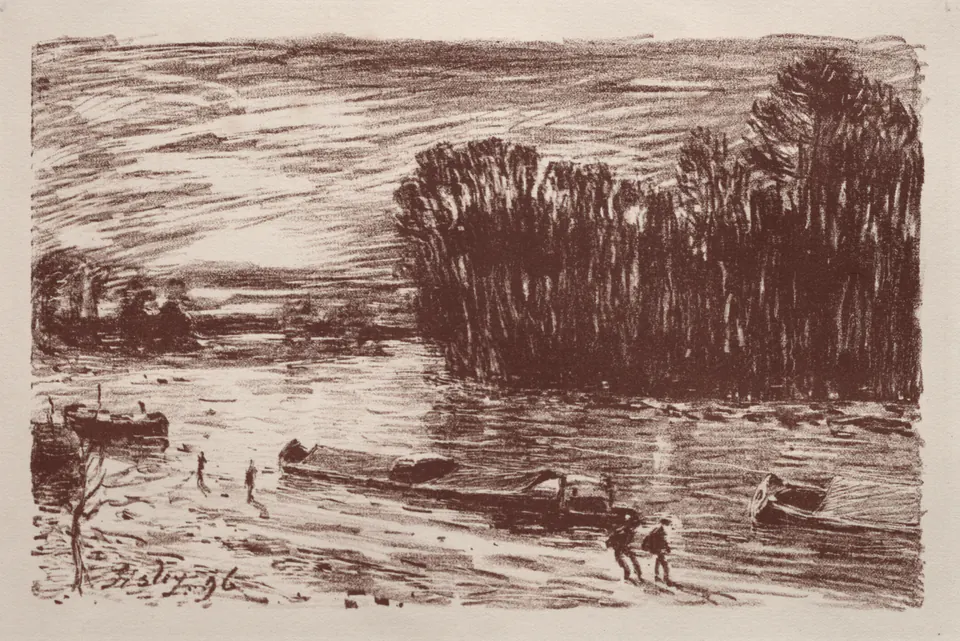
Alfred Sisley, On the Banks of the Loing, 1896, lithograph. Cleveland Museum of Art, 1925.1054, Dudley P. Allen Fund. Museum image: CC0. Object record.
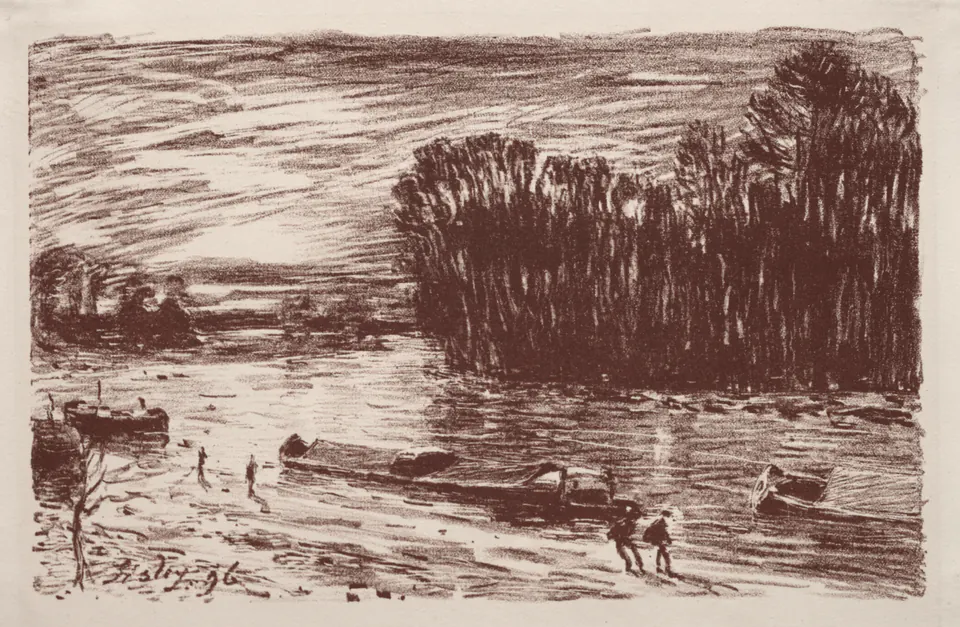
Alfred Sisley, Bords du Loing, près Saint-Mammès, 1896, lithograph. Cleveland Museum of Art, 1956.648, Mr. and Mrs. Lewis B. Williams Collection. Museum image: CC0. Object record.
These two titles can look like separate discoveries in an image search. The museum records identify both as Delteil 5. Their boats, figures, riverbank and trees repeat the same composition, even though the paper, tonal appearance and photographed sheet boundaries differ.
Delteil’s 1923 entry 5 reproduces that design and records an earlier reproduction in Théodore Duret’s Histoire des Peintres Impressionnistes, published in 1906. The 1923 page was visually compared with both Cleveland files for this guide; the 1906 plate was not independently inspected. The verified 1923 reproduction is already before the U.S. cutoff.
There is no need to pretend that both museum sheets have been traced to the same original book or issue. Their exact printing dates remain open, while the published underlying composition is documented. Equally, two museum accession numbers do not turn one design into two separate historical publication events.
Why some Sisley paintings still need another check
The research behind this guide considered twelve exact museum records. It did not establish an unqualified U.S. reuse result for all twelve.
Take Street in Moret, AIC accession 1922.441. A 1923 Art Institute handbook identifies the Palmer Collection painting as Village Street in Moret, with matching dimensions. A later catalogue points to earlier exhibitions and a 1933 reproduced illustration. Those are useful facts, but a textual listing is not the same as a checked reproduction of the painting, and a museum acquisition date is not automatically its publication date.
For A Corner of Moret-sur-Loing, AIC accession 1977.774, the available record includes later twentieth-century catalogue references and an explicitly illustrated 1987 entry. That does not prove the work was first published in 1987. It does mean the earlier history cannot be filled in from the 1895 date written beside the artwork.
The distinction is legal as well as historical. U.S. section 101 distinguishes publication from public display. Section 303 also gives qualifying old, previously unpublished works a possible term through 2047 when first published between 1978 and 2002. An empty museum history field proves neither publication nor non-publication.
This is why an exhibition, auction reference, private sale, printed illustration and modern image upload should be recorded as different events. Some may establish the missing link; none should be silently renamed to make a rights answer easier.
What Cleveland’s CC0 label lets you do
The Cleveland Museum of Art’s Open Access policy makes its eligible images available under CC0, including for commercial reuse. Each of the three selected records currently carries that designation, and each exact high-resolution JPEG was accessible when checked on 3 October 2026.
Use the museum’s actual file, not a screenshot of an image-search result. Keep the accession number, source URL and rights statement with your working copy. Cleveland’s policy does not require attribution for CC0 images, but an informative credit helps the next reader identify the work and distinguish it from a painting, another impression or a later adaptation. A credit also must not suggest that the museum endorses your project.
If you crop, recolour, remove marks or combine the image with other material, document the change. Those decisions can affect the accuracy of a reproduction even where copyright permission is not the obstacle. A modern restoration or photograph obtained from someone else is a new file check, not an automatic extension of Cleveland’s terms.
Before you use a Sisley image
Start with the title, medium, institution and accession number. For a print, add its catalogue number and any recorded state or edition. Then separate three questions: whether the historic work is outside the applicable copyright term, whether the version shown contains different creative material, and whether the particular file is available on usable terms.
For the three Cleveland files above, the documented print designs and the institution’s CC0 statements provide that chain within this guide’s scope. For another Sisley painting or drawing, return to its own record. Do not copy this conclusion into a product description merely because the image has the same artist’s name.
For more context, read GeMarkt’s Impressionism chapter or the Pissarro public-domain guide. How to cite art and images explains how to keep the artwork, edition and digital file visible in a useful caption.
Source and image notes
Research checked 3 October 2026. This is general research information, not legal advice or a worldwide clearance certificate.
- The principal historic source is Delteil, volume XVII (1923), Getty copy: title page at PDF page 11; Sisley entries 5 and 6 at PDF pages 253–254. The relevant pages and their reproductions were inspected, rather than relying only on OCR.
- Current object/file identities were checked through Cleveland’s official API for 1942.1053, 1925.1054 and 1956.648.
- The Moret comparison uses the 1923 AIC Handbook, printed page 69, entry 848, and the 1933 AIC exhibition catalogue, entry 303. Neither is presented as an inspected pre-1931 illustration of that painting.
- The drawing limitation follows AIC’s exact record for 1977.774. No unverified source image of that drawing is included here.
Sources and review method
We checked the artist chronology against museum records, treated each named jurisdiction separately, and recorded the provider policy for the image set. These sources support the legal framework and artist dates used above; the source file for any individual image still needs its own record.
- The River Bank or Geese, 1942.1053 — Cleveland Museum of Art. Exact feature, accession, Delteil 6 composition and institutional CC0 file.
- On the Banks of the Loing, 1925.1054 — Cleveland Museum of Art. The first pictured Delteil 5 impression and exact CC0 file.
- Bords du Loing, près Saint-Mammès, 1956.648 — Cleveland Museum of Art. A second museum impression of the same Delteil 5 design, not a separate composition.
- Le peintre-graveur illustré, volume XVII (1923) — Loys Delteil; Getty Research Institute digitised copy. Title page and illustrated entries 5–6 were visually checked in the source review; this is the inspected pre-1931 publication anchor.
- Copyright notice: duration of copyright — UK Intellectual Property Office. Distinguishes ordinary paintings and drawings from the conditional historical rules for unpublished engravings.
- Open Access — Cleveland Museum of Art. Cleveland releases eligible collection images and metadata under CC0.
- Directive 2006/116/EC, Article 1 — EUR-Lex. The EU term for an artistic work is the author’s life plus 70 years.
- How long copyright lasts — UK Government. UK guidance gives 70 years after the author’s death for artistic works.
- Law No. 5846 on Intellectual and Artistic Works, Article 27 — WIPO Lex. The Turkish economic-rights term is the author’s life plus 70 years.
- Circular 15A: Duration of Copyright — U.S. Copyright Office. Applying the maximum 95-year publication term to 2026 places works published before 1931 outside that term.
- 17 U.S.C. Chapter 3, including §303 — U.S. Copyright Office. Section 303 keeps the unpublished-work transition and the 1978–2002 first-publication floor separate.
- Visual Artists: Publication — U.S. Copyright Office. Distribution can publish visual art; public display alone does not establish publication.
- Copyright notice: digital images, photographs and the internet — UK Intellectual Property Office. The old work and the exact modern digital file remain separate checks.
Editorial record
About this article
- Author
- Publisher
- GeMarkt
- Published
- Reviewed
- Internal source & rights check. Conducted by GeMarkt Research Review. This is an internal editorial check—not independent peer review.
- Source standard
- Rights guide source standardSeparates the underlying work from the source file, records the review date, and links the evidence used for the conclusion.
Found a claim that needs checking? Report a factual error.