GeMarkt Blog · Essay
Realism: Millet, Courbet and the Dignity of Work
Eight paintings make ordinary work worth looking at: fields, road labour, horses, rail travel, a factory, floor scraping and laundry.

A bent back, a basket of stones, a hand pressing down on an iron: these are small actions with consequences for a whole body. Realist painting asks us to give them the attention we might otherwise reserve for a king, a battle or a myth.
Realism is not simply art that looks photographic. In nineteenth-century France, it made ordinary contemporary people and places central subjects. Courbet and Millet are essential to that story. The eight paintings below begin with their work and follow related attention into animal handling, rail travel, factory labour and urban interiors.
The later examples do not all belong to one organised movement. Menzel worked in a German setting, while Caillebotte and Degas participated in Impressionist exhibitions. They help us see what realist attention could make possible without turning every painting of work into a Courbet follower.
Realism changes what deserves attention
The Met’s account of French Realism describes artists challenging established hierarchies of subject matter in the middle of the nineteenth century. Everyday life could become the subject of an ambitious painting rather than a minor incident in the background.
For a first reading, look at three things: what people are doing, how much space they occupy and whether the image gives them a heroic climax. The answer is often a repeated task rather than a remarkable event. Clothes, tools and posture may matter more than a recognisable face.
That does not make the picture unarranged. Painters choose viewpoints, organise bodies and edit the world. The choices are worth noticing precisely because an everyday scene can initially seem so familiar that we stop asking how it was made.
Courbet: The Stone Breakers
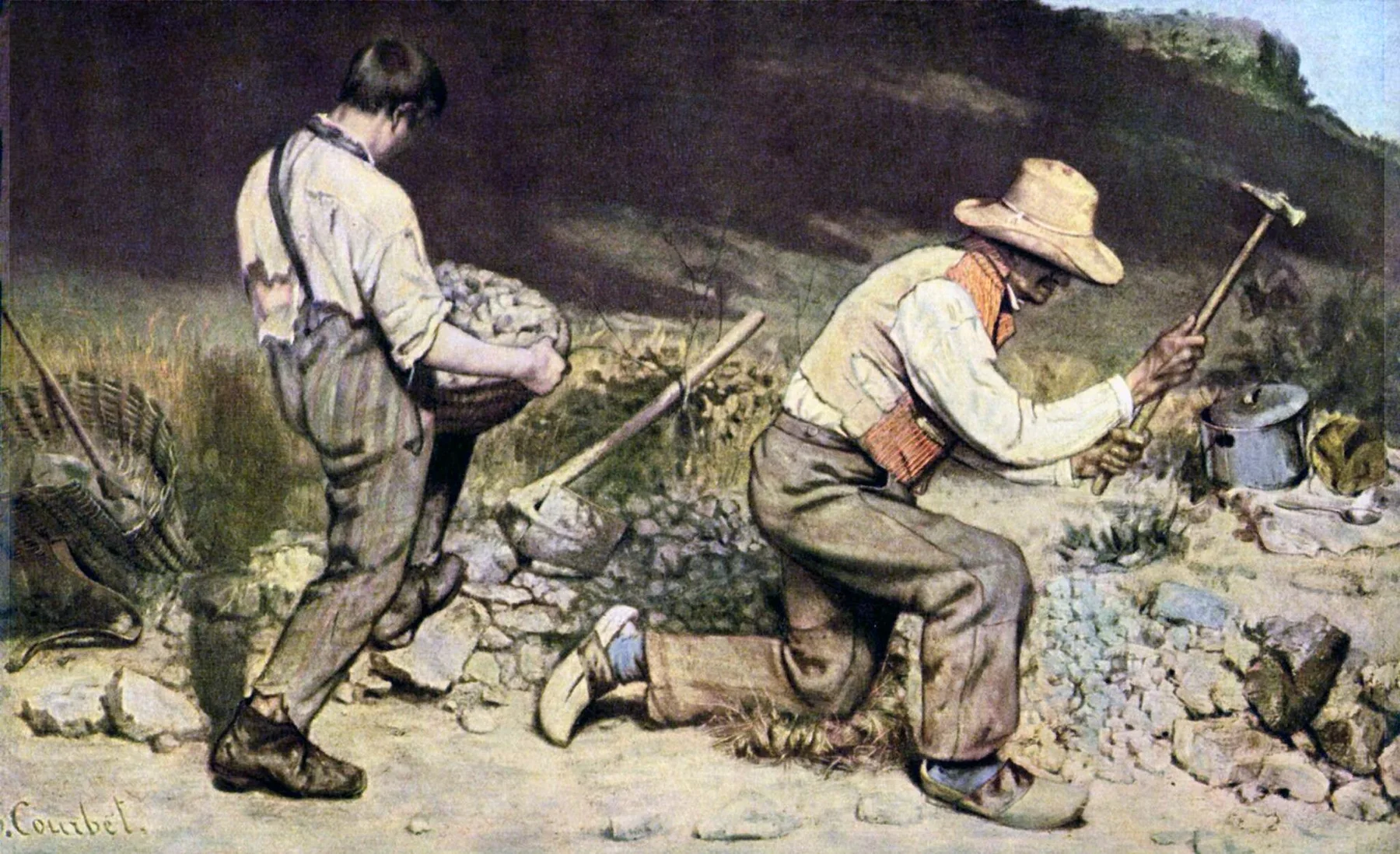

There is little scenic escape. The bank behind the workers closes off the view, while their bodies and tools occupy most of the picture. One carries broken stone; the other raises a hammer. The painting gives effort a shape without giving either person a conventional portrait.
The Thyssen’s Courbet biography places this work among the paintings that made a powerful impact at the Salon of 1851. Ordinary workers had entered a demanding public arena for art.
The original is lost. This is a surviving reproduction, not a recent photograph of its surface. We can discuss the arrangement, the blocked horizon and the relation of age to task, but not confidently recover every original colour or brushstroke. Nor does the image establish that the two people are father and son; resemblance to a life cycle is an interpretation, not a documented family relationship.
Millet: The Gleaners
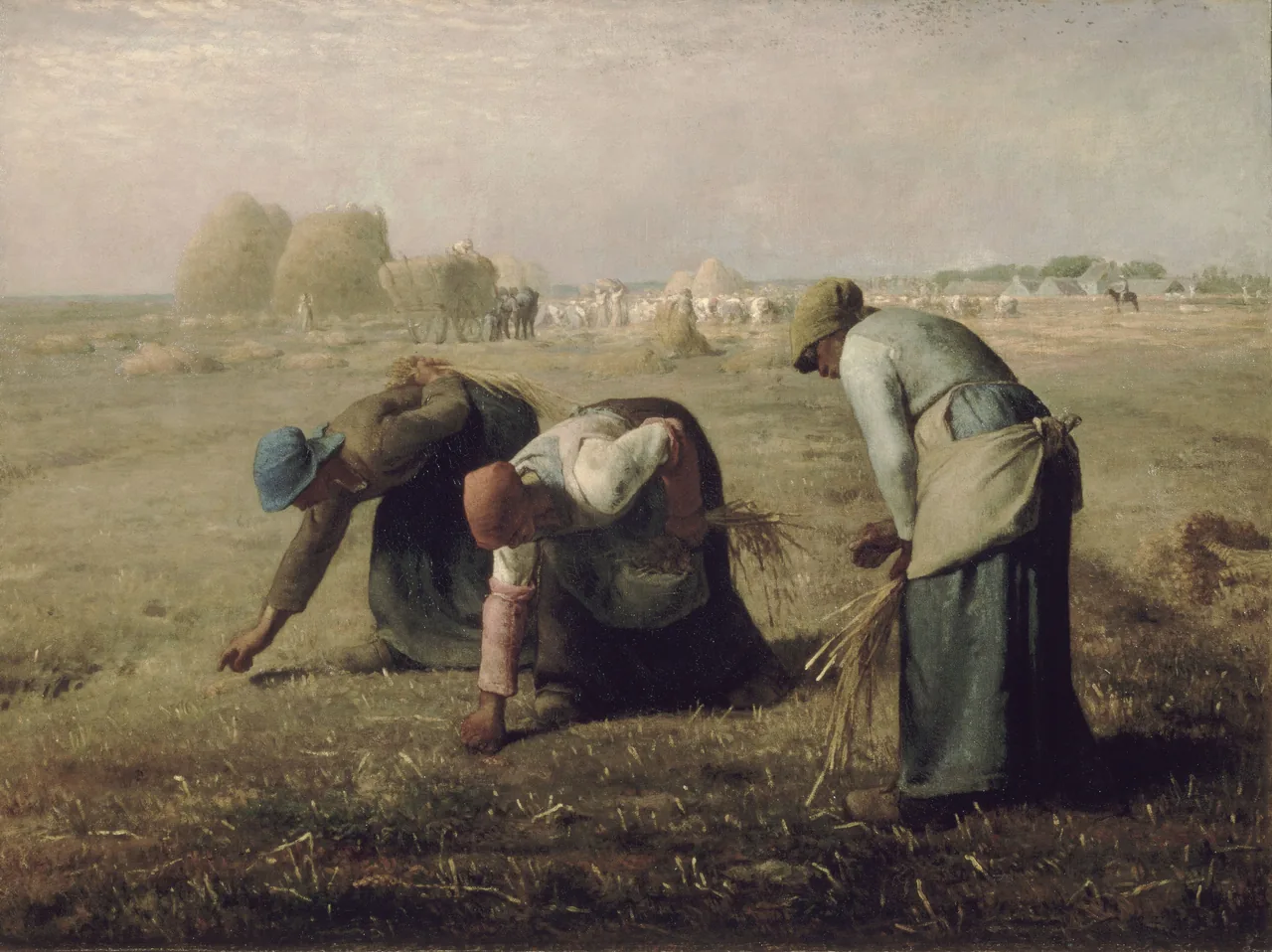

Gleaning means collecting what remains after the main harvest. The women are not sowing or bringing in the abundant crop behind them. That distinction makes the distance between foreground and background important: there is plenty in the picture, but the women gather small remnants close to the ground.
Their repeated bends give the painting a steady rhythm. Try tracing shoulders, arms and hands rather than looking for expressions. The gestures tell us about time spent repeating an action, not one decisive moment.
The Orsay record explains the contrast between their work and the harvest beyond. Millet grants the women prominence without making their circumstances easy. Calling the picture dignified should not turn the field into a comforting fantasy of simple rural life. Its visual calm contains a real imbalance.
Millet: Haystacks: Autumn
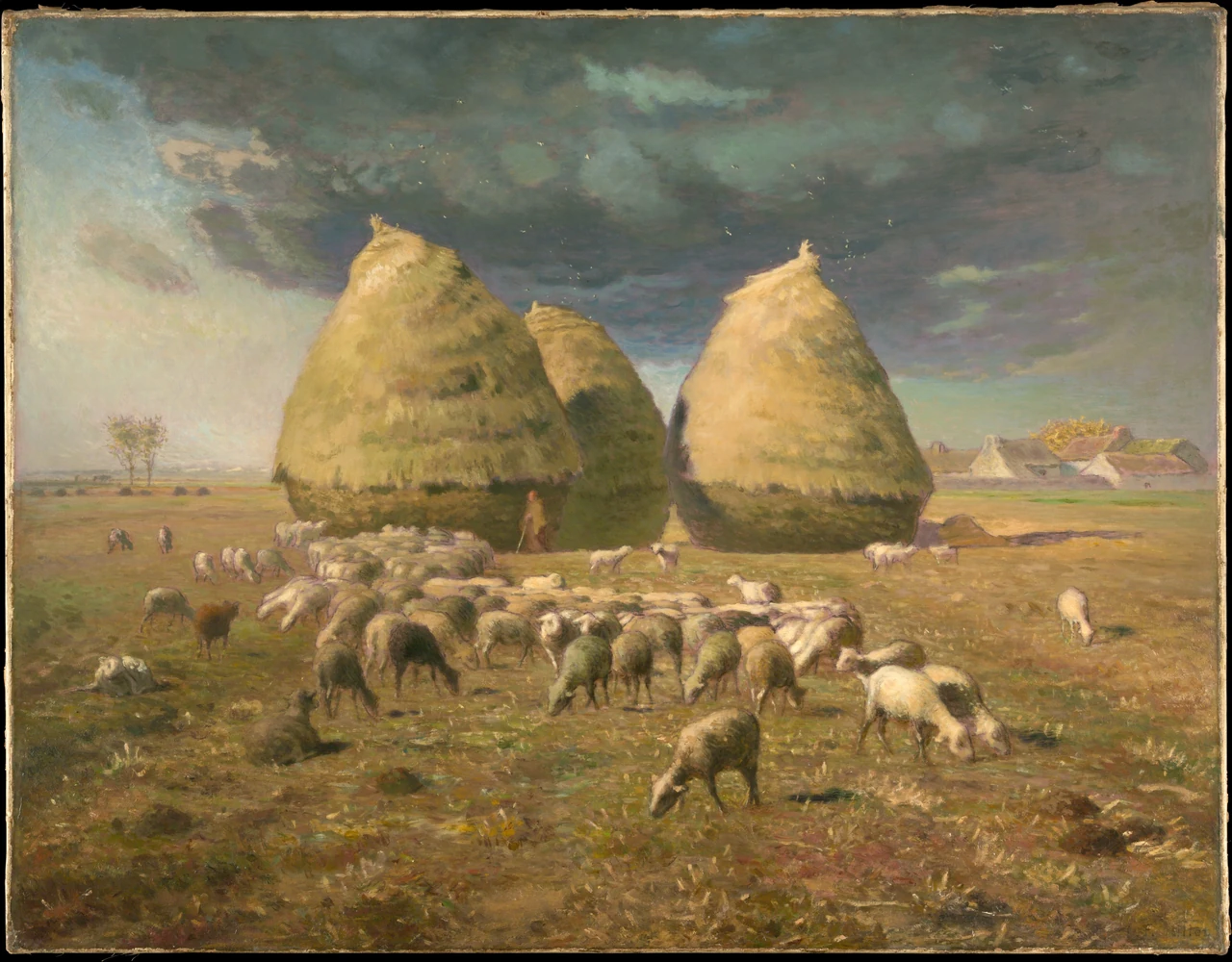
Here the biggest forms are the results of work. Three stacks dominate the field, with animals spreading across the ground and small human figures moving among them. The title directs us toward a season rather than a single exceptional event.
The Met connects the painting with a series of the seasons commissioned by Frédéric Hartmann. This autumn is not just a colour scheme. Harvesting, stacking, grazing and maintaining the land have produced the scene we see.
Compare the size of the stacks with the people. Millet does not always make the worker physically enormous in order to take work seriously. Sometimes he lets accumulated material speak for sustained effort. The dramatic sky also reminds us that Realism did not ban atmosphere or feeling; an ordinary field could still carry considerable visual weight.
Bonheur: The Horse Fair
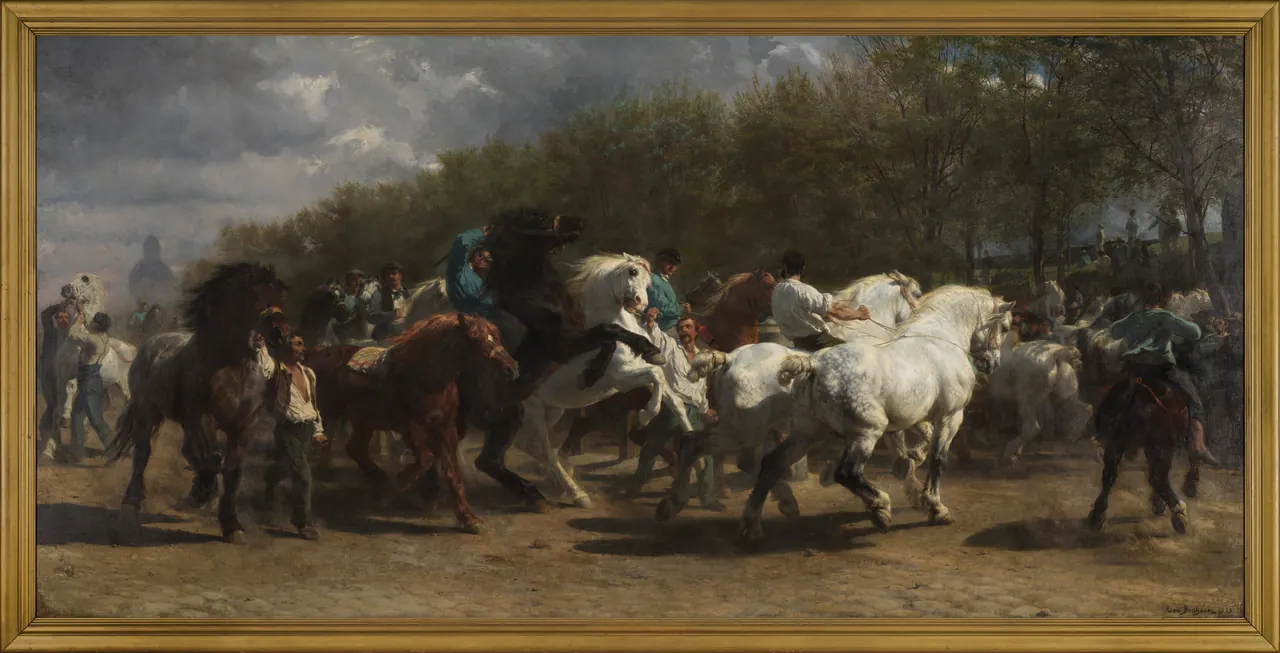
The horses almost seem to push beyond the available space. Pale and dark bodies overlap, legs cross and handlers lean into the movement. Look at the reins and hands: the scene depends on people managing powerful animals, not simply admiring them.
The Met identifies the setting as the horse market on Paris’s Boulevard de l’Hôpital and describes Bonheur’s repeated visits to sketch there. The resulting painting is more than five metres wide. Its scale makes animal handling a substantial public subject.
Yet observation is only part of the method. The museum also notes Bonheur’s interest in earlier painting and ancient sculpture. The sweeping procession is organised to be seen, not copied from a single passing instant. This is the Met’s large canvas, not the smaller version in London. The Bonheur guide keeps those object distinctions in view.
Daumier: The Third-Class Carriage
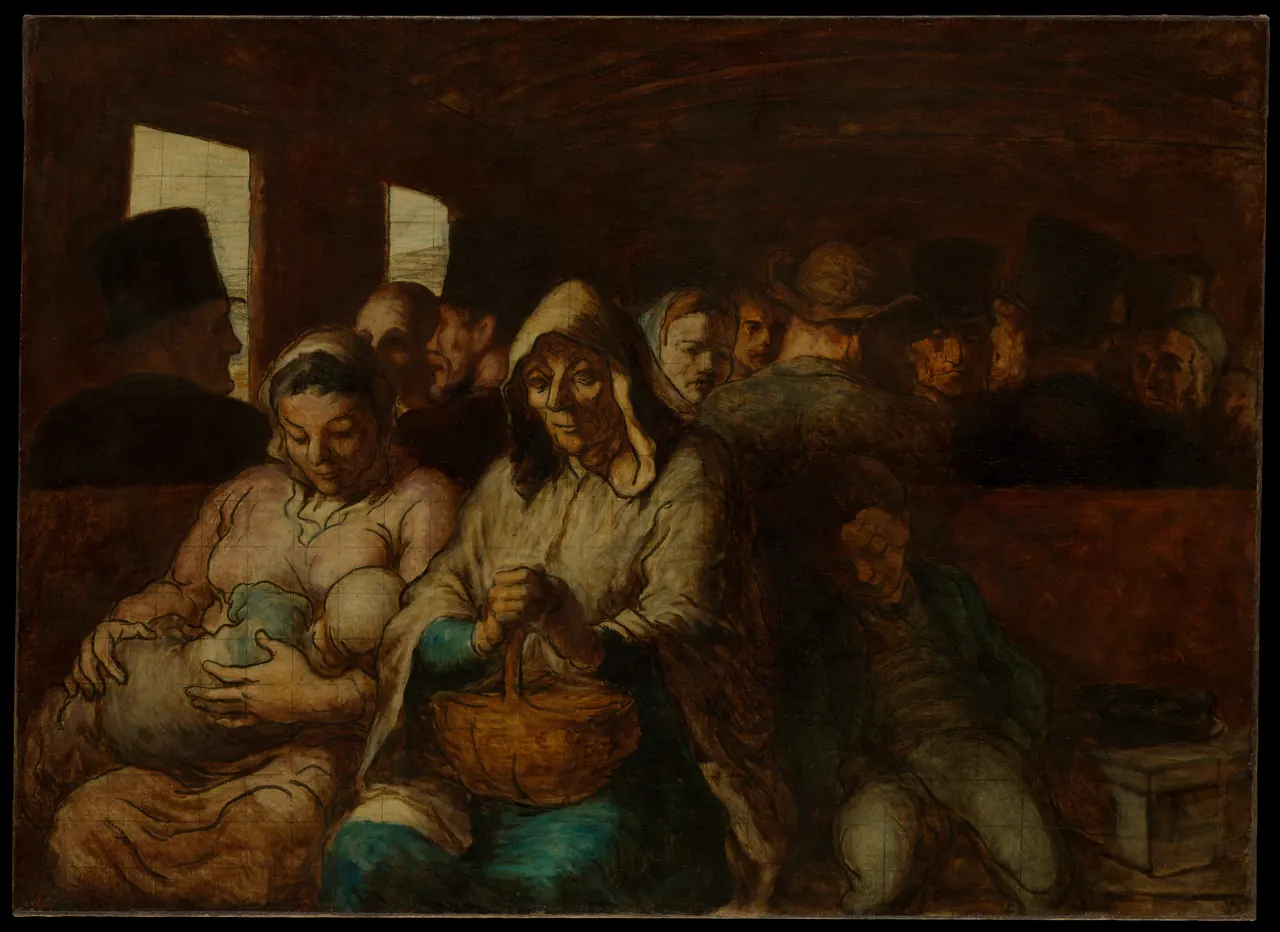
Nobody in the foreground is demonstrating a trade. Nevertheless, travel, tiredness and care belong to everyday life as much as a hammer or a plough. Daumier puts us opposite people who must share a cramped public space.
The central woman’s hands rest on a basket. A mother holds a baby; a boy sleeps beside her older companion. Behind them, heads form a crowded band. Their closeness is physical, but the figures do not become a lively social entertainment for us.
The Met identifies this particular canvas as unfinished and squared for transfer. Some straight grid lines remain visible. They are evidence of the making process, not railway fittings. Other versions exist, so a reproduction labelled only The Third-Class Carriage can conceal a meaningful difference. Here the broad modelling still gives the passengers weight and presence despite the unfinished surface.
Menzel: The Iron Rolling Mill
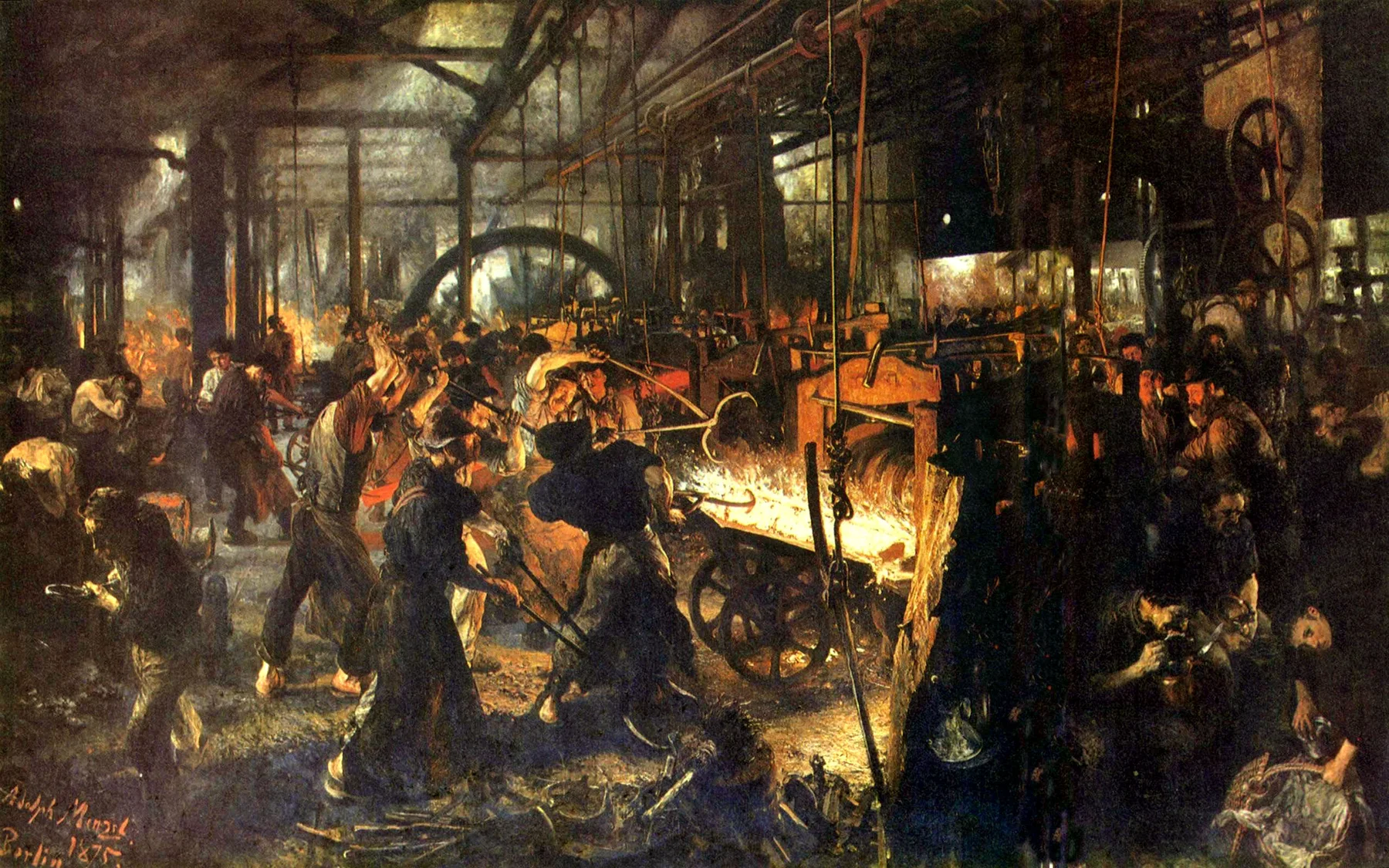

Begin with the glowing metal, then follow the people handling it. The work depends on a group whose actions must meet at the right moment. Wheels, poles and beams complicate the view; no single body explains the whole process.
The German Historical Institute’s account describes Menzel’s research at the Königshütte rail works and his study of tools and movements. This German painting broadens our route beyond the French movement rather than proving that Menzel belonged to Courbet’s circle.
At the right, people eat while work continues elsewhere. That detail changes the rhythm of looking: exertion and interruption coexist inside the same building. The alternative title compares the workers with mythic Cyclopes, but the food and ordinary clothing keep their human needs visible. Magnifying labour can honour skill while still leaving us to ask about the conditions around it.
Caillebotte: The Floor Scrapers
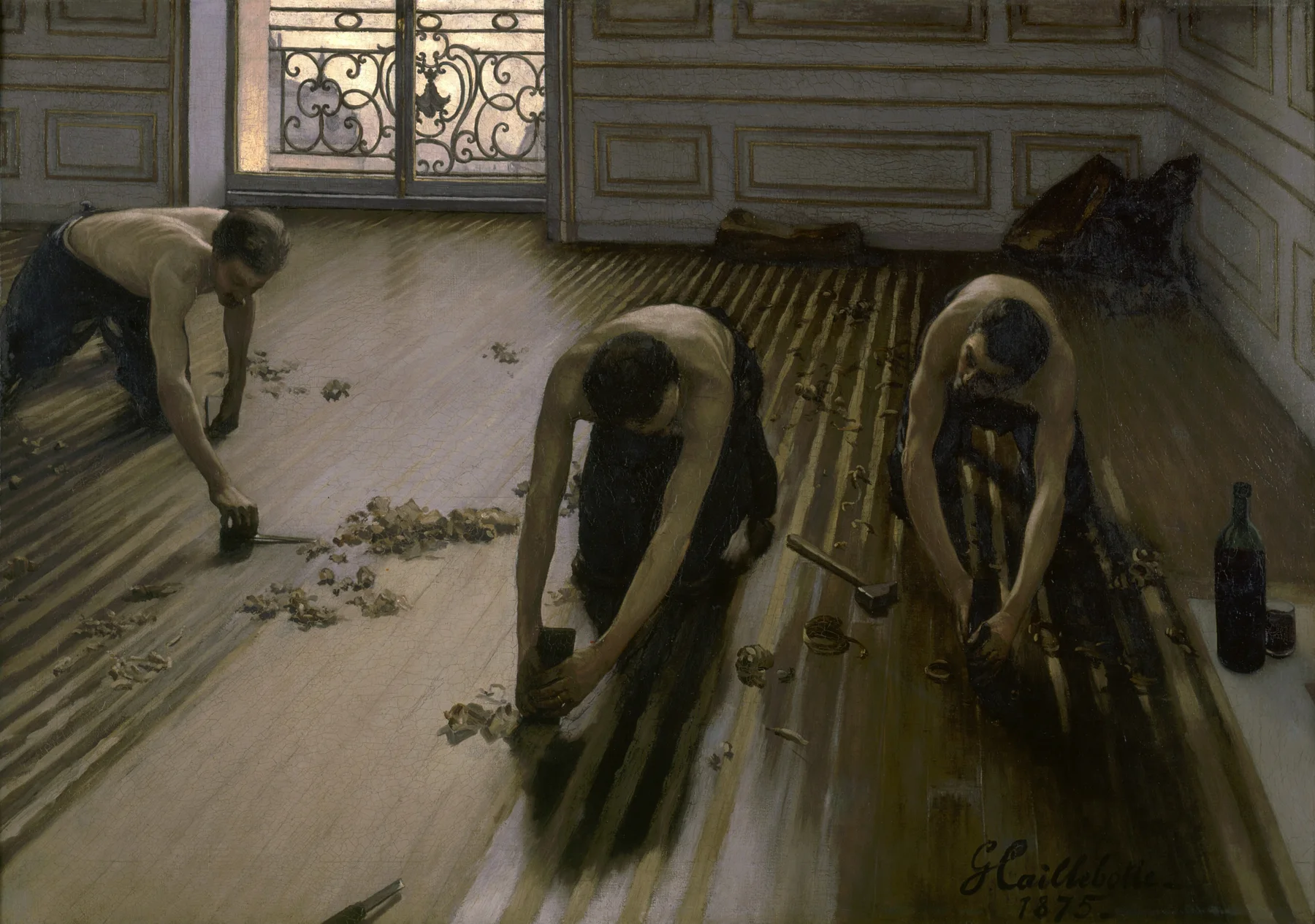

The floorboards pull our eye into the room, but the bodies repeatedly interrupt those long lines. Each man leans into a tool. Shavings gather around their hands; a bottle stands near the wall. The interior becomes legible as something maintained through work.
Caillebotte’s high viewpoint is carefully organised. Orsay describes his academic preparation and records the painting’s rejection from the 1875 Salon, followed by its appearance in the second Impressionist exhibition in 1876.
That exhibition history is why we should not simply label him a member of the earlier Realist movement. He extends some of its attention to contemporary subjects while working within another artistic circle. Compared with Courbet’s closed roadside view, this room uses deep perspective and glancing light to make skilled movement worth following. Caillebotte’s guide provides further context.
Degas: Women Ironing
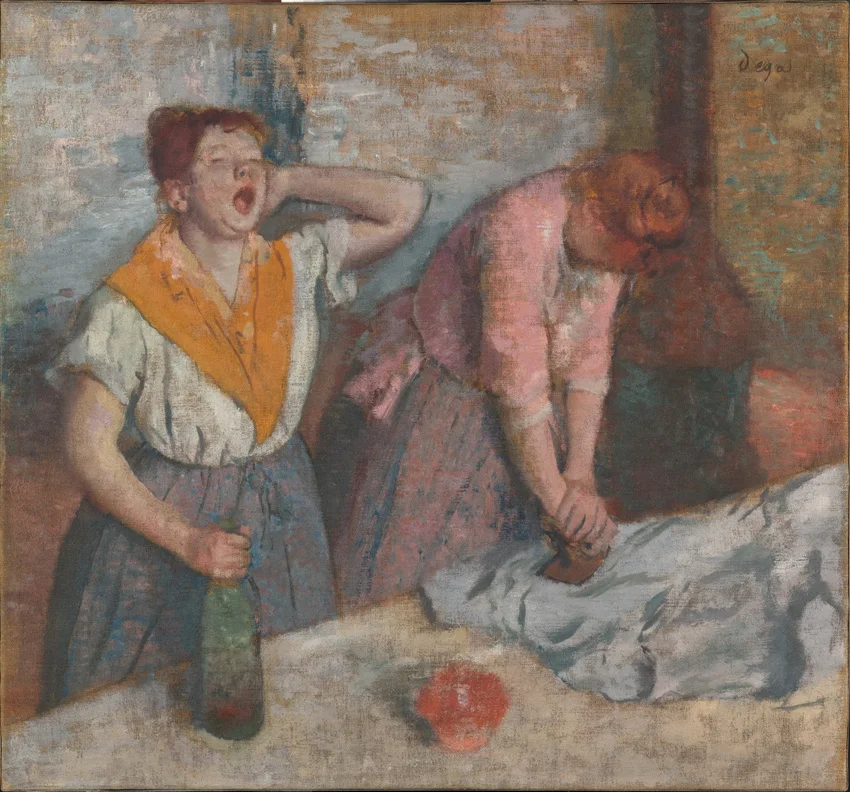

The gestures refuse to line up neatly. One woman pauses with a yawn; the other puts her weight onto an iron. Rest and pressure sit side by side, making the work feel ongoing rather than ceremonially posed for our benefit.
Orsay identifies this canvas as the third variation of a composition Degas revisited. It also notes the coarse, unprepared canvas showing through the paint. The rough appearance is not evidence that the work or reproduction ought to be digitally smoothed.
Degas belongs to the Impressionist story, but his laundresses make a strong concluding comparison with Millet’s gleaners. Both paintings pay attention to repetitive bodily effort. Neither needs a crowned hero to hold the viewer. Differences in setting, gesture and paint remain important; women at work are not interchangeable symbols of hardship.
Dignity does not mean an easy life
These paintings can make people important without showing them happy. They can admire a gesture without establishing fair wages, safe conditions or personal contentment. A beautifully arranged scene is not proof that the life it represents was beautiful.
Try looking once for skill and again for strain. Then notice what the image cannot tell you. That keeps attention on the people without inventing their biographies or reducing them to a lesson about poverty.
Follow the people and the process
Continue with the Millet guide, Degas guide or Romanticism vs Realism. The existing Degas collection is a separate route into selected works, not a promise that this particular laundry painting is currently offered.
When you meet another painting of work, begin with the hands. Ask what they hold, what supports the body and what must happen next. Realist attention often begins with exactly those ordinary questions.
Editorial record
About this article
- Author
- Publisher
- GeMarkt
- Published
- Reviewed
- Internal source & rights check. Conducted by GeMarkt Research Review. This is an internal editorial check—not independent peer review.
- Source standard
- Art history source standardPrioritises object records and research sources, distinguishes evidence from interpretation, and states material uncertainty.
Found a claim that needs checking? Report a factual error.