GeMarkt Blog · Practical guide
Is Jean-François Millet’s Art Public Domain? Paintings and Files
A practical Millet rights guide with two Met Open Access paintings, twelve research records and separate checks for the artwork, country and image file.
Rights check · reviewed
The short answer
Millet’s ordinary EU author term has expired. The two illustrated paintings have exact Met Public Domain / CC0 files; the guide does not independently establish their U.S. publication histories or clear every Millet reproduction.
| What is being checked | Result | Why |
|---|---|---|
| European Union — ordinary author term | Named artist’s own term expired | Millet died in 1875; the ordinary life-plus-70 economic term has elapsed. Later contributions, first-publication rights and national moral-rights rules are not cleared by this calculation. |
| United States — work-specific publication history | Independent publication chain not established | This guide does not independently establish U.S. publication history for the twelve research objects, including every illustrated work. Museum public-domain designations are attributed, not presented as our own publication findings. Creation or exhibition dates alone are insufficient. |
| Selected digital files | Exact Met Open Access files | Met objects 437097 and 437098 are marked Public Domain and supply the exact selected files through the CC0 Open Access programme. Their source JPEGs, metadata and deterministic web-master hashes are preserved in the packet4 evidence. |
| Other works, providers and countries | Separate evidence needed | No worldwide or whole-catalogue clearance. Research links do not create an approved download set. Modern photographs, adaptations, writing and other contributors’ work require separate evidence. |
Twelve exact Met research records, two displayed files. The other ten are research links, not additional acquired and approved images. Broad or qualified catalogue dates remain qualified.
This is a documented research summary, not legal advice. Copyright and moral-rights rules can vary by country and by the history of a particular work.

What we’ll look at
Which Millet artwork and which museum file are you planning to use?
Short answer: Millet’s own ordinary EU copyright term has expired. The two paintings illustrated here also have exact files that The Metropolitan Museum of Art offers as Public Domain through its CC0 programme. That gives you a practical source to check—not a blanket guarantee for every Millet image, every country or every modern reproduction.
Jean-François Millet lived from 1814 to 1875. His name appears on images of field workers, shepherds and farm landscapes, often reproduced in soft brown and green tones. Before downloading one, identify what you are looking at. A painting, a pastel, an engraving after a painting and a modern photograph can show a similar figure while belonging to different records.
This guide uses two Met paintings to make that distinction concrete. It also links to ten further works without presenting them as ten additional approved downloads.
Start with the scene, not just the surname
Millet’s rural subjects can look deceptively interchangeable in small thumbnails. A woman holding a rake is not the same composition as a woman holding knitting; sheep in an open field are not the same scene as sheep beside a seated shepherdess. Search results labelled simply “Millet peasant painting” lose exactly the information you need.
The museum’s medium helps. Woman with a Rake is an oil painting on canvas, dated probably 1856–57. Woman with a Churn is a Conté-crayon drawing on paper, dated 1854. Conté is a drawing material; it is not a type of paint. The similar everyday subject does not make the images versions of one object.
Start your source note with the full title, date as catalogued and accession number. Keep words such as “probably” and “about”: removing them turns a qualified museum date into a certainty the source does not provide.
Haystacks after the harvest
The opening painting, Haystacks: Autumn, is in New York, not a photograph of a contemporary farm. The Met dates it to about 1874 and places it within a four-season commission begun in 1868 for Frédéric Hartmann.
Look first at the three stacks. They occupy much more space than the people. Their rounded golden tops stand against a heavy, green-grey sky, while the sheep spread across the lower half of the painting. The eye moves between large, simple shapes above and many small bodies below.
The field is not empty when harvesting stops. Animals graze, and the buildings on the distant right place the scene near human settlement. The Met identifies the setting with the plain of Chailly and the roofs of Barbizon. Those details matter more than a generic caption calling this an “idyllic countryside.”
The photograph also includes the irregular edges of the painted support. They are useful evidence of the object as photographed. If a later design removes them, it should not silently pass as the complete museum photograph. Likewise, the loose marks around the sheep should not be “repaired” into invented detail by automatic sharpening.
A shepherdess at close range
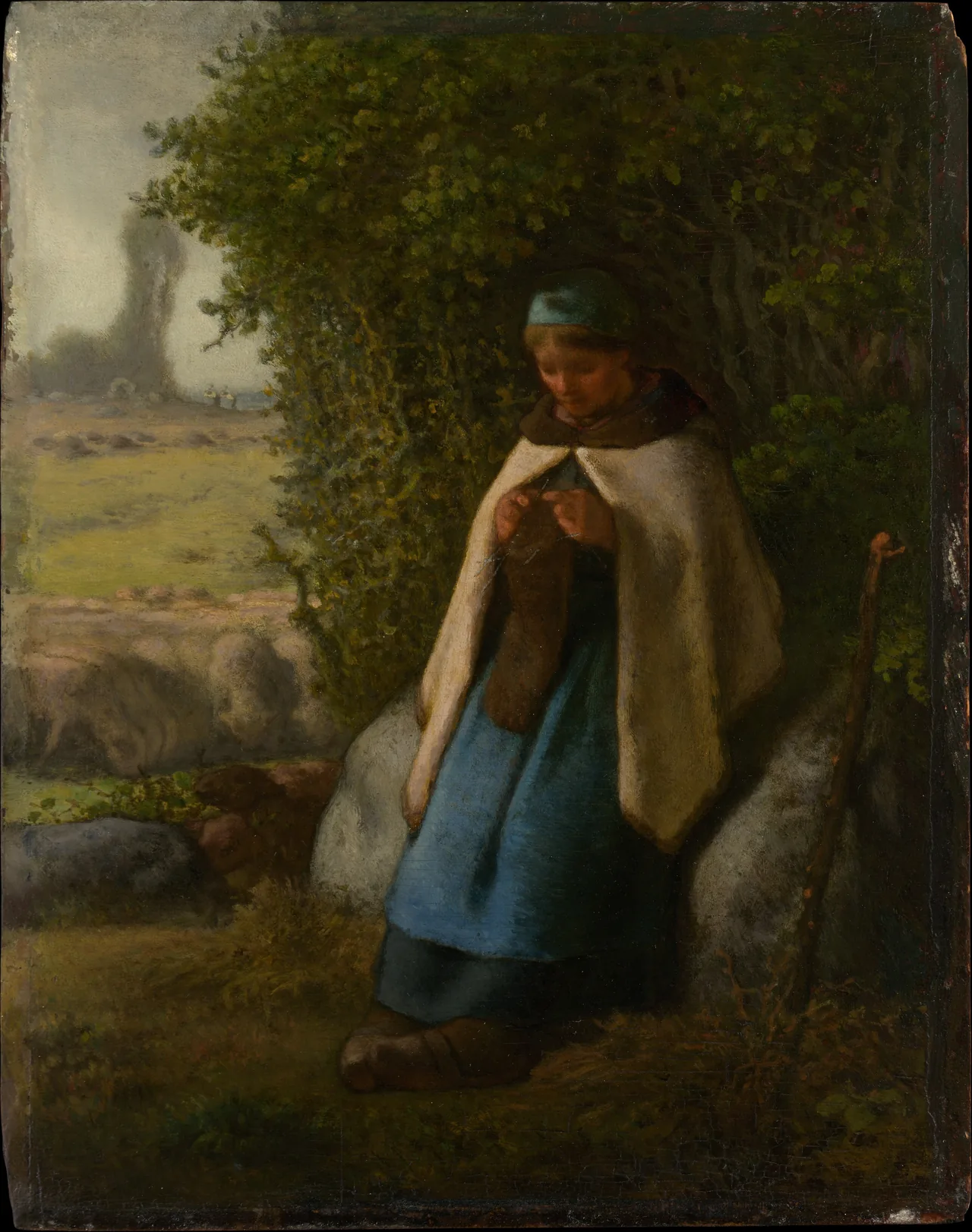
Jean-François Millet, Shepherdess Seated on a Rock, 1856. The Metropolitan Museum of Art, Gift of Douglas Dillon, 1983, 1983.446. Object record. Public Domain / Open Access (CC0).
Here the scale of attention changes. The woman fills the foreground. Her head bends toward her hands; the pale cloak frames her blue skirt. Sheep remain visible at the left, but the dense hedge closes off much of the space behind her.
This is a small oil painting on wood, about 36 by 28 centimetres. Seeing it enlarged on a screen can make it seem comparable in size to Haystacks: Autumn, which is more than a metre wide. The dimensions restore a useful distinction: one image is a close encounter with a figure; the other spreads a flock across a broad landscape.
The dark foliage and shaded face are part of the supplied image. Brightening every shadow until it becomes equally legible would change its balance. For an article, an accurate complete image is more informative than a dramatic “enhanced” version whose changes are not explained.
Twelve records to explore
All twelve links below lead to distinct Met objects. Only the first two files are illustrated and acquired for this guide. The remaining rows are research references, not a cleared image pack.
| Work | Museum date and medium | Use in this guide |
|---|---|---|
| Haystacks: Autumn | About 1874; oil on canvas | Exact Met CC0 image illustrated. |
| Shepherdess Seated on a Rock | 1856; oil on wood | Exact Met CC0 image illustrated. |
| Autumn Landscape with a Flock of Turkeys | 1872–73; oil on canvas | Research link. |
| Calling the Cows Home | About 1872; oil on wood | Research link. |
| Garden Scene | 1854; oil on canvas | Research link. |
| Woman with a Rake | Probably 1856–57; oil on canvas | Research link. |
| Retreat from the Storm | About 1846; oil on canvas | Research link. |
| Women Carrying Faggots | About 1858; charcoal and white gouache | Historical title: bundles of firewood. |
| Shepherd and His Flock | “Late 19th century”; pastel | Broad catalogue date retained. |
| Hamlet in a Wheat Field, Vichy | 1867; ink, wash and watercolour | Research link. |
| Roadworkers at Lunch | About 1850–52; Conté crayon and gouache | Research link. |
| Woman with a Churn | 1854; Conté crayon | Research link. |
What “public domain” establishes here
For the ordinary EU author term, Millet’s death in 1875 places his own contribution well beyond life plus seventy years. The EU term directive also distinguishes later first-publication rights and leaves national moral rights outside that calculation. This guide does not clear every later contribution or country.
For the United States, this guide does not independently establish publication history for the twelve objects, including the two illustrated paintings. It reports the Met’s own public-domain designation. Creation, ownership and exhibition are not interchangeable with publication; section 303 provides a separate route for qualifying older, formerly unpublished works.
For the digital files, the evidence is narrower and more direct. The Met marks the selected objects Public Domain and supplies their images through Open Access under CC0. That does not release a different photographer’s photograph, a recent book’s text or a commercially redesigned download.
Choose and credit the actual file
Download from the identified institution rather than saving a search thumbnail. Keep its object URL, accession, credit and rights statement alongside the original file. Those details let you return to the source if a later catalogue changes an attribution or date.
A useful caption names Millet, the work, its date and the holding museum. It does not imply that the museum endorses your product. If you make a detail crop, call it a detail; if you change the colours, do not present the result as a faithful reproduction.
The practical answer is therefore specific: there are clearly identified open institutional Millet files you can start with. Choose one exact object and retain its evidence, rather than treating the artist’s surname as permission for everything a search engine returns.
Sources and review method
We checked the artist chronology against museum records, treated each named jurisdiction separately, and recorded the provider policy for the image set. These sources support the legal framework and artist dates used above; the source file for any individual image still needs its own record.
- Haystacks: Autumn, 60.71.12 — The Metropolitan Museum of Art. Exact feature painting, commission context, medium, date, credit and Public Domain designation.
- Shepherdess Seated on a Rock, 1983.446 — The Metropolitan Museum of Art. Second illustrated painting, support, small physical dimensions and exact open file.
- Woman with a Churn, 29.93.3 — The Metropolitan Museum of Art. Drawing medium and date; a different rural object from the painted examples.
- Open Access at The Met — The Metropolitan Museum of Art. CC0 designation for the exact museum-supplied images marked Public Domain; not a release of unrelated third-party files.
- Directive 2006/116/EC, Articles 1, 4, 8 and 9 — EUR-Lex. Ordinary author-life-plus-70 term, later first-publication rights and national moral-rights distinctions.
- 17 U.S.C. Chapter 3, including section 303 — U.S. Copyright Office. Publication and formerly unpublished-work analysis; painting and exhibition dates do not establish publication.
Editorial record
About this article
- Author
- Publisher
- GeMarkt
- Published
- Reviewed
- Internal source & rights check. Conducted by GeMarkt Research Review. This is an internal editorial check—not independent peer review.
- Source standard
- Rights guide source standardSeparates the underlying work from the source file, records the review date, and links the evidence used for the conclusion.
Found a claim that needs checking? Report a factual error.