GeMarkt Blog · Reference
Matisse in 2025: What Changed in Europe and Türkiye
What Matisse’s 2025 public-domain milestone changed in France and Türkiye, why Spain differs, and why US publication history and image files still matter.

What actually changed in 2025?
Matisse’s 2025 public-domain milestone was real, but it was not a worldwide release of everything carrying his name. France’s national library announced the change from 1 January 2025. Türkiye’s ordinary life-plus-70 calculation also reaches that date. Spain’s older term rules and the United States’ publication-based rules need separate answers.
That distinction is useful whether you are illustrating an essay, choosing a scan for a print or trying to understand a museum’s download notice. “Matisse is public domain” leaves out the country, the particular work and the particular file. Add those details and the statement becomes something you can investigate.
This retrospective is checked as of 13 October 2026. It explains the change and its limits; it is not legal advice or a licence for an individual image. Our Matisse artist guide approaches the same problem through individual works and source records.
Why the calendar starts after 1954
Matisse died in 1954, as the Bibliothèque nationale de France’s account records. In a calendar-year life-plus-70 calculation, the seventy years after that death year are 1955 through 2024. The ordinary term therefore finishes at the end of 2024, rather than on the seventieth anniversary within that year.
The date is an application of a rule, not an extra seventy-year period starting when someone digitises a painting. Nor is it a calculation from the painting’s creation date. A work made early in an artist’s career and one made late in that career can share the same ordinary author-based endpoint.
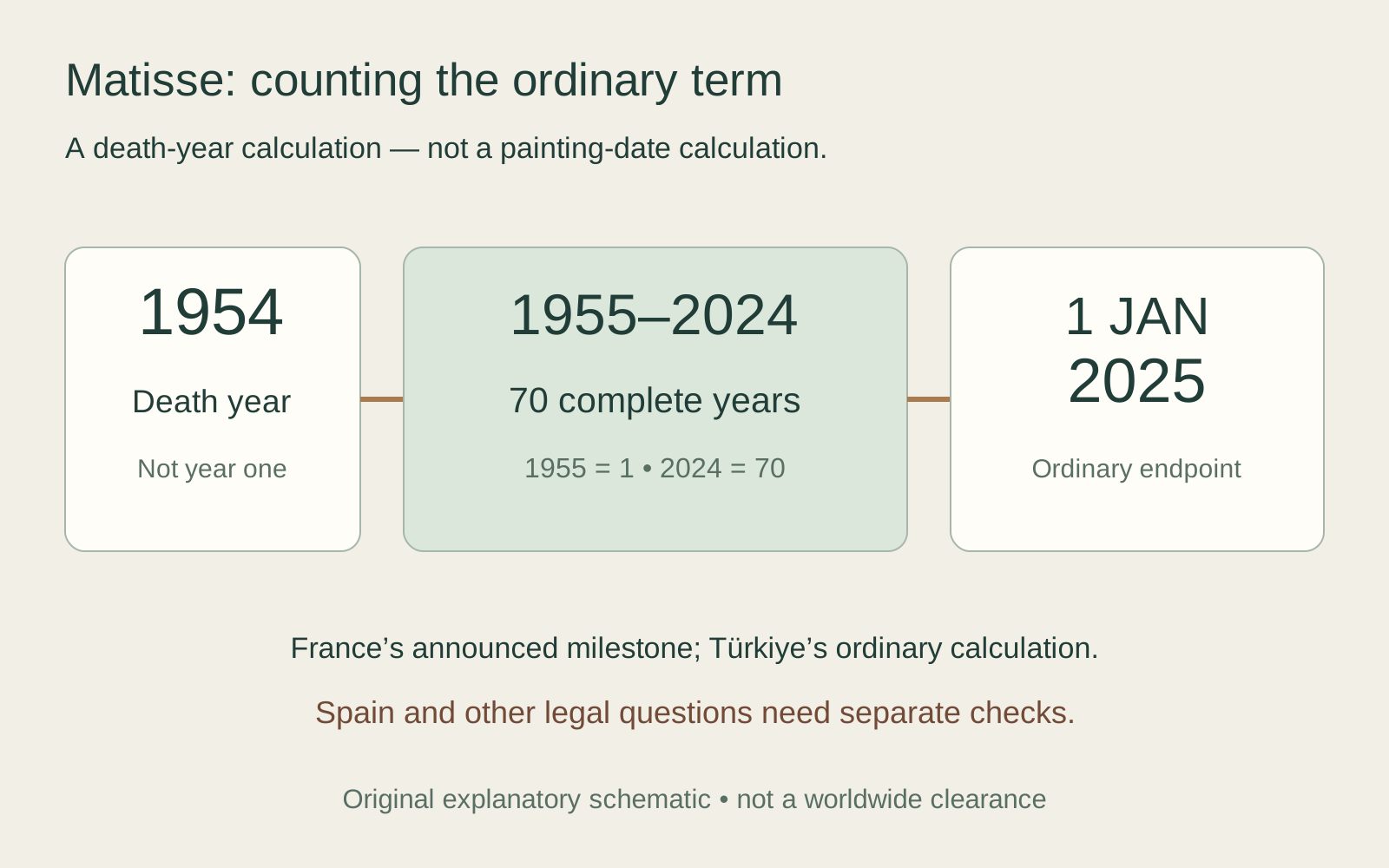
Our life-plus-70 guide explains that general counting method. Here the important question is where it gives the relevant answer for Matisse, and where another rule changes the analysis.
France: a real milestone, not an end to every right
The BnF expressly identifies 1 January 2025 as Matisse’s entry into the public domain in its French account. It also distinguishes freely consulting digitised material from purchasing high-resolution files through its image service. A copyright milestone does not promise that every institution will supply every file without charge.
France’s moral-rights protection remains a separate issue. Article L121-1 protects the author’s name, status and work, and describes that right as perpetual. Expiry of economic rights is therefore not a reason to remove attribution or treat any distortion as unobjectionable. Whether a particular alteration infringes is a more specific question than this guide can decide.
You may also encounter calculations that add French wartime extensions automatically. That is not a reliable shortcut. In its 2007 Monet decision, the Cour de cassation explained that the harmonised seventy-year period absorbs those extensions, except where a longer term was already running on 1 July 1995. This was not a judgment about Matisse himself; the BnF’s later announcement supplies the Matisse-specific milestone.
Why Spain needs a different date
“Europe” is a convenient heading, but it is not one undifferentiated expiry date. Spain preserves the older duration for authors who died before 7 December 1987 in the fourth transitional provision of its copyright statute. The Spanish education ministry’s licensing guide explains the general legacy term as eighty years after death.
For Matisse, that ordinary legacy calculation runs through 2034, pointing to 1 January 2035, not 2025. It is a material difference for a project involving Spain. Do not replace the French answer with a claim that the same answer applies throughout the EU.
The practical lesson is to give a rights note a country field. A French cultural institution’s accurate statement about its own context is not necessarily wrong because another country has a different endpoint. The mistake occurs when a reader silently turns that statement into a global permission.
Türkiye reaches the date through its own law
Türkiye is not an EU member, and its result should not be described as automatic application of an EU directive. The Ministry of Culture and Tourism’s term guidance states the ordinary life-plus-70 rule and counting from the beginning of the following year. Applied to Matisse’s 1954 death, that gives the same ordinary 1 January 2025 endpoint.
The ministry also separates the term of an original work from that of an adaptation. This matters if the material in front of you is not simply the painting: a recent illustrated book, translation or independently creative treatment may contain additional contributions.
For a straightforward painting enquiry, record the artist and death year first. For a book or other composite publication, identify which component you actually want to reproduce. The ordinary Matisse calculation is not a substitute for checking the other people’s contributions or any applicable special rule.
The United States asks a different question
A Matisse creation date alone cannot settle US copyright. The Copyright Office’s Circular 15A distinguishes older published works, renewal and restoration issues, and works still unpublished when the 1976 Act took effect. Some previously unpublished works can also have a statutory protection floor extending through 2047.
For the ordinary ninety-five-year publication branch, the end of 2025 completed the term for 1930 publications. But “painted in 1930” does not establish “published in 1930.” An exhibition label, later catalogue and dated reproduction may answer different questions. Nor does a post-1930 date, by itself, prove continuing protection: the applicable branch and evidence still matter.
When the publication history is unresolved, say so. Do not convert a gap in the research into either “free” or “definitely protected.” The US publication guide explains what kind of evidence belongs in that investigation.
A painting and a download are not the same thing
Imagine three things offered under the same artwork title: a faithful scan of the painting, a photograph showing it in a decorated room, and a recent book cover incorporating it. They do not necessarily contain the same creative material. That is why the source file needs its own entry in your notes.
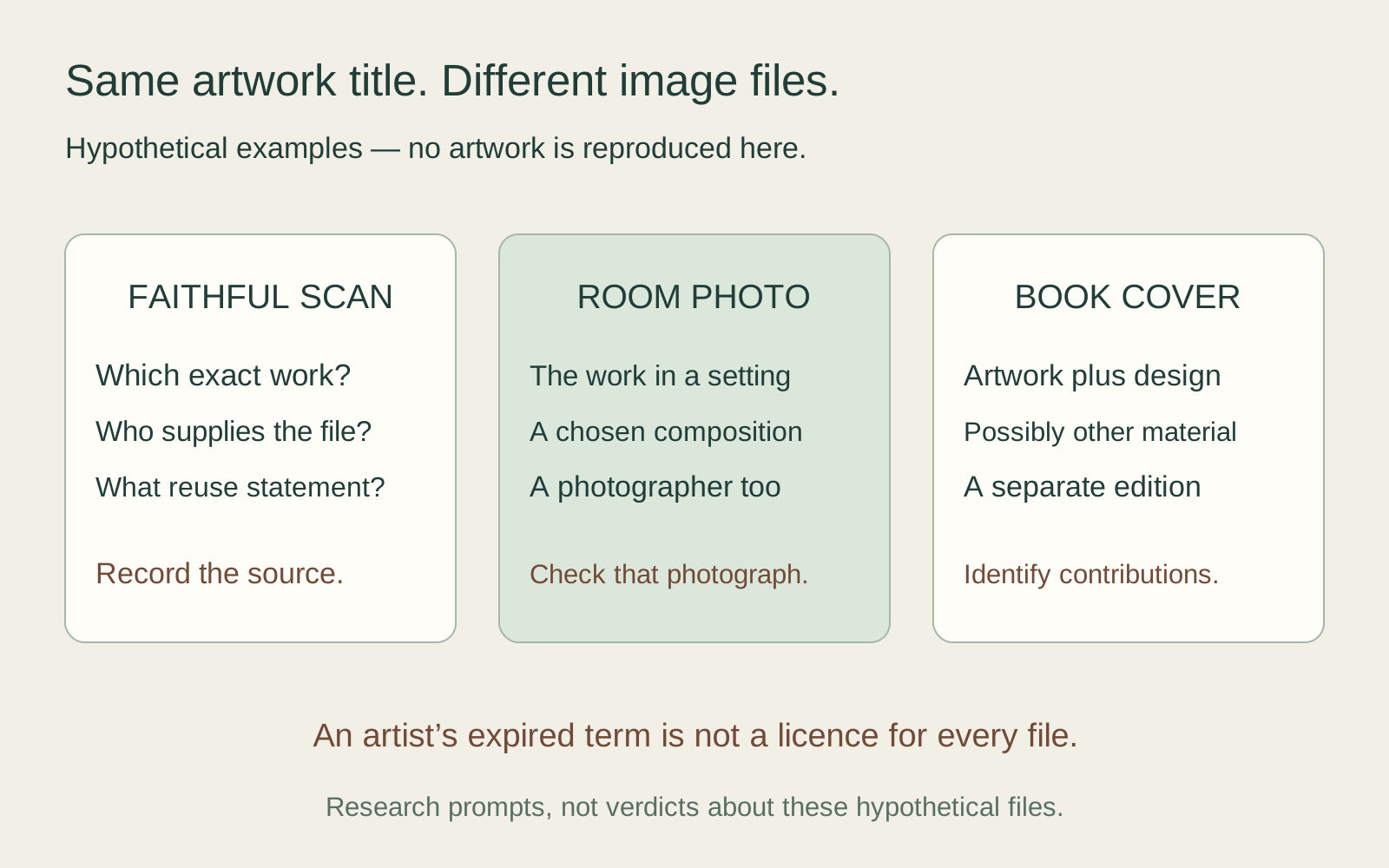
Start with the supplying institution’s exact record, not a search-result thumbnail. Save its object number, file URL, credit and reuse statement. If the file is labelled open, check what that label covers; if its scope is unclear, ask or choose a better-documented source. Our guide to CC0, public-domain labels and museum licences separates those terms.
Turn the headline into a useful research note
A usable conclusion reads more like “this identified work, for this country, with this documented source file” than “Matisse is free.” Keep the underlying-work analysis beside the file evidence, rather than merging them into one checkbox.
For a proposed publication, note where it will be distributed, which image will appear and whether you will crop or otherwise change it. Those details make a later permission enquiry or professional assessment much more efficient. They also make it easier to update the conclusion when better evidence appears.
The 2025 change opened a significant chapter in access to Matisse. Taking it seriously means using its actual scope—not enlarging a valid milestone into a promise it never made.
Editorial record
About this article
- Author
- Publisher
- GeMarkt
- Published
- Reviewed
- Internal source & rights check. Conducted by GeMarkt Research Review. This is an internal editorial check—not independent peer review.
- Source standard
- Rights guide source standardSeparates the underlying work from the source file, records the review date, and links the evidence used for the conclusion.
Found a claim that needs checking? Report a factual error.