GeMarkt Blog · Reference
Life Plus 70: How the EU and Türkiye Count Copyright
Learn the ordinary year-end calculation for art copyright, why national exceptions matter, and what a copyright expiry does not settle about an image.

The short answer
For an identified individual artist, life plus 70 years is the ordinary starting rule in the EU and Türkiye. Count from the year after the artist died, not from the year the picture was painted. But the calculation only answers the question to which that rule applies. National exceptions, older legislation and the particular image can change what you may use.
The EU’s Your Europe guidance describes the general life-plus-70 term and the last-surviving-author rule for joint works. Türkiye’s Ministry of Culture and Tourism explains its corresponding term and year-end calculation. Türkiye follows its own legislation; it does not become subject to every EU copyright provision because the ordinary number is the same.
This is general research information, checked on 12 October 2026, not legal advice. It is most useful for understanding a museum rights note or organising a reuse enquiry. A valuable or uncertain commercial project needs a decision about the actual work and relevant countries, not just the arithmetic below.
Count complete calendar years
Take a hypothetical artist who died in 1955. Under an applicable ordinary life-plus-70 rule, the seventy calendar years are 1956 through 2025. The term ends on 31 December 2025; 1 January 2026 is the first day outside that ordinary term. It does not matter whether the death occurred in February or November. This follows the next-year calculation in Article 8 of the EU duration directive and Türkiye’s ministry explanation above.
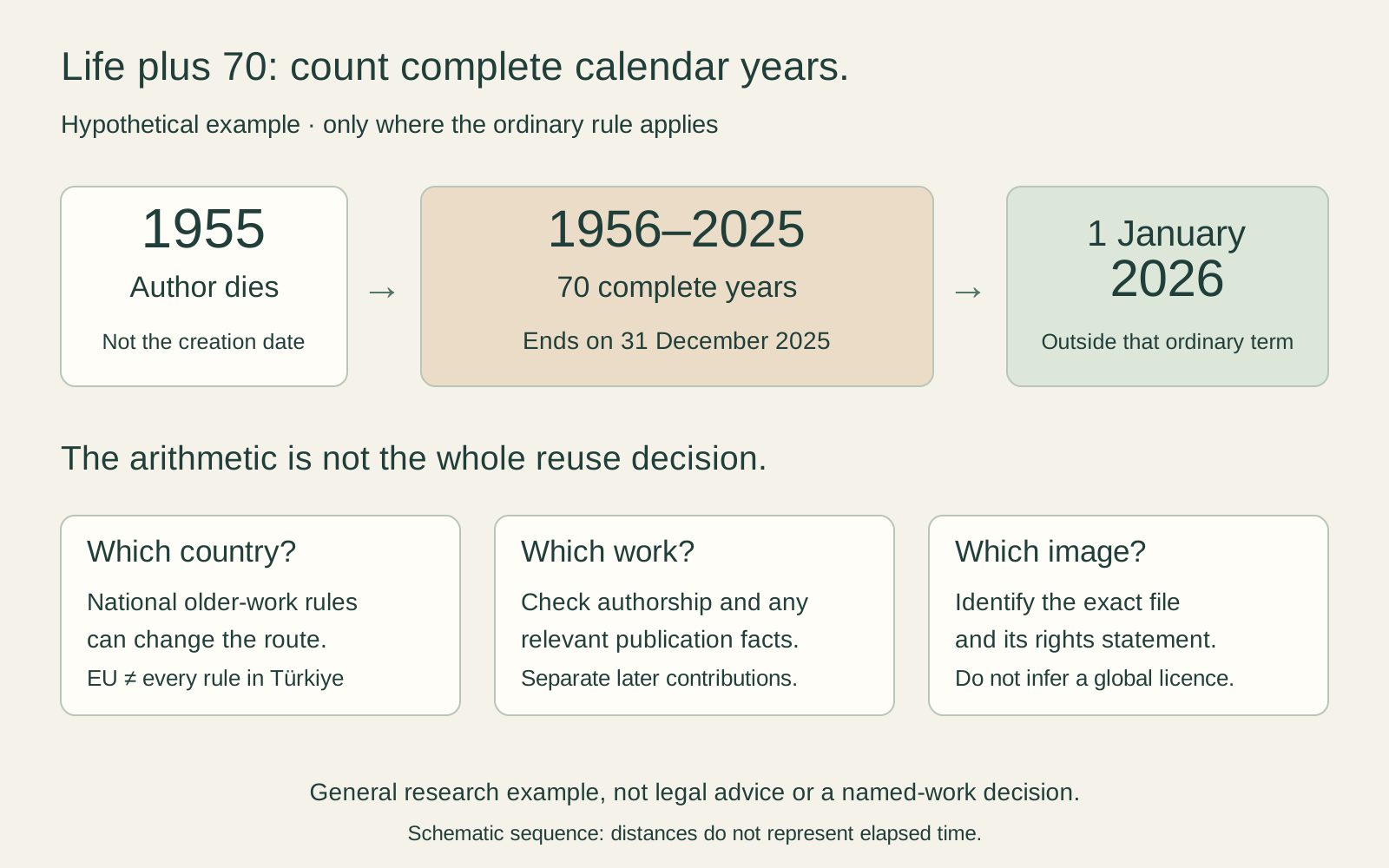
An easy arithmetic check is 1955 + 70 = 2025, followed by the next January. Do not add seventy to a picture’s 1920 creation date instead. That would count a different event and could produce an answer decades too early.
Give each date in your notes a name. “Painted”, “artist died”, “first published” and “museum acquired” are not interchangeable fields. If a catalogue says “circa 1920” and “gift of 1988”, neither supplies a missing death date. Likewise, the year printed in a website footer tells you nothing useful about when the old painting’s ordinary term ends.
Find the person whose life you are counting
Start with an identified creator, not a loosely attributed name. A work described as “after”, “school of” or “follower of” a famous painter may be a different person’s creation. Looking up the famous painter’s death date does not resolve that attribution.
Joint work creates another practical trap. Suppose two identified co-authors died in 1944 and 1960. If the last-survivor life-plus-70 rule applies to their joint work, the relevant year is 1960, giving the end of 2030, not the end of 2014. This is a hypothetical application of the joint-author rule, not a claim that every collaboration creates joint copyright.
Keep later contributions on separate lines. The painter, a translator of the exhibition text and a photographer of an installation have not necessarily co-authored one artwork. You might establish the painting’s status yet still need permission for the new text or photograph accompanying it.
Anonymous and genuinely unidentified pseudonymous works need another route. Article 1 of Directive 2006/116 distinguishes those cases from identified authors, including what happens when identity becomes known. A signature you cannot decipher is a research problem; it is not proof that the legal anonymous-work rule applies.
The EU rule still needs a country
“The artist died more than seventy years ago” is a useful screening observation, not an all-Europe certificate. Article 10 preserves certain longer terms already running on 1 July 1995. Article 7 also addresses works originating outside the EU and non-EU authors, with qualifications. National implementation and the work’s history therefore remain relevant.
Spain provides a concrete reason to slow down: its fourth transitional provision sends works by authors who died before 7 December 1987 back to the duration rules of the 1879 law. You cannot simply replace that instruction with the modern headline number. Nor should a rule found for Spain be pasted into a record for Germany or Türkiye.
Previously unpublished material needs care too. Article 4 provides a separate 25-year protection for a qualifying first lawful publication or communication of a previously unpublished work after copyright expiry. Finding an old drawing in a newly released archive is not the same factual situation as downloading a long-circulated print.
For a project covering several countries, make a short country column beside the artwork record. A qualified conclusion for one territory is better than an apparently convenient universal answer you cannot support.
Türkiye has its own law
For Türkiye, read Law No. 5846, particularly Articles 26 and 27, rather than treating an EU explanation as Turkish law. The ministry’s published English translation distinguishes ordinary duration, works first made public after death, and cases in which the author is unidentified. Article 27 measures the stated posthumous category from death, not automatically from the later release date.
Article 26 also refers to a work being made public. For an unpublished family drawing or newly released archive item, record that history and seek advice about the applicable category. Do not invent a countdown to reconcile the provisions.
Expiry of economic rights does not erase every other issue. Article 19 contains post-death provisions concerning specified moral rights, including a ministry role in certain nationally important works. Article 46 separately concerns certain unpublished works held by public institutions after economic-right expiry. Neither is a reason to call every old Turkish painting restricted; both are reasons to describe what you are actually using.
The ministry’s copyright overview also explains territorial protection. A conclusion reached under Turkish law does not itself decide a use in another country.
Check the image after the artwork
Suppose the old painting clears the relevant duration check. You still need to identify the downloaded file: a straightforward reproduction, a photograph of a framed object in a room, a new illustration after the painting, or an edited composite. These are not automatically the same thing.
EU Directive 2019/790, Article 14 addresses reproductions of public-domain visual art: protection does not arise for the resulting material unless it is original in the required sense. That is a specific EU provision to read with national law, not a worldwide licence for every image found online or a rule automatically imported into Türkiye.
Other controls can sit outside copyright duration. The Uffizi’s commercial-image service, for example, expressly operates permissions under Italy’s cultural-heritage legislation. “The Renaissance artist died centuries ago” does not answer that separate institutional and legal question.
For a practical next step, choose an identifiable open-access file and keep its object record and rights statement. Our guide to finding high-resolution public-domain art explains that file-selection process.
Write a conclusion with boundaries
A useful record says which work, which creator, which country, which rule and which image. Add the source for the death date, any publication evidence that matters, and the date you checked the file’s terms. Keep uncertainties attached to the missing fact rather than hiding them in a vague “probably fine”.
For example: “The ordinary term calculation ends in year X; the country’s older-work provisions still need checking.” That is an unfinished but intelligible result. “The exact museum image is supplied under CC0” answers a different, equally important question. Neither should silently stand in for the other.
If your audience also includes the United States or the UK, continue with the separate U.S. publication guide or UK copyright guide. Use life plus 70 to begin the right calculation, not to avoid choosing the right law.
Editorial record
About this article
- Author
- Publisher
- GeMarkt
- Published
- Reviewed
- Internal source & rights check. Conducted by GeMarkt Research Review. This is an internal editorial check—not independent peer review.
- Source standard
- Rights guide source standardSeparates the underlying work from the source file, records the review date, and links the evidence used for the conclusion.
Found a claim that needs checking? Report a factual error.