GeMarkt Blog · Reference
Is Kandinsky’s Squares with Concentric Circles Public Domain?
Check Kandinsky’s 1913 colour study, Lenbachhaus’s exact CC0 image and the publication evidence still needed for a separate U.S. conclusion.

The short answer
The ordinary EU and UK author-copyright term for Kandinsky has elapsed, and Lenbachhaus explicitly supplies this particular study’s image under CC0. That is a useful, identifiable source—not an independently established worldwide clearance. This guide leaves the study’s U.S. publication history unresolved.
The object is Color Study: Squares with Concentric Circles, the 1913 paper work in Munich, inventory GMS 446. It is not any modern arrangement of coloured circles bearing Kandinsky’s name. Our check is dated 13 October 2026. If your intended use depends on U.S. rights, the missing publication evidence remains a real question, even though the museum’s file is readily downloadable.
The small paper study behind the familiar image
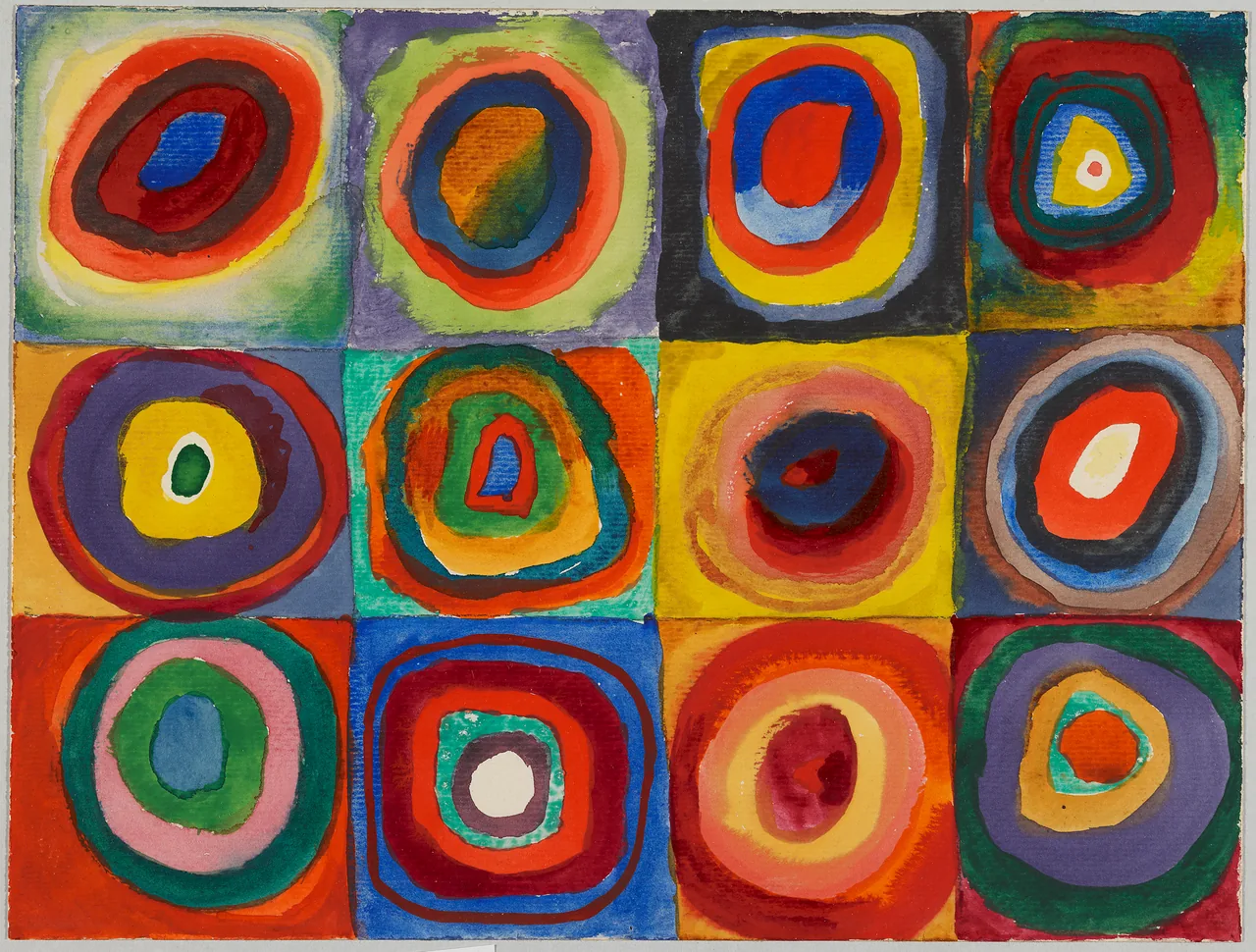
The Lenbachhaus record calls the work Farbstudie – Quadrate mit konzentrischen Ringen: a colour study, squares with concentric rings. It lists watercolour, gouache and chalk, and dimensions of 23.9 × 31.5 cm. The familiar image therefore starts with a modest sheet, not a huge oil painting designed to fill a wall.
That distinction affects a sensible caption. “Painting on canvas” would be wrong for this object, even if a modern reproduction is printed on canvas. The museum records its arrival through the Gabriele Münter Stiftung in 1957. That is collection history, not evidence that the study was first published that year.
Similar titles can conceal different sheets. The Fundación Juan March’s 2004 watercolour catalogue distinguishes the squares study in figure 6 from another Colour Study with Concentric Rings, catalogue number 30, measuring 24.1 × 30.3 cm. A title shortened to “Concentric Rings, 1913” is consequently not enough to identify your download. Keep GMS 446 beside the title when recording your source.
Look at the uneven rings, not just the grid
The sheet contains twelve roughly square compartments, four across and three down. Each holds nested coloured shapes. They are not interchangeable targets stamped from a template: centres wander, rings thicken and narrow, and some shapes are closer to ovals or rounded triangles than circles.
Look across the top row. A blue centre sits inside red and dark rings at the left, while the next group has an orange-green centre surrounded by blue. Near the opposite corner, a small red spot rests inside a pale centre. The repeated structure makes these differences easy to compare without reducing them to a single correct colour recipe.
The bottom row is equally useful. One group has a pale centre within purple, turquoise and orange; another spreads warm pink and yellow against orange-red. You can follow the relationship between centre, ring and surrounding square rather than searching for a hidden landscape or portrait.
These are observations of the supplied image, not a claim that each hue has a fixed psychological meaning. Nor does the study establish that one colour combination will make every room or viewer feel the same way. Its usefulness comes partly from letting the eye test neighbouring colours for itself.
For reproduction, the handmade edges matter. A cleaned-up vector version with perfect circles would be a reinterpretation, not a faithful facsimile. A narrow crop removes entire comparisons; a twelve-piece wall arrangement adds physical gaps that are absent from the paper. Either can be described honestly, but neither should silently replace the complete study in an explanatory article.
What Lenbachhaus releases under CC0
The current exact object page carries a CC0 1.0 designation beside its image and offers a download. Our illustration uses that institutional source, with its composition and paper boundaries retained. It is not a screenshot from a poster shop or a scan of a recent book.
CC0 relinquishes the applying party’s copyright and related rights as far as legally possible; it does not clear rights held by somebody else or promise that every jurisdiction will reach the same result. The museum’s designation is meaningful evidence about its supplied file. We attribute it rather than turning it into a guarantee covering the whole Kandinsky catalogue.
Keep a copy of the object URL, designation and downloaded file together. Otherwise, a later replacement from an image search may look nearly identical while coming from a different photographer or publisher. The permission attached to the institutional file does not automatically travel to that replacement.
Why 1913 is not a U.S. publication date
“Made in 1913” answers when the sheet was created. It does not tell us when authorised copies were distributed. U.S. law specifically distinguishes publication from public display: an exhibition alone is not publication. A useful next source would be a dated illustrated book or catalogue reproducing this sheet, with evidence connecting that reproduction to an authorised publication. See the statutory definition.
The Copyright Office’s duration circular explains the pre-1978 system and the importance of publication, registration and renewal. Its 2026 edition identifies works published in the United States before 1931 as public domain. This review has not established such a publication for GMS 446; the museum’s 1913 date cannot stand in for it.
There is also a separate rule for works created before 1978 but then neither published nor copyrighted: qualifying publication by the end of 2002 can preserve protection through 2047. That is a reason to investigate the history, not a claim that this study necessarily falls into that category. The relevant provision is 17 U.S.C. §303.
Country and file questions to keep apart
Kandinsky died in 1944. The ordinary EU life-plus-70 rule and UK artistic-work term have therefore run their course. That explains the European term conclusion; it does not replace the different U.S. inquiry.
National qualifications still deserve attention. Spain’s transitional provision for authors who died before 7 December 1987 retains an older duration regime. “Europe means one identical expiry date” is a poor general research rule. Likewise, later text, new photographs and adapted teaching materials are not all Kandinsky’s own work.
For this page, the practical distinction is simple:
| Question | What this review establishes |
|---|---|
| Which object? | The twelve-part 1913 paper study, GMS 446. |
| Which image? | The exact Lenbachhaus image, expressly designated CC0. |
| Ordinary EU/UK author term? | Elapsed for Kandinsky; not a blanket answer about other rights. |
| Independently proved U.S. publication history? | No; still a separate research requirement. |
Using the study without misrepresenting it
For a classroom explanation or article, a good caption names the artist, study, date, institution and source. For a cropped detail, say which part you selected. For your own colour exercise, make clear that it is your response to the study rather than an authentic Kandinsky sheet.
For a product or a widely distributed downloadable file, complete the territory-specific check before describing it as unrestricted. Also check whether your intended file is the museum image, your own adaptation or someone else’s reproduction. These are practical differences a purchase page should not conceal behind “public domain.”
The Kandinsky artist guide explains why one confirmed source does not clear every work. Here the strongest conclusion stays narrower: a well-identified study, an explicit institutional CC0 file and a clearly disclosed U.S. evidence limit.
Editorial record
About this article
- Author
- Publisher
- GeMarkt
- Published
- Reviewed
- Internal source & rights check. Conducted by GeMarkt Research Review. This is an internal editorial check—not independent peer review.
- Source standard
- Rights guide source standardSeparates the underlying work from the source file, records the review date, and links the evidence used for the conclusion.
Found a claim that needs checking? Report a factual error.