GeMarkt Blog · Reference
The US Publication Rule Explained: Why Painting Date Isn’t Enough
Why a painting’s creation date does not settle US copyright: publication evidence, the 2026 cutoff, renewals and older unpublished works explained.

The short answer
A painting’s date tells you when it was made. It does not necessarily tell you when its copyright clock began in the United States. For older art, the relevant event may be authorised publication: distribution of the original or copies, rather than public display alone.
In 2026, the US published-work cutoff reaches 1930. The Copyright Office’s current overview confirms that works published in the United States before 1 January 1931 are in the public domain. That is a useful rule for old artworks with documented publication. It is not permission to relabel every painting dated 1930 or earlier as free to reproduce.
A painting can have several different dates
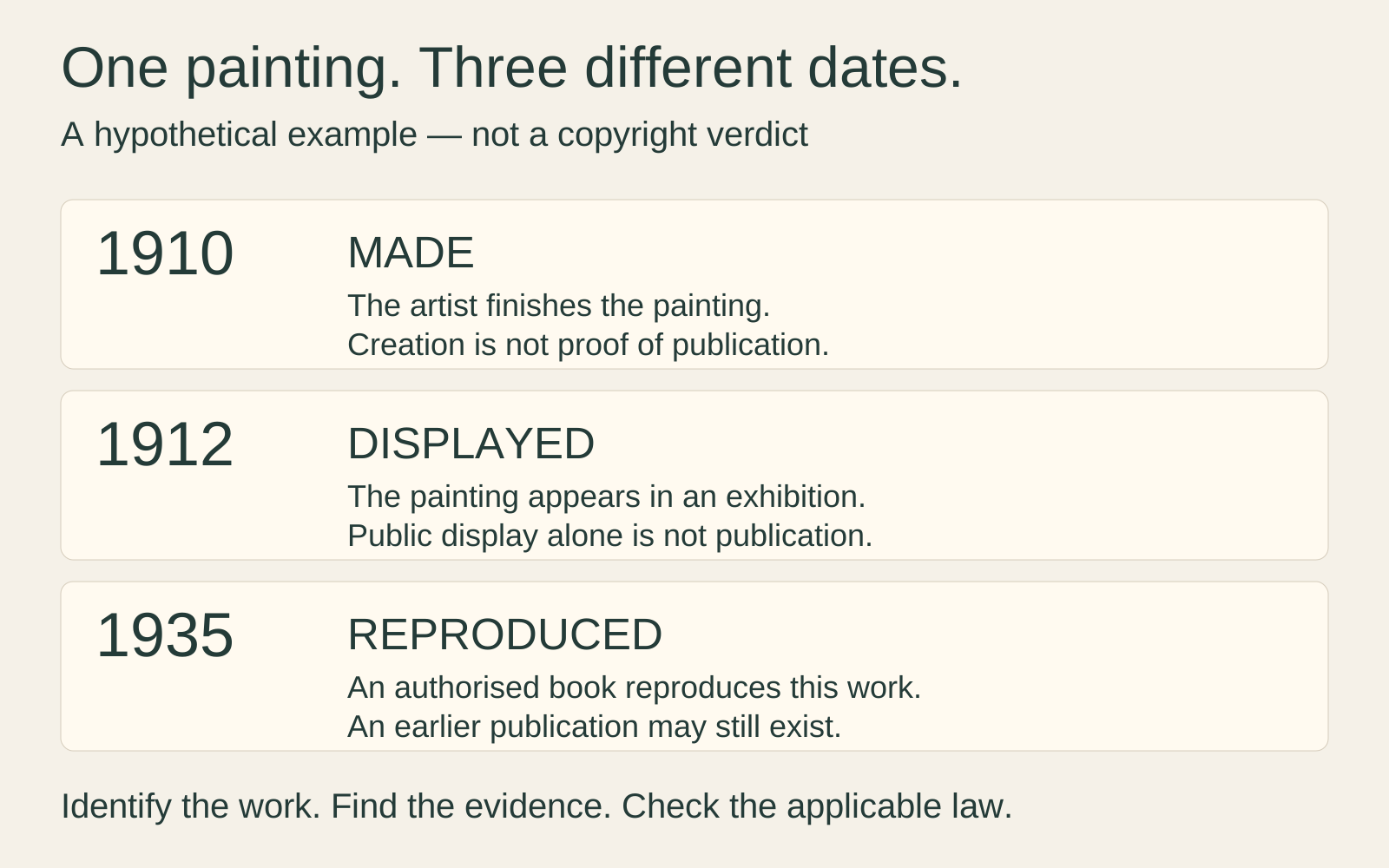
Imagine a hypothetical painting finished in 1910, displayed in 1912 and reproduced in an authorised book in 1935. Those dates describe three different events. Its creation date cannot stand in for the date of that reproduction. Nor does finding the 1935 book establish that no earlier publication occurred.
Start a small record with separate fields: date made, earliest documented distribution or reproduction, registration if relevant, and the evidence supporting each. Put an exhibition date in its own field. This simple separation prevents a museum label from being asked to answer a question it was never designed to answer.
An institutional bibliography can help. Look for an illustrated catalogue entry, not merely the title of an exhibition. Check that the illustration shows this painting, rather than a study, another version or a similarly named work.
What publication means for visual art
The Copyright Office explains that distribution of an original or copies to the public can constitute publication. Its visual-artist guidance distinguishes an authorised commercial-gallery offering from display alone. A work can therefore be published through a transaction involving the original; publication does not always require a mass-produced book.
But “sold in 1912” is still a research lead, not a universal legal conclusion. Was the transaction public? Was it authorised? What restrictions applied? Which legal rules governed that historical event? An incomplete provenance line cannot answer all of these questions.
The Copyright Office’s publication guidance also distinguishes authorised distribution from unauthorised copying. A pirate reproduction is not a safe substitute for proof that the rights holder published the work. For events before 1978, historical publication rules require particular care; do not apply a modern registration example mechanically.
Why 1930 matters in 2026
For many works whose US copyright was secured before 1978, the longest ordinary term is 95 years. The Copyright Office’s duration circular explains the older system and the different treatment of later and unpublished works.
The calendar arithmetic is straightforward once the legal starting point is established: a qualifying 1930 copyright completing 95 years runs through 2025. The complication is establishing that starting point, not adding the years.
Treat the cutoff as a first filter. It can resolve an old, documented publication, but it does not prove first publication, the identity of the reproduced version or the conditions attached to today’s scan. Conversely, a publication after 1930 is not automatically still protected: another rule or an earlier loss of protection may matter.
Earlier loss of copyright can change the answer
Older US law imposed requirements involving notices and renewals. Some works became public domain before their maximum term ended. A missing internet search result, however, is not proof that a renewal never existed.
The Art Institute of Chicago provides a concrete example. Its library exhibition record for American Gothic says Grant Wood’s painting was first published in 1930 and entered the US public domain in 1958 after the renewal window was missed. The estate’s 1980 filing was too late. Consequently, calling it newly public domain in 2026 would erase the earlier event.
For a different work, repeat the research rather than borrowing that result. The Copyright Office’s investigation guide explains how to examine copies and search records, and why even searches have limitations. A work’s alternative titles, publication format and claimant can all affect what you need to investigate.
Unpublished older works need a different route
Some old drawings, notebooks and paintings did not enter the pre-1978 published-work system. Section 303 concerns qualifying works created before 1978 that had not already entered the public domain or secured federal statutory copyright. The Copyright Office describes the relevant category as works neither published nor registered before 1978. It uses the applicable section 302 term, but includes important minimum protection dates.
The section prevents expiry before the end of 2002. For qualifying old works first published between 1978 and the end of 2002, it prevents expiry before the end of 2047. These are minimum protection dates, not universal expiry dates. The Copyright Office’s explanation of the 2003 transition helps explain why an old unpublished work and an old published work can reach different results.
This is especially relevant when a private archive was published decades after the artist’s death. “Made in 1907” or “first exhibited in 1986” does not, by itself, resolve that history. Establish whether and when that exact work was published and which statutory branch applies.
Foreign works bring another check
A French, Swedish or Japanese work may have a different US history from an American publication. Certain foreign copyrights were restored under the Uruguay Round Agreements Act, even when protection had previously been lost in the United States for specified reasons.
The Copyright Office’s restoration circular sets out eligibility and the remaining term. The country of origin, source-country protection at the relevant date and US publication timing can matter. Restoration does not simply create a fresh 95-year term.
This is why “no American renewal found” is a poor universal rule for museum collections containing art from around the world. A result for one US painting cannot settle a European print merely because both were made in the same year.
Check the downloaded file separately
An artwork finding is not a licence for every photograph, book page or edited image depicting it. Identify the exact download and read its terms. An original modern adaptation may contain additional protected material; it does not regain ownership of the underlying public-domain artwork. The Copyright Office’s derivative-work circular explains that distinction.
Keep the object record, publication evidence and file record together. That lets you answer three useful questions: which work is this, why does the US conclusion follow, and where did this particular reproduction come from?
If a material link remains uncertain, say what remains uncertain. A narrower answer that can be checked is more useful than an emphatic yes attached to the wrong date.
For a worked example, see our rights check for Monet’s Woman with a Parasol. Our public-domain introduction separates the artwork, the file and your intended use.
Editorial record
About this article
- Author
- Publisher
- GeMarkt
- Published
- Reviewed
- Internal source & rights check. Conducted by GeMarkt Research Review. This is an internal editorial check—not independent peer review.
- Source standard
- Rights guide source standardSeparates the underlying work from the source file, records the review date, and links the evidence used for the conclusion.
Found a claim that needs checking? Report a factual error.