GeMarkt Blog · Reference
Is Madonna by Edvard Munch Public Domain?
Identify Munch’s Madonna painting and print versions, then separate expired author terms, U.S. publication evidence and the museum photo licence.

The short answer
Munch’s Madonna paintings are beyond the ordinary life-plus-seventy author term, but “Madonna” does not identify one interchangeable image. The National Museum’s photograph of NG.M.00841, illustrated here, carries CC BY 4.0 for the photographic contribution. That licence is separate from the underlying painting’s status in each country.
As of 13 October 2026, this guide has not independently established the specific painting’s U.S. publication and authorisation history. It therefore offers a bounded answer, not a worldwide commercial clearance. For the prints, identify the impression, colour treatment and source as well: a licence for the Oslo canvas photograph does not extend to a different museum’s lithograph.
The Oslo painting checked here
The National Museum record identifies Madonna, NG.M.00841, dated (1894), in oil on canvas, measuring 90.5 × 70.5 cm. Olaf Schou gave it to the collection in 1909. The parenthesised date matters: do not turn a museum’s qualified dating into an exact, documented publication day.
Munch made several painted versions. A search result may show the same pose while pointing to a different physical painting, an impression on paper or a recent reproduction. The title alone cannot tell you which one you have.
Start by matching the accession number and medium. Then compare the image itself. Is the figure surrounded by loose, dark painted lines, or by a sharply defined printed border? Does the page identify canvas, lithography or a combination of printing techniques? These are practical clues, not reasons to guess the source from colour alone.
This guide uses the museum’s current downloadable photograph of its own painting. It does not use a screenshot of a book spread, an auction photograph or an image lifted from a commercial print listing.
Look at the halo and the surrounding lines
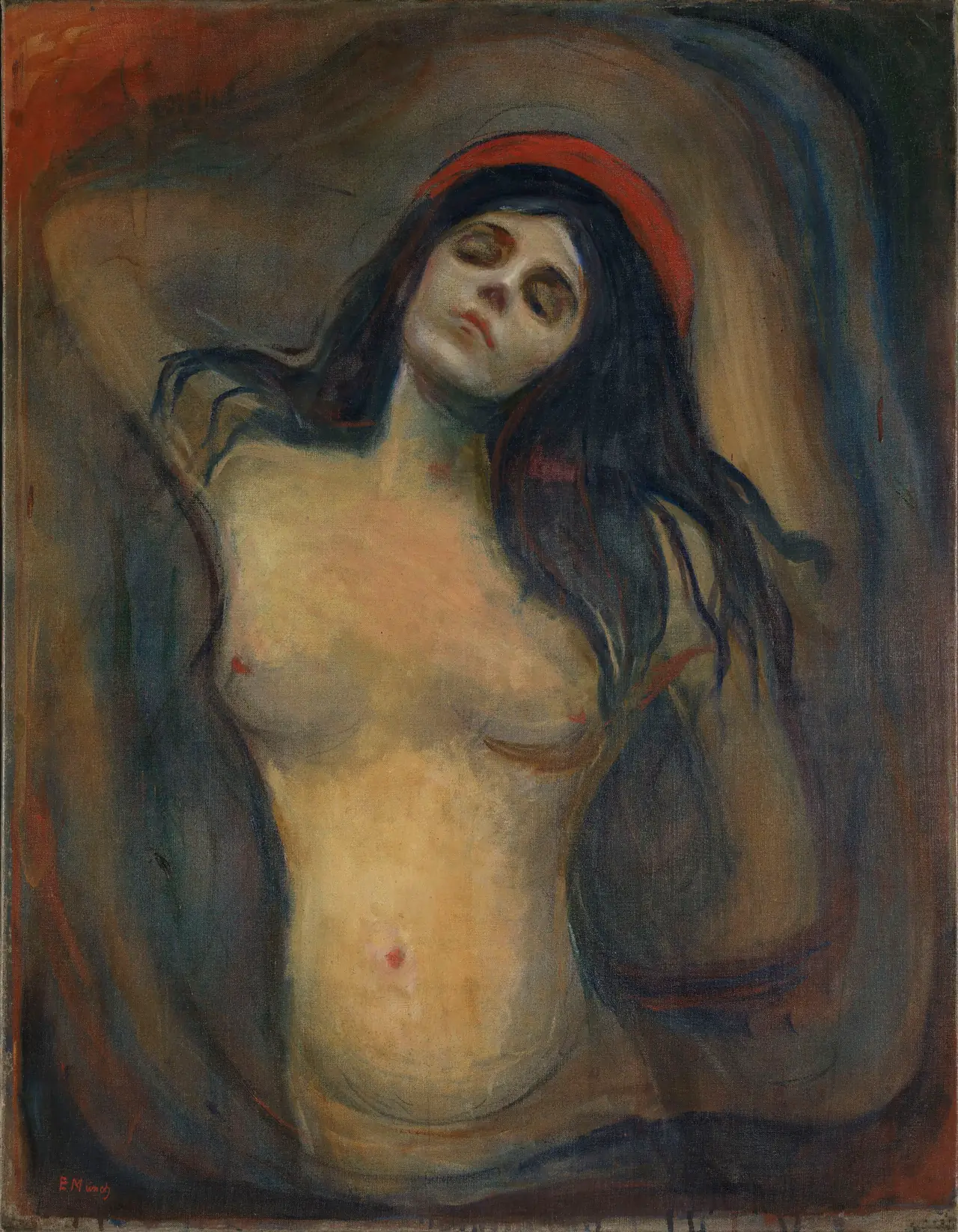
The red band above the head is small compared with the body, yet it anchors the composition. The closed eyes, tilted face and lifted arm draw attention upwards; the dark curves return it towards the torso. The figure seems enclosed without occupying a clearly described room.
Notice how little conventional setting is provided. There is no bed, landscape or recognisable architectural background to tell the viewer exactly what is happening. The pale body and moving outlines do most of the work. A reproduction that clips the upper red band or dark side passages changes that balance, even if it leaves the face intact.
The religious title makes the halo suggestive, but the picture is not a straightforward copy of a traditional mother-and-child composition. Here, no child appears beside the woman. Describing what is actually visible is safer than attaching a familiar religious narrative that this particular image does not show.
Nor should a contemporary colour filter be mistaken for another historical version. A warmer skin tone or stronger red can come from lighting, reproduction or editing. That is why the museum record and the source file matter alongside visual recognition.
The print with a border is another work
The familiar bordered Madonna belongs to Munch’s graphic work. MUNCH records one impression, MM.G.00194-21, as a lithograph dated 1895/1902, printed by M. W. Lassally, and catalogued as Woll G 39 A II / Schiefler 33. A catalogue number for the graphic motif is useful, but it does not identify every sheet’s later treatment.
MoMA’s impression, 114.1956, is described as lithograph and woodcut, dated 1895–1902. Its record names Munch as publisher and Lassally as printer, with approximately 150 impressions in differing colours and compositions. The border’s sperm-like forms and small fetal figure belong to this graphic treatment; their absence from the canvas above is not evidence that we cropped them off.
The two institutional records are not contradictory merely because their techniques or catalogue details differ. They describe particular objects within a changing print practice. For a download, keep the museum accession as well as the general title. For a colour variation, check whether the colour was printed, added by Munch or introduced later by someone else.
Neither of these linked print images is reproduced here. MoMA displays a current rights notice; MUNCH has its own reproduction conditions. Their records support identification, not a transfer of permission to use their files.
A title in an old book is not enough
The National Museum’s catalogue discussion provides a useful warning about early evidence. An 1894 text described a Madonna-face associated with a now-lost precursor. That is not automatically an illustration of the surviving NG.M.00841 canvas. A familiar title can conceal a different object.
The same care applies to publication dates attached to prints. A named publisher and a dated graphic work are meaningful leads. To use them as evidence for a particular painting, however, you must establish what was actually reproduced and distributed, and under whose authority.
Under the U.S. definition of publication, public display alone is not publication. An exhibition appearance, museum acquisition or mention in a review cannot simply take the place of distributed copies of the work. This guide does not treat the 1909 gift as a publication event or the 1894 title reference as proof for every Madonna.
Country rules do not follow the download
Munch died in 1944, according to the National Museum’s artist record. The ordinary life-plus-seventy calculation in UK guidance and EU guidance has expired. National exceptions and moral rights still need their own consideration; this is not a claim that all countries have identical rules.
The U.S. question remains separate. In 2026, works published by 1930 are beyond the maximum ninety-five-year publication term. That shortcut requires evidence of publication, not just a creation date. Older works that remained unpublished and uncopyrighted before 1978 fall under section 303, with transitional provisions that can matter.
We have not independently resolved that history for NG.M.00841. The unresolved point does not prove that the painting remains protected; it means this article should not be used as a complete U.S. clearance opinion. A photographer’s licence cannot grant an underlying right the photographer does not own.
The exact photo permission
The chosen file comes directly from the National Museum’s download for NG.M.00841, with Børre Høstland credited. The institution’s current policy permits reuse of unlabelled works and licenses its photographs under CC BY. The object’s download data specifies CC BY 4.0. That current source, not an old third-party repost, is our photographic permission record.
CC BY 4.0 requires credit, a licence link and a change notice where applicable. Commercial use is permitted under the licence; endorsement is not implied. Our caption identifies the work, photographer, museum and proportional reduction.
Do not transfer these terms to another provider. MUNCH’s photo policy distinguishes non-commercial use and specified publication uses. The National Museum and MUNCH are different institutions, even though both hold Munch works.
What to keep when you reuse Madonna
Keep the object number, source URL, original download and licence together. If the file is replaced, check the replacement. A sharper image of another canvas is not an upgrade to the same photograph; it is a different source decision.
Label a detail as a detail, and identify a modern recolouring as an alteration. Do not erase the photographer’s credit or describe a printed border as part of every painted version. For further examples of Munch’s changing motifs, see our artist guide. The most useful rights record begins with the individual object, not the name alone.
Editorial record
About this article
- Author
- Publisher
- GeMarkt
- Published
- Reviewed
- Internal source & rights check. Conducted by GeMarkt Research Review. This is an internal editorial check—not independent peer review.
- Source standard
- Rights guide source standardSeparates the underlying work from the source file, records the review date, and links the evidence used for the conclusion.
Found a claim that needs checking? Report a factual error.