GeMarkt Blog · Practical guide
Is Henri Matisse’s Art Public Domain? Check the Work and Country
Explore Matisse through two vivid portraits and twelve museum records, with separate checks for French, Spanish, UK and U.S. rights and exact image files.
Rights check · reviewed
The short answer
Some exact museum files are openly available, not the whole catalogue worldwide. France’s ordinary term ended in 2025; Spain’s legacy rule and U.S. publication histories need separate consideration. The two illustrated SMK portraits carry the museum’s Public Domain Mark, not an independent worldwide clearance.
| What is being checked | Result | Why |
|---|---|---|
| France — ordinary economic rights | 2025 change confirmed by BnF | The French National Library confirms 1 January 2025. Moral rights and independently authored reproductions remain distinct; no worldwide inference. |
| European Union — national exceptions | Do not generalise France to all countries | Ordinary life-plus-70 is not the complete national/transitional analysis. Spain retains its pre-1987 legacy term; do not treat Matisse as cleared there by the French 2025 announcement. |
| Spain — legacy term | Longer term requires territorial review | BOE transitional provision four and BNE describe the older 80-year rule. With Matisse’s 1954 death, that calendar calculation points to 2035, not 2025. |
| United Kingdom — ordinary painting term | Ordinary painting term elapsed | The IPO guidance distinguishes older unpublished engravings and specified material; its 2039 rule is not a blanket extension for paintings. Later photographs and editions are separate. |
| United States — all twelve research objects | Independent publication histories unresolved | Museum public-domain flags are attributed. Creation dates, exhibitions and bibliography entries alone are not checked authorized historical publication. No all-pre-1931-creation or all-post-1930-protection claim. |
| Selected digital files | Two exact SMK Public Domain Mark images | Portrait of Madame Matisse. The Green Line and Self-Portrait use the museum’s official files. PDM is not CC0, a worldwide warranty or permission for unrelated modern reproductions. |
| Other files | Ten display HOLDs | No remaining file has been acquired for display. AIC sampled image requests returned HTTP403; no bypass. Current SMK Jazz is not marked public domain. |
Twelve exact research records: two selected SMK files and ten display HOLDs. Jazz is a 1947 book not marked public domain in the current SMK record; The Serf has a separate casting date. This bounded guide supersedes the old twelve-cleared-file requirement, not the unresolved legal or file conditions.
This is a documented research summary, not legal advice. Copyright and moral-rights rules can vary by country and by the history of a particular work.

What we’ll look at
Which Matisse work, country and image file are you checking?
Short answer: Some Matisse images are openly available, but there is no worldwide yes for the whole catalogue. France’s ordinary economic-right term ended in 2025; Spain has a longer legacy rule, and U.S. results depend on the particular work’s publication history. The two portraits here use SMK’s Public Domain Mark files, not a claim that every Matisse download is cleared everywhere.
Start with a named object. Portrait of Madame Matisse. The Green Line is a particular 1905 painting in Copenhagen. Jazz is a 1947 printed book. Treating both simply as “Matisse art” loses the information needed to understand either the image or its rights.
Colour that does more than describe
Henri Matisse lived from 1869 to 1954. His work includes painting, drawing, sculpture, prints and cut paper; the familiar bright shapes are only one part of that long career. MoMA’s collection places early paintings such as Dance (I) alongside sculptural studies and later cut-out work.
The useful starting question is not whether a colour looks realistic. Ask what it does to the shape beside it. A green strip can divide a face; a dark contour can hold a shoulder against a pale ground. The subject remains recognisable even when colour stops imitating the light in a room.
That approach makes two small portraits a good introduction. They show Matisse painting somebody close to him and then turning the same searching attention on himself. Neither needs to be mistaken for a photograph to feel specific.
The Green Line
The opening image depicts Matisse’s wife, Amélie. SMK identifies the painting as Portrait of Madame Matisse. The Green Line, 1905. Its collection interpretation connects the unusual colour to experiments Matisse and André Derain made at Collioure that summer.
Look first at the stripe running down the forehead and nose. It divides two differently coloured halves without turning the head into two separate faces. Yellow occupies much of the viewer’s left; pale pink and cooler marks occupy the right. Dark eyebrows and the line of the mouth hold those large areas together.
Then look outside the face. The orange field on the left and green on the right continue the division, but not as a tidy mirror. Pink appears both in the upper background and the blouse below. The portrait works as a set of connected colour decisions, not just a likeness with an eccentric green nose.
For a reproduction, the surrounding fields matter. Cropping tightly to the eyes would remove the coloured ground that makes the face so forceful. The museum’s supplied file presents the painting without a decorative frame; our display retains that supplied composition. It is not a mockup of a framed product.
Self-Portrait
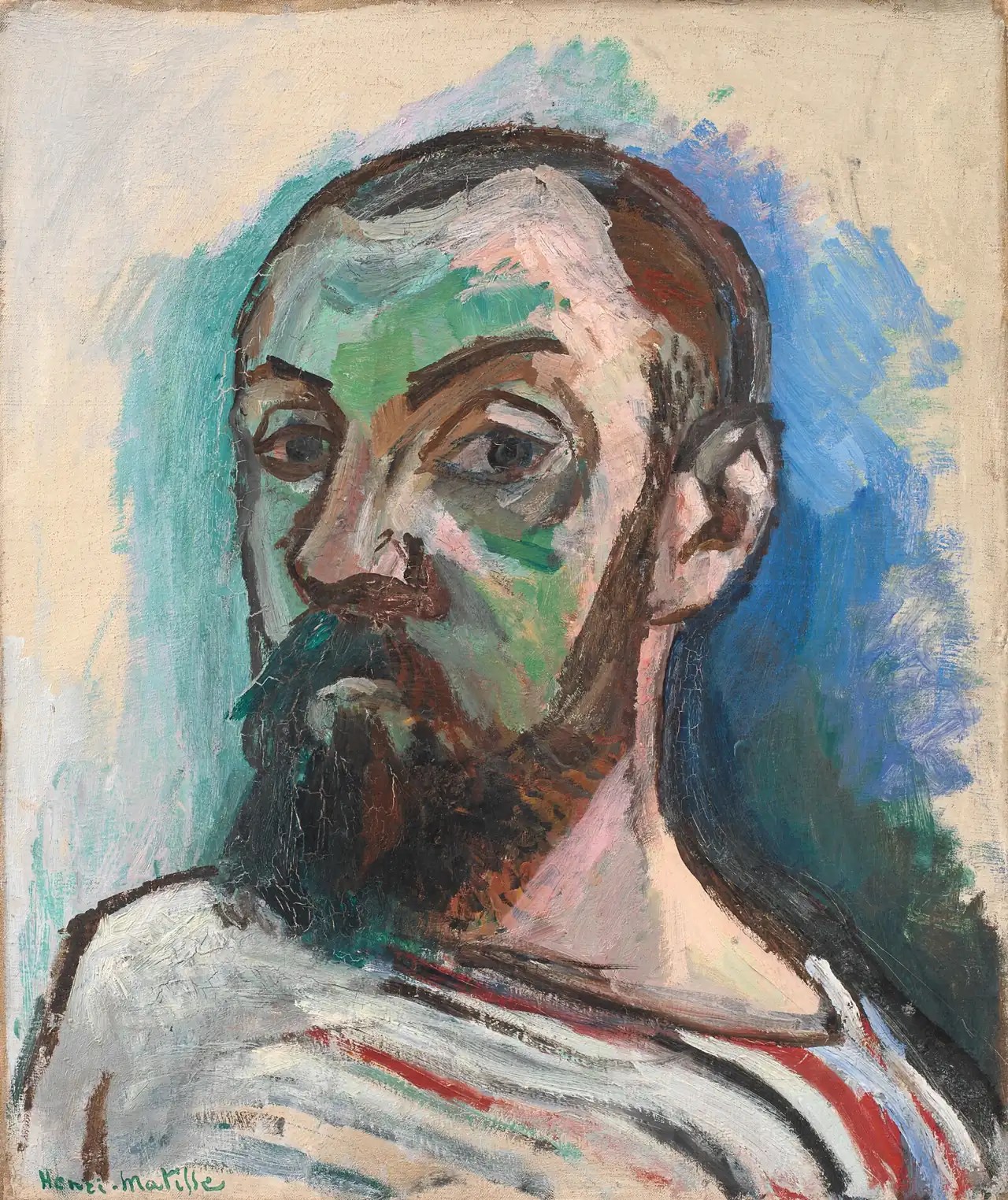
In SMK’s 1906 self-portrait, the colour is less sharply divided. Green crosses the forehead and cheek in separate strokes. Pink runs along the temple, ear and neck. The beard provides a darker mass, while red stripes carry the eye across the lower edge.
The background is particularly revealing. Blue-green paint gathers around the head, but broad cream areas remain near the top and sides. This is not a fully described studio interior. The visible marks give the head a setting without telling us what furniture stands behind it.
Compare the two faces rather than ranking one as more accurate. Amélie’s portrait has a more frontal, compact arrangement; the self-portrait turns slightly and lets the shirt sweep diagonally across the bottom. Both make a person legible through the organisation of colour. The differences are a useful reminder that “Matisse style” is not a single reusable template.
Twelve works to identify
These are twelve exact collection records, not twelve approved downloads. Only the two portraits above have display files checked for this guide. The other links let you investigate the objects at their institutions; their publication histories and image permissions need separate attention.
| Work | Museum date | Exact institutional record |
|---|---|---|
| Portrait of Madame Matisse. The Green Line | 1905 | SMK KMSr171 |
| Self-Portrait | 1906 | SMK KMSr78 |
| Goldfish | 1912 | SMK KMSr82 |
| Interior with a Violin | 1918 | SMK KMSr83 |
| Odalisque | 1923 | SMK KMSr87 |
| Jazz | 1947 | SMK KKSbog18297 |
| Bathers | 1907 | SMK KMS8867 |
| Woman on Rose Divan | 1921 | Art Institute of Chicago 27980 |
| Woman before an Aquarium | 1921–23 | Art Institute of Chicago 27984 |
| Apples | 1916 | Art Institute of Chicago 64001 |
| Still Life with Geranium | 1906 | Art Institute of Chicago 87045 |
| The Serf | 1900–03; cast about 1908 | Art Institute of Chicago 64916 |
Two distinctions are worth keeping. The Copenhagen Goldfish record identifies one particular painting, not every work Matisse made around that subject. The Serf records both the sculpture’s development and the later casting date. A new photograph of that three-dimensional bronze is another authored image, not automatically equivalent to a faithful scan of a flat painting.
What changed in 2025?
The Bibliothèque nationale de France confirms the entry of Matisse’s work into the public domain from 1 January 2025 in its French account. This removes a major economic-right barrier, not every condition attached to every reproduction.
The ordinary EU term is life plus seventy years, but national and transitional rules still matter. Spain’s fourth transitional provision preserves its older term for authors who died before 7 December 1987. The Spanish National Library explains that term as eighty years. A French announcement should therefore not be read as blanket Spanish clearance; that legacy calculation points to 2035 for Matisse.
The UK’s ordinary painting term has likewise elapsed. Its older unpublished-work provisions require care with engravings and other specified material; they should not simply be applied to every painting. Moral rights, a new translation, book design or photograph can raise additional questions even after the artist’s economic rights expire.
The U.S. question is about publication
Under the ordinary U.S. maximum term for older published works, publication through 1930 falls beyond ninety-five years in 2026. That is a publication boundary, not a painting-date test. Later publication, renewal, restored foreign rights and previously unpublished material require their own analysis. The Copyright Office’s duration provisions explain the different routes.
This guide does not independently establish U.S. publication histories for the twelve objects, including the illustrated portraits. SMK’s Public Domain Mark is reported as the provider’s designation. Its bibliographies supply useful leads, not a substitute for checking a dated reproduction and the circumstances of publication.
The reverse shortcut is also wrong: “made after 1930” does not itself prove continuing protection. For a particular late print or book, identify the edition and relevant rights history. Here, Jazz remains a research link; SMK’s current record does not mark that book public domain, and its images are not reproduced.
Choosing an exact image
Use the museum record to match title, date, collection number and composition before evaluating a download. Then keep the source URL and its rights statement with the file. The two portraits here come from SMK’s own image service under its Public Domain Mark, rather than an unattributed image search result.
A public-domain designation is not a guarantee about every jurisdiction or a licence to unrelated modern material. Nor does an image visible on a museum website necessarily carry the same status as its neighbour. Do not transfer the portraits’ file statement to a catalogue cover, a photographed sculpture or a recent exhibition installation.
Finally, inspect the picture itself. Keep the painted edges, compare the colours with the source and avoid replacing visible brushwork with automated smoothing. In these portraits, a jagged green stroke or uneven blue edge is part of the painting’s argument. A cleaner-looking file is not always a more faithful one.
Sources and review method
We checked the artist chronology against museum records, treated each named jurisdiction separately, and recorded the provider policy for the image set. These sources support the legal framework and artist dates used above; the source file for any individual image still needs its own record.
- Portrait of Madame Matisse. The Green Line — SMK. Exact 1905 painting, Amélie, collection number, composition and PDM image.
- KMSr171 machine-readable record — SMK. Preserved source metadata, PDM flag and official IIIF file.
- Self-Portrait — SMK. Exact 1906 painting and selected PDM image.
- Jazz — SMK. 1947 edition, contributors and false public-domain flag; no acquired image.
- L’œuvre de Matisse à la portée de tous — Bibliothèque nationale de France. French 1 January 2025 term change, not global image permission.
- Copyright in the EU — European Union — Your Europe. Ordinary term and importance of national law.
- Intellectual Property Law, transitional provision four — BOE. Older Spanish term preserved for pre-1987 deaths.
- ¿Qué obras se considera que se encuentran en dominio público? — Biblioteca Nacional de España. 80-year explanation; official indexed text checked, direct page returned403.
- Copyright Notice: Duration of copyright — UK Intellectual Property Office. Ordinary painting term and medium-specific unpublished exceptions.
- U.S. Copyright Act, Chapter3 — U.S. Copyright Office. Distinct publication and unpublished-work routes; no per-object clearance asserted.
Editorial record
About this article
- Author
- Publisher
- GeMarkt
- Published
- Reviewed
- Internal source & rights check. Conducted by GeMarkt Research Review. This is an internal editorial check—not independent peer review.
- Source standard
- Rights guide source standardSeparates the underlying work from the source file, records the review date, and links the evidence used for the conclusion.
Found a claim that needs checking? Report a factual error.