GeMarkt Blog · Reference
Germany’s Museum Photo Ruling: The Reiss-Engelhorn Case, Then and Now
What Germany’s 2018 museum-photo ruling decided, how the law changed in 2021, and why photographic copyright and museum access remain separate questions.

The short answer has a date
Germany’s Reiss-Engelhorn museum-photo case does not establish that every photograph of an old painting is protected today. The Federal Court of Justice upheld protection for the photographs before it in December 2018. German law subsequently changed: §68 now excludes reproductions of public-domain visual works from specified related-rights protection. A separate question in the case concerned a visitor’s agreement not to take photographs.
Those distinctions matter if you find a warning saying that a museum owns copyright in an image because it paid for the photography. The warning might describe the old ruling, an original photograph, an access condition—or several things compressed into one sentence. Identify which claim is actually being made before deciding what follows.
This guide explains the historical decision and the current provisions, checked on 13 October 2026. It is general information, not advice about a particular dispute or permission to reuse a contested file.
Two sets of images, two legal questions
The case was Museumsfotos, I ZR 104/17, decided on 20 December 2018. The museum in Mannheim had published photographs of public-domain paintings in a 1992 publication. The defendant scanned those photographs. He also photographed other public-domain works during a museum visit in 2007. Both groups of files were uploaded to Wikimedia Commons. These facts appear in paragraphs 1–4 of the judgment reproduced by WIPO Lex.
The first group raised a claim about rights in the museum’s photographs. The second raised a claim about the conditions under which the visitor had entered and photographed the collection. The age of the underlying artworks did not make those two disputes identical.
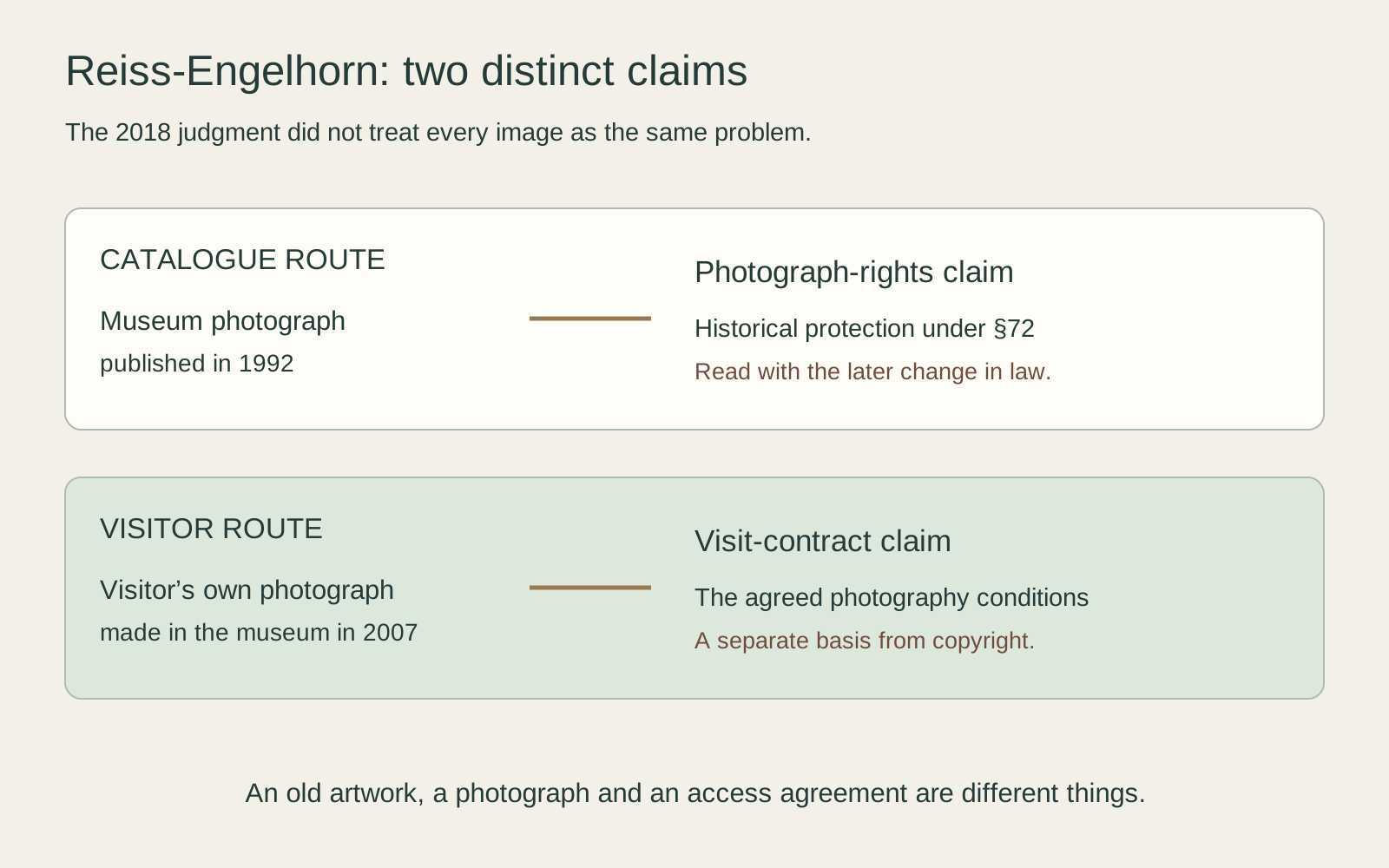
Imagine two researchers using the same painting. One copies a photograph from a book. The other takes a camera into a gallery. Their final images might look similar, but the route by which each image was made can introduce different issues. That is the most useful starting point for understanding this case.
Why the catalogue photographs were protected
German law distinguishes original photographic works from the related protection given to simpler photographs. In 2018 the court held that the museum photographs qualified at least for the latter protection under §72. It did not need to decide that every faithful reproduction was a new artistic creation.
The court discussed choices such as distance, position, exposure and framing. Even when those choices aimed at accurate reproduction rather than artistic expression, they could meet the modest threshold then required for photograph protection. It also distinguished making the original photograph from mechanically copying an existing photograph. See paragraphs 20–32 of the decision.
That is why translating the result simply as “the court found creativity in copying” loses an important part of the reasoning. A related right was doing work that ordinary copyright in an original photographic work did not have to do.
The general §72 provision still exists. But reading it alone today misses the specific exclusion in §68. A current answer needs both provisions, not a quotation from the earlier judgment detached from later legislation.
The visitor’s own photographs were a different problem
The court upheld the claim concerning the visitor’s photographs on the basis of the museum visit contract. It accepted that clearly displayed camera-prohibition signs and visitor rules had become part of that agreement. The claimed permission from a member of staff had not been proved. The court therefore did not need to resolve the alternative property-law claim. This distinction is explicit in paragraphs 34–43 of the judgment.
The lesson is narrower than “museums can copyright whatever they own.” The result concerned this visitor, these conditions and these acts. Nor does it establish that any statement on any museum website automatically binds every later user of a file.
For your own visit, establish the photographic conditions before taking pictures. Permission to enter, permission to photograph and permission for a proposed commercial shoot are not interchangeable. A public-domain conclusion about the painting is not a substitute for that conversation.
What changed after the ruling
Article 14 of Directive (EU) 2019/790 addresses reproductions of visual art whose copyright has expired. The resulting material is not to acquire copyright or related rights unless it is itself original in the sense of the author’s own intellectual creation.
Germany implemented this change through §68 of its Copyright Act. It excludes reproductions of public-domain visual works from related rights under Parts 2 and 3. The government’s explanatory memorandum, pages 105–106, specifically discusses Museumsfotos. It explains the intended application to existing reproductions as well as newly made ones when the rule took effect on 7 June 2021.
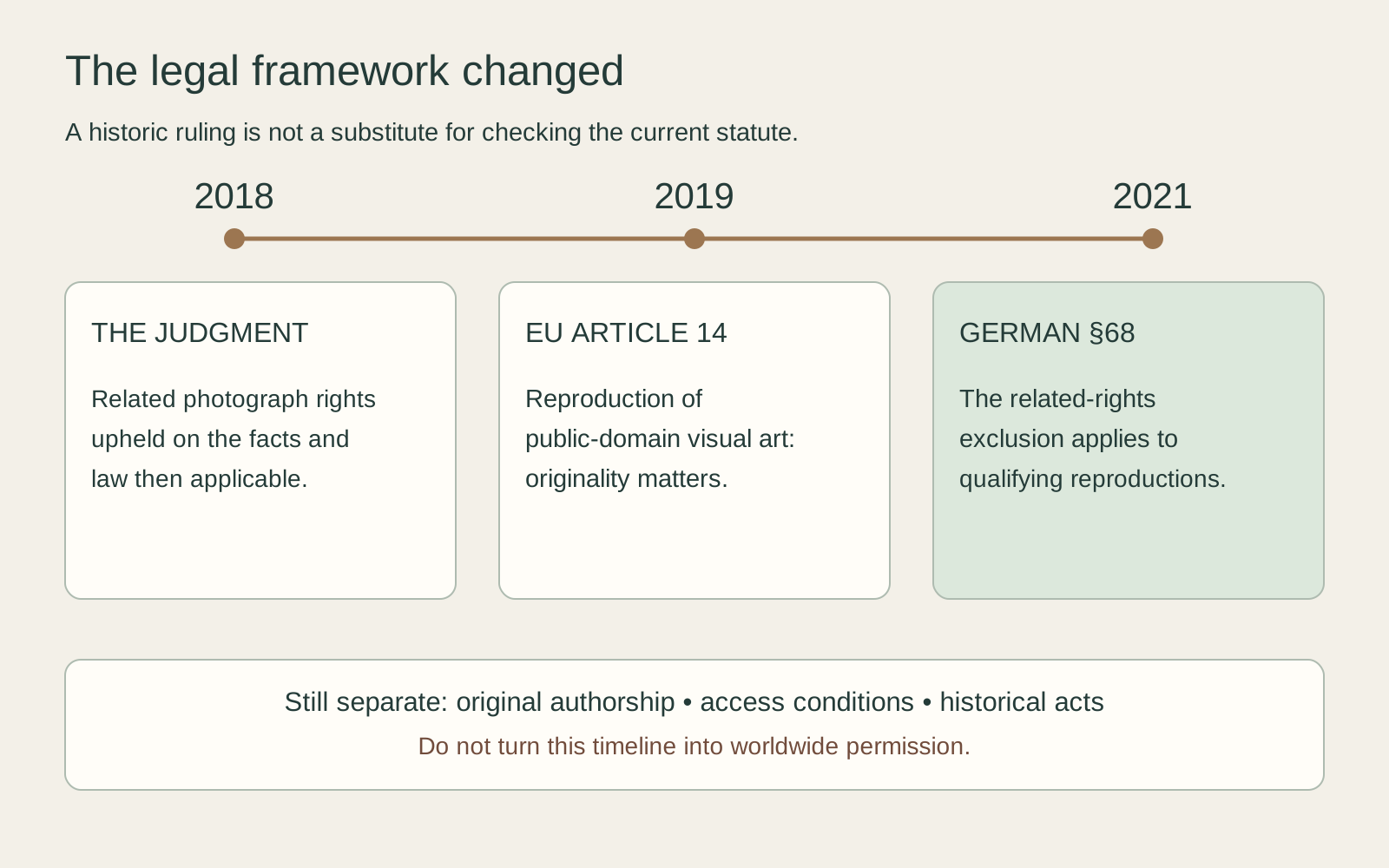
This is a change in the legal framework, not a reason to pretend the 2018 court applied a rule that did not yet exist. Equally, an old date on a reproduction is not by itself a way around the new exclusion. Historical acts and acquired rights require temporal analysis; Article 26 also addresses that issue. An existing injunction or settled dispute should not be treated as automatically cancelled by a general explainer.
An original photograph is not the same as a faithful copy
The exclusion does not mean that every photograph containing an old artwork lacks protection. §2 recognises photographic works and requires personal intellectual creation. Article 14 expressly preserves the possibility of original material resulting from reproduction.
Consider a photograph of a sculpture with a distinctive viewpoint and lighting, or a gallery interior arranged around visitors and several objects. Its potentially protectable contribution is not necessarily the old artwork alone. By contrast, a flat image made only to reproduce a public-domain painting raises the specific question addressed by the reproduction rule.
These are examples for analysis, not automatic verdicts. “Photograph” is a file description, not a complete legal classification. Our guide to whether a photograph of a painting has its own copyright explains why the actual image matters.
Check the museum’s current rules
Do not use the 2007 visit conditions as a description of what the museum allows now. The Reiss-Engelhorn museums’ current visitor FAQ permits photography without flash for private purposes, with exceptions for marked objects and designated special exhibitions. It says commercial or editorial photography requires prior written permission. That is the institution’s current stated policy, not a new judicial ruling.
This difference makes date checking practical rather than academic. Someone planning a shoot today needs today’s conditions. Someone analysing the old case needs the conditions proved in that litigation. Neither should substitute one document for the other.
How to use the case in your own research
Start with the exact artwork and its status in the country relevant to your use. Then identify the file: who made it, whether it is a faithful reproduction or something more, and where you obtained it. Keep the source page and the applicable permission statement with your notes.
Next separate copyright from access. If you made the image during a visit, record the terms you accepted. If a museum supplies a file under an express licence, read the actual scope instead of inferring permission from a download button. Where a rights assertion appears inconsistent with the current reproduction rule, ask for its legal basis; do not assume the assertion either creates copyright or can safely be ignored.
Finally, name the authority accurately. Museumsfotos is a German Federal Court of Justice judgment about particular photographs and conduct. It is not the US Bridgeman decision, and neither decision is worldwide clearance. The durable lesson is to read the image, the country, the date and the asserted right together.
Editorial record
About this article
- Author
- Publisher
- GeMarkt
- Published
- Reviewed
- Internal source & rights check. Conducted by GeMarkt Research Review. This is an internal editorial check—not independent peer review.
- Source standard
- Rights guide source standardSeparates the underlying work from the source file, records the review date, and links the evidence used for the conclusion.
Found a claim that needs checking? Report a factual error.