GeMarkt Blog · Essay
Early Netherlandish Painting: Van Eyck, Bosch and Bruegel
Look closely at eight paintings by five artists, from Van Eyck’s reflective rooms to Bosch’s imagined worlds and Bruegel’s working landscapes.

A tiny mirror can open another room. A carpenter’s workshop can sit beside an angel’s arrival. A distant field can contain as much human activity as the crowded foreground. Early Netherlandish painting rewards looking at the whole picture, then returning to something almost too small to notice.
That precision does not make these paintings simple records of life. An apparently solid room may contain a miracle; a carefully described bird may belong to an impossible world. The painters made things convincing so that an encounter, belief or invention could feel present.
The eight works below follow five artists and workshops from devotional interiors to Bruegel’s seasonal landscapes. The aim is to recognise their different ways of constructing a world, rather than treating every shiny object as a secret code.
What Early Netherlandish means
“Netherlandish” refers here to the historic Low Countries, not just the modern Netherlands. The Met’s introduction centres on painting of roughly 1420–1550, including the workshops and markets of Bruges and Antwerp. These were connected places, not isolated national schools.
Bruegel’s paintings of 1565 extend this route beyond that conventional early period into the sixteenth-century Northern Renaissance. They are not contemporary with Van Eyck, who died in 1441. Nor is this the seventeenth-century Dutch Golden Age.
Look for particular surfaces, carefully arranged sightlines and small incidents that reward sustained attention. Oil paint helped artists explore these effects, but Van Eyck did not invent it. And neither meticulous technique nor familiar furniture guarantees an ordinary subject. The relationship between the visible and the imagined is often the point.
Campin’s workshop: the Mérode Altarpiece
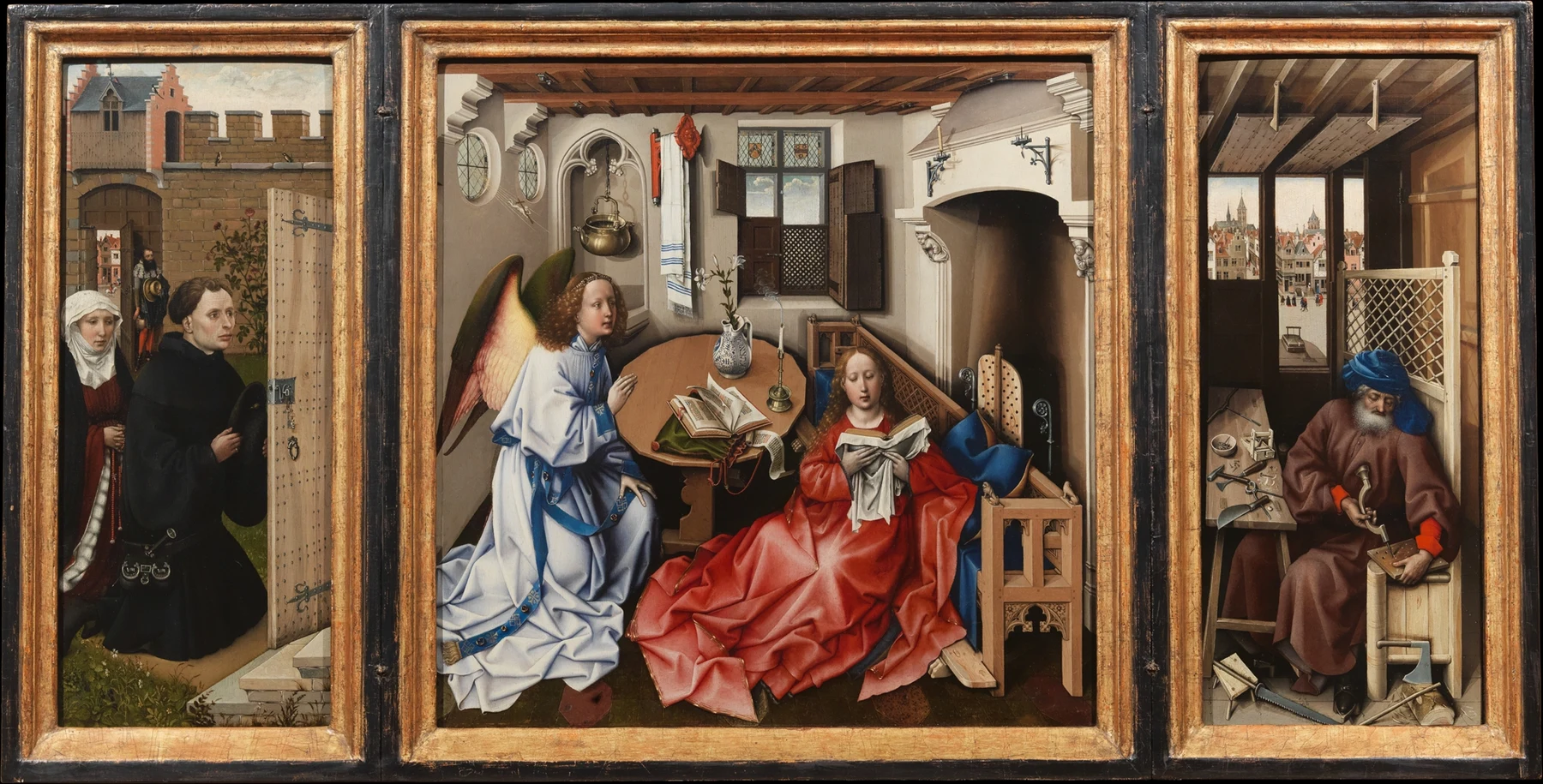
Begin with the table. Its tilted top gives us a generous view of the book, vessel and candle, while the floor and bench crowd towards the foreground. The space is intelligible without behaving like a photograph taken from one fixed position.
Mary reads beside the newly arrived Gabriel. Through the left-hand doorway, the kneeling donors approach the sacred scene; on the right, Joseph works among tools. The three panels connect prayer, a biblical event and a recognisable environment of domestic work.
The Met attributes the triptych to Campin’s workshop, not confidently to one individual hand throughout. Its technical account describes changes and additions made in stages. That matters: an early Netherlandish masterpiece could be a developing object made by several people, not a single untouched moment of genius. Notice how the doors let different kinds of time coexist without dissolving the scene’s everyday solidity.
Van Eyck: the Arnolfini Portrait
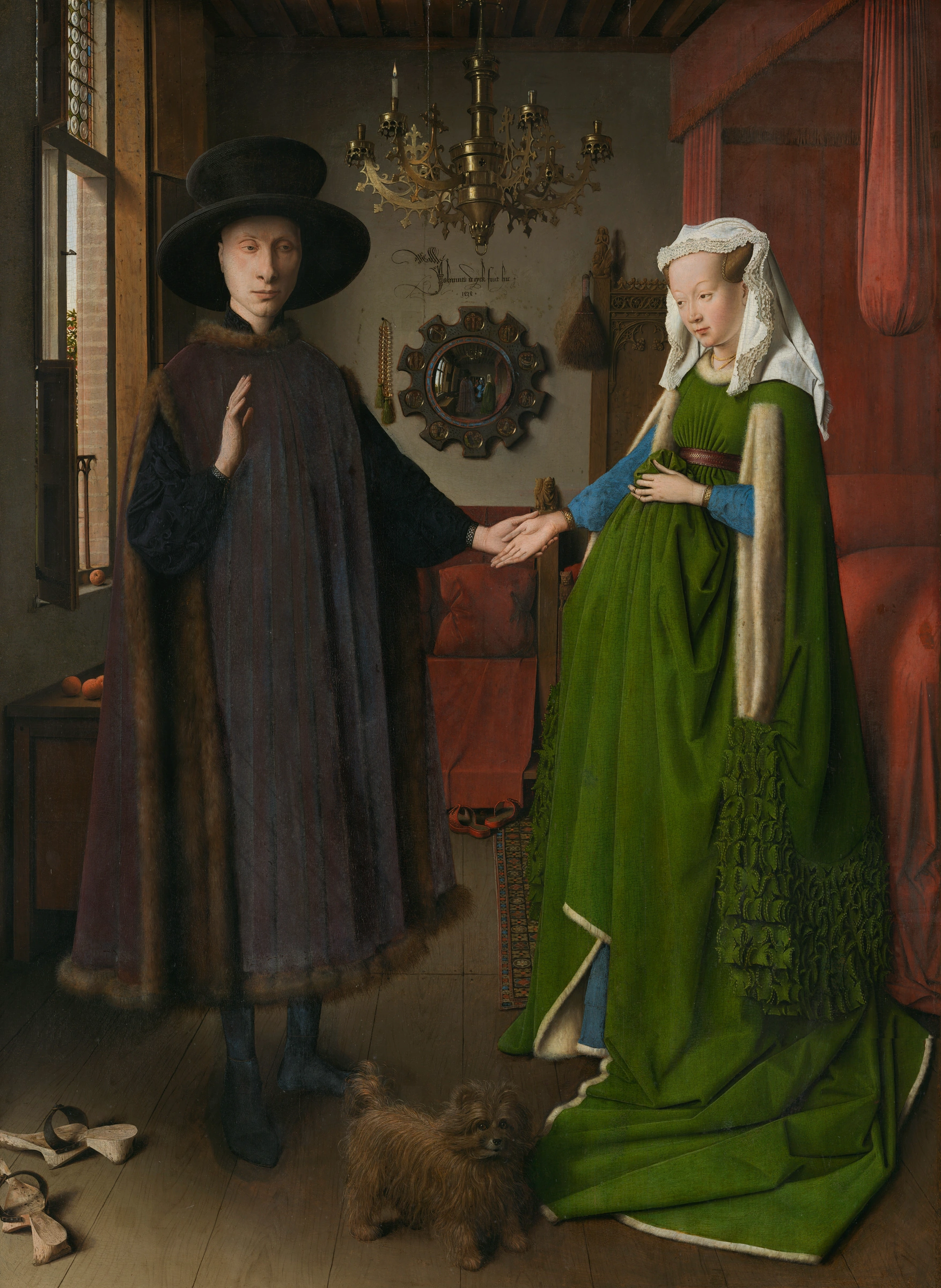

Van Eyck turns a room into a meeting. The figures face partly towards us, the joined hands establish a connection, and the mirror shows a space beyond what we can see directly. Move between the soft fur, polished metal and folds of green cloth: different kinds of reflected light make each material distinct.
The National Gallery’s record identifies the painting as a portrait of a wealthy couple, probably Giovanni di Nicolao Arnolfini and his wife. The exact occasion and identities have prompted debate. It is unwise to turn the whole scene into a confidently decoded wedding certificate.
The raised fabric is not proof of pregnancy either. You can appreciate the deliberate display of wealth and the strange intimacy of the room without pretending every detail has one settled explanation. Our Arnolfini story follows the mirror and clothing more closely.
Van Eyck: the Crucifixion and the Last Judgment
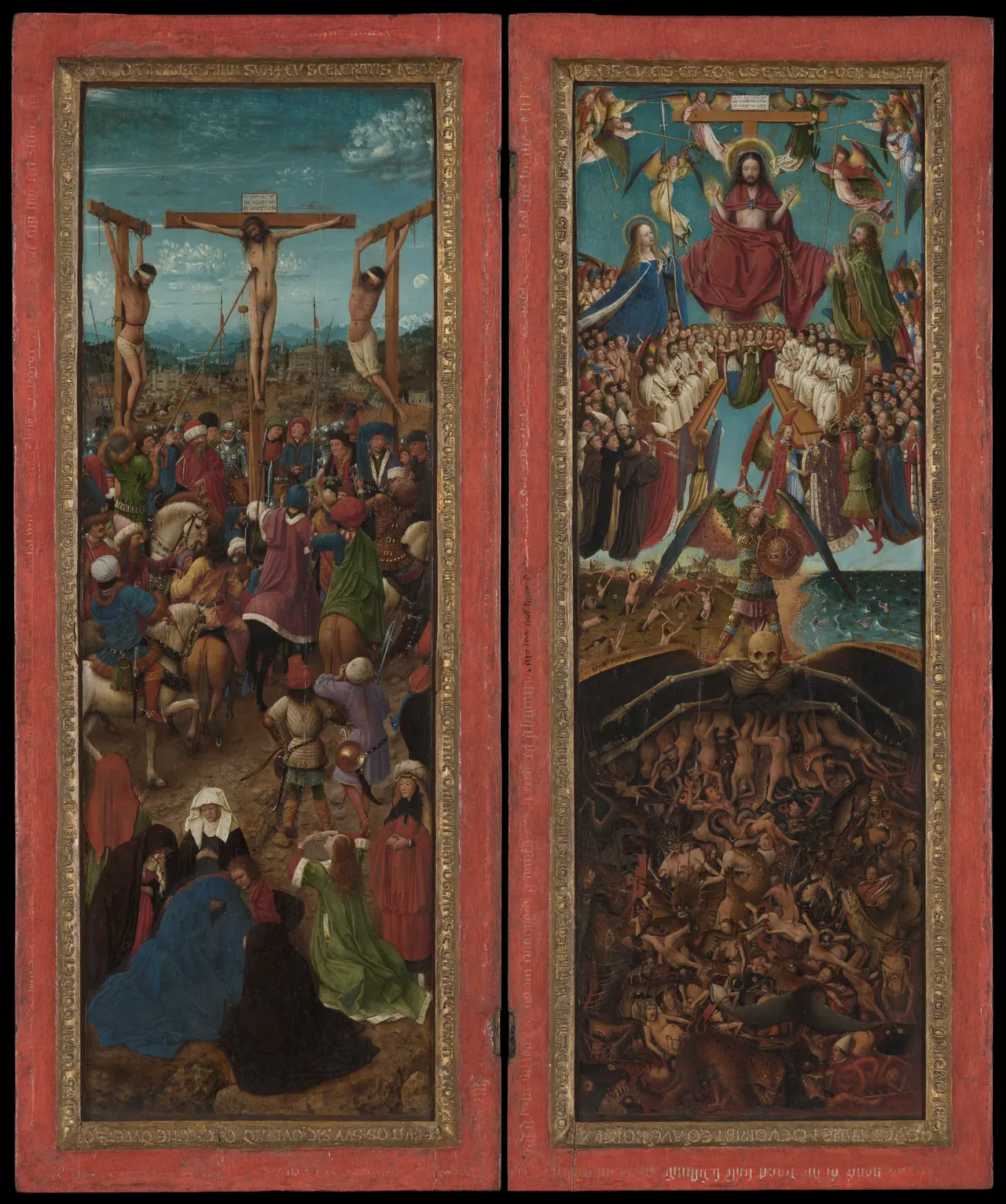
These narrow paintings show how much a small surface can contain. In the Crucifixion, the eye climbs from grief in the foreground through spectators towards the crosses and distant city. In the Judgment, ordered ranks above give way to a tangled darkness below.
The contrast is not just between two locations. One panel organises an event across receding space; the other stacks a moral universe vertically. Similar precision serves very different kinds of explanation.
The Met’s technical research indicates that the panels were not originally arranged as the familiar two-part object shown here: they may have been wings or shrine doors. Its interpretation also addresses antisemitic imagery in the Crucifixion’s crowd. Admiring the painting’s invention should not make its hostile historical stereotypes invisible. Close looking includes asking who is characterised sympathetically and who is turned into a threatening type.
Petrus Christus: A Goldsmith in his Shop
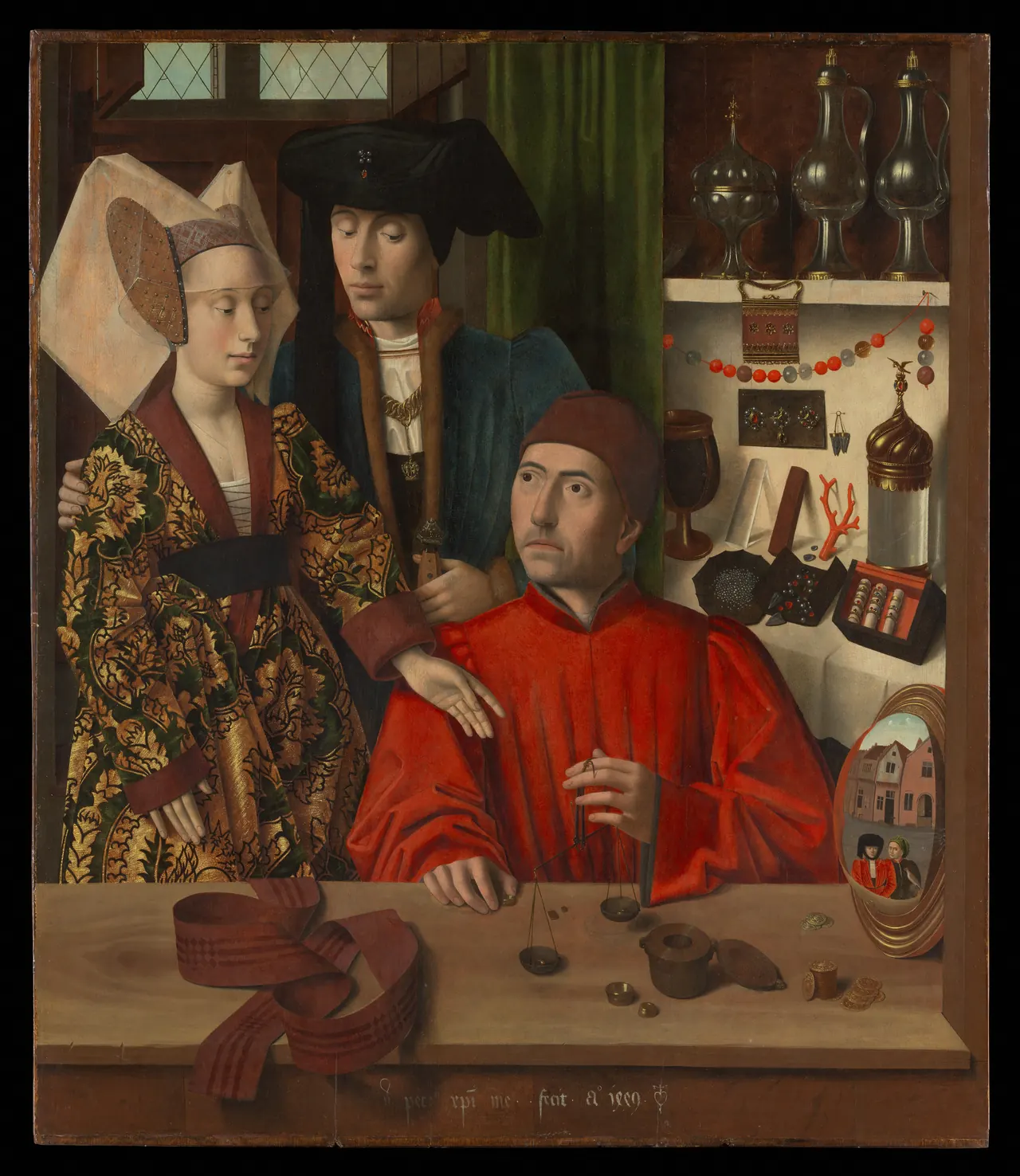
Another mirror, another carefully stocked interior. Here the small reflection belongs to the public world outside the shop. Inside, a balance, rings, containers and shining vessels surround a seated craftsman. The counter gives our eye a place to stand, almost as though we were customers.
Christus makes painting and metalworking seem related: both require attention to materials, edges and the effects of light. Compare the thin balance arm with the heavy red folds of the man’s clothing. The finely described objects do not all have the same visual weight.
The central figure was once read as Saint Eligius because of a halo later recognised as an addition and removed. The Met now favours a professional portrait or representation of goldsmithing, without treating the sitter’s proposed identity as certain. A convincing face is not the same thing as a securely identified person.
Bosch: the Adoration of the Magi
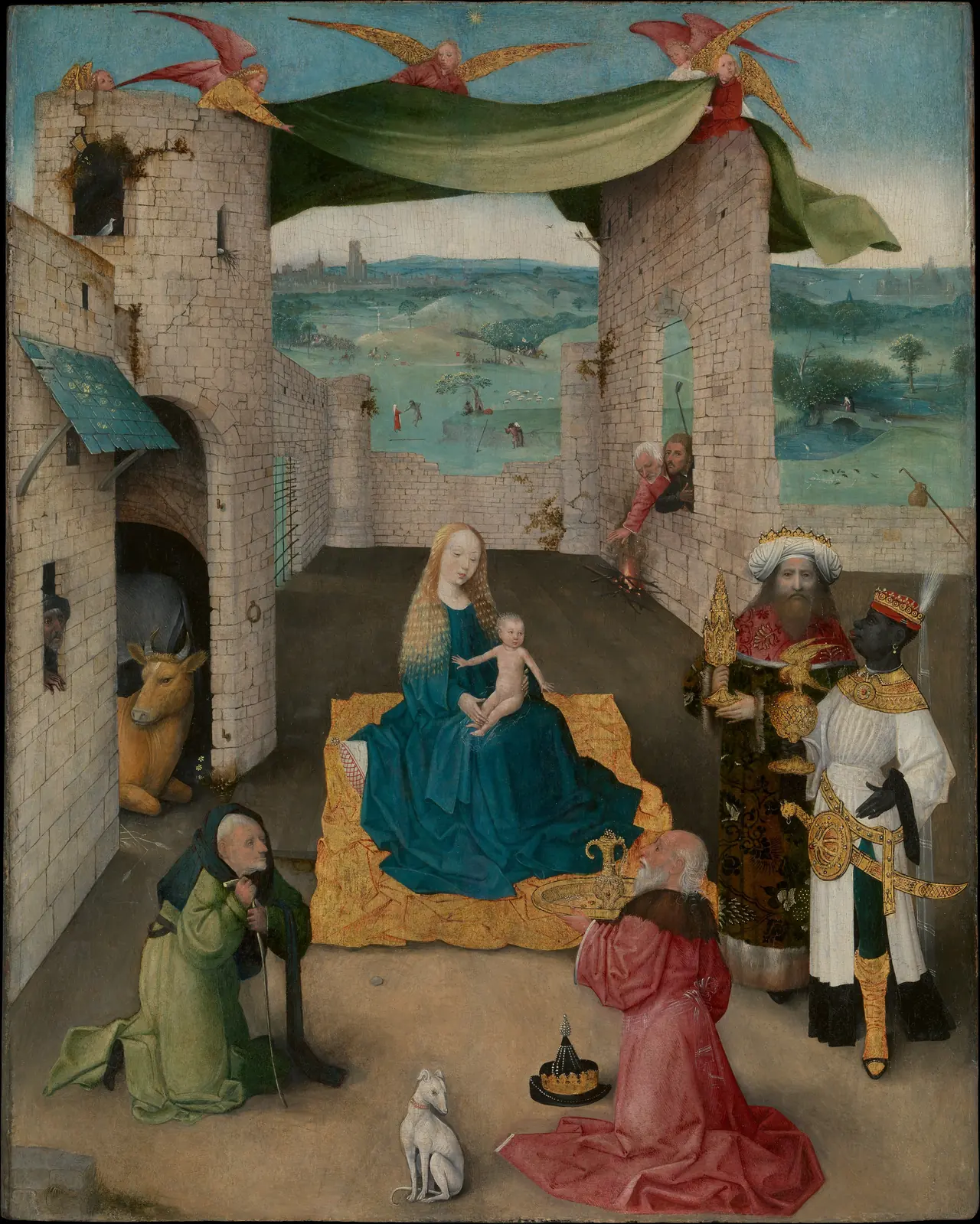
If Bosch means only monsters to you, pause here. The kneeling visitor, richly dressed companions and central child establish a quiet ceremonial encounter. Behind them, broken masonry leaves large openings into a green landscape. The space feels both sheltered and exposed.
The cloth held above by angels makes the gathering look staged, an effect the Met relates cautiously to religious plays. At the same time, small figures peep around a wall while distant people continue their activities. There is more than one way of watching the event.
This early work is useful because it connects Bosch to Netherlandish devotional painting rather than making him an inexplicable exception. His precise surfaces and populated distances can serve a familiar sacred story. The extraordinary worlds of his later reputation grow more interesting when set beside this measured, attentive scene.
Bosch: the Garden of Earthly Delights
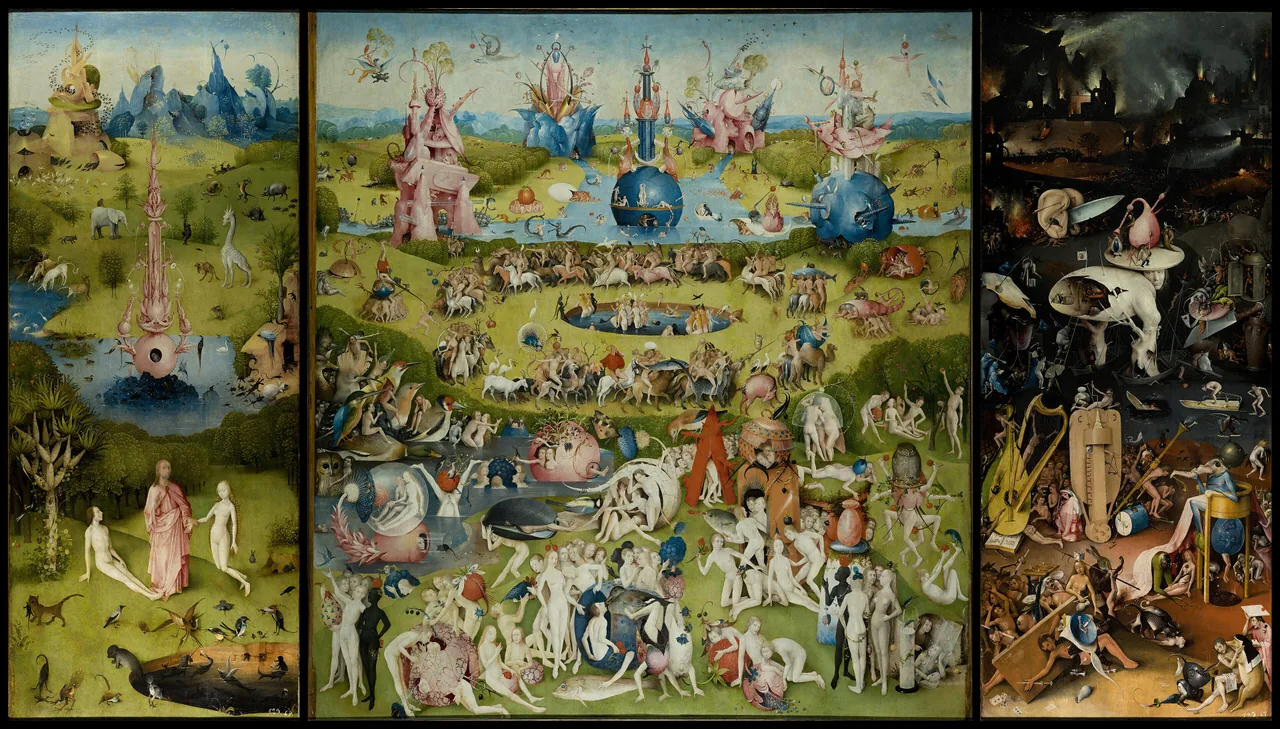

Now keep the whole triptych in view before following its small figures. The light gardens on the left and centre meet the dark, burning world on the right. The panels belong together; an isolated cluster of fruit or bathing figures cannot explain the entire object.
Scale becomes unstable. Birds tower over people, fragile structures loom over pools, and bodies gather inside shapes that could never comfortably contain them. Yet each invented thing has an edge, colour and apparent surface. Meticulous description makes the impossible strangely tangible.
The Prado’s current catalogue dates the work to 1490–1500. Interpretations of its details remain contested. You need not choose between enjoying its invention and recognising its moral and religious setting. Nor should its modern appeal make Bosch a member of Surrealism, a movement founded centuries later.
Bruegel: the Harvesters
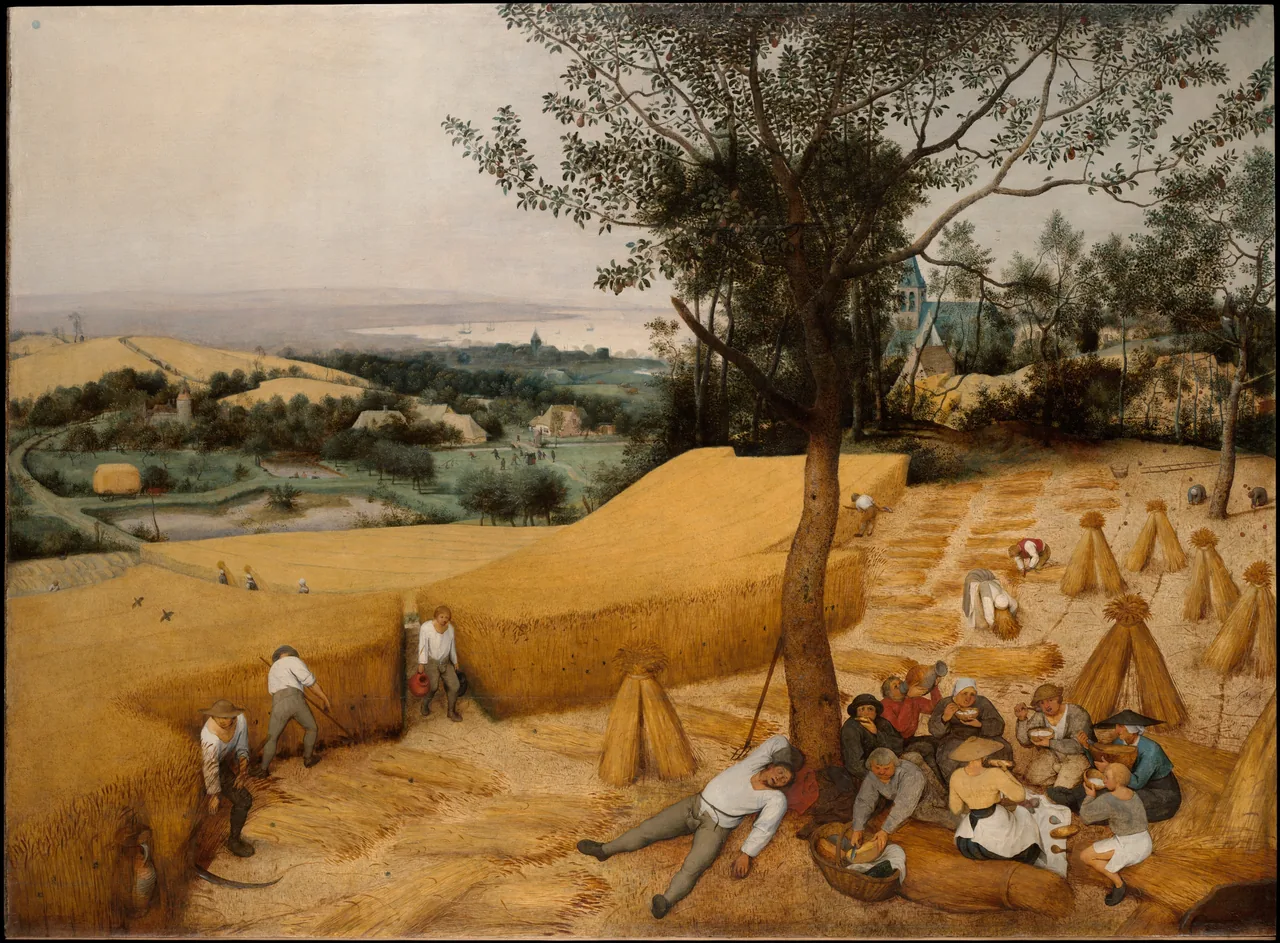
The great tree divides working from resting without separating them completely. On one side, figures cut the standing crop; beneath the branches, people eat and a man sleeps. Paths and strips of field carry us beyond them towards a distant shore.
This is not simply a landscape with a few figures added for scale. Human routines make the season legible. The tall grain, cut stalks, shade and food connect weather to the body’s needs.
The Met places the painting in a six-part seasonal cycle commissioned by an Antwerp merchant. It also cautions that the apparent harmony suits a wealthy patron’s view of rural labour. Recognisable work can still be idealised. Bruegel gives us an expansive, absorbing world, not transparent evidence that agricultural life was easy. Notice how the inviting rest occupies the nearest space while much of the repetitive labour recedes.
Bruegel: Hunters in the Snow
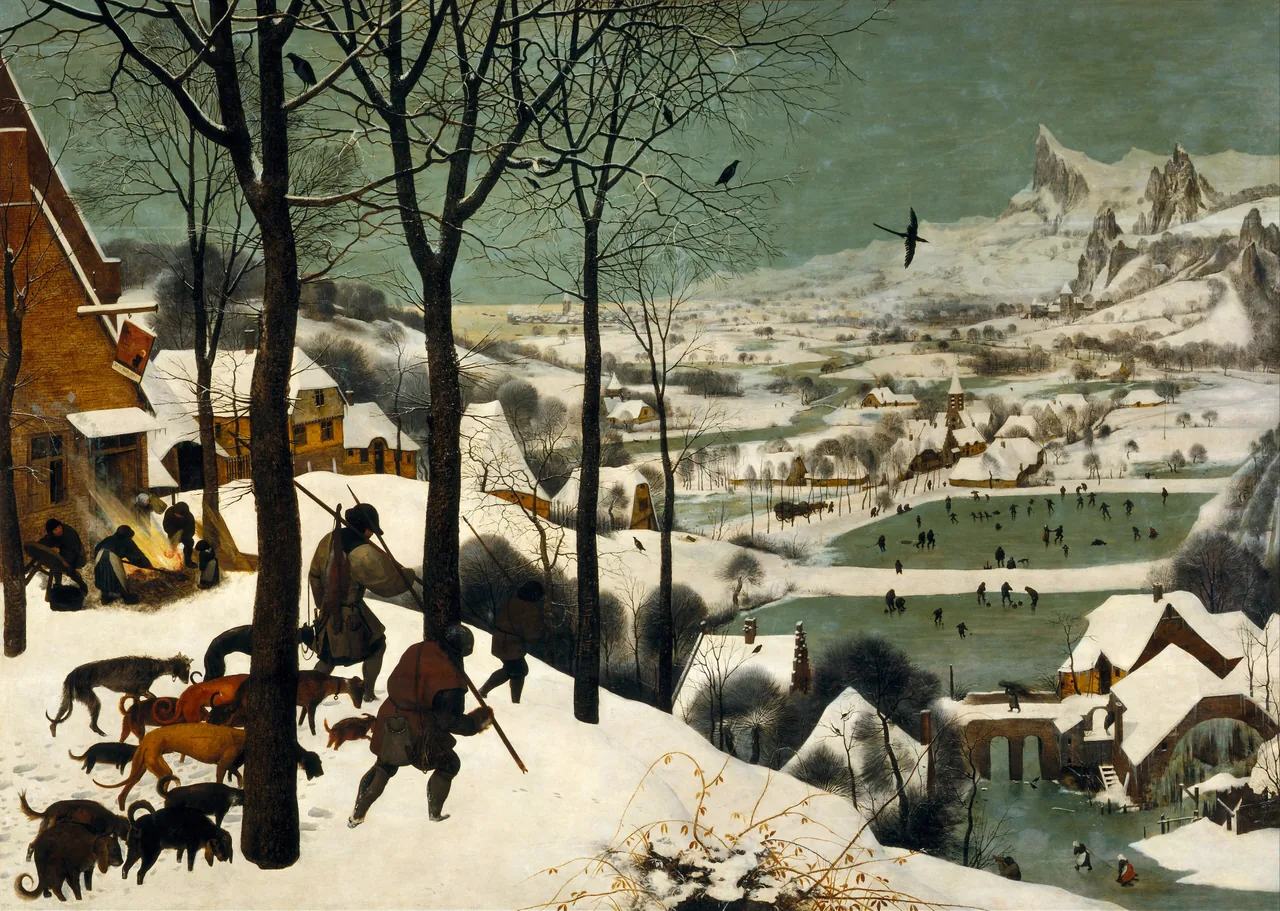

Compare the hunters’ slow descent with the tiny skaters spread across the ponds. The foreground feels tired; the distance offers a different tempo. Strong dark trunks and bodies give way to pale roofs and a broad, cold sky.
The Kunsthistorisches Museum’s record draws attention to the meagre return: a single fox. The hunters’ effort and the distant leisure occupy the same winter, but not the same experience of it.
Alongside The Harvesters, this painting shows how a seasonal subject can organise an entire community. Bruegel changes colour, movement and the distribution of activity, not merely the weather. Try covering the foreground briefly with your hand, then the distance. Neither half supplies the painting’s full mood alone; the tension between them is what holds you there.
Five artists and three ways to look
Campin’s workshop brings sacred history into an inhabited room; Van Eyck tests the reach of sight; Christus connects description with a working trade. Bosch stretches believable surfaces into invention, while Bruegel distributes attention across people and landscape.
For closer routes, follow the existing guides to Van Eyck, Bosch and Bruegel. For available prints, browse the current collections; this historical selection is not a list of products for sale.
On your next encounter, ask three questions: what makes the surface convincing, where does the picture place you, and what remains uncertain despite all that detail? Those questions leave room for both the painters’ extraordinary skill and the complicated worlds they made visible.
Editorial record
About this article
- Author
- Publisher
- GeMarkt
- Published
- Reviewed
- Internal source & rights check. Conducted by GeMarkt Research Review. This is an internal editorial check—not independent peer review.
- Source standard
- Art history source standardPrioritises object records and research sources, distinguishes evidence from interpretation, and states material uncertainty.
Found a claim that needs checking? Report a factual error.