GeMarkt Blog · Essay
The Dutch Golden Age: Vermeer, Rembrandt and Everyday Light
Eight paintings by six artists reveal Dutch Golden Age art: quiet rooms, unruly parties, working lives and landscapes, with a closer look at light.

A woman opens a window. Milk falls from a jug. Officials look up from a table as though you have interrupted them. Seventeenth-century Dutch painting can make an ordinary action feel unusually present. The attraction is not simply that its people and things look convincing: the painters decide exactly how much attention a gesture, a face or a patch of wall should receive.
That makes light a useful starting point, but not a complete definition. The same period includes Hals’s crowded merrymakers, Leyster’s confident self-presentation and Ruisdael’s unsettled skies. There is no single Dutch mood.
These eight paintings by six artists offer a short route through that variety. Look first at what each picture makes visible, then at what kind of scene it asks you to believe.
A period, not one painting style
“Dutch Golden Age” is a conventional name for the seventeenth-century flowering of art in the Dutch Republic. It is not a movement with one manifesto or a rule that everyone painted brown interiors. Portraits, landscapes, still lifes, everyday scenes and historical subjects belong within this broad period.
Genre painting means scenes of everyday life, not a particular painting technique. The Met’s account of northern European genre painting explains how domestic and social subjects became important pictures in their own right. But an everyday-looking room may still be invented, arranged or full of comic suggestion. Naturalistic painting is not unfiltered documentation.
Three questions help: where does the light enter; which surface catches it; and who notices whom? A jug may be brighter than a face. A sitter may look straight at us while a supposed companion turns away. These choices organise our relationship with the picture. They matter more than a checklist of windows, black coats and tiled floors.
Vermeer: Young Woman with a Water Pitcher
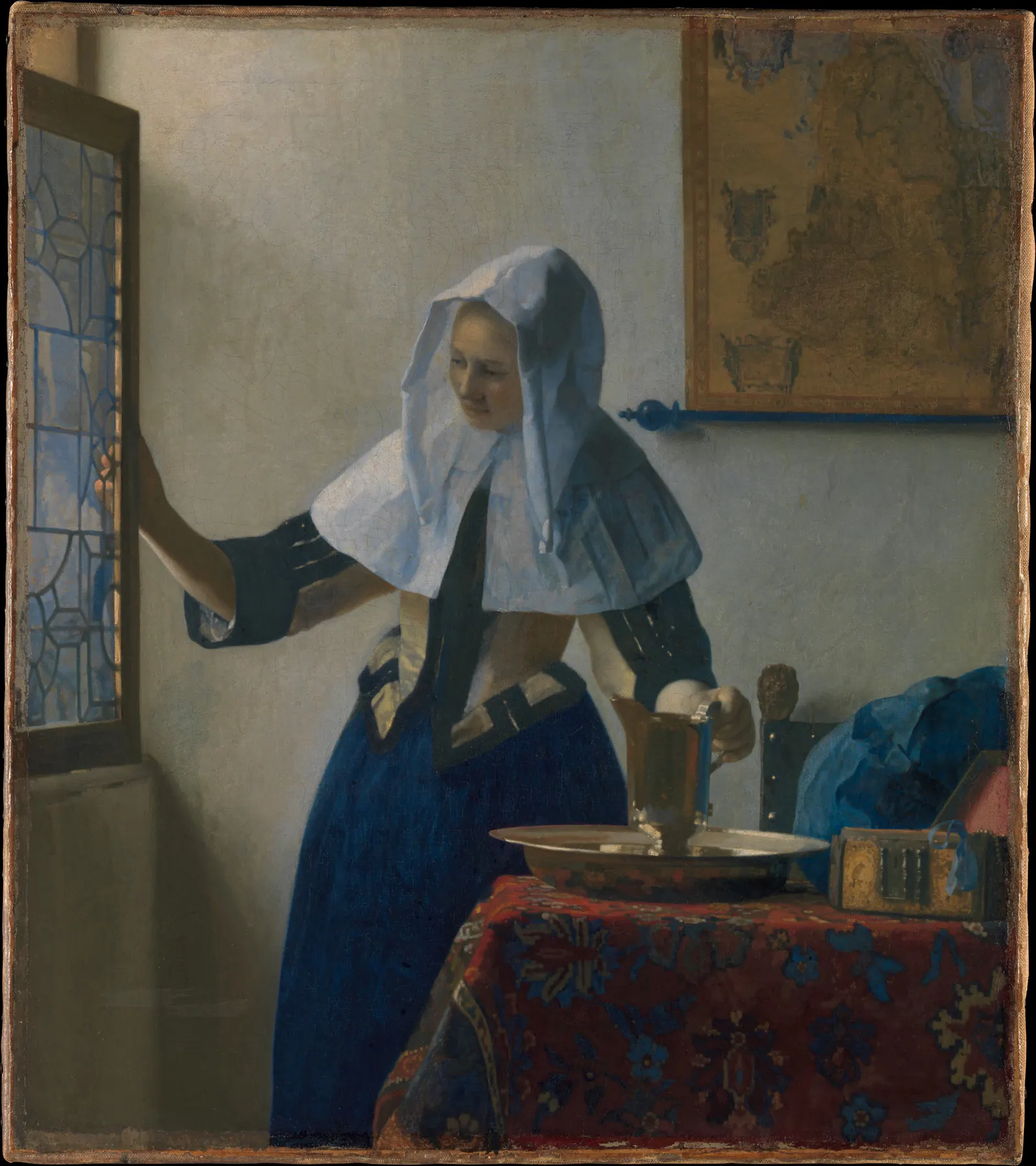
The two hands stretch between window and pitcher. That small connection gives the figure an activity without turning the painting into a dramatic event. Behind her, the wall is mostly empty; beside her, the table is crowded with colour and reflective objects.
Follow the white linen from the top of her head to her shoulders. It contains grey and blue passages as well as bright light. Vermeer makes whiteness depend on its surroundings rather than filling the shape with a uniform colour.
The image is useful for recognising his controlled quiet. Nothing needs to move quickly for the eye to keep moving. The dark window frame, pale wall and blue skirt create distinct areas, while the figure joins them through a very modest action.
Vermeer: The Milkmaid
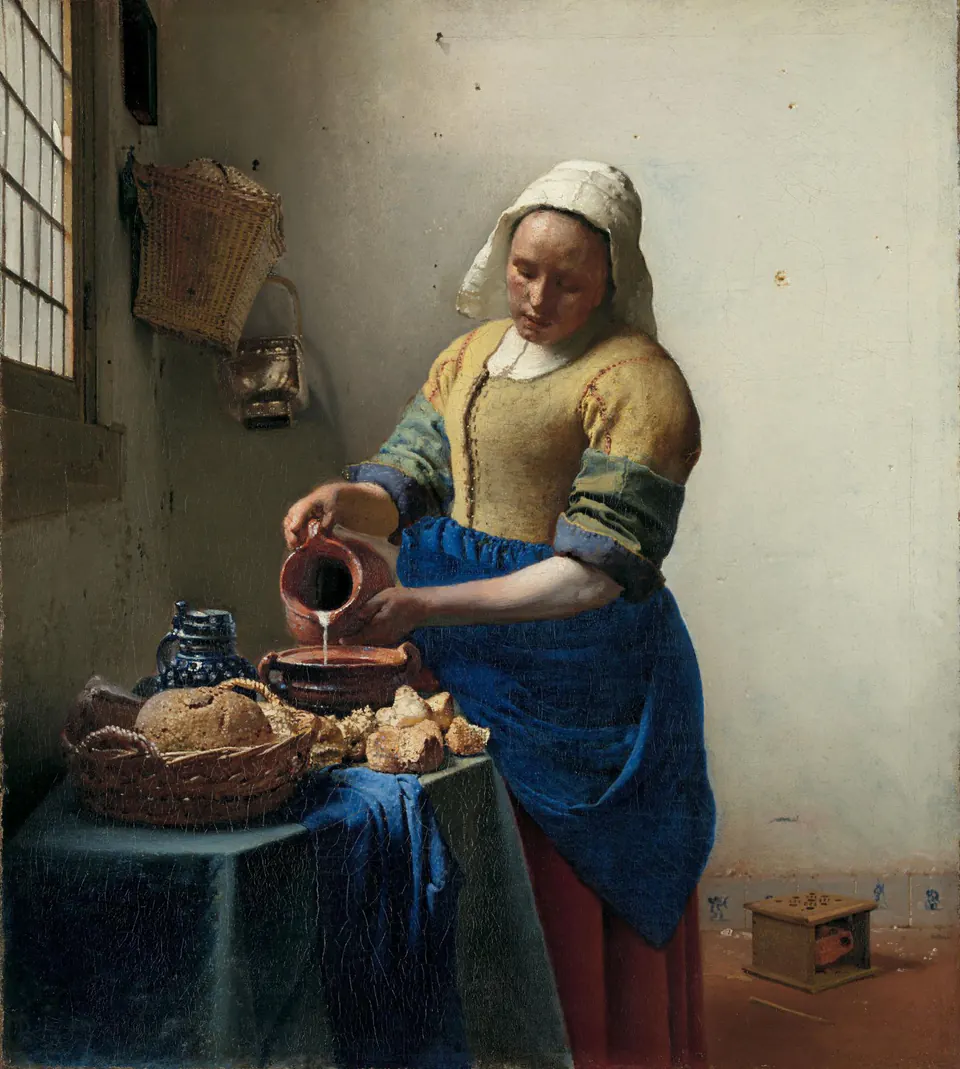
Here the small action has become the picture’s centre: a fine line of milk falling from an earthenware jug. The maid’s lowered eyes, angled wrists and planted body all lead toward it. Her task feels sustained rather than interrupted.
Compare the bread with the wall. The bread breaks into tiny bright touches; the wall gives the figure a broad, relatively plain background. Looking closely means noticing that different materials receive different kinds of marks.
This is not simply the previous room with another woman in it. The figure occupies more of the space, and the table presses forward. The painting gives domestic work visual weight. That is something we can see in its construction without inventing a biography for the unnamed person represented.
Rembrandt: Aristotle with a Bust of Homer
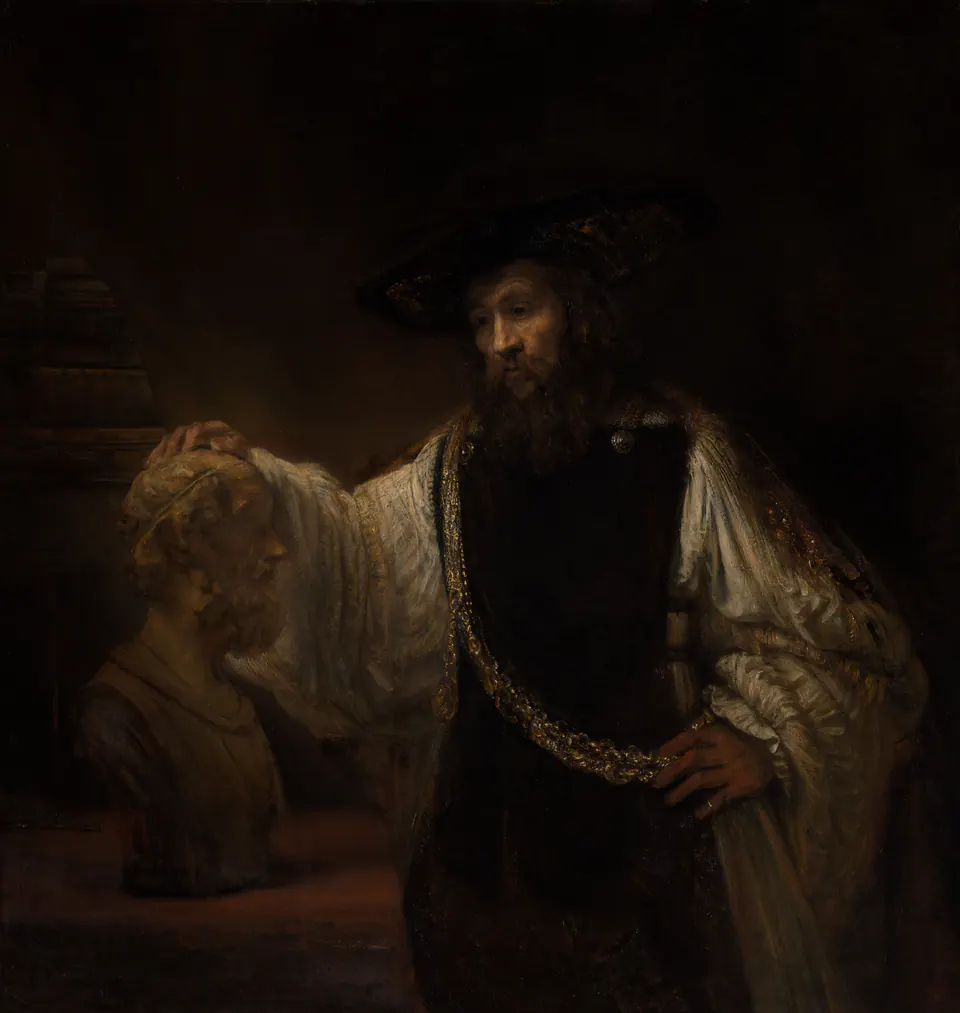
This is an imagined ancient philosopher, not a portrait of an ordinary seventeenth-century neighbour. Its inclusion matters: Dutch art did not abandon learned, historical or literary subjects when it became interested in everyday life.
The painted hand joins living figure and sculpted head. A broad sleeve catches light, while the face remains partly withdrawn. Instead of illuminating everything evenly, Rembrandt makes some connections clear and leaves others uncertain.
Try following the chain across the chest, then returning to the face. The eye moves between something conspicuously material and a person whose thoughts remain inaccessible. You do not need to settle the painting’s philosophical meaning to notice that tension. Here light creates a hierarchy of attention rather than simply describing a room.
Rembrandt: The Syndics
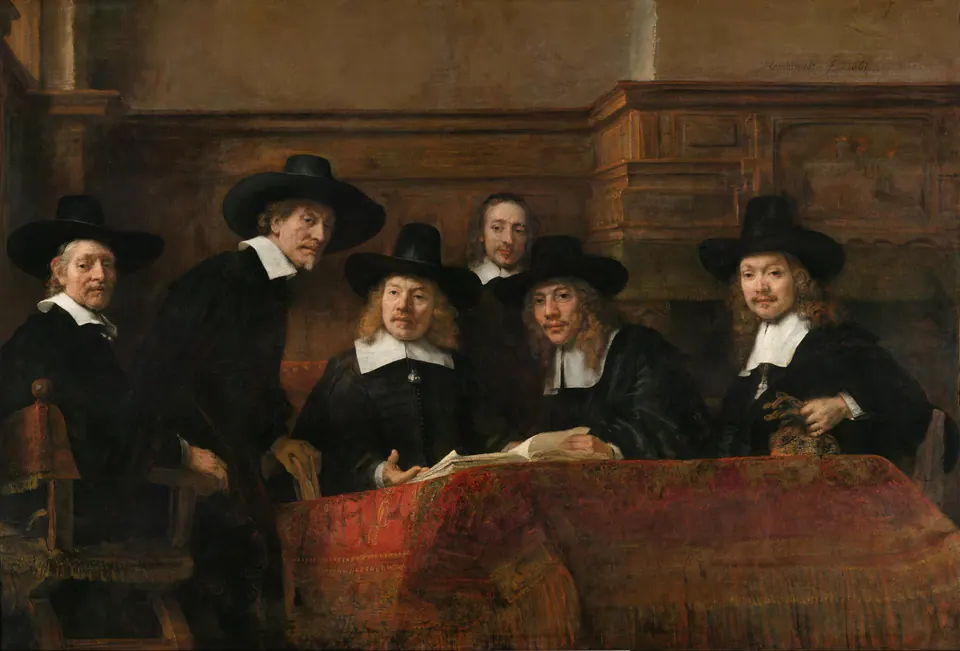
These men had a specific job: the five officials assessed the quality of cloth. A sixth man, their attendant, stands behind them without a hat. This is a group portrait organised around professional responsibility, not an anonymous scene of conversation.
The faces form an uneven sequence. One man appears to be rising; another presents a hand above the book. The table’s strong diagonal keeps the group from becoming a flat row.
Their outward looks create the feeling that someone has entered. We occupy that visitor’s position, although the composition is carefully arranged rather than an accidental interruption. Compare this with Aristotle: the same painter can hold a figure apart from us or make a room acknowledge our presence.
Hals: Merrymakers at Shrovetide
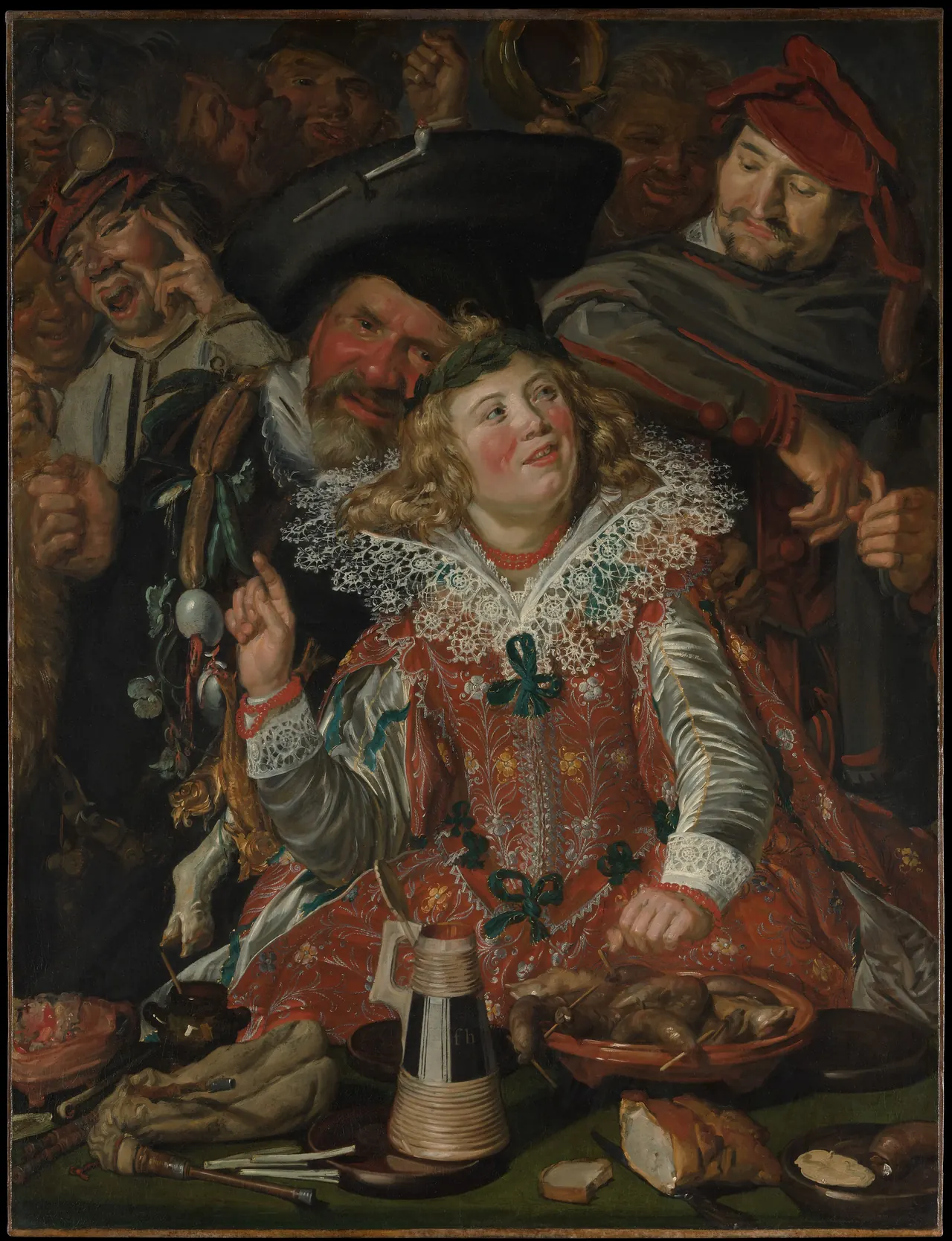
Hals supplies an antidote to the idea that Dutch painting is always restrained. Faces overlap, mouths open and hands push toward the foreground. The patterned costume almost competes with the people for attention.
The Met connects this scene with Shrovetide festivities and theatrical comic types. Treat it as a constructed scene of revelry, not a reliable group photograph of a particular party. Costume and performance are part of its subject.
Notice how little empty space remains around the heads. In Vermeer, a bare wall helps separate a gesture from its surroundings; here, crowding makes individual expressions collide. The picture does not need an actual soundtrack for us to read its visual noise. Its abundance is deliberate, not an exception that needs explaining away.
Leyster: Self-Portrait
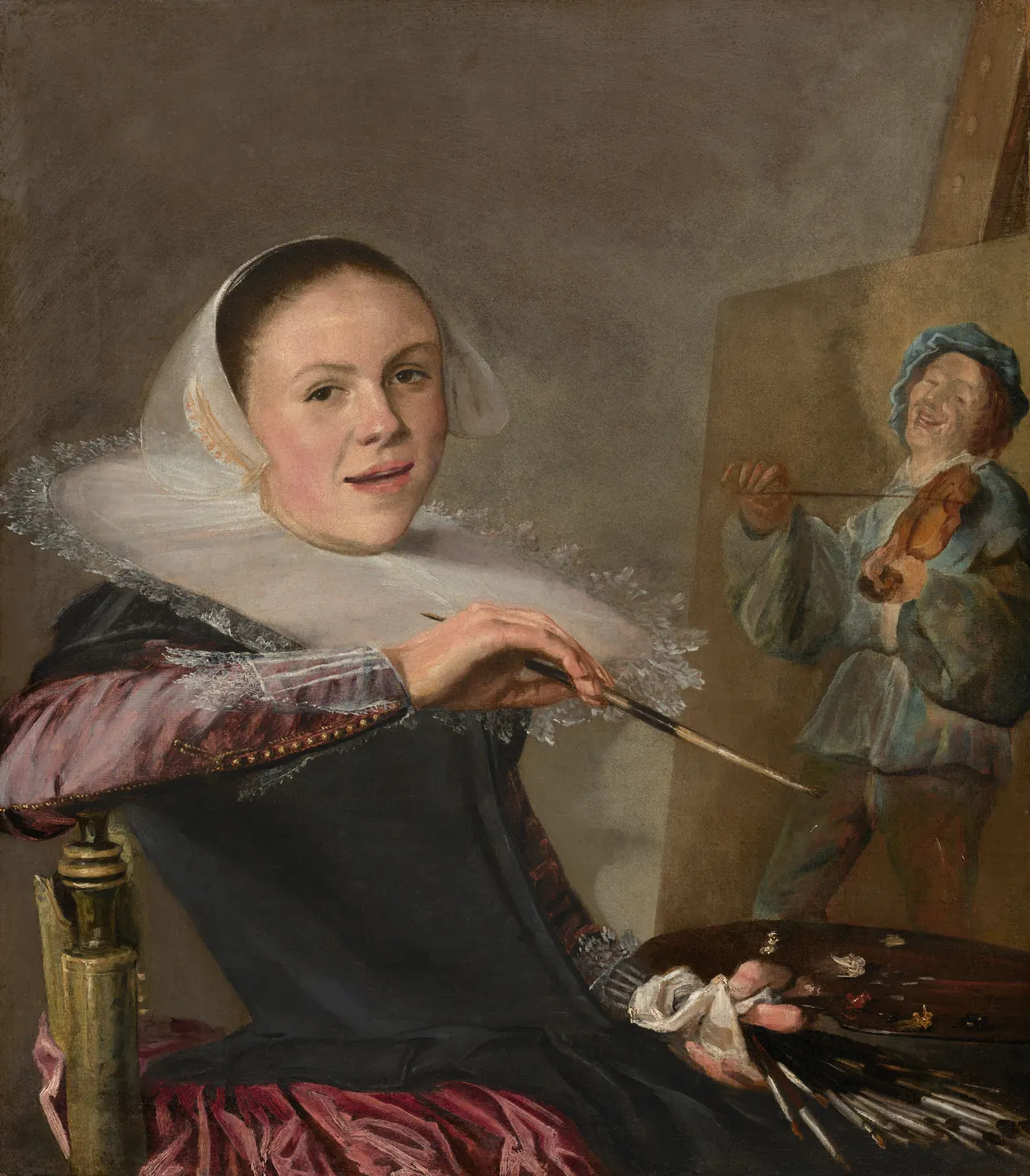
Leyster turns toward us with a brush still raised. Her open expression suggests easy conversation, while the palette and easel make the nature of her work unmistakable. The violinist on the canvas adds another smiling figure inside the picture.
The broad collar is especially revealing. Its crisp, elaborate appearance is part of a professional self-image, not evidence that this is unplanned footage of studio work. She is showing both the painter and what the painter can do.
Put this beside Hals’s merrymakers. Both pictures make faces feel socially active, but Leyster directs that liveliness toward her own identity as an artist. Including her changes the story from a parade of famous men to a closer look at who could claim a place behind the easel.
Steen: The Dancing Lesson
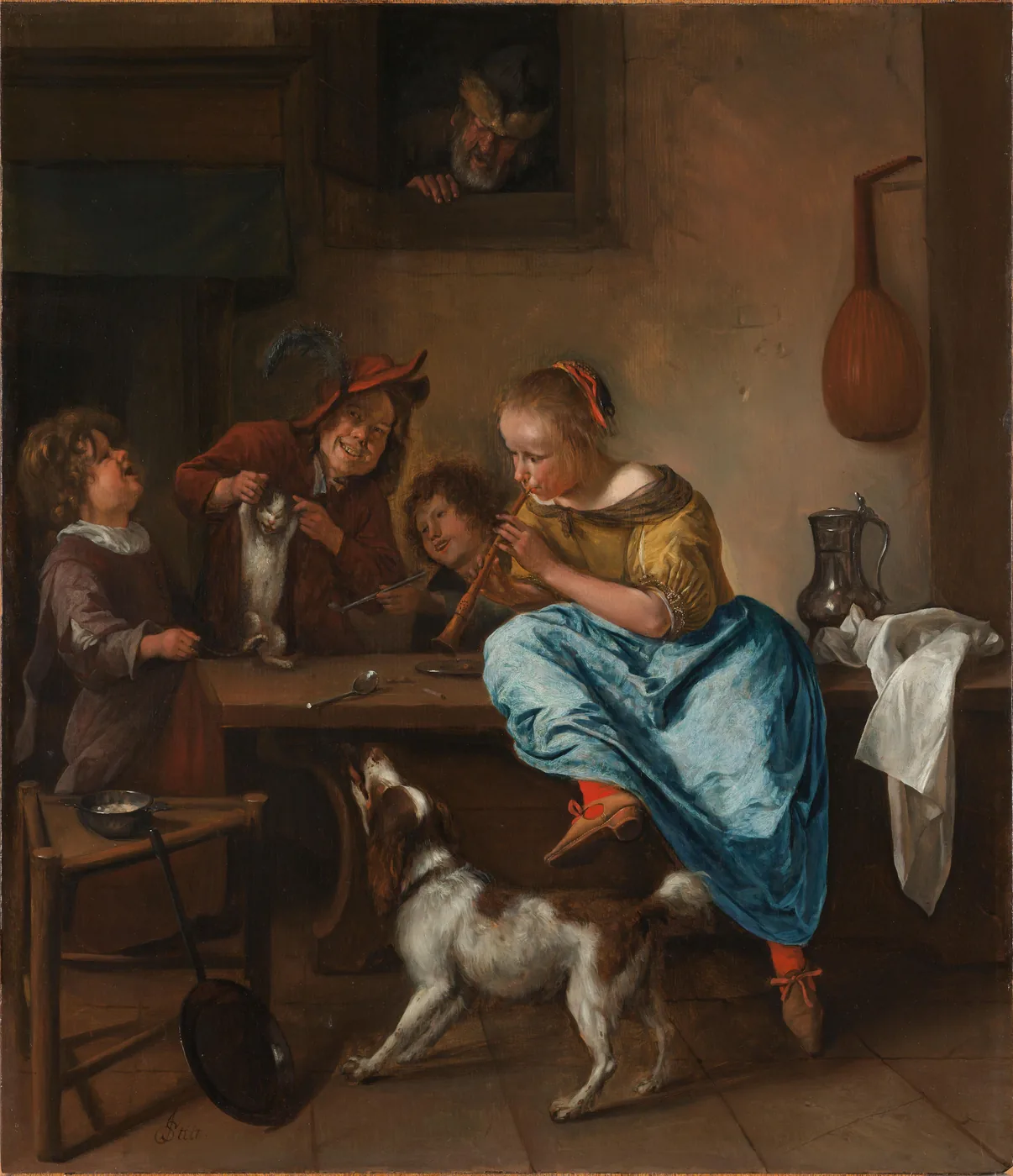
The title promises a lesson, but the pupils have chosen an unwilling dancer. The children’s music, the cat held upright and the dog below create a chain of competing attention. An older man peers in from above.
Steen turns a room into a small theatre. The bright skirt and white cloth help organise a scene that might otherwise become a jumble of limbs and objects. Follow the looks as well as the bodies: not everyone is interested in the same thing.
Humour does not make the picture a model of behaviour to imitate, especially toward the animal. It lets us see how a painter can stage disorder. Against Vermeer’s measured task, Steen offers activity that has spilled beyond adult control.
Ruisdael: Grainfields
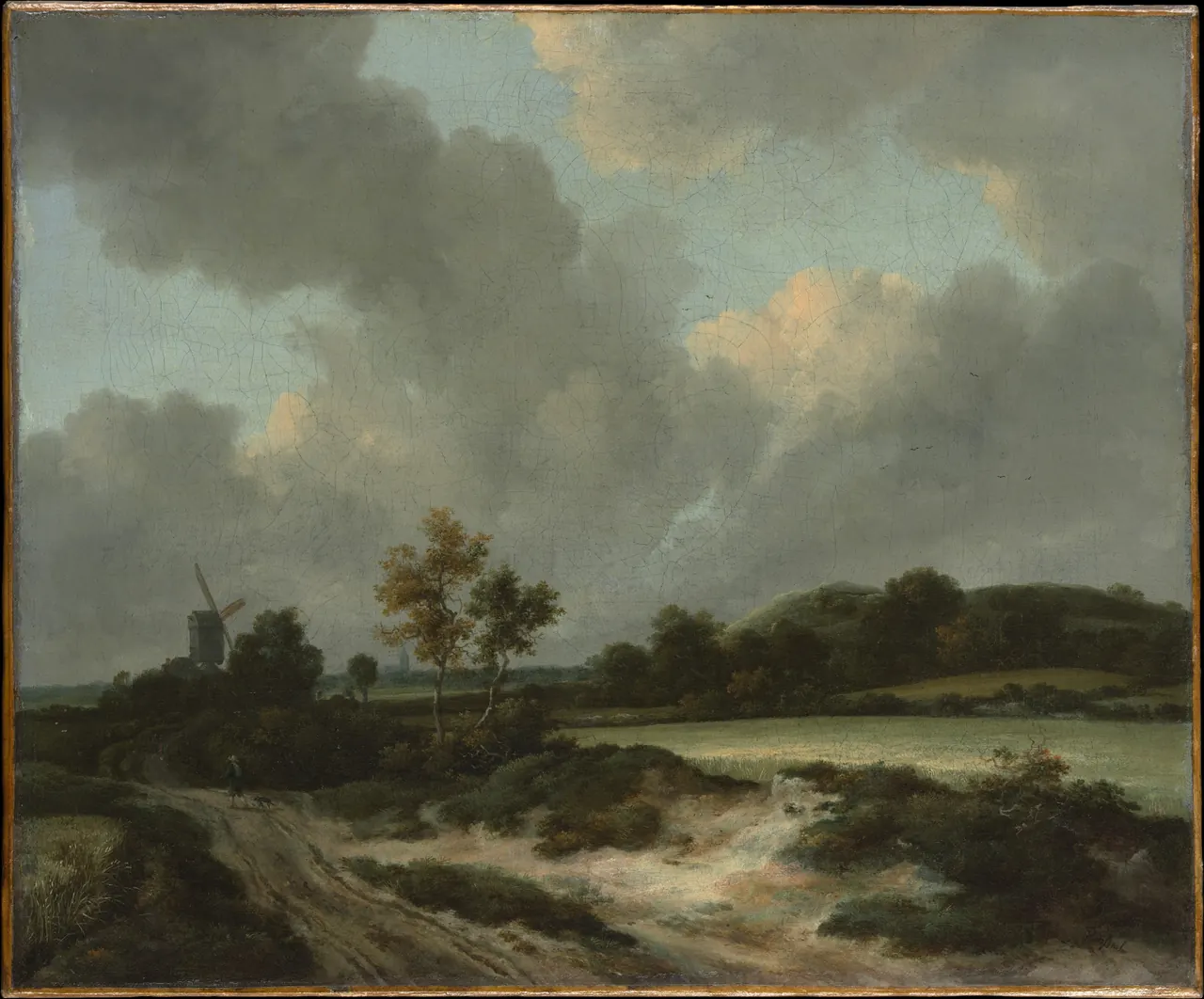
Step outside and light becomes weather. The low land gives most of the picture to clouds, while a pale band across the field makes the shadowed foreground feel nearer.
The road provides a way into the landscape, but the sky resists becoming a passive backdrop. Its large changing shapes are as consequential as the small mill and trees. A tiny human presence does not control the scene.
Compare the lit field with Vermeer’s lit wall. Both painters use a broad pale area to guide attention, but the effects differ: one steadies an interior, the other suggests an opening in shifting weather. Looking for these differences is more rewarding than assuming every Dutch landscape records the nation in an uncomplicated mood of pride.
Golden for whom?
The name “Golden Age” should not imply that prosperity was shared fairly. The Rijksmuseum’s research into its collections and slavery connects Dutch history with colonial expansion and enslavement, including histories once left outside familiar museum narratives.
That context matters without making every painting proof of the same specific transaction. Identifying a sitter’s activities or an object’s colonial connection requires evidence about that person or object. We can admire the painting of a comfortable room while asking whose labour and whose absence made such comfort possible.
Six artists and a way to keep looking
Vermeer, Rembrandt, Hals, Leyster, Steen and Ruisdael give us six different ways to distribute attention. Return to one picture and ask what changes if you look at the background before the face, or follow hands before eyes. The subject may stay ordinary; the experience of looking does not.
For closer study, continue with Vermeer’s artist guide, Rembrandt’s artist guide or our Vermeer and Rembrandt comparison. This selection is a route into the period, not a claim that eight paintings can stand for every person or every kind of art it produced.
Editorial record
About this article
- Author
- Publisher
- GeMarkt
- Published
- Reviewed
- Internal source & rights check. Conducted by GeMarkt Research Review. This is an internal editorial check—not independent peer review.
- Source standard
- Art history source standardPrioritises object records and research sources, distinguishes evidence from interpretation, and states material uncertainty.
Found a claim that needs checking? Report a factual error.