GeMarkt Blog · Practical guide
Is Jan van Eyck’s Art Public Domain? Version and Image Checks
Check Van Eyck panels, uncertain portraits and altarpiece versions separately. Includes an identified Met CC0 image and twelve museum research records.
Rights check · reviewed
The short answer
Jan van Eyck’s own paintings are beyond the ordinary EU author-life-plus-70 term. The Met designates the selected Crucifixion and Last Judgment image Public Domain / CC0. That does not clear every panel’s U.S. publication history, every restoration image or another museum’s download.
| What is being checked | Result | Why |
|---|---|---|
| European Union — Jan van Eyck’s own contribution | Ordinary author term expired | The Met records Jan’s death in 1441, centuries beyond the ordinary life-plus-70 term. Joint authorship, later replacement panels, first-publication rights, moral rights and specific image-file conditions are separate; his life dates do not identify every contributor. |
| United States — individual works | Publication history not independently closed | The twelve-record research set does not establish a U.S. publication chain for every work. Making, exhibition and acquisition dates are not substituted for publication. Section 303 can preserve qualifying previously unpublished works first published in 1978–2002 through 2047; unresolved does not mean current copyright has been demonstrated. |
| Selected Met feature image | Provider designates Public Domain / CC0 | The exact object record, API image URL and local master are identified for this feature. The Met’s affirmative file designation is retained as the provider’s position; it is not an independently reconstructed U.S. publication history or a licence for another museum’s image. |
| Other files, editions and later contributions | Check the particular source | The ordinary author-term finding does not clear modern photographs, restoration films, critical editions, later creative contributions or every download. UK and Türkiye rules are outside this bounded EU/U.S. guide; no all-country clearance is asserted. |
One Met record, accession 33.92ab, contains the two featured panels; their present pairing is not claimed to be the original arrangement. This is a bounded guide, not a cleared twelve-image collection. The Ghent Altarpiece’s shared authorship and uncertain portrait identities remain qualified in the research set.
This is a documented research summary, not legal advice. Copyright and moral-rights rules can vary by country and by the history of a particular work.

What we’ll look at
Which work is this, and what evidence supports reuse of this particular image?
Short answer: Jan van Eyck died in 1441, so his own paintings are beyond the ordinary life-plus-70 copyright term. A digital reproduction still needs its own check. Identify the actual panel or altarpiece, the country of reuse and the file’s source conditions. Some museum images are explicitly public domain; a modern photograph, restoration film or website screenshot is not automatically covered by that finding.
Van Eyck painted portraits and Christian subjects in the fifteenth-century Low Countries. His pictures make small things extraordinarily noticeable: reflected windows, fur, metalwork, lettering and the shine of a jewel. He did not invent oil painting, but his handling of it helped make those surfaces convincing. The National Gallery’s artist catalogue places that achievement in context.
The practical challenge is not just the artist’s name. Some pictures have uncertain sitters; an altarpiece may involve more than one painter; museum images may show different stages of restoration. A precise caption prevents those differences from disappearing behind the phrase “a Van Eyck.”
The country and the image are separate checks
The EU’s ordinary life-plus-70 term has long expired for Jan’s own work. Owning a fifteenth-century panel does not create a perpetual copyright in what he painted.
For the United States, distinguish making from publication. Section 303 addresses some old works previously unpublished and outside federal copyright. This guide does not independently establish U.S. publication history for the works below, including the illustrated Met panels. Where a museum labels an image public domain, we report that provider designation without inventing a historical publication event.
A photograph can also add new material beyond a straight reproduction—for example, gallery architecture, people or a carefully staged setting. Modern commentary and restoration videos are separate content. Check the actual file and intended use rather than treating the artist’s death as permission to copy a whole museum webpage. This is general information, not legal advice.
Twelve museum records to keep distinct
Only the Met’s paired panels are reproduced here, using their identified Open Access file. The other eleven records are research references, not an approved download collection. Neither those links nor the Met’s image designation is a claim that this guide has independently established U.S. publication history for every painting.
1. The Arnolfini Portrait, 1434
The London panel shows a couple in a richly furnished interior, with a small convex mirror behind them. Their identity and the picture’s precise purpose have prompted debate. Do not present a legally documented wedding as settled fact. For the painting’s imagery, continue to our separate Arnolfini story; this guide concerns identification and reuse.
2. Portrait of a Man (Self Portrait?), 1433
The red-headdress portrait is often used as Van Eyck’s face. The National Gallery keeps a question mark in the title. Preserve that uncertainty if using it to introduce the artist: “possible self-portrait” is more accurate than a confident identification. The age of the panel does not remove the need to examine London’s image licence.
3. Portrait of a Man (Léal Souvenir), 1432
Another London portrait places its sitter behind an inscribed stone-like parapet. It is not a second title for the red-headdress painting. When records describe a sitter as unknown or propose an identity, carry that qualification into your caption rather than turning a suggestion into a name.
4. The Crucifixion; The Last Judgment, about 1436–38
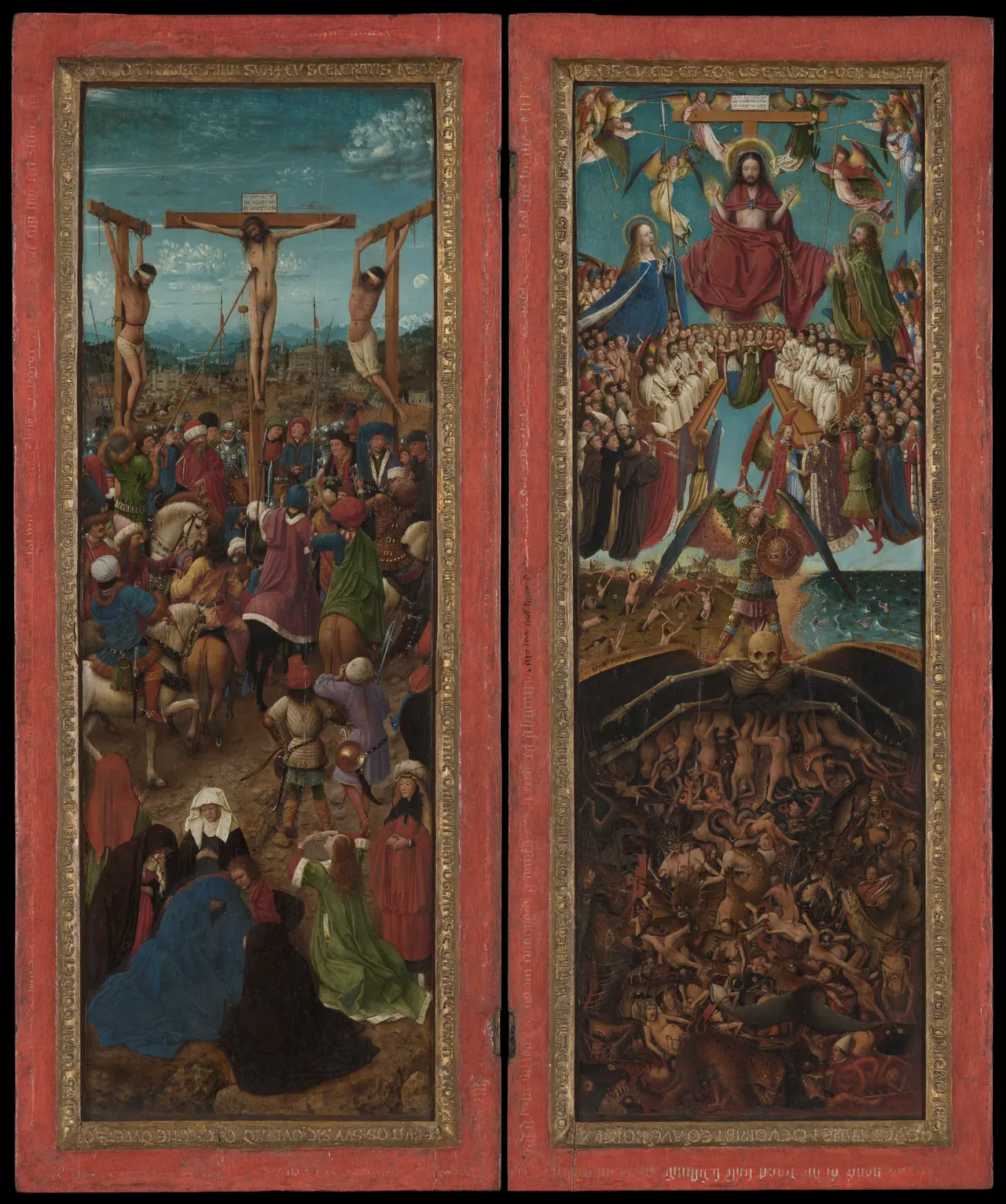
Jan van Eyck, The Crucifixion; The Last Judgment, about 1436–38. The Metropolitan Museum of Art, Fletcher Fund, 1933, 33.92ab. Object and image source; Met Open Access / CC0.
The Met’s paired panels compress crowds, distant landscapes and religious drama into narrow spaces. Research indicates they belonged to a different original arrangement; the present pairing should not be described as unquestionably original. The Met marks their image public domain. A whole-pair image and a single-panel detail need different descriptions even though the institution groups them in one record.
5. The Annunciation, about 1434–36
In Washington’s painting, Gabriel and Mary face one another inside a church. Their words appear as gold lettering within the painted space. The National Gallery of Art explicitly marks this object’s media public domain. It is a practical starting point for an image search, with a named object and a source statement attached.
6. The Virgin of Chancellor Rolin, about 1430–35
The Louvre painting brings a richly dressed donor face to face with Mary and the Christ Child, with a city visible beyond. The donor, figures and background belong to one carefully arranged scene. Do not confuse a detail of its distant city with a standalone Van Eyck landscape. The selected Louvre file’s conditions remain a separate check.
7. Madonna with Canon Joris van der Paele, 1436
The Bruges panel places the kneeling canon within a gathering of sacred figures. Metal, fabric and flesh invite close comparison. Use its full identity: it is not interchangeable with the Louvre donor painting simply because both include Mary and a patron. The museum’s own collection record anchors the title and date.
8. Portrait of Margareta van Eyck, 1439
This portrait in Bruges has an identifying inscription on its original frame. That makes its naming evidence different from the uncertain red-headdress self-portrait. If a reproduction crops the frame away, it also removes part of the object carrying that information. Keep a record of what your image includes and excludes.
9. The Ghent Altarpiece, completed 1432
The cathedral’s account associates this immense work with Hubert and Jan van Eyck. Do not reduce it to an unqualified “Jan painted every panel” claim. Open and closed views show different painted surfaces. Restoration photographs and scans must also be identified by the actual image and stage represented, not pooled under one generic download label.
10. Madonna in the Church, about 1440
Berlin’s small panel sets Mary within a richly described church interior. It offers a useful comparison with Washington’s Annunciation: similar attention to architecture does not mean the pictures show the same scene or building. Use Berlin’s object record and image conditions, not the Washington picture’s Open Access designation.
11. The portrait traditionally called Cardinal Niccolò Albergati
KHM’s record supplies a stable object identity, inventory GG 975. Its sitter and dating require care: the current German record gives 1438 with a question mark, while other institutional material uses different dates. An image can be precisely identified by museum and inventory even while the sitter’s name and exact painting date remain uncertain.
12. Saint Barbara, 1437
The Antwerp work combines silverpoint and oil on panel and is dominated by extraordinarily detailed drawing. Its appearance raises questions about how to describe its state of completion; a simple “unfinished painting” label can conceal that discussion. Its unusual surface also makes fidelity important: a heavily contrast-adjusted web image is not a neutral replacement for the museum record.
Where to find a file with an explicit statement
The Met’s paired panels and Washington’s Annunciation have affirmative public-domain image statements. The exact Met file is displayed here; the Washington record is a further source to investigate. Use the Met’s Open Access guidance and the National Gallery of Art’s image policy with those records. Neither policy extends to another institution just because it holds work by the same artist.
The National Gallery in London’s policy separates collection data from image licensing. That provider distinction matters for the Arnolfini Portrait and the two male portraits. A museum’s offered terms are not a legal conclusion that every faithful photograph carries a new copyright; they still need to be considered when selecting a source.
For any chosen file, keep the object link, source statement and downloaded-image identity together. Then describe the work honestly: tentative sitter names stay tentative, details stay labelled as details, and multi-panel works do not become unrelated pictures. Van Eyck’s age gives a straightforward ordinary-term answer. Accurate sourcing makes that answer usable.
Sources and review method
We checked the artist chronology against museum records, treated each named jurisdiction separately, and recorded the provider policy for the image set. These sources support the legal framework and artist dates used above; the source file for any individual image still needs its own record.
- The Crucifixion; The Last Judgment, 33.92ab — The Metropolitan Museum of Art. Current Jan van Eyck attribution, about 1436–38 object heading, artist life dates, two-panel identity and Public Domain feature image.
- The Crucifixion; The Last Judgment — public collection API, object 436282 — The Metropolitan Museum of Art. Binds accession 33.92ab and isPublicDomain: true to the exact LC-33_92ab-Primary_Temp.jpg source asset preserved in the acquisition manifest.
- Portrait of a Man (Self Portrait?), NG222 — National Gallery, London. The sitter remains a possible self-portrait, not a confirmed identity; London’s offered file terms do not inherit Met CC0.
- The Ghent Altarpiece — Saint Bavo’s Cathedral, Ghent. Hubert and Jan van Eyck attribution and multipart work history; not a licence for every panel, restoration scan or later replacement.
- Directive 2006/116/EC, Articles 1, 4, 8 and 9 — EUR-Lex. Ordinary author-life-plus-70 term and calendar calculation; first-publication rights and national moral rights remain separate.
- 17 U.S.C. Chapter 3, including section 303 — U.S. Copyright Office. Separate rules for older published and formerly unpublished works; a qualifying first publication in 1978–2002 can preserve protection through 2047.
- Open Access at The Met — The Metropolitan Museum of Art. CC0 reuse of the public-domain images designated by the museum, not permission for every image on its website or another provider’s file.
- CC0 1.0 Universal — Creative Commons. Terms of the CC0 dedication used for the selected Met images; third-party rights and implied endorsement remain separate questions.
Editorial record
About this article
- Author
- Publisher
- GeMarkt
- Published
- Reviewed
- Internal source & rights check. Conducted by GeMarkt Research Review. This is an internal editorial check—not independent peer review.
- Source standard
- Rights guide source standardSeparates the underlying work from the source file, records the review date, and links the evidence used for the conclusion.
Found a claim that needs checking? Report a factual error.