GeMarkt Blog · Practical guide
Is Hieronymus Bosch’s Art Public Domain? Work and File Checks
Identify Bosch paintings, workshop drawings and later copies before reuse. A Met CC0 image and twelve museum records show where the evidence stops.
Rights check · reviewed
The short answer
Bosch’s own historic works are beyond the ordinary EU author-life-plus-70 term. The Met designates its Adoration of the Magi image Public Domain / CC0. Workshop attributions, later copies, U.S. publication histories and other digital files need their own checks.
| What is being checked | Result | Why |
|---|---|---|
| European Union — Bosch’s own contribution | Ordinary author term expired | The Met records Bosch’s death in 1516, centuries beyond the ordinary life-plus-70 term. This finding applies to his own expression, not automatically to an uncertain workshop or copyist attribution. First-publication rights, moral rights and file conditions remain separate. |
| United States — individual works | Publication history not independently closed | The twelve-record research set does not establish a U.S. publication chain for every work. Making, exhibition and acquisition dates are not substituted for publication. Section 303 can preserve qualifying previously unpublished works first published in 1978–2002 through 2047; unresolved does not mean current copyright has been demonstrated. |
| Selected Met feature image | Provider designates Public Domain / CC0 | The exact object record, API image URL and local master are identified for this feature. The Met’s affirmative file designation is retained as the provider’s position; it is not an independently reconstructed U.S. publication history or a licence for another museum’s image. |
| Other files, editions and later contributions | Check the particular source | The ordinary author-term finding does not clear modern photographs, restoration films, critical editions, later creative contributions or every download. UK and Türkiye rules are outside this bounded EU/U.S. guide; no all-country clearance is asserted. |
The selected Met panel, accession 13.26, is not the Prado Adoration triptych. This bounded guide does not turn the twelve-record research set into a cleared image collection. The Louvre Ship of Fools drawing retains its copy/workshop uncertainty and is not presented as an autograph Bosch.
This is a documented research summary, not legal advice. Copyright and moral-rights rules can vary by country and by the history of a particular work.

What we’ll look at
Which work is this, and what evidence supports reuse of this particular image?
Short answer: Bosch died in 1516, so his own works are beyond the ordinary life-plus-70 copyright term. But a “Bosch image” might be an original painting, a workshop drawing, a later copy or a modern photograph. Check that identity, the country’s rules and the particular digital file. Some museums explicitly provide public-domain images; do not apply their permission to an unrelated download.
Hieronymus Bosch worked in the Netherlandish town of ’s-Hertogenbosch around 1500. His paintings include ordinary-looking landscapes as well as creatures assembled from unsettling combinations of bodies, animals and objects. Their religious subjects concern choices, temptation, punishment and salvation. They were made for people with beliefs and expectations different from ours—not as illustrations of modern fantasy stories.
The Prado’s artist record is a useful starting point for the historical artist. Attribution matters particularly with Bosch: followers reused his subjects and methods, and museums continue to examine which works he painted himself.
Separate the old work from the modern file
The EU’s ordinary copyright term is the author’s life plus 70 years. Bosch’s death falls centuries outside that window. A modern discovery or a change of attribution does not, by itself, restart the artist’s copyright clock.
For American reuse, the making date is not a substitute for publication history. Section 303 of U.S. copyright law contains a special rule for some previously unpublished old works. This guide does not independently establish U.S. publication history for the works below, including the illustrated Met painting. It reports the institution’s own public-domain image designation, not a publication date we have proved.
Then examine the image itself. A straight reproduction, an installation photograph with other works, a museum film and a newly painted “Bosch-style” scene are not the same file or creative work. This guide is general information, not legal advice or a promise covering every intended use.
Twelve records, with the versions kept separate
Only the Met’s Adoration is reproduced here, from its identified Open Access file. The other eleven entries are research references, not eleven approved downloads. Their U.S. publication histories have not been independently resolved in this guide; the different image-source statements below remain important.
1. The Garden of Earthly Delights Triptych, about 1490–1500
The Prado’s triptych is a folding, three-part painting, not just its famous crowded central panel. Eden and Hell on the wings change how that centre reads. Its many details invite interpretation, but not every modern explanation is established fact. Select the whole open triptych or a clearly labelled detail; keep those identities distinct.
2. The Haywain Triptych, about 1512–15
People surround a wagon of hay in this Prado work. The struggle for worldly possessions becomes a procession moving towards danger. A photograph of the closed shutters will not show the same composition as the open triptych. Record which view you are using instead of calling every photograph simply The Haywain.
3. The Adoration of the Magi Triptych, about 1494
The Prado’s Adoration places the visitors to the Christ Child in the centre, with donors on the wings. Those donor panels tell us this was a commissioned devotional object. Do not confuse it with the Met’s smaller, earlier painting of the same subject—or transfer one museum’s image licence to the other.
4. Christ Mocked, about 1510
In the National Gallery’s Crowning with Thorns, four figures press around a calm Christ. It shows how Bosch could create tension without a panoramic landscape full of monsters. The gallery’s attribution and object record identify this painting; its file-use conditions are a separate part of the reuse check.
5. Death and the Miser, about 1485–90
The Washington painting presents a final choice at a deathbed. Money, a crucifix and competing figures pull the man’s attention in different directions. The National Gallery of Art marks this object’s media public domain. That is a concrete image source to investigate, rather than a reason to assume every online Bosch scan is equally reusable.
6. The Adoration of the Magi, about 1475
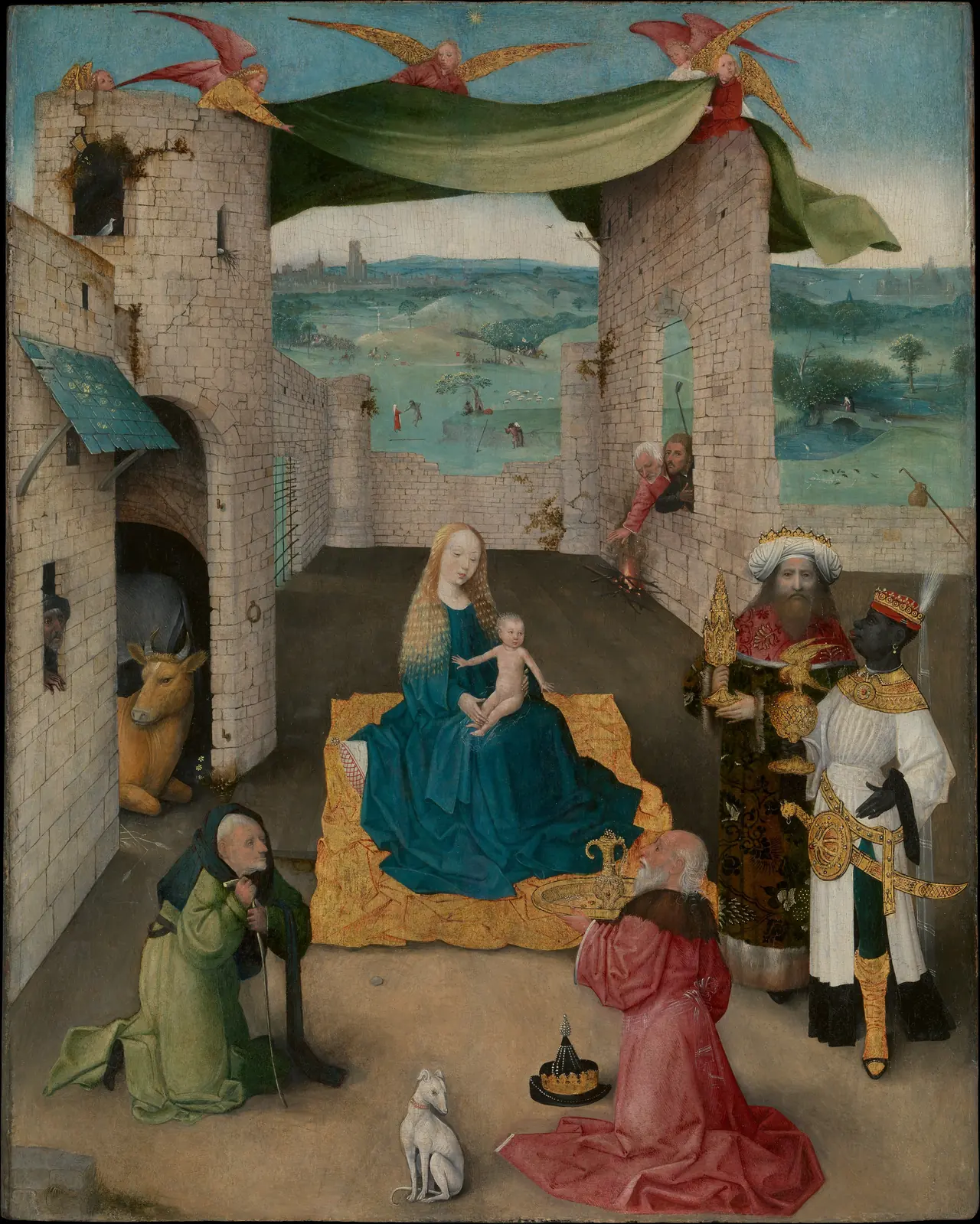
Hieronymus Bosch, The Adoration of the Magi, about 1475. The Metropolitan Museum of Art, John Stewart Kennedy Fund, 1913, 13.26. Object and image source; Met Open Access / CC0.
The Met’s Adoration is a relatively quiet scene centred on the visiting kings. Its current object record attributes it to Bosch and marks the image public domain. It is a useful reminder that his work is not limited to Hell scenes. Keep its date, museum and object number with the download so it remains distinguishable from the Prado triptych.
7. Ship of Fools: the Louvre painting
This painted panel shows people in a crowded boat, drawn into eating, drinking and foolish behaviour. It survives as part of a once larger arrangement. Its present boundaries are therefore part of its history, not necessarily Bosch’s complete original composition. The Louvre’s accessible image does not, on its own, establish an unrestricted download licence.
8. Ship of Fools: the Louvre drawing
The drawing with the same title is a different object. The Louvre records competing copy and workshop attributions; it should not be confidently advertised as another autograph Bosch. Its materials, authorship and record must travel with its image. This distinction matters even when the composition looks familiar and the historic object is very old.
9. The Pedlar, about 1500
The Boijmans panel, also called The Wayfarer, focuses on a traveller rather than an enormous crowd. Following one person through a threatening world provides a different entry into Bosch’s subjects. Use the museum’s exact record to separate this panel from other Bosch-associated travellers and from drawings linked to the same wider composition.
10. Saint Christopher Carrying the Christ Child
This Boijmans painting concerns a giant carrying a small child across water. Its quiet central action makes a useful contrast with the busier triptychs. The museum has also documented conservation of the work. A modern photograph of a conservator treating it is not simply another unrestricted reproduction of the old painting.
11. The Temptation of Saint Anthony, about 1500–10
The Nelson-Atkins panel illustrates why attribution needs a dated source. The museum explains how research led to its recognition as Bosch’s work after earlier association with assistants or imitators. That research changes what we say about the painter, not whether a museum photograph has suddenly become free to use.
12. Saint Jerome, about 1485–95
MSK Ghent’s record identifies this devotional painting and labels the image public domain. It supplies another potentially useful source outside the best-known Prado pictures. Match the museum’s record to the actual downloaded image and retain the credit. The availability of an image viewer is not a substitute for checking its associated rights statement.
Where to begin if you need an image
Three object records provide an affirmative starting point: the Met’s Adoration, Washington’s Death and the Miser and Ghent’s Saint Jerome. The Met file displayed here has been matched to its record; the other two are source leads, not files supplied by this guide. Follow the relevant Met or Washington Open Access policy, rather than borrowing a general rule for every museum.
For London, read the image-specific licence, which is not the same as its collection-data licence. For other providers, establish the selected file’s conditions before promising commercial reuse. A provider’s terms are not themselves a court ruling on copyright in a faithful reproduction.
The strongest reusable Bosch image is not necessarily the first spectacular detail you find. It is one whose particular object, attribution, country analysis and image source you can explain without filling the gaps with assumptions.
Sources and review method
We checked the artist chronology against museum records, treated each named jurisdiction separately, and recorded the provider policy for the image set. These sources support the legal framework and artist dates used above; the source file for any individual image still needs its own record.
- The Adoration of the Magi, 13.26 — The Metropolitan Museum of Art. Current Hieronymus Bosch attribution, approximate 1475 date, artist life dates and exact feature image designation.
- The Adoration of the Magi — public collection API, object 435724 — The Metropolitan Museum of Art. Binds accession 13.26 and isPublicDomain: true to the exact DP372687.jpg source asset preserved in the acquisition manifest.
- La Nef des fous, RF 3714 recto — Musée du Louvre. Drawing with copy/workshop alternatives, separate from the Ship of Fools painting RF 2218; no Bosch attribution or open-file permission is inferred.
- The Adoration of the Magi Triptych, P002048 — Museo Nacional del Prado. Identifies the different Prado triptych; the Met’s file designation is not transferred to this work or its photographs.
- Directive 2006/116/EC, Articles 1, 4, 8 and 9 — EUR-Lex. Ordinary author-life-plus-70 term and calendar calculation; first-publication rights and national moral rights remain separate.
- 17 U.S.C. Chapter 3, including section 303 — U.S. Copyright Office. Separate rules for older published and formerly unpublished works; a qualifying first publication in 1978–2002 can preserve protection through 2047.
- Open Access at The Met — The Metropolitan Museum of Art. CC0 reuse of the public-domain images designated by the museum, not permission for every image on its website or another provider’s file.
- CC0 1.0 Universal — Creative Commons. Terms of the CC0 dedication used for the selected Met images; third-party rights and implied endorsement remain separate questions.
Editorial record
About this article
- Author
- Publisher
- GeMarkt
- Published
- Reviewed
- Internal source & rights check. Conducted by GeMarkt Research Review. This is an internal editorial check—not independent peer review.
- Source standard
- Rights guide source standardSeparates the underlying work from the source file, records the review date, and links the evidence used for the conclusion.
Found a claim that needs checking? Report a factual error.