GeMarkt Blog · Essay
American Realism: Homer, Sargent, Cassatt and Whistler
Eight works by Homer, Eakins, Sargent, Cassatt and Whistler reveal different ways of painting modern life, with clear limits to the Realism label.

Two rowers work in rhythm. Boys pull one another across a field. A woman steadies a child’s foot in a washbasin. These are ordinary actions, yet their painters make them worth the attention once reserved for battles, saints or mythological heroes.
“American Realism” is a useful starting point for that interest in observed life, but a poor box for everything painted by an American. Mary Cassatt belonged to the French Impressionist circle. James McNeill Whistler helped shape Aestheticism and insisted on the importance of arrangements of colour and line. Their pictures belong in this conversation precisely because they test its boundaries.
These eight works by five artists ask how a believable person or situation becomes a painting—or, in one case, a published print. Look for weight, attention, posture and the decisions that make an apparently unremarkable moment memorable.
A useful label with important limits
Realism can mean a recognisable treatment of bodies and settings; it can also name a historical commitment to contemporary subjects rather than idealised or inherited stories. Neither meaning requires a painting to imitate a camera or expose poverty in every scene.
The Met’s American Stories exhibition traced changing representations of everyday life, including the international careers and audiences of later nineteenth-century artists. The category was never sealed at the United States border. Sargent painted in Venice and Paris; Cassatt made her career in France; Whistler worked extensively in Britain.
Here, Homer and Eakins anchor a discussion of direct physical experience. Sargent, Cassatt and Whistler show where portraiture, Impressionism and Aestheticism overlap with, or pull away from, that emphasis. This is a selected route through related problems, not a claim that the five formed one organised movement.
Homer: Snap-the-Whip in print
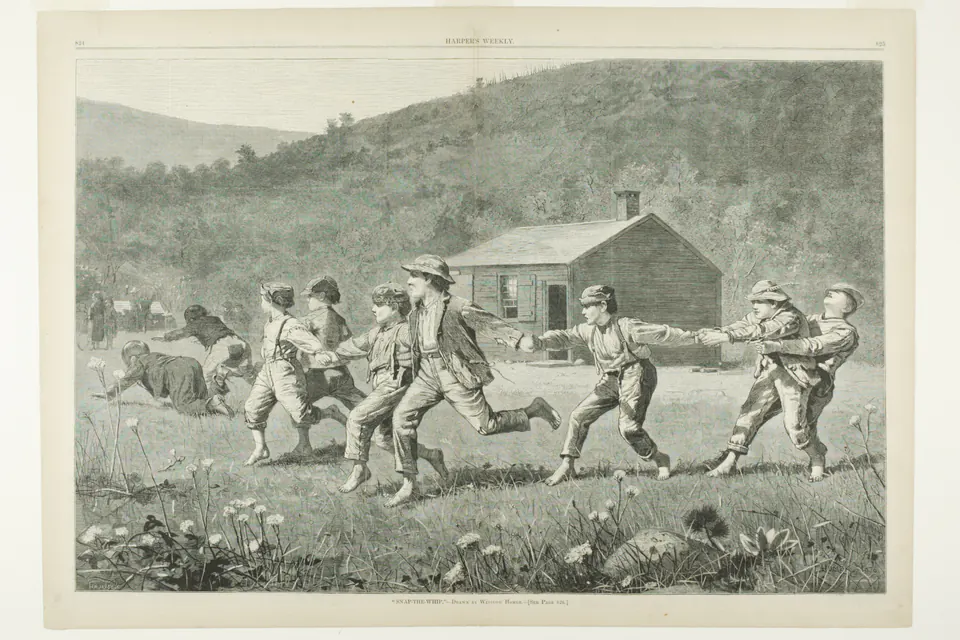
The hands make a continuous line, but the bodies cannot keep a uniform pace. Some boys lean, others stretch, and the end of the group begins to come apart. Even without colour, the image communicates speed through differences of balance.
The Art Institute’s record identifies this particular object as a wood engraving published in Harper’s Weekly. It is not one of Homer’s painted versions. The printed page, including its margins and lettering, matters: scenes of ordinary life reached readers through reproducible images as well as gallery pictures.
Look at the schoolhouse behind the game. Its still, compact shape makes the scrambling figures seem even less settled. The setting gives the action a familiar social frame without explaining every child individually. The pleasure of the picture lies partly in recognising a movement your own body understands: the pull between keeping hold and losing your footing.
Eakins: the Biglin Brothers Racing
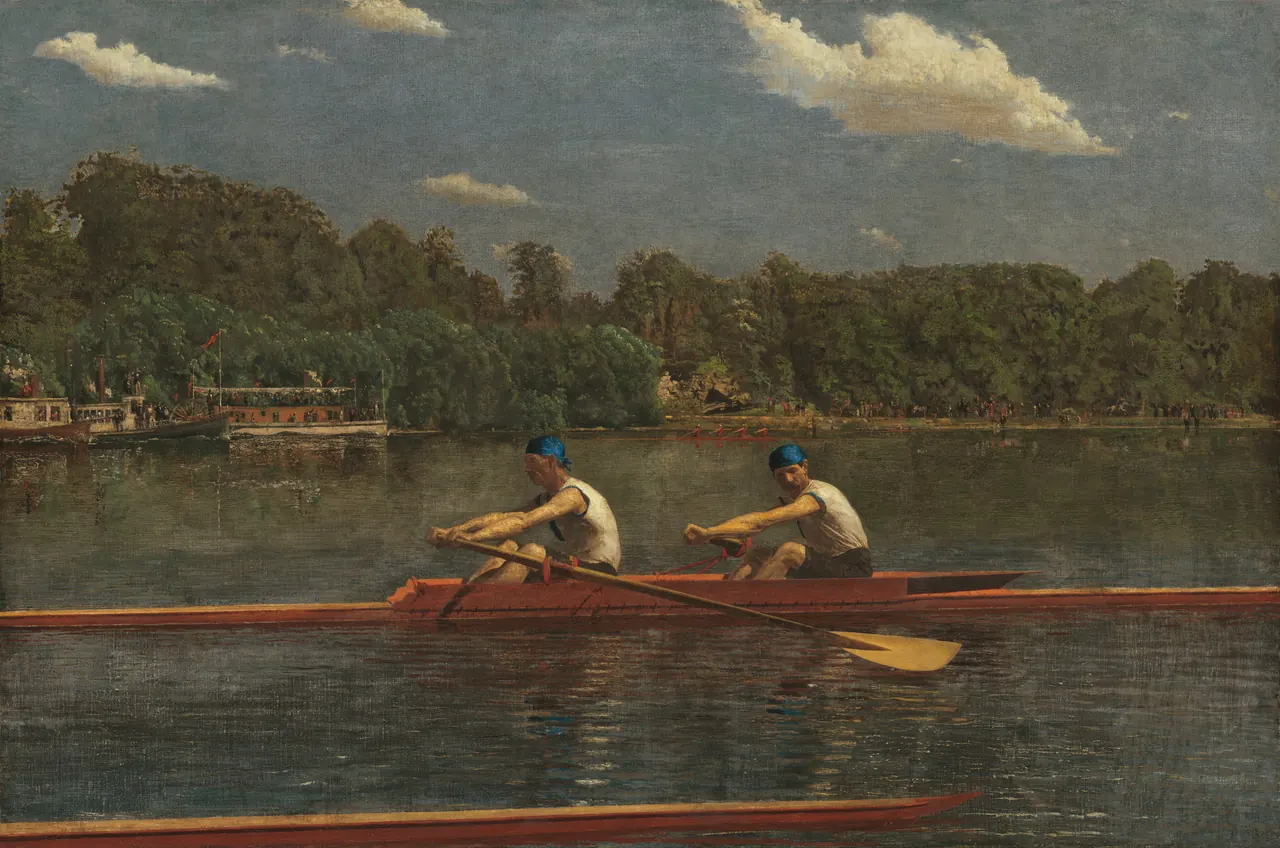
Eakins makes athletic effort specific. The arms are extended, the narrow hull runs across the picture, and the two bodies work together without becoming identical shapes. A second boat cuts into the near edge, so competition enters before we see its occupants.
The National Gallery connects the painting to the Biglin brothers’ 1872 race on Philadelphia’s Schuylkill River. Its account identifies Barney checking the rival shell while John begins the next stroke. A small turn of the head turns a general rowing scene into a contest.
This is a useful example of Realism as organised observation. Water, anatomy and equipment appear materially convincing, yet the picture is highly arranged. Long horizontal bands stabilise the river, while the angled bodies and oars supply movement. The spectator is close to the working muscles but outside the boat, able to compare both men within one measured view.
Homer: the Gulf Stream
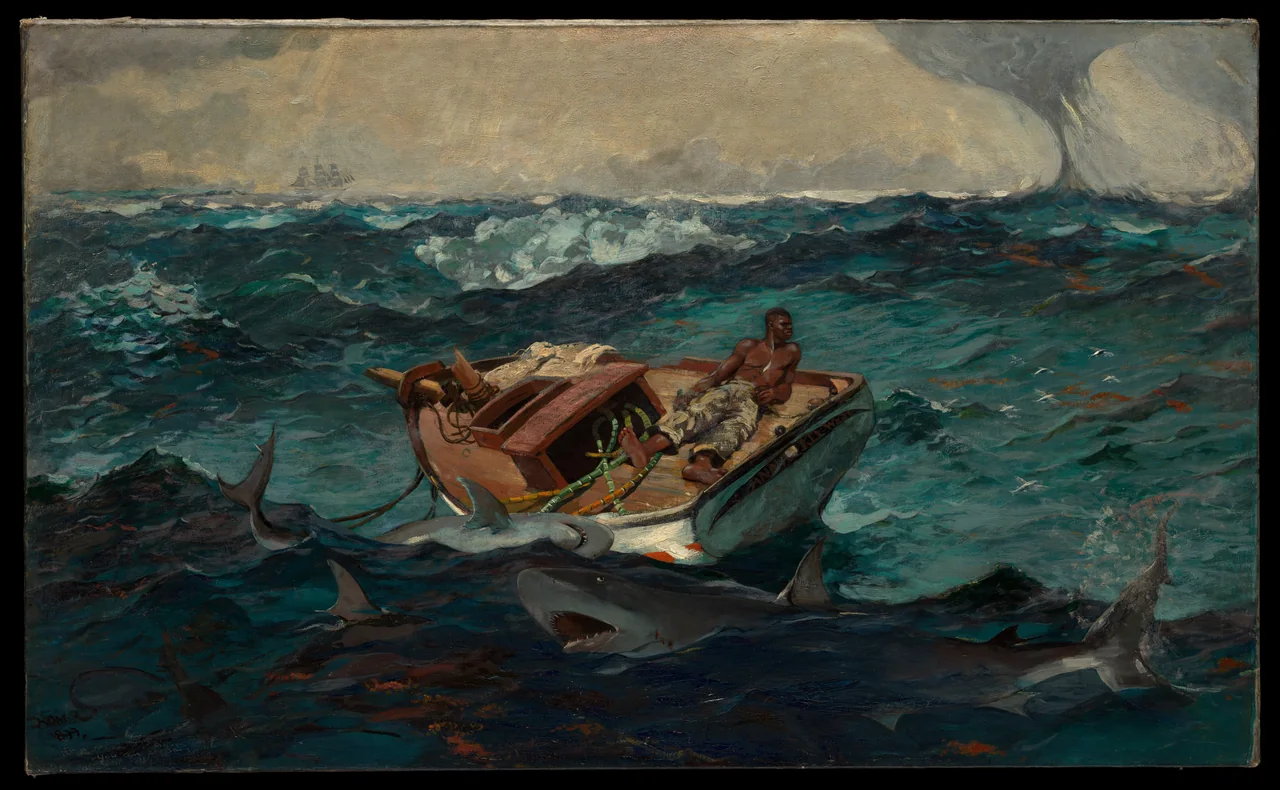
The boat is near enough to inspect, but rescue is not. The distant ship and waterspout occupy opposite reaches of the horizon, while the sharks press towards our side of the picture. That distribution makes the man’s stillness more unsettling than a dramatic raised arm might be.
Homer’s sea is neither a neutral backdrop nor merely a test of rendering waves. The Met reads the sugarcane aboard the boat and the Atlantic current in relation to Caribbean empire and slavery. That historical interpretation enlarges the image beyond a generic “man against nature” story.
At the same time, the figure’s thoughts remain inaccessible. We should not convert his face into a certain statement of fear, indifference or heroic confidence. The painting’s physical clarity coexists with unresolved narrative: we can see the danger much more securely than we can predict an ending. Realism need not give us a complete explanation.
Sargent: Madame X
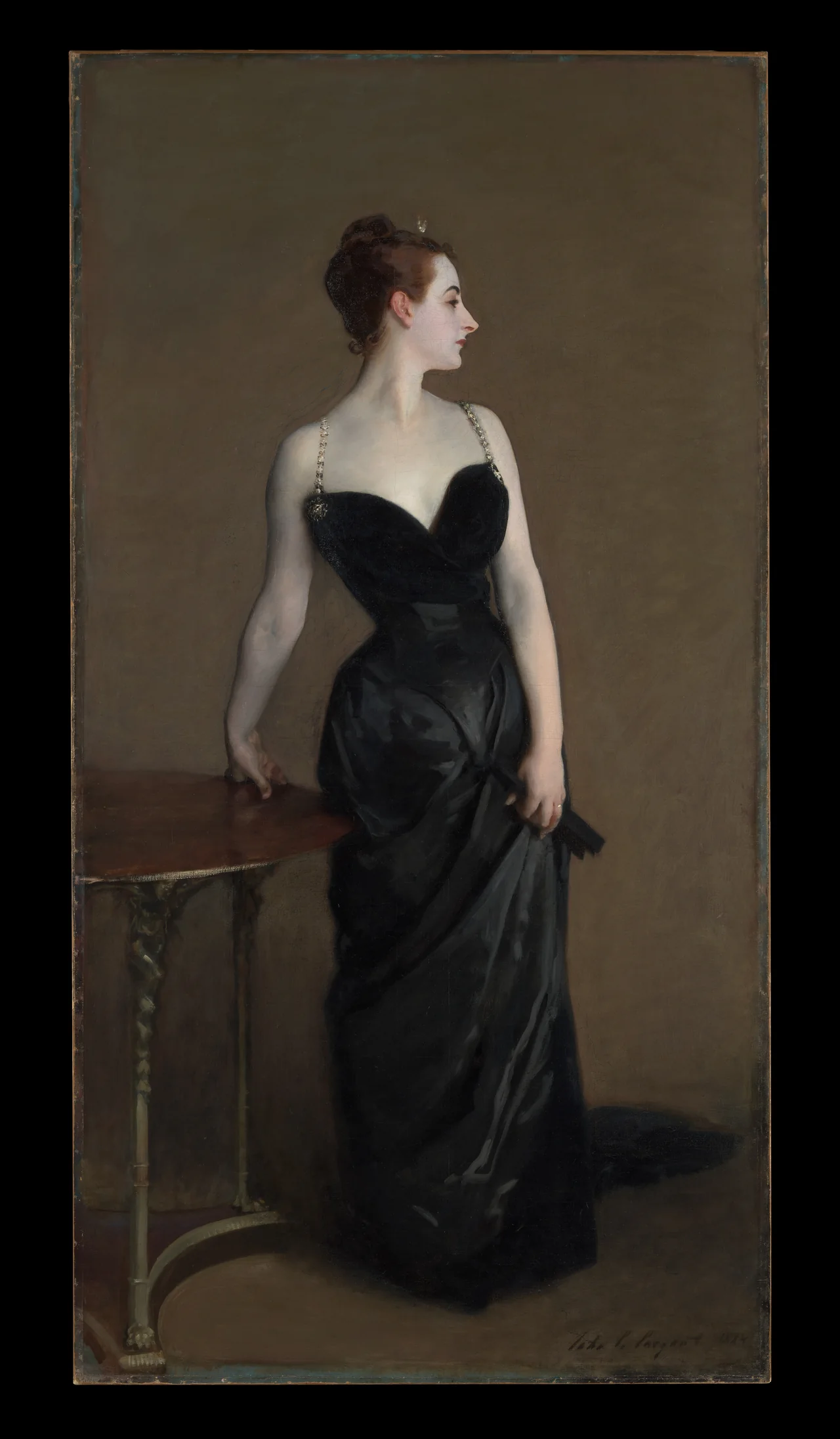
The black gown creates a large, nearly continuous shape beneath the pale shoulders. Gautreau turns her face away while her arm reaches back to the table, making the pose feel controlled rather than casually comfortable. Small changes in the dress distinguish lustrous fabric from deep shadow.
Sargent was not simply recording someone who happened to stand there. According to the Met, he pursued the portrait without a commission, with Gautreau’s cooperation, and hoped its exhibition would advance his reputation. The hostile response at the 1884 Salon prompted him to repaint the originally slipping shoulder strap.
The version shown here therefore contains a revision to the image’s public presentation. Recognisable likeness, fashionable self-fashioning and artistic ambition are inseparable. Sargent’s fluency can look effortless, but this portrait is evidence of negotiation, not the absence of it. An apparently immediate person may be the result of many calculated choices.
Sargent: Street in Venice
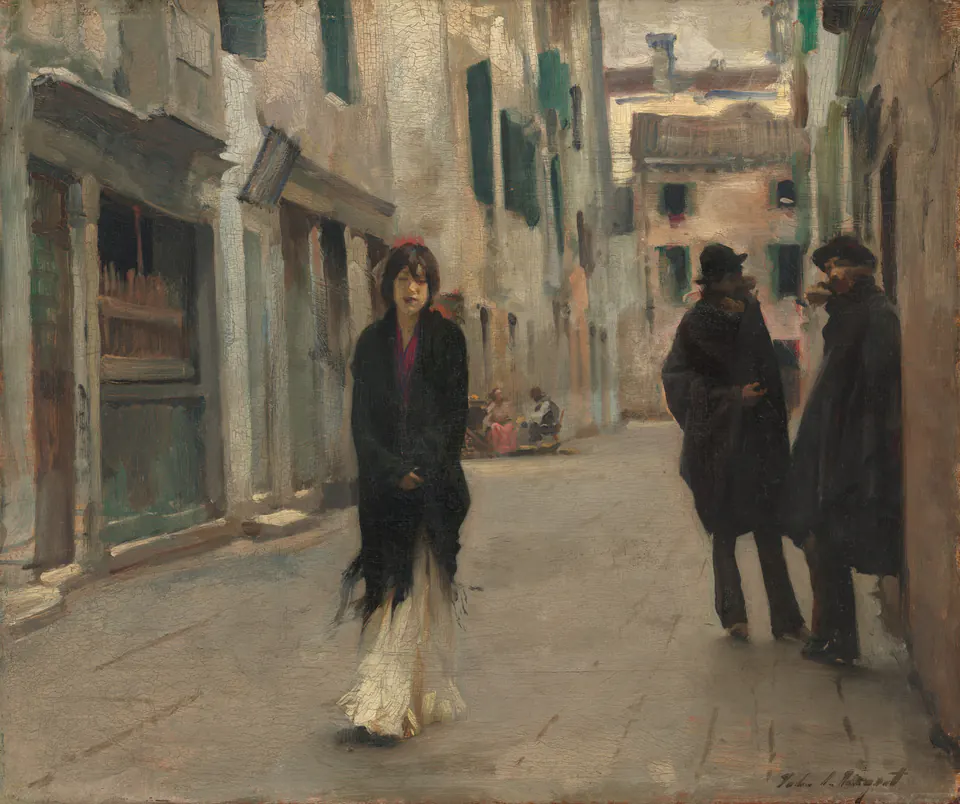
This woman does not present herself as Gautreau does. She seems to be passing through, wrapped in a dark shawl, with two men paused behind her. Their positions create a social tension without supplying dialogue or a settled account of their relationship.
The alley also changes how we read Sargent’s paint. Pale architecture is broken into broad, irregular touches; faces remain economical. The space is convincing even though individual marks are conspicuous. Realistic recognition does not depend on polishing every surface smooth.
Compare the two Sargents by following the figures’ outlines. Madame X isolates a deliberately posed silhouette against an uncluttered background. Street in Venice lets bodies interrupt a shared passageway. The difference is not that one is true and the other false. They offer two ways of shaping an encounter: formal display and the impression of a passing moment.
Cassatt: the Child’s Bath
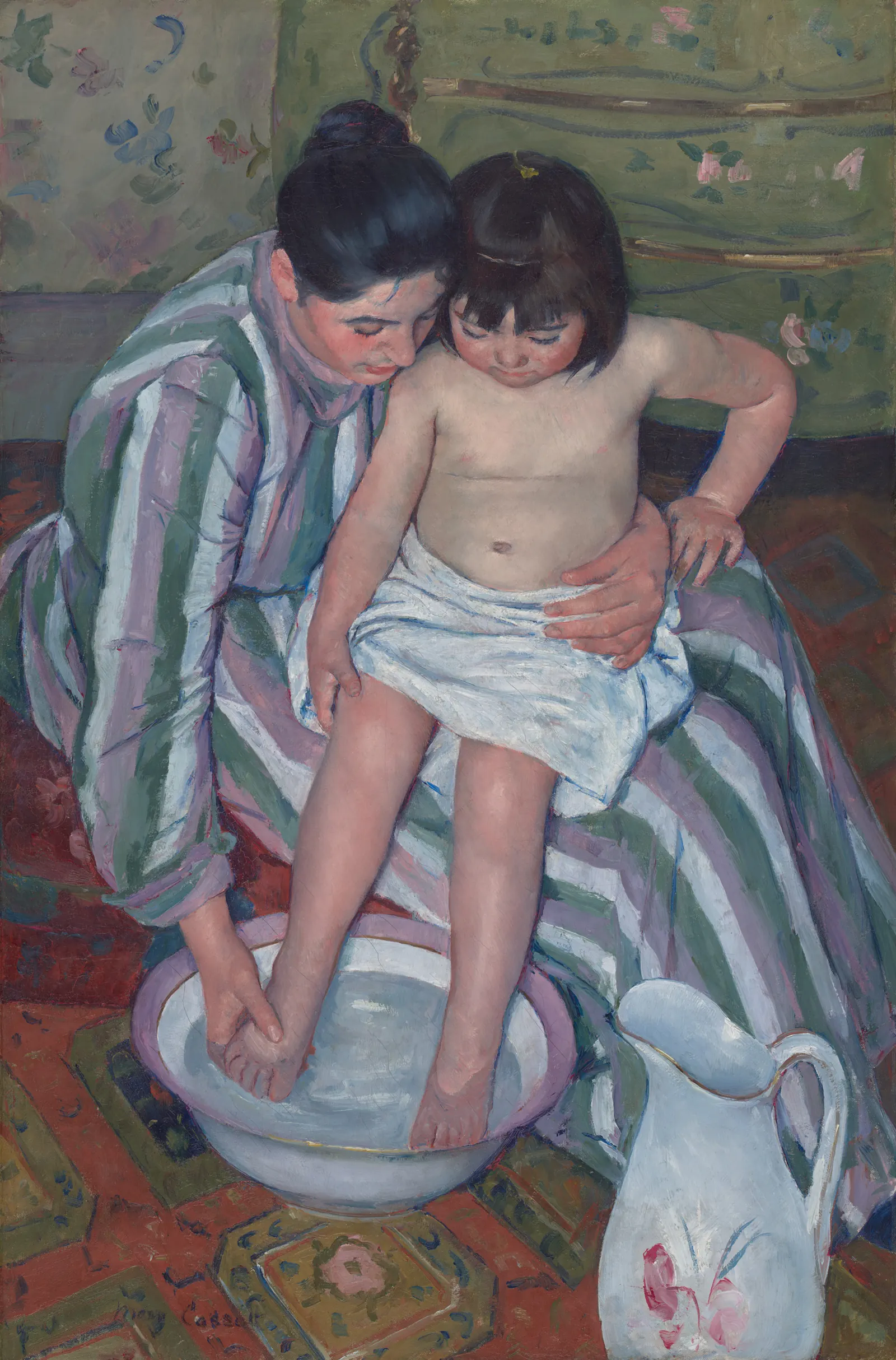
Both faces turn towards the same small task. Hands steady the child and support the foot; the basin gives their attention a precise destination. Care is shown as coordinated physical work, not just an affectionate expression.
The high viewpoint compresses the space. Stripes run across the woman’s dress, while the patterned floor rises towards us instead of disappearing far behind the figures. The Art Institute relates these choices to Cassatt’s engagement with Japanese art. Pattern and believable bodies are not competing goals here.
Cassatt is better identified as an Impressionist than absorbed without qualification into an American Realist school. The Met’s account of her career places her within that French exhibition network. Her inclusion here helps separate subject from affiliation: an intimate, recognisable modern activity can be painted through a markedly experimental organisation of the surface.
Cassatt: the Boating Party
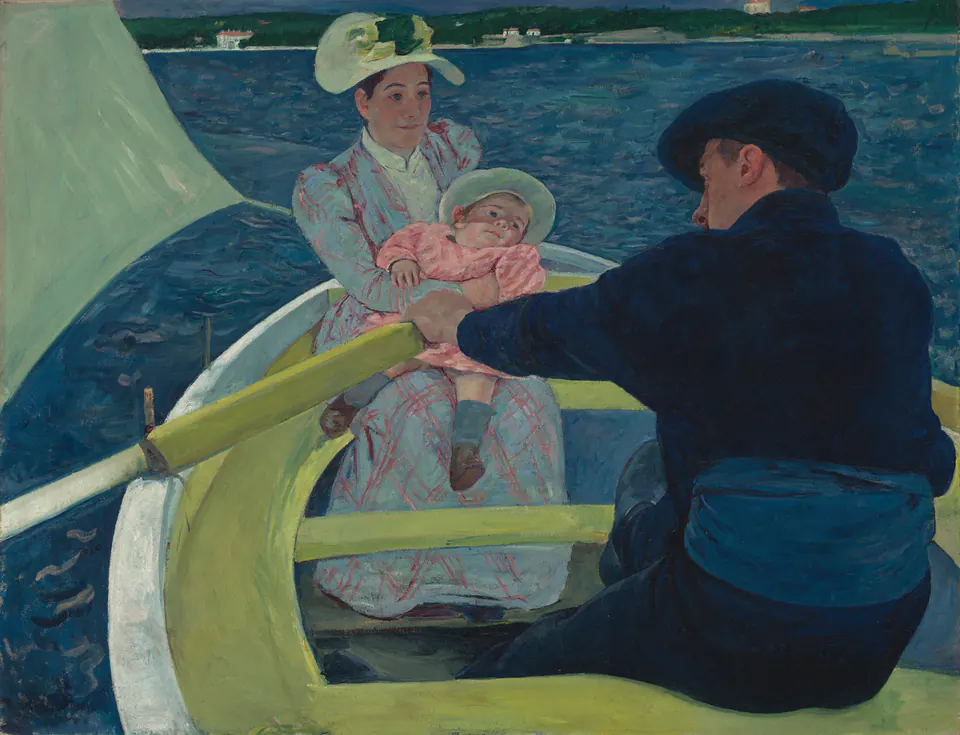
Return to Eakins’s rowers after looking at this boat. Cassatt brings us inside the vessel, close to the boatman’s back. His dark shape blocks a large part of the water; the sail and curving hull cut the remaining space into strong coloured areas.
The woman and child sit beyond his outstretched arm. Their light clothes stand out against the water, but they do not erase the force of the foreground figure. This is not a sentimental scene with scenery attached: its impact depends on an unexpectedly assertive arrangement.
The National Gallery dates the painting to 1893–94. Alongside The Child’s Bath, it reveals the variety within Cassatt’s apparently repeated subject of women and children. One picture closes around touch; the other creates distance across a boat. Looking at where the viewer has been placed is more revealing than calling both images simply “maternal.”
Whistler: Symphony in White, No. 1
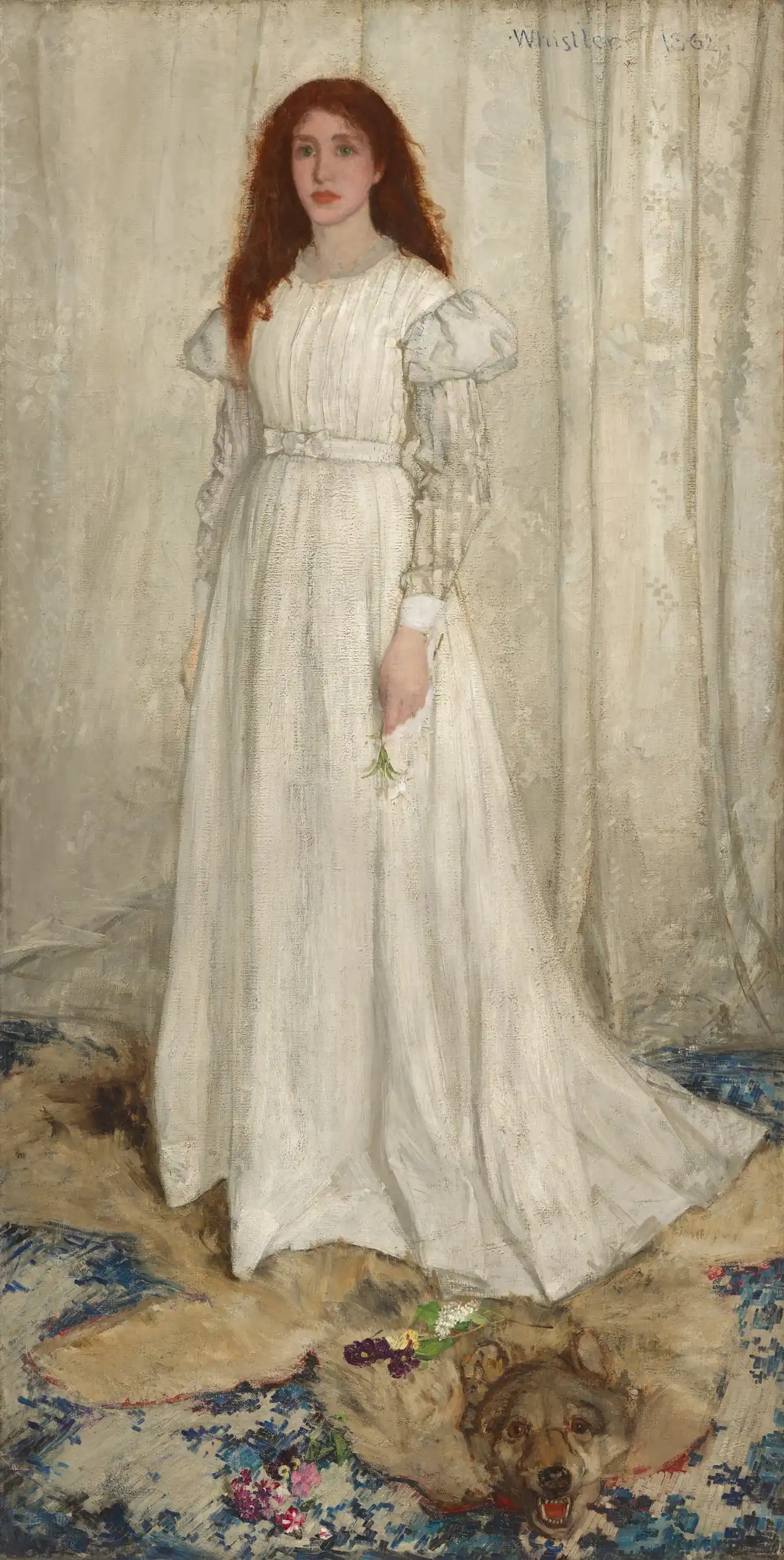
White is not a single colour in this painting. Dress, curtain and sleeves vary in warmth, shadow and texture. The auburn hair and patterned carpet intensify the pale figure without requiring a crowded setting.
The sitter is Joanna Hiffernan, Whistler’s model and collaborator. The National Gallery explains that he eventually grouped three white-dress paintings under musical titles, emphasising qualities such as line and colour. The Met identifies him as a central figure in the Aesthetic movement.
That position complicates the label “Realism.” Hiffernan is a tangible individual, but Whistler does not offer the sort of explicit activity found in Eakins’s race. The figure supplies the painting’s subject while the tonal arrangement supplies much of its purpose. A realistic body can belong to an artwork that resists being reduced to a realistic story.
Five artists without one national style
Homer makes familiar action and uncertain survival equally absorbing. Eakins gives exertion a precise structure. Sargent explores public appearance and passing encounters; Cassatt reorganises everyday attention; Whistler asks how much a picture can communicate through colour alone.
Continue with the existing Homer, Sargent, Cassatt and Whistler guides, or compare Sargent and Whistler directly. The shop’s current collections are a separate selection; the eight works discussed here are not a product list.
Rather than asking only whether a work looks real, ask what it makes convincing. A movement, a social presence, a shared task and an arrangement of tones are different achievements. Keeping those differences visible makes American art more interesting than a single national style could be.
Editorial record
About this article
- Author
- Publisher
- GeMarkt
- Published
- Reviewed
- Internal source & rights check. Conducted by GeMarkt Research Review. This is an internal editorial check—not independent peer review.
- Source standard
- Art history source standardPrioritises object records and research sources, distinguishes evidence from interpretation, and states material uncertainty.
Found a claim that needs checking? Report a factual error.