GeMarkt Blog · Essay
Ukiyo-e vs Shin-hanga: What’s the Difference?
Compare eight Japanese prints, from Hokusai and Utamaro to Goyō and Yoshida, through their lines, light, publishers and individual museum impressions.

The short difference
Ukiyo-e and shin-hanga are not two names for the same century of Japanese art. Ukiyo-e, usually translated as “pictures of the floating world,” grew through the Edo period and continued into the nineteenth century. Shin-hanga, “new prints,” describes a twentieth-century renewal of colour woodblock printing. It looked back to earlier subjects and craft while responding to modern ways of picturing light, bodies and places.
The simplest visual shortcut is to expect strong contour and pattern in ukiyo-e, and more atmospheric light or softly modelled forms in shin-hanga. It is a starting point, not a reliable identification test. Hokusai could make colour fade gradually; Goyō could build a modern picture around a wonderfully emphatic line.
These eight prints by six artists let us test the distinction with our eyes. The dates identify the particular museum records discussed here, not a guarantee that every sheet of the same design was printed at that moment.
A wave and a morning on the water
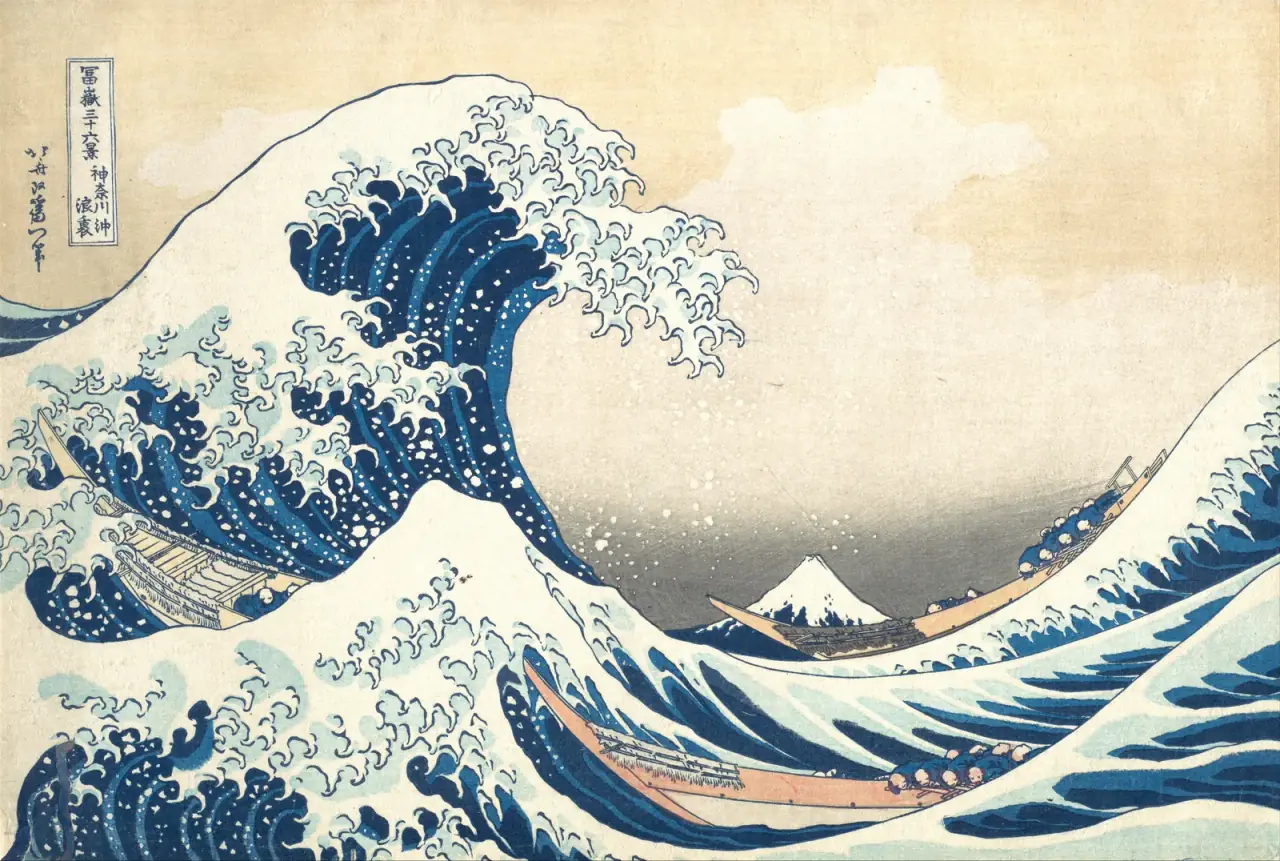
Hokusai’s Great Wave, Met impression JP1847, makes water feel like an enormous moving structure. Dark and pale bands carry the eye up the wave, while the foam breaks into small hooked shapes. The distant mountain sits within this activity as a tiny stable triangle. Space comes from those contrasts in scale as much as from shading.
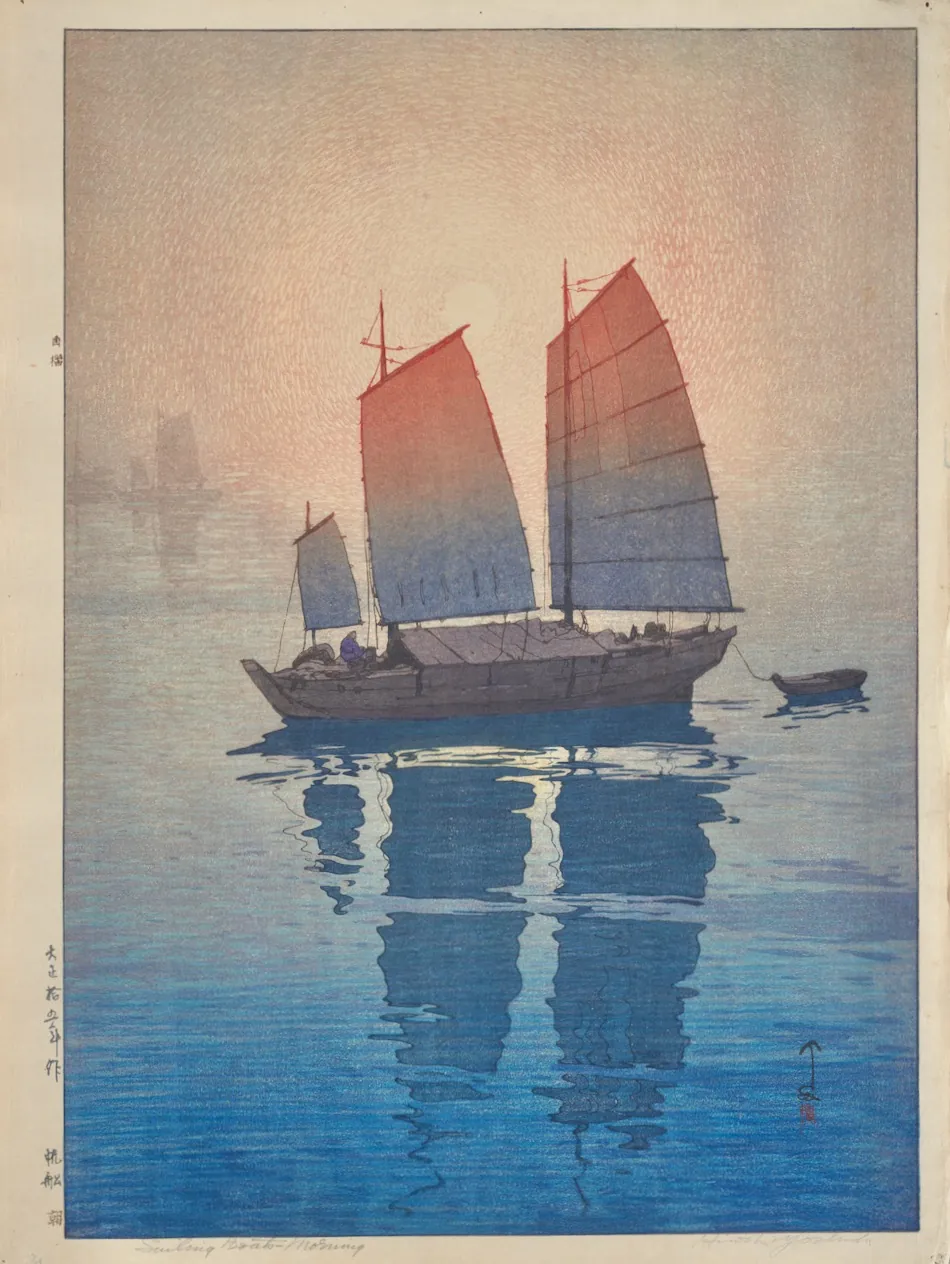
In Yoshida’s Sailing Boats—Morning, the mast and sails remain sharply intelligible, but the light changes across them. Warm colour gathers above; cooler blue travels down into the water. The reflection repeats the upright shapes while undoing their edges. The eye moves through a continuous atmosphere rather than through the wave’s sharply interlocking bands.
This is a comparison between two works, not proof that all Edo prints are dramatic and all modern ones peaceful. Yoshida’s museum biography records training in Western-style painting before his first woodblock print in 1920. The later print belongs to an artist moving between media, rather than simply making an older style more realistic.
Red Fuji is not flat in every sense
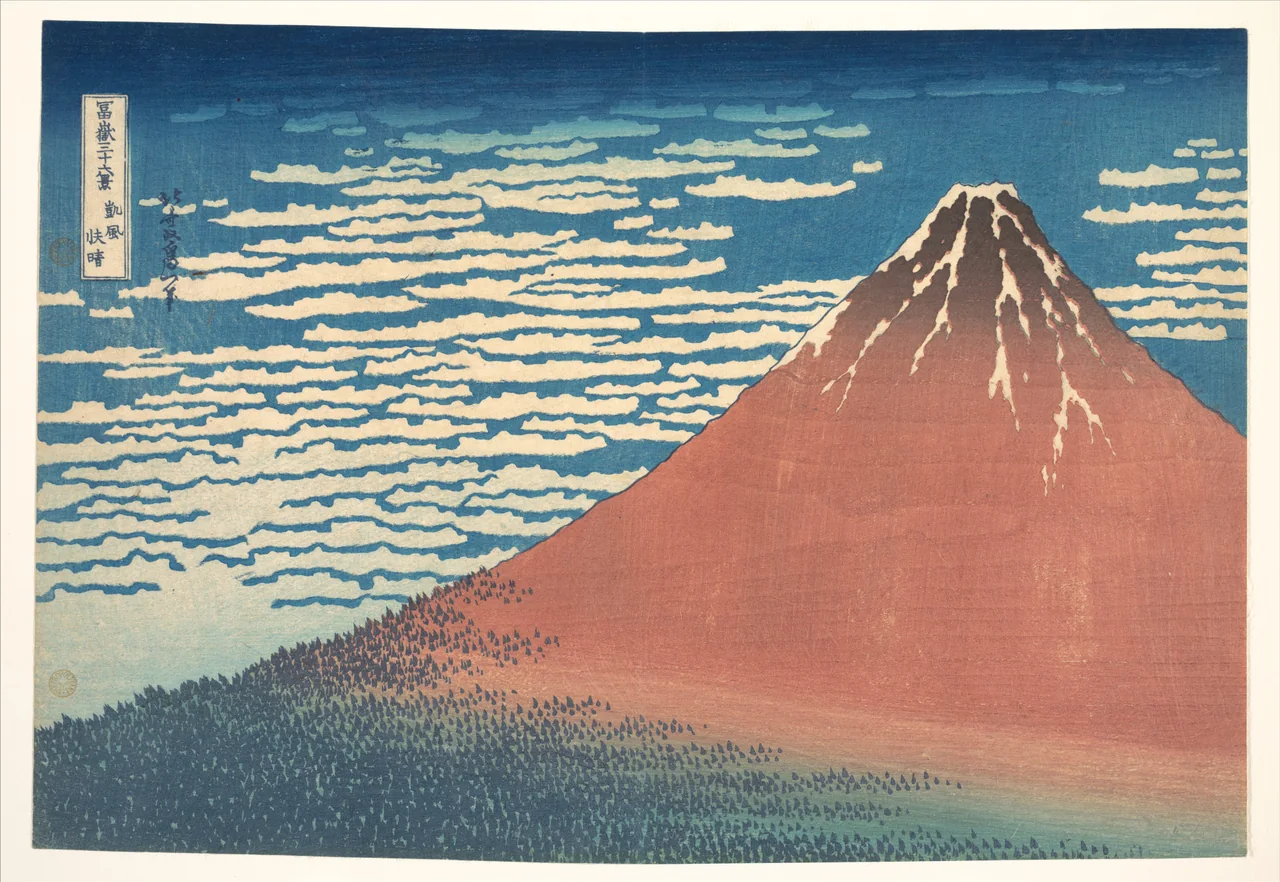
Red Fuji, Met JP9, complicates the shortcut immediately. The mountain is an exceptionally clear silhouette, yet its lower slopes soften into trees and colour. The sky is not uniformly blue. Small trees establish scale while narrow clouds stretch the picture sideways.
There is no need to choose between calling this decorative and calling it a landscape. Its design lets colour and shape carry the experience of a particular place. Next to Yoshida’s print, the difference is a matter of emphasis: a broad mountain form and a vibrating patchwork of reflected light make different demands on the viewer.
Do not read the apparent age or saturation of a web image as the artist’s whole style. These are individual surviving impressions, photographed and presented by different institutions. Paper tone, condition and printing differences remain part of what we see.
Two women, two kinds of attention
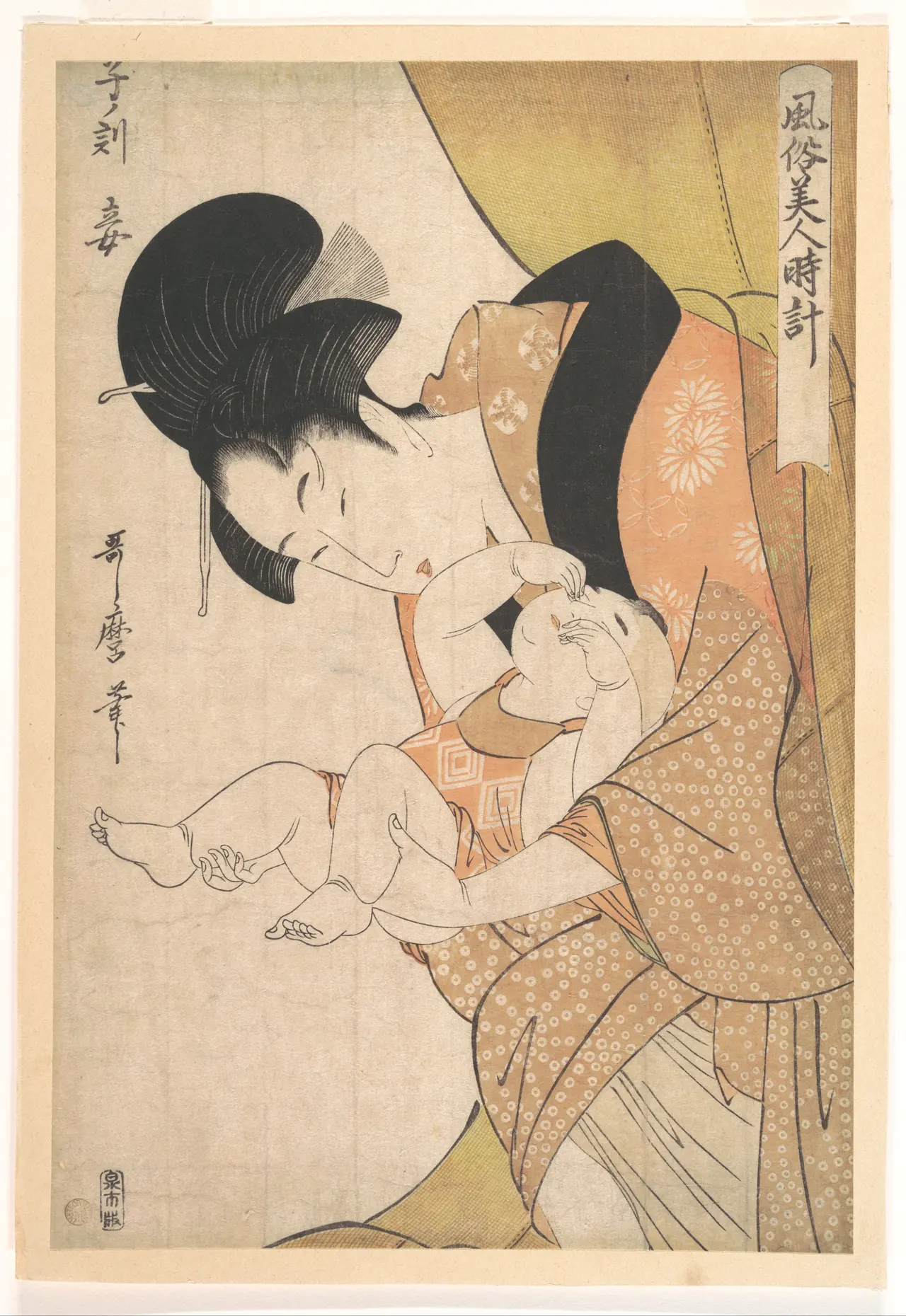
Utamaro’s Hour of the Rat offers a small domestic event. The mother bends towards her child; the child’s limbs reach into the remaining space. Their faces and arms make the action easy to follow even where the net and patterned garments overlap. The title situates this scene within a sequence of women’s daily customs, rather than identifying a private family portrait.
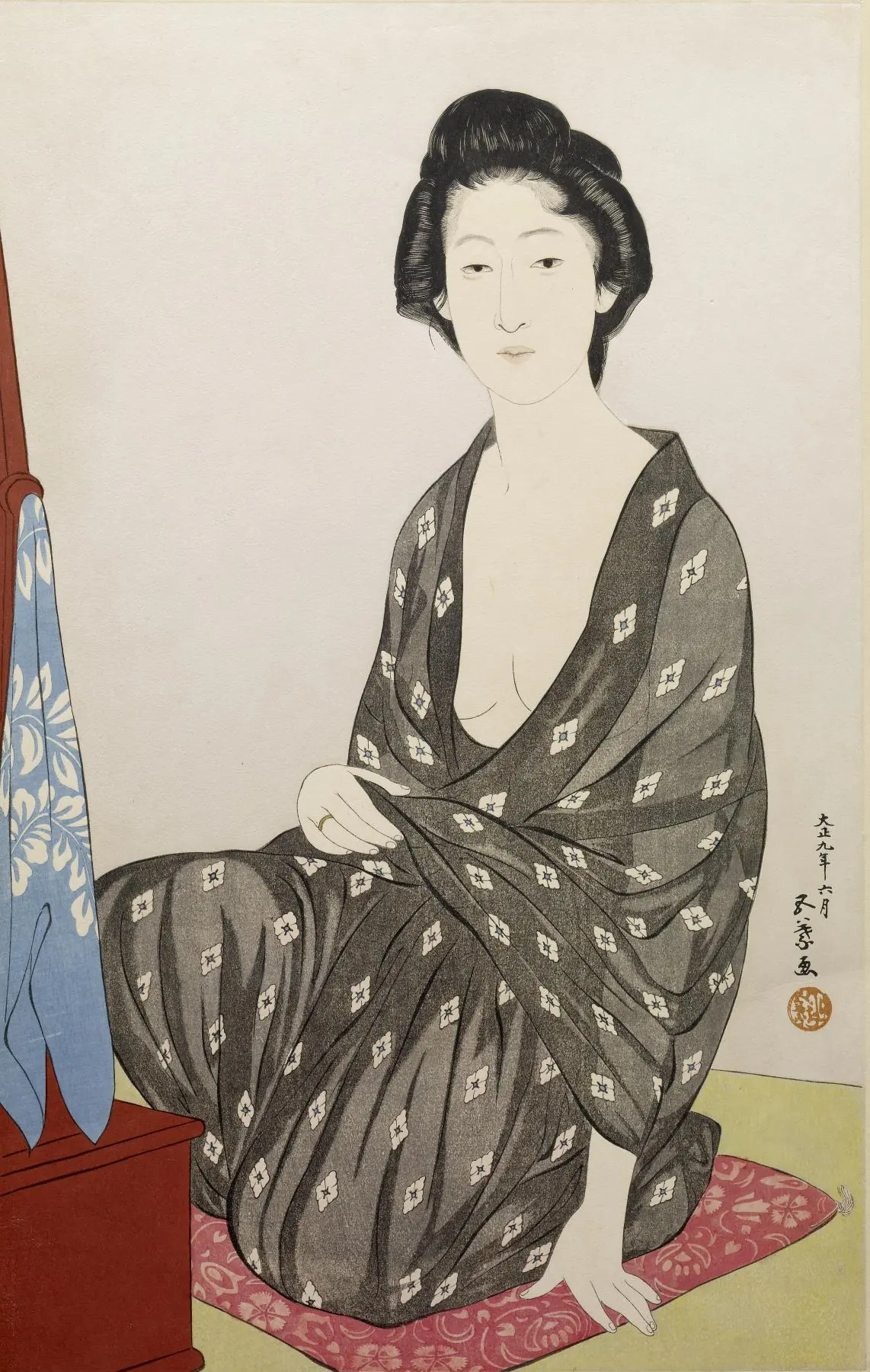
Goyō’s Woman in a Summer Kimono gives one figure more room. Her pale face is surrounded by a broad, quiet background. The transparency and folds of the kimono ask us to look at cloth against a body, while a hand gathers the material at her waist. Its current Walters record dates the work to 1920.
Both pictures select and stylise. A twentieth-century print is not automatically a candid photograph of an individual, just as an eighteenth-century design is not incapable of intimate observation. What changes here is the arrangement of our attention: a connected action between two figures, then the sustained presence of one.
What Goyō makes a line do
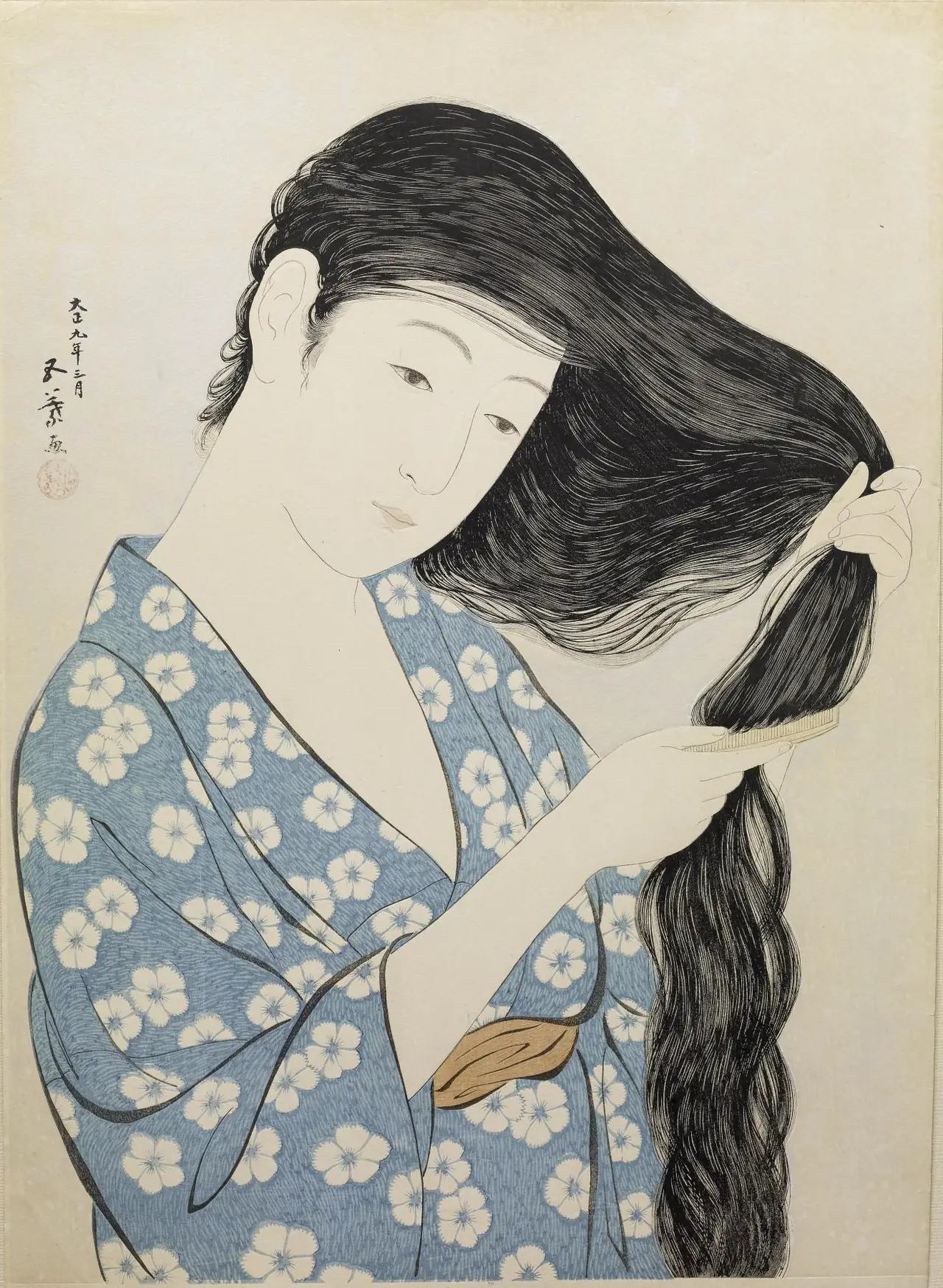
In Woman Combing Her Hair, the great sweep of black hair nearly becomes a landscape of its own. Fine pale lines break the mass into strands, then gather again where the hand grips them. The diagonal forearm, the curve of the shoulder and the falling hair create three different movements in a compact space.
The blue floral kimono does not dissolve into naturalistic shadow. Pattern is still a powerful organising device. This is why “shin-hanga added Western realism” is too blunt an explanation: modern artists could adapt selected effects without abandoning the expressive resources of earlier prints.
The Met’s discussion of another Goyō design identifies his close study of earlier masters, including Utamaro. That connection is more useful than ranking one period above another. Continuity could be an active artistic choice, not a failure to become modern.
Rain across a city and around two birds
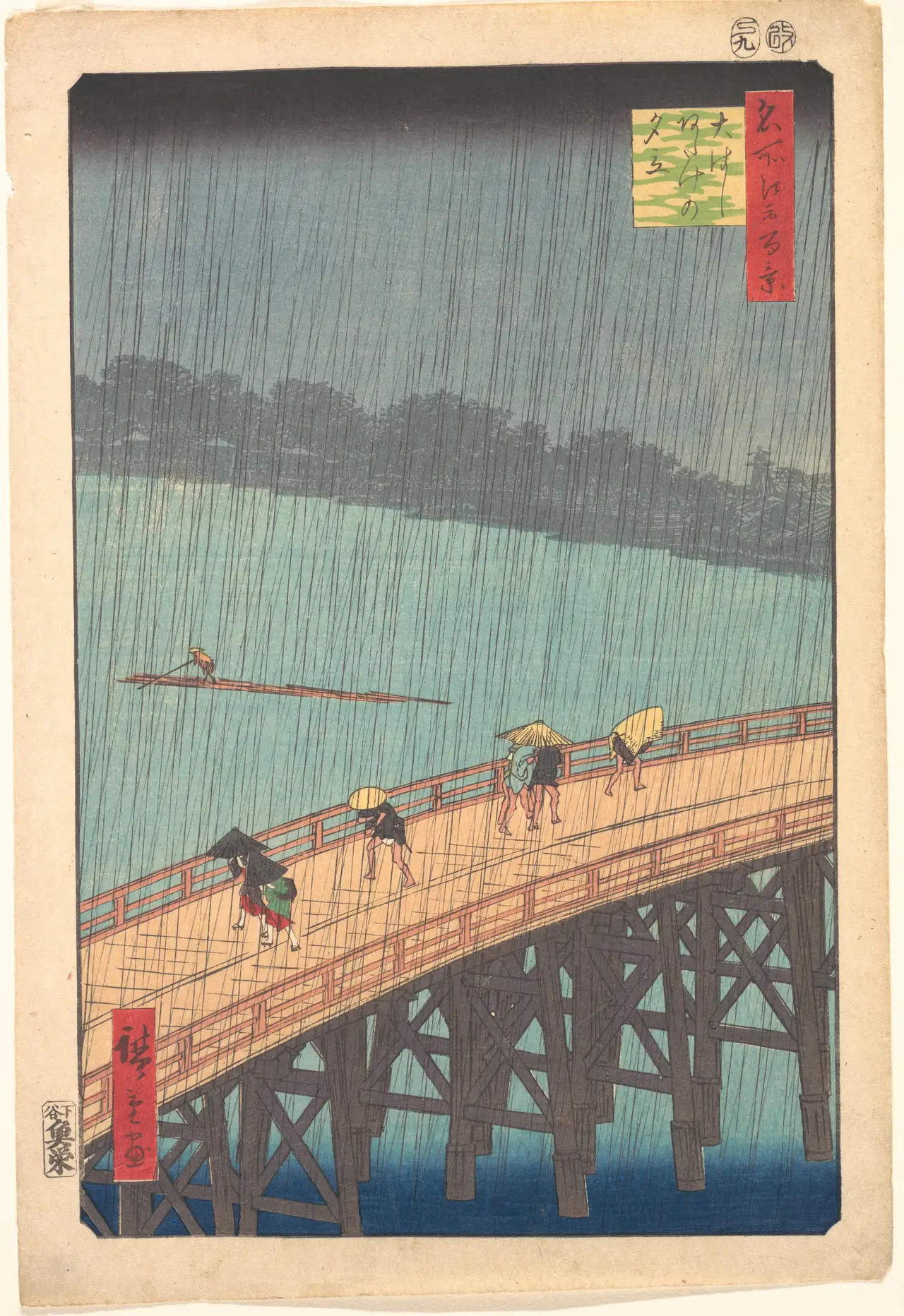
Hiroshige’s Sudden Shower spreads weather over a public place. The bridge crosses the rain’s direction, and the tiny bent figures answer the storm with bodily movement. The distant bank is less emphatic than the near bridge: atmospheric depth was already available to this earlier printmaker.
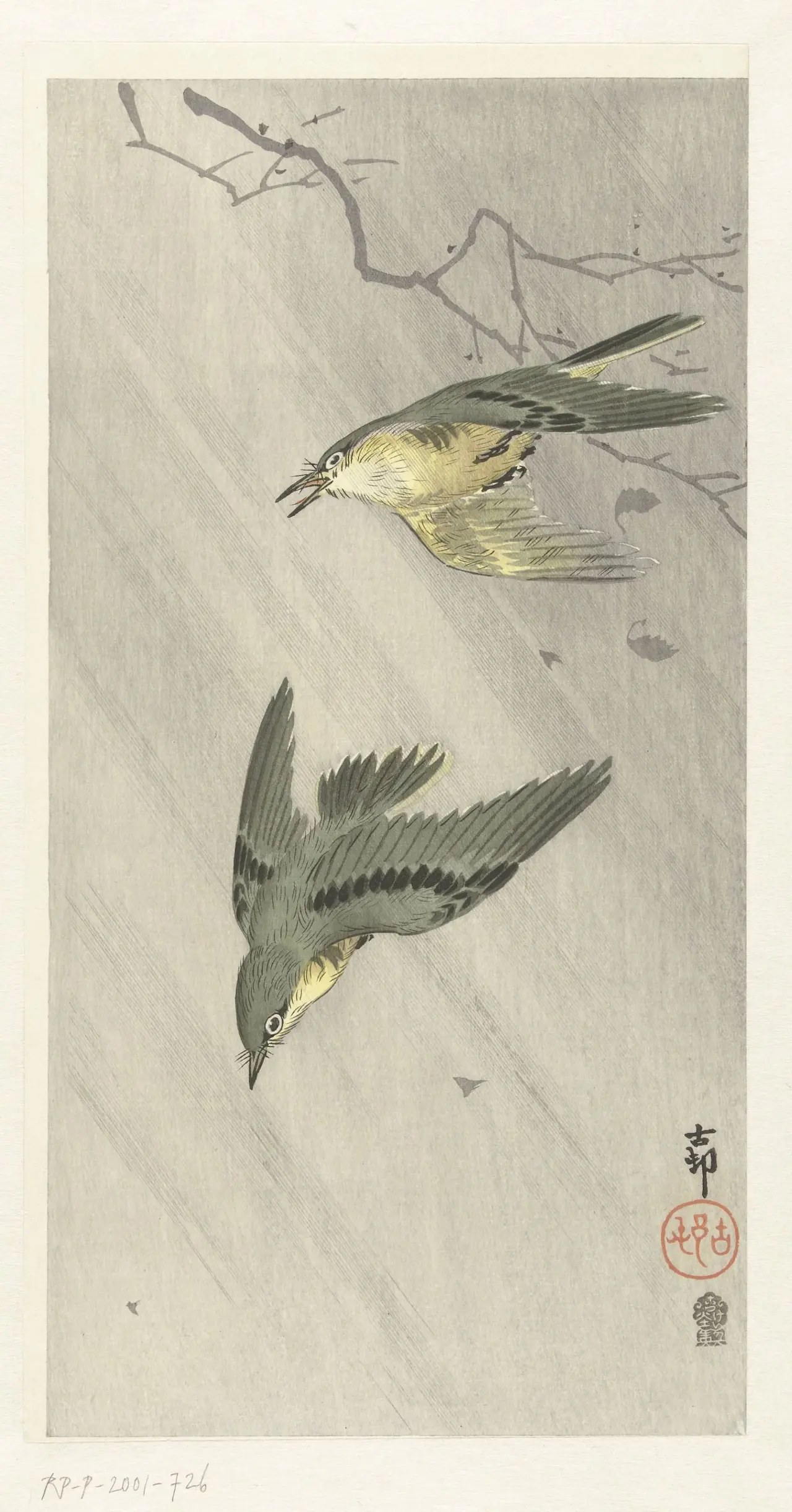
Koson’s Songbirds in Rain removes the city and makes fragile moving bodies the centre of the event. Pale diagonal strokes cross a narrow sheet. The two birds point in different directions; their small dark eyes remain clear against the muted feathers.
The Rijksmuseum dates this Akiyama Buemon publication to 1900–1910. It is a transitional comparison, not an example we should relabel as a later Watanabe edition. Koson’s career crosses the neat boundaries that introductory timelines create. A publisher’s name and an individual record can tell us more than a style label alone.
The new print still needed skilled makers
Colour woodblock printing did not suddenly become a solo activity with shin-hanga. The Met’s account of ukiyo-e production describes the collaboration of designer, carver, printer and publisher. Separate colour blocks had to register accurately on the paper. The visible line and subtle transition of colour depend on that combined labour.
In the twentieth century, publisher Watanabe Shōzaburō helped renew such collaboration for new audiences, including buyers abroad. The Met’s record of Shinsui’s 1916 Before the Mirror describes a specific commission from a painting and the partnership that followed. That is evidence for one production relationship, not proof that every shin-hanga sheet came from Watanabe’s workshop.
Nor do these two headings exhaust Japanese printmaking. They are useful ways into related histories, not containers that every modern woodcut must fit. Artist, publisher, subject and printing history should remain visible underneath the label.
Read the sheet, not only the style
A design date, the date a particular impression was printed, and the date of a digital reproduction answer different questions. A modern reproduction of a Hokusai design is not thereby an Edo-period object. A twentieth-century artist’s name does not settle whether a later print is a lifetime impression, a posthumous edition or a newly made copy.
Permissions also remain specific. The Met marks the four Edo impressions illustrated here as public domain; the Walters releases its two Goyō files openly; Tokyo Fuji Art Museum identifies its Yoshida image as CC0. Those records support these chosen illustrations, not a declaration that all shin-hanga is free to reuse. The movement name is neither a licence nor a copyright expiry date.
Where to look next
Follow the Hokusai, Hiroshige and Koson guides for individual works and sources. For the physical differences between an old impression and a modern reproduction, continue with the Japanese woodblock print buyer’s guide.
The collections directory is a separate browsing route, not a claim that every example here is stocked. When you return to a print, begin with one small thing: the edge of a wave, a strand of hair, a rain line or a reflected sail. The difference between ukiyo-e and shin-hanga becomes clearer when the terminology follows that looking, rather than replacing it.
Editorial record
About this article
- Author
- Publisher
- GeMarkt
- Published
- Reviewed
- Internal source & rights check. Conducted by GeMarkt Research Review. This is an internal editorial check—not independent peer review.
- Source standard
- Art history source standardPrioritises object records and research sources, distinguishes evidence from interpretation, and states material uncertainty.
Found a claim that needs checking? Report a factual error.