Are Ohara Koson's prints public domain? A collector's guide
Koson used three signatures across three periods, turning each into a date clue. See how his bird-and-flower prints stand in Japan, the EU, and the US, print by print.
From the guide to the collection
Explore the Koson collection → · Shop all art → · Free Koson wallpapers — the complete paintings at 4K ↓
From the studioKoson prints — 90+ restored works, curated and annotated →
The artist whose signature is a date
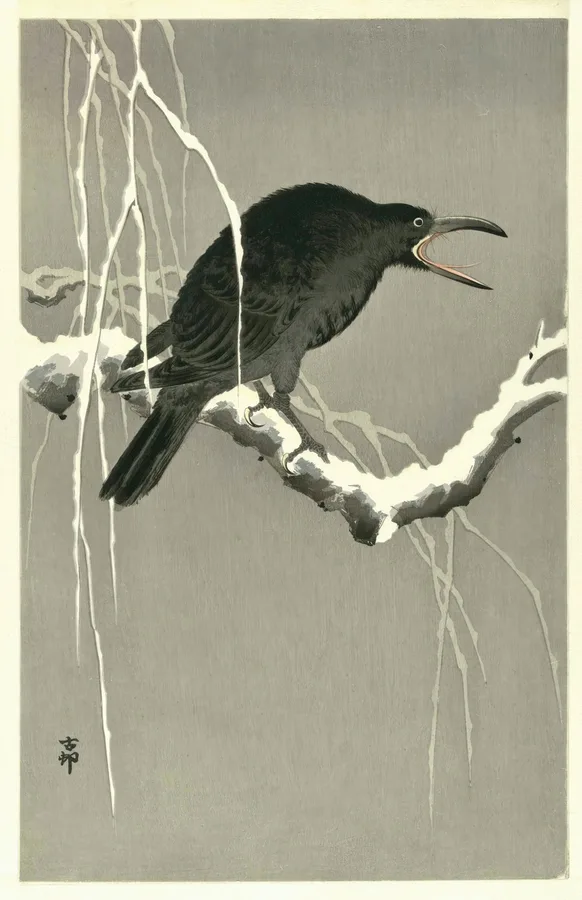
Ohara Koson was born Ohara Matao in Kanazawa in 1877 and took his working name from his teacher, the painter Suzuki Koson. He gave nearly his entire career to a single genre: kacho-e, pictures of birds and flowers. A crow calling from a snow-laden branch, a heron hunched in the rain, sparrows jostling along a wisteria vine — he designed hundreds of prints — by most counts around five hundred, the great majority of them birds — with a restraint that makes each one feel considered rather than repeated.
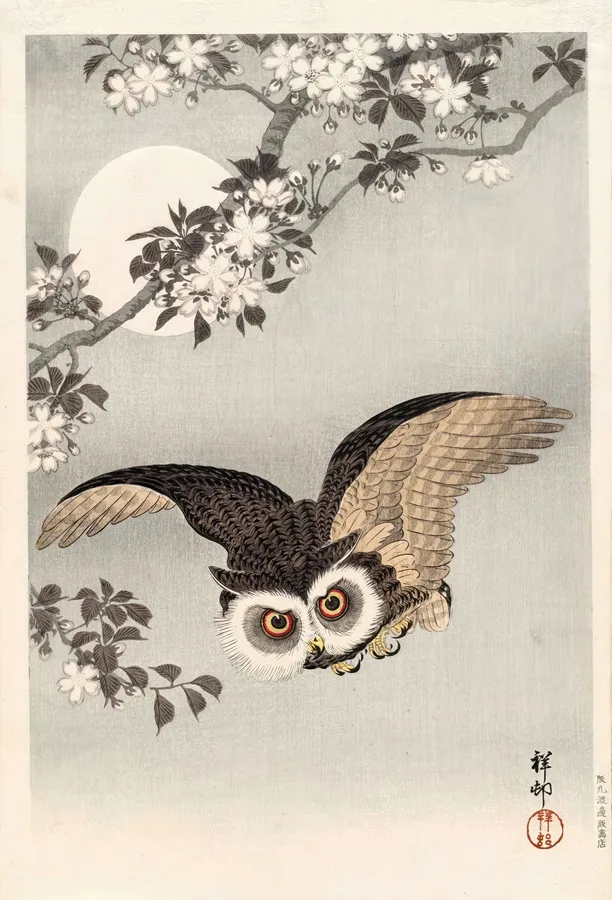
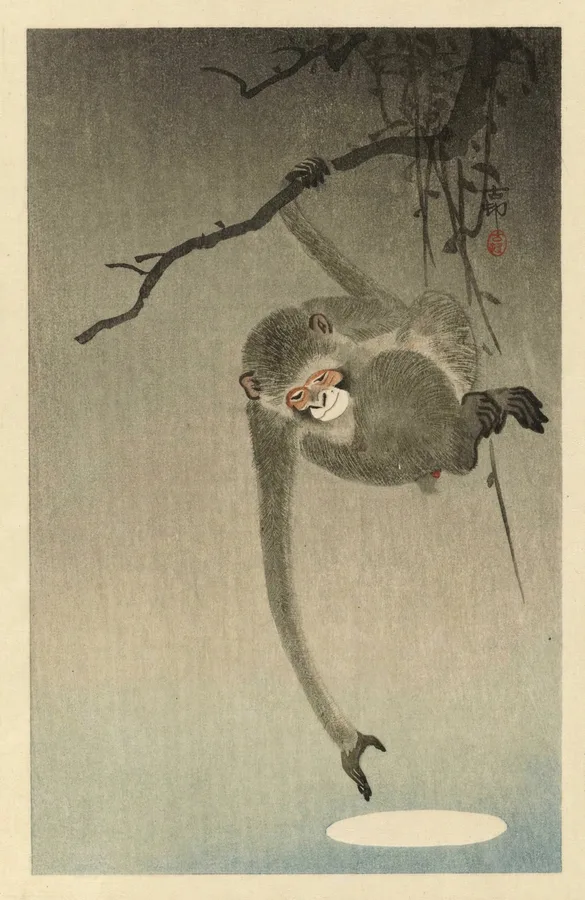
The career divides into chapters, and — unusually for any artist — the chapters are written into the signatures. From roughly 1900 to 1912 he signed his prints Koson (古邨) and worked with the Tokyo publishers Kokkeido (Akiyama Buemon) and Daikokuya (Matsuki Heikichi); our Cawing Crow and Monkey Reaching for the Moon’s Reflection, both from around 1910, belong to this period. In 1912 he changed his name to Shoson and set print design largely aside for some fourteen years to concentrate on painting. Then, in 1926, the publisher Watanabe Shozaburo — rebuilding his business after the Great Kanto Earthquake of 1923 — drew him back to printmaking, and the prints from 1926 onward carry the signature Shoson (祥邨). The Scops Owl, Cherry Blossoms and Moon in our collection is one of the designs that announced that return. A third name, Hoson (豊邨), appears on the prints he made with the publisher Kawaguchi. Three names, three periods, three sets of publishers: on a Koson print, the signature is also a date stamp. Hold that thought — it is about to matter legally.
One more thing worth knowing. Koson’s market was never really Japan. Around the turn of the century the American scholar Ernest Fenollosa, former curator of Japanese art at the Museum of Fine Arts, Boston, encouraged him to send his bird prints abroad, and abroad they went: American and European collectors were the audience for these prints from the beginning, and the Watanabe-era work was produced overwhelmingly for export. At home he remained so little known that Japan’s first major Koson exhibition was held only in 2018, at the Chigasaki City Museum of Art, followed in 2019 by a retrospective at Tokyo’s Ota Memorial Museum of Art. A Koson on a Western wall is not a transplant; it is the destination these images were made for.
He died at his home in Tokyo in 1945 — and in copyright, that date decides most of what follows.
Are the prints public domain?
Start in Japan. When Koson died, Japanese copyright ran for the author’s life plus fifty years, which carried his rights to the end of 1995. Japan did extend its term to life plus seventy at the end of 2018, but the extension was not retroactive: works whose copyright had already expired stayed expired. Koson’s had, by more than two decades. In Japan, his work is public domain.
In the European Union — and in most of the world, which uses the same rule — copyright lasts for the life of the author plus seventy years. For an artist who died in 1945, that term ran out at the end of 2015, and his work has been public domain across the EU since 1 January 2016.
The United States is where the signature earns its keep. For older works, US copyright is measured not from the artist’s death but from publication: ninety-five years, which as of 2026 means works published before 1931 are in the public domain. Everything signed Koson — the whole Daikokuya-era catalogue, finished by 1912 — clears that bar by decades. The first Watanabe years clear it too: prints published from 1926 through 1930, including the scops owl of 1926 and the Cockatoo and Pomegranate of around 1927, have crossed the line. But Koson kept designing until at least 1935, and a Shoson-signed print first published after 1930 may still be inside its US term. So the honest answer for this artist is not one blanket yes. It is: public domain worldwide for the early work, public domain almost everywhere for the late work, and in the US a question that turns on the publication date of the individual print. The signature narrows the window; the date decides. That is exactly how we approach it — we verify the rights status of every individual piece before it is listed, and the works we restore and sell clear the bar in all major systems.
The standing caveat belongs here too: copyright terms vary by country, transitional rules produce odd edge cases, and this page is general information about how the terms work — not legal advice. If a commercial decision hangs on the answer, ask a lawyer in your jurisdiction.
The artwork being free is not the same as the file being free
A distinction that trips up collectors of every artist, and printmakers most of all. When a Koson design is public domain, the design is free — anyone may reproduce and sell it. But a particular digital file of that design is a separate question. Museums and image libraries sometimes assert rights or impose contractual terms over their photographs of public-domain works, and whatever the legal force of those claims in any given country, the practical point stands: the freedom attached to the artwork does not automatically travel with every file of it circulating online. With woodblock prints there is a further wrinkle — every surviving impression was printed by hand, so no two copies of a design are quite identical, and the file’s source shapes what you actually get.
That is why the provenance of the file matters as much as the status of the design. The restorations we sell are our own work, made from material whose status we have checked — artwork and source both.
Koson in our collection
Our Koson collection holds over 90 works, spanning both signatures: the quiet Daikokuya-era sheets and the saturated Watanabe-era designs. The curated selection on the collection page includes the Goose and Reeds in Snow, a winter goose set against a flat field of vermilion that dulls toward brick in tired copies and keeps its heat here; the Heron in Snow, woodblock printing at its barest; and the Two Women in Snow on Yanagi Bridge of 1927, a rare city scene from a man who mostly drew birds.
Every piece is available in the same four formats: rolled poster, stretched canvas, framed canvas, and framed paper print. The rolled poster suits collectors with a framer they trust; the framed options arrive ready to hang.
Few bodies of work reward slow looking the way kacho-e does, and few artists make the rights story this legible — the date is on the print, in the artist’s own hand. Browse the Koson collection and start with the owl that brought him back.
Editorial record
About this article
- Publisher
- GeMarkt
- Published
Found a claim that needs checking? Report a factual error.